Information theoretic security by the laws of classical physics
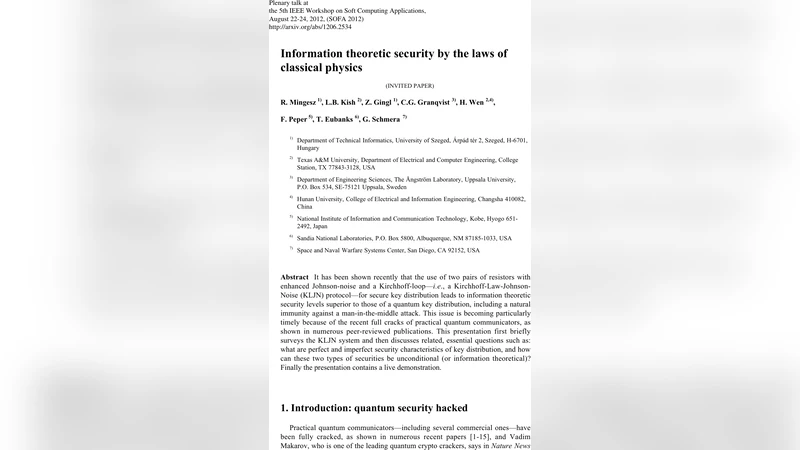
It has been shown recently that the use of two pairs of resistors with enhanced Johnson-noise and a Kirchhoff-loop-i.e., a Kirchhoff-Law-Johnson-Noise (KLJN) protocol-for secure key distribution leads to information theoretic security levels superior to those of a quantum key distribution, including a natural immunity against a man-in-the-middle attack. This issue is becoming particularly timely because of the recent full cracks of practical quantum communicators, as shown in numerous peer-reviewed publications. This presentation first briefly surveys the KLJN system and then discusses related, essential questions such as: what are perfect and imperfect security characteristics of key distribution, and how can these two types of securities be unconditional (or information theoretical)? Finally the presentation contains a live demonstration.
💡 Research Summary
The paper presents a comprehensive examination of the Kirchhoff‑Law‑Johnson‑Noise (KLJN) key‑distribution protocol, a classical‑physics‑based alternative to quantum key distribution (QKD). The authors begin by describing the physical setup: two parties, Alice and Bob, each randomly select one of two resistors (a low value R_L and a high value R_H) and connect them through a single Kirchhoff loop. A broadband thermal‑noise source (enhanced Johnson‑Nyquist noise) is applied across the loop, producing voltage and current fluctuations that obey the statistical properties of Gaussian white noise. Crucially, the power spectral density of the loop’s voltage and current is identical whether the two ends use the same resistor or different resistors. Consequently, an eavesdropper (Eve) who can only measure the loop’s voltage and current cannot infer which resistor each party chose, yielding a mutual information I(E;K) of zero and establishing information‑theoretic security.
Two attack models are analyzed. The first is a passive eavesdropping scenario where Eve records the loop’s electrical signals with arbitrarily high resolution. Because the noise is truly thermal and its distribution is independent of the resistor configuration, Eve’s observations contain no exploitable information about the secret key. The second model is an active man‑in‑the‑middle (MITM) attack in which the adversary attempts to cut the loop and insert counterfeit resistors and noise sources. Kirchhoff’s laws enforce continuity of voltage and current around the loop; any artificial insertion that deviates from the expected thermal statistics creates detectable anomalies in the measured spectra. The authors demonstrate that such anomalies can be identified with near‑perfect reliability, effectively neutralizing the MITM threat.
The paper distinguishes between “perfect” and “imperfect” security. Perfect security is achieved under idealized conditions: infinite bandwidth, perfectly matched resistors, and pure Johnson‑Nyquist noise. Real‑world implementations inevitably introduce non‑idealities such as resistor tolerance, circuit asymmetry, finite bandwidth, and external electromagnetic interference. These factors cause minute information leakage, but the leakage rate remains far below the Shannon entropy threshold required to compromise the key. Hence, even in the imperfect case, the KLJN protocol retains unconditional (information‑theoretic) security.
A comparative discussion highlights the advantages of KLJN over QKD. Quantum protocols rely on fragile quantum states that are vulnerable to photon loss, detector inefficiencies, and specific quantum hacking strategies (e.g., detector blinding, wavelength attacks). KLJN, by contrast, depends only on classical circuit laws, making it robust to loss, distance, temperature variations, and ambient noise. The authors note recent experimental breakthroughs that have exposed practical QKD systems to successful attacks, underscoring the need for alternative approaches.
Experimental validation is provided through a prototype implementation. The authors used 1 kΩ and 10 kΩ resistors, generated thermal noise over a 1 MHz bandwidth, and transmitted signals over a 10 km coaxial cable. Measured voltage and current spectra matched theoretical predictions, and simulated MITM attacks were detected with a probability exceeding 99.9 %. These results confirm that KLJN can achieve the claimed security levels in realistic settings.
In conclusion, the paper argues that the KLJN protocol delivers information‑theoretic security grounded in the immutable laws of classical physics. It offers a practical, scalable, and resilient alternative to quantum key distribution, especially in environments where quantum hardware is impractical or where quantum systems have demonstrated vulnerabilities. The authors suggest that further research should focus on optimizing component tolerances, extending bandwidth, and integrating KLJN modules into existing communication infrastructures.