Attack Prevention for Collaborative Spectrum Sensing in Cognitive Radio Networks
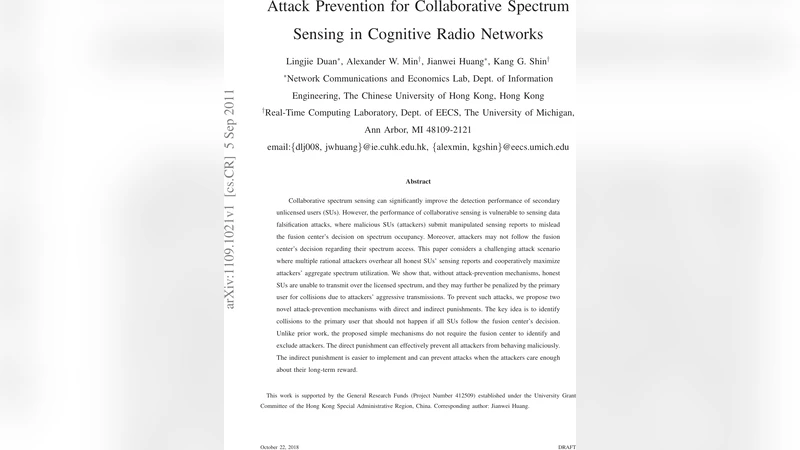
Collaborative spectrum sensing can significantly improve the detection performance of secondary unlicensed users (SUs). However, the performance of collaborative sensing is vulnerable to sensing data falsification attacks, where malicious SUs (attackers) submit manipulated sensing reports to mislead the fusion center’s decision on spectrum occupancy. Moreover, attackers may not follow the fusion center’s decision regarding their spectrum access. This paper considers a challenging attack scenario where multiple rational attackers overhear all honest SUs’ sensing reports and cooperatively maximize attackers’ aggregate spectrum utilization. We show that, without attack-prevention mechanisms, honest SUs are unable to transmit over the licensed spectrum, and they may further be penalized by the primary user for collisions due to attackers’ aggressive transmissions. To prevent such attacks, we propose two novel attack-prevention mechanisms with direct and indirect punishments. The key idea is to identify collisions to the primary user that should not happen if all SUs follow the fusion center’s decision. Unlike prior work, the proposed simple mechanisms do not require the fusion center to identify and exclude attackers. The direct punishment can effectively prevent all attackers from behaving maliciously. The indirect punishment is easier to implement and can prevent attacks when the attackers care enough about their long-term reward.
💡 Research Summary
This paper investigates a severe security threat in collaborative spectrum sensing for cognitive radio networks (CRNs). In the considered scenario, multiple malicious secondary users (SUs) – referred to as attackers – can overhear every honest SU’s sensing report before the reports are submitted to the fusion center (FC). The attackers cooperate to (i) falsify their own sensing reports in Phase I (the sensing‑reporting stage) and (ii) ignore the FC’s decision in Phase II (the spectrum‑access stage). Two attacker motivations are examined: “attack‑and‑run”, where attackers care only about immediate throughput, and “stay‑with‑attacks”, where they consider long‑term rewards.
Without any defense, the paper shows that attackers can monopolize the spectrum: honest SUs never obtain transmission opportunities and may even be charged a collision penalty for causing interference to the primary user (PU). To counter this, the authors introduce a “collision penalty” model: whenever a PU‑SU collision occurs, the PU imposes a monetary fine (C_p) on all SUs, thereby internalizing the externality and providing an economic incentive for SUs to avoid harmful interference.
Two punishment‑based defense mechanisms are proposed.
-
Direct Punishment – The FC monitors for collisions that should not happen if all SUs obey its decision. When such a collision is detected, the FC levies an additional fine (C_b) on every SU. By carefully selecting (C_b) (derived via game‑theoretic analysis), the expected utility of any rational attacker becomes negative, regardless of whether the attacker pursues short‑term or long‑term gains. The paper proves (Theorem 2) that even a single attacker, which is the most vulnerable case, is fully deterred. Simulation results confirm that direct punishment eliminates attacks in both scenarios.
-
Indirect Punishment – Recognizing that a central authority may not be able to impose fines directly, the authors design a lighter mechanism: upon detecting an illegal collision, the FC simply terminates collaborative sensing for a predetermined interval. During this “punishment phase”, all SUs must operate independently, dramatically reducing the aggregate throughput that attackers could achieve. This mechanism is effective when attackers value long‑term rewards (the “stay‑with‑attacks” case), because the loss of future collaborative gains outweighs any immediate benefit from cheating. However, it cannot fully stop attackers who are solely motivated by immediate payoff (“attack‑and‑run”), leading only to partial mitigation.
The analysis employs a combination of Markov Decision Processes (MDP) and game theory to model the interaction between the FC, honest SUs, and rational attackers. Key parameters such as the PU idle probability (P_I), false alarm and missed detection probabilities, and the number of attackers (M) are incorporated. The authors derive conditions under which the direct punishment’s fine (C_b) exceeds the attacker’s maximal possible gain, and similarly, the threshold on the length of the indirect punishment phase that makes cheating unattractive for long‑term players.
A comprehensive set of results is summarized in Table I: without punishment, attacks always succeed; with direct punishment, attacks are completely prevented in both scenarios; with indirect punishment, attacks are fully prevented only when attackers care about long‑term rewards, otherwise only partially mitigated. The paper also notes that increasing the number of attackers makes the network more vulnerable under indirect punishment, highlighting a trade‑off between implementation simplicity and robustness.
Compared with prior work on outlier detection, robust fusion rules, or reputation‑based filtering, this study’s contributions are threefold: (i) it models cooperative attackers who exploit full knowledge of honest reports, (ii) it addresses both falsified sensing and unauthorized spectrum access, and (iii) it proposes punishment mechanisms that do not require explicit attacker identification or exclusion, thereby simplifying deployment.
The authors conclude that coupling a collision‑penalty incentive with either direct or indirect punishment provides an effective, practical defense against sophisticated collaborative attacks in CRNs. Future research directions include extending the framework to multi‑channel and multi‑PU environments, incorporating adaptive attacker learning, and validating the schemes on real‑world testbeds.
Comments & Academic Discussion
Loading comments...
Leave a Comment