Downlink SDMA with Limited Feedback in Interference-Limited Wireless Networks
The tremendous capacity gains promised by space division multiple access (SDMA) depend critically on the accuracy of the transmit channel state information. In the broadcast channel, even without any network interference, it is known that such gains …
Authors: Marios Kountouris, Jeffrey G. Andrews
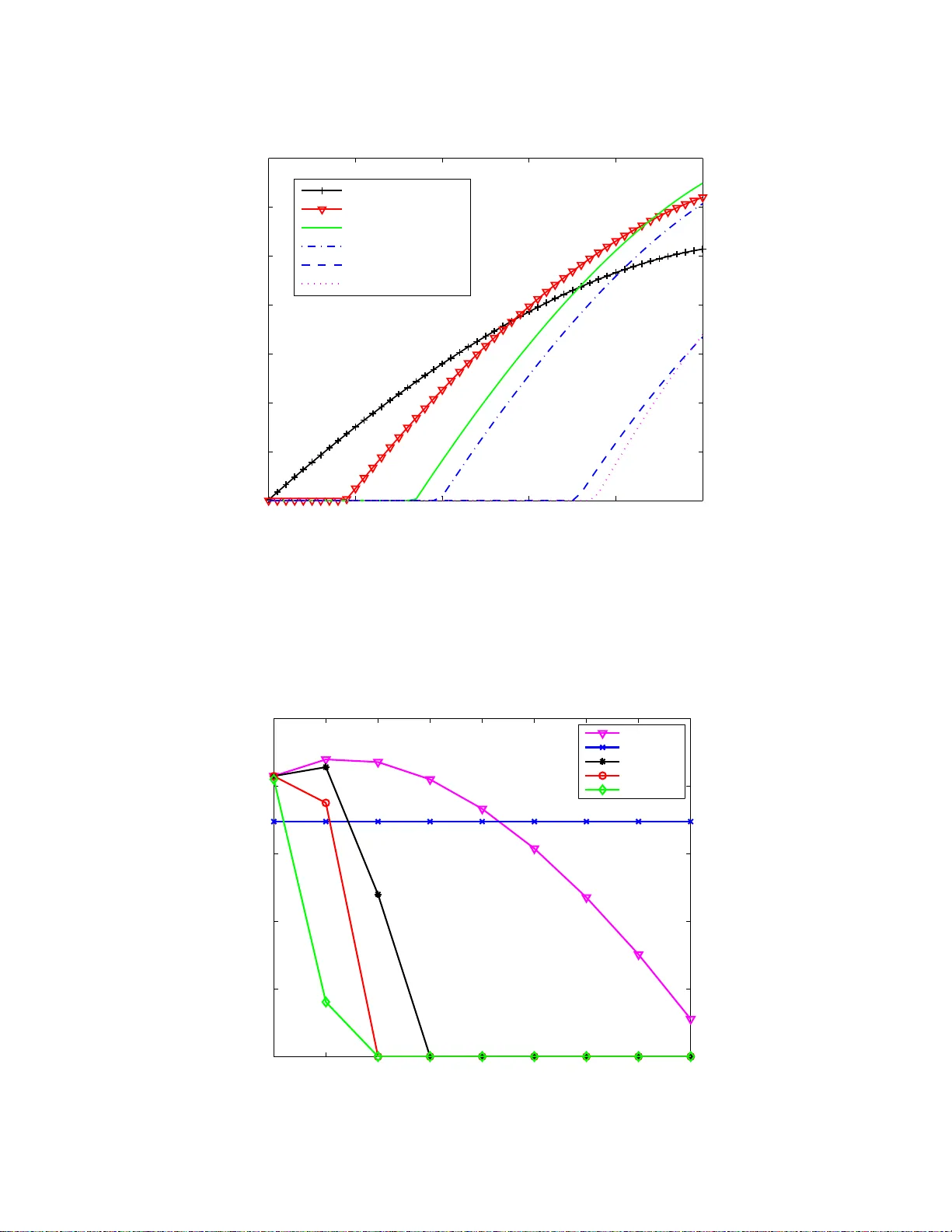
1 Do wnlink SDMA with Limited Feedback in Interfer ence-Limit ed W ireless Netw orks Marios K ountouris and Jeffre y G. Andre ws Abstract The tremendo us capacity gains p romised by space division mu ltiple access (SDMA) depend critically on the accuracy of the tra nsmit ch annel state infor mation. In th e broadcast chan nel, even without any network interferen ce, it is k nown that such gains co llapse du e to interstream interfer ence if th e feed back is delayed or low rate. In this paper, we inv estigate SDMA in the presence of in terference from many othe r simultan eously a cti ve transmitters distributed randomly over the network. In p articular we consid er zero-for cing b eamform ing in a de centralized (ad hoc) n etwork where ea ch receiver provides feedback to its respectiv e transmitter . W e der i ve closed-form expressions for the o utage p robability , network th rough put, tr ansmission cap acity , and av erage achiev ab le r ate an d go on to quantify the degradation in n etwork pe rforman ce d ue to residual self-interferenc e as a function of key system parameters. One particular finding is that as in th e classical b roadcast c hannel, the per-user feedba ck rate must increase linear ly with the number of tran smit antennas and SINR (in dB) fo r the fu ll multiplexing gains to b e preserved with limited feedback. W e derive the throug hput-m aximizing number of streams, estab lishing that single- stream tr ansmission is optimal in most practically rele vant settings. In short, SDMA do es not appear to be a p rudent design ch oice for interferen ce-limited wireless networks. I . I N T R O D U C T I O N In multi user MIMO (multiple-input, multiple-outp ut) channels, the spatial multi plexing capability o f- fered by multipl e a ntennas can be advantageously exploited to si gnificantly i ncrease the achie vable throughput. In s ingle-cell point-to-mult ipoint channels, the achiev able sum rate scales lin early with the number of transmit antennas, eve n when the mobile us ers have only a single antenna. By duality , l inear increase with t he number of receive r antennas can also be achieved in m ultipoint-t o-point channels, even with a single-antenna transm itter . Extensive research on MIMO broadcast channels over the l ast few years has rev ealed that th e capacity can be boosted by transmi tting to mult iple users simultaneous ly , by means of Space Di v ision Mul tiple Access (SDMA), rather than trying to maximize the capacity of a single- user link [1], [2]. Nev ertheless, all these promising gains critically depend on accurate channel state information (CSI), and in cont rast to point -to-point channels , the quality of CSI affects the mult iplexing gain of multiuser MIMO s ystems. As a result, a con siderable amount of ef fort has been dedicated to multiuser MIMO systems operatin g with parti al CSI at the transmitt er (CSIT) in the absence of out-of- cell interference [3]. In this paper we are interested in the capacity gains th at SDMA may provide in decentralized (ad hoc) networks with both intra-cell due to imperfect CSIT and ot her us er in terference du e t o uncoordinated concurrent transmi ssions. W e aim at answering whether and how aggressiv e use o f multiple antennas through SDMA may i ncrease the network through put un der a broad set of scenarios. Specifically , we build upon the practically relev ant limi ted feedback model, in which each user i s allowed to feed back B -bit quantized informati on on its channel directio n based on a predetermined codebook known at both the transmitter and the recei vers. Due t o the high i mplementation complexity and sensi tivity t o channel errors of the optimal scheme (dirty paper codi ng [4]), linear precoding based on zero-forcing beamformi ng (ZFBF) [5] is employed here. ZFBF has been shown to achie ve full multiplexing gain while exhibiting reduced complexity [6], [7]. ZFBF is also used both for its asymptotic optimality in M IMO poin t-to- multipoi nt channels and it s analytical tractability . In short, it i s a lo gical starting poin t for understanding the effe ct of imperfect CSIT in interference-limited networks. M. Koun touris is with S UPELEC, France, Email: marios.kount ouris@supelec.f r , and J. G. Andre w s is wi th the University of T exas at Austin, USA, Email: jandre ws@ece.utexas.e du . This research has been sup ported by the D ARP A IT -MANET program. 2 A. Related W ork Se veral recent papers have stu died MIMO ad hoc n etworks wit h Poisson distributed interferers, but the majority of prior work considers only point-to-po int ad h oc links, in which each transmi tter comm unicates with on ly one receive r at a tim e (TDMA). Sev eral recei ve antenna processing techniques ha ve been in vestigated quant ifying the performance gains of ant enna combini ng and interference cancelatio n [8]– [11]. Open-loop spatial multiplexing wit h linear receivers is studied in [12], while [13] stud ies mul ti-mode precoding wit h recei ve i nterference cancelation. Spatial mul tiplexing wi th limited t ransmit CSIT h a ve been studied for asymptotically large numb er of antennas in [14]. Multius er transmissio n, in wh ich each transmitter sends different messages to mult iple users, is analyzed recently for scalar broadcast channels using superpositi on codi ng in [15]. The p erformance of m ultiuser MIMO comm unication in a Poisson field of int erferers is first studi ed in [16] considering non-linear and li near precoding with perfect CSIT . Therein the network-wide capacity is shown to i ncrease linearly and sublin early wit h t he number of antennas when DPC and ZFBF are employed, respectively , for sin gle-antenna receivers. It is also shown that it is often throughput m aximizing to send fe wer streams than the numb er of transmit antennas. Here, we in vestigate wheth er these results derived under the idealized perfect CSI ass umption still hold i n a more practical and realistic scenario. Single-user beamforming is compared to SDM A with p erfect CSIT in [17] for t wo-tier networks with spatial rando mness. A key findi ng is that si ngle-stream transm ission at each tier provides s ignificantly superio r coverage and sp atial reuse relative to multi user transmiss ion. B. Main Cont ributions In thi s paper , in contrast to all prior work on multiu ser MIMO ad hoc netw orks, we consider SDMA ad hoc links i n whi ch only l ocal, parti al CSI i s known at the transmit ter . W e in vestigate the zero-forcing transmissio n technique wi th quanti zed CSIT in the context of decentralized i nterference-limited networks using a random access medium access control protocol. The spatial distribution of the nodes follows a homogeneou s Poisson point p rocess (PPP), and each transmitter serves multipl e receivers (point-to- multipoi nt), each located at a certain distance away from it. First, we in vestigate the performance of limi ted feedback SDMA and derive n ove l closed-form ex- pressions for the outage probability , network aggregate throu ghput, t ransmission capacity [18], and m ean user rate using st ochastic geomet ric t ools. These expressions enable u s to quantify the capacity gains that zero-forcing p recoding can provide in decentralized networks and t he network-wide performance loss due to resid ual (uncanceled) m ultiuser int erference caused by quantized channel information. Ke y findin gs are that there is a node density value that maxim izes the network throughput and that for practically rele vant values of feedback bit s, if th e nu mber of antennas/streams is increased, the ou tage con straint for non zero node density is prohibi tiv ely high. Second, we ev aluate the performance degradation as a function of the feedback rate, the number of antennas, and t he outage constraint s for fixed feedback levels. A first result is that, simi lar to the si ngle-cell case, the t hroughput of feedback-based zero-forcing is self-interference-limited, i .e. the ave rage t hroughput is bounded i f the feedback load is kept fix ed, ev en if the transmit po w er i s taken to in finity . W e th en provide the scaling of feedback bits in order to guarantee bounded performance offset. A ke y finding is that per -user feedback load B mus t be increased alm ost linearly wit h the numb er of antennas and logarithmically with the target signal-to -interference-plus-noise ratio (SINR), i.e. si milar t o the sin gle-cell case analyzed by Jindal [19] if the transm it power is replaced wit h the tar get SINR cons traint. Finally , we derive the opti mal number of st reams in order t o m aximize through put and t ransmission capacity , enabling us to propose transmissi on s chemes that dynami cally adju st t he number of streams to the network operating values. Our resul ts establish that the op timality of single-stream transmis sion in most practically relev ant settings. The main takea way of th is paper is that limited feedback SDMA m ay not be a wise use of an ant enna array in ad hoc networks, and in general in network settings where interferers can be close by as in heterogeneous networks including femtocells, pi cocells, relays, and W iFi hotspots. 3 I I . S Y S T E M M O D E L A N D P R E L I M I N A R I E S The network model consists of transmitters arranged according to a hom ogeneous Poiss on poin t process (PPP) Φ of intensi ty λ in R 2 . Each transm itter has M antennas and com municates with a set of intended single-antenna recei vers K with cardinality | K| = K ≤ M . Every transmi tter sends K st reams destined to a different user each, formi ng thus a K -user broadcast cluster . Users are distributed according to some independent stationary poin t process. T ransmission s are uncoordinat ed (random access MA C protocol) and t he signal i s attenuated according to the standard power law , i. e. the recei ved power decays wi th the distance d as d − α for path l oss exponent α > 2 . F o r the fading model (random channel component), we assume that all point-to-po int channels experience i.i.d. Rayleigh block fading with unit mean. W e in vestigate m ultiuser transmiss ion, in which each transmit ter s ends a different mess age to its associ- ated recei vers. Due to the stationarity and the rotational in variance of the PPP (Slivn yak’ s Theorem [20]), it is sufficient to analyze the performance o f a typ ical one-to-many comm unication channel, as the stat istics of th e signal reception remain the same for the d isjoint set of in tended receiv ers in the broadcast clus ter . Denote the typi cal transmitter by T 0 located at the orig in communi cating with its k -th t ypical user , lo cated at distance d k , for k ∈ K and denoted as R ( k ) 0 . The received signal y 0 k at typical recei ver R ( k ) 0 , k ∈ K assuming frequency-flat channels is given by y 0 k = √ ρ d − α 2 k h 0 k x 0 + √ ρ X i ∈ Φ( λ ) /T 0 D − α 2 i h ik x i + n 0 k (1) where ρ = P K , P is the transmit power , D i ∈ R 2 is the distance to the i -th transmi tter , and n 0 k is the complex additive Gaus sian noise wi th variance σ 2 . The v ector channel from the i -th transm itter to R ( k ) 0 is denoted by h ik ∈ C 1 × M and x i is the M × 1 norm alized transm it sign al vector of the i -th transmitter . The vectors h are assumed to hav e i.i .d. C N (0 , 1) entries, i ndependent across transmitters and of th e random distances D i . Th e index ‘0’ is dropped for no tation sim plification, as all t he sub sequent analysis is performed on a typical broadcast cluster . A. F inite Rat e F eedbac k Model W e assum e that each receiver has perfect knowledge of the channel to its correspondi ng transmi tter . In each cluster , the transmit ter acquires partial CSIT t hat only captures the spatial direction information of t he channel, referred to as channel direction information. For that, a quantizatio n codebook V k = { v k 1 , v k 2 , . . . , v k N } containin g N = 2 B unit norm vectors { v k i } N i =1 ∈ C M is employed, assumed to be known t o both T 0 and receive r R ( k ) 0 . At each feedback reporting slot , each receiver k q uantizes it s channel realization h k to the closest codew o rd with respect to the chordal dis tance [21], [22], ˆ h k = arg max v ki ∈V k | ¯ h k v k i | 2 = arg max v ki ∈V k cos 2 ( ∠ ( ¯ h k , v k i )) , where ¯ h k = h k / k h k k corresponds to the channel direction. Each user sends the corresponding quantization index b ack to the t ransmitter using B = ⌈ log 2 N ⌉ bi ts through an error and delay-free feedback chann el 1 . The optim al vector quantization strategy in mult iuser downlink channels is not k nown in general, even in single-cell systems, and is o ut of the scop e of ou r work. W e resort hence to a vec tor quantization scheme following the quanti zation cell approximation (QCA) [22 ], [23]. It has been shown i n [23], [24] that QCA can fa cilitate the analysis and provide a very accurate performance approximation, with only small differe nce from random vector quant ization. 1 The error-free assumption can be well approximated using sufficiently po werful error-correcting codes ov er the feedback link, whereas the zero-delay assumption may be v alid when the processing and feedback delays are small relati ve to the channe l coherence time. 4 B. Zer o-for cing B eamforming In thi s paper , we focus on lin ear precoding (do wnl ink beamforming), in which the transmit symbol vector x is a li near function x = P k ∈K w k s k , where s k is the data symbol int ended for the k -th recei ver and w k ∈ C M × 1 is the unit-norm beamforming vector for user k . Specifically , users are served via zero-forcing for which the beamforming vectors are chosen as ˆ h k w i = 0 , ∀ k 6 = i, k ∈ K . Let H ( K ) = h ˆ h T 1 , . . . , ˆ h T K i T denote th e concatenation of the quantized channel vectors u pon which zero-forcing is performed. The beamforming vectors are given by the Moore-Penrose pseudo in verse W ( K ) = H ( K ) † = H ( K ) H ( H ( K ) H ( K ) H ) − 1 (2) with w k obtained by normalizing the k -th column of W ( K ) . The recei ve SINR at the k -th typical user , treating interference as no ise and usin g equal power allocation for each of the data streams, can be expressed as SINR k = ρ | h k w k | 2 d − α k I p + I q + σ 2 , with I p = X i ∈ Φ( λ ) /T 0 ρ k h ik W i k 2 D − α i (3) and I q = X j ∈K ,j 6 = k ρ | h k w j | 2 d − α k (4) where I p is t he aggregate inter-cluster interference from the Poisson field of interferers Φ /T 0 and I q is t he intra-cluster self-interference due to t he fact that zero-forcing vectors are calculated based on quantized CSIT . C. P erformance Metri cs Outage pr obabi lity . A primary performance measure is the outage probabilit y , which is defined as the probability that the recei ved SINR falls below a target SINR β , i .e. F ( β , α ) = P (SINR ≤ β ) . (5) It can be thou ght of equiv alently as the probabilit y of no coverage of a user , and is evidently a continuous increasing funct ion of t he i ntensity λ . 2 In multius er communication, different SINR st atistics may be seen on different us ers (st reams), resultin g in a per-user outage probabi lity F ( k ) ( β k , α ) , ∀ k ∈ K , with β k being the target SINR on stream k . Network t hr oughput . The network th roughput is defined as the prod uct of the unconditi oned success probability and the sum rate p er unit area assuming that capacity-achie vi ng codes are us ed. When K independent data streams are sent on each broadcast cluster th e throug hput is g iv en by T = λ X k ∈K P (SINR k > β k ) log 2 (1 + β k ) . (6) Note th at the success probability P (SINR k > β k ) is itself a monotonically decreasing function of λ . As the success probability is not constrained to a minimum value, the throughp ut-maximizing density may be obtained at the expense of very high outage lev els. Multi-str eam transmission capacity . Generalizing [18] for the case where K streams are sent by each source node, we define the multi-stream transmis sion capacity (TC) as the maxim um number of concurrent multi-stream transmissio ns λ ǫ per unit area allowed subject to an outage constraint ǫ , i.e. C = K λ ǫ (1 − ǫ ) , (7) 2 In an SDMA setting, we can alternativ ely define F ( β , α ) = P ( I ( x 0 ; y 0 ) ≤ r ) , where I ( x 0 ; y 0 ) i s the mutual i nformation between x 0 and y 0 , and r is a certain target information rate. Howe ver , a decompo sed per-stream/user outage constraint is more meaningful in SDMA ad hoc networks, i n which each stream contains a different message. 5 where λ ǫ = sup { λ : P (SINR k ≤ β k ) ≤ ǫ k , ∀ k ∈ K} (8) defines the m aximum contention dens ity for a per-stream outage const raint ǫ k ∈ (0 , 1 ) . This outage- based metric quantifies how efficiently the n etwork uti lizes space as resource under a maximum outage constraint, as opposed to the network throughput that may result in high o utage events. In ot her words, it calculates the m aximum density of transmissi ons per uni t area so t hat all K users in the broadcast cluster do n ot exceed a desi red outage l e vel ǫ . A vera ge er godic rate. Finally , we d efine the av erage data rate (in nats/Hz) achie vable by a typical user assuming Shannon capacity achieving modulatio n and coding for the i nstantaneous SINR t o be R ( λ, α ) = E { log(1 + SINR) } . (9) In contrast to the two aforementi oned metrics, this a verage capacity measure presum es dy namic rate adaptation to the instantaneous SINR. In the remainder , for the sake of exposition simpli city we assum e that all streams have i dentical st ream outage con straint ǫ and SINR target β , i.e. ǫ k = ǫ and β k = β , ∀ k ∈ K . I I I . Z F B F P E R F O R M A N C E A NA L Y S I S In this section, we derive new closed-forms expressions for the network throughput, transmissi on capacity , and av erage achieva ble rate o f zero-forcing precoding. A. Outage Pr obabil ity Theorem 1: The outage pr obab ility fo r the k -th typical user in a wire less ad hoc network us ing multiuser zer o-for cin g with quant ized CSIT is given by F ( k ) ( β k , α ) = 1 − e − λ I K ζ 2 /α k e − σ 2 ζ k /ρ (1 + β k δ ) K − 1 wher e ζ k = β k R α k , δ = 2 − B M − 1 , and I K = 2 π α K − 1 X m =0 K m B m + 2 α , K − m − 2 α , with B ( a, b ) = R 1 0 t a − 1 (1 − t ) b − 1 dt = Γ( a )Γ( b ) Γ( a + b ) being th e Beta function and Γ( x ) = R ∞ 0 t x − 1 e − t dt the Gamma function. Pr oof: See Appendix A. As expected, the out age probability is a decreasing funct ion with the feedback bit rate B and an increasing funct ion of K si nce ∂ F ( k ) ∂ K > 0 . Fig. 1 sho ws the outage probability vs. the node i ntensity for diffe rent v alues of feedback load and a ntennas. The single-antenna, single-stream (SISO) outage probabili ty is also plott ed for comparison. Numerical e valuations of Theorem 1 confirm the analysis and show that increasing the numb er of antennas/streams results in unacceptably high outage probabilit y values even in sparse networks ( λ → 0 ). B. Network Thr oughput Based on the above derived o utage probability and the throughput definiti on (cf.(6)), when K indepen- dent data streams are s ent on each broadcast cluster , the total number of successful bits/s/ Hz/unit area (throughput) i s given by T = λ X k ∈K e − λ I K ζ 2 /α k e − σ 2 ζ k /ρ (1 + β k δ ) K − 1 log 2 (1 + β k ) ( a ) ≥ K λ e − λ I K ζ 2 /α max e − σ 2 ζ max ρ (1 + β δ ) K − 1 log 2 (1 + β ) . (10) where (a) results by setting β k = β , ∀ k ∈ K , and ζ max = β d α max with d max = max k ∈K d k . The approximati on is deriv ed for the sake of exposition sim plicity and can be s een as a lower bound o n the network throughput 6 with equal target SINR for all users. In t he sequel, for exposition con venience and unless otherwise stated, we consider that K = M users are served on each cluster . Remark 1: By taking the deriv ative of T with respect to λ keeping all other parameters fixed, we see that throughput decreases with the node density , if λ ≥ ( I M β 2 α d 2 max ) − 1 = λ ∗ . (11) The optimal in tensity λ ∗ does not d epend on the number of feedback bits, which only af fects the amount of inter -cluster interference. Howe ver , althou gh thro ughput can be maxim ized for λ ≥ λ ∗ , the number of outage ev ent s can be arbitrarily hi gh due to intra-cluster interference. For λ = λ ∗ , the success probability becomes 1 e e − σ 2 ζ max /ρ (1+ β δ ) M − 1 , which means t hat multiuser zero-forcing b eamforming with finite rate feedback decreases the success probabili ty by a factor of (1 + β δ ) M − 1 as compared to the case of poi nt-to-point ad hoc comm unications. Furthermore, λ ∗ is a regularly varying function of M with index − 2 /α and for lar ge M , the optimal network density s cales as λ ∗ = O ( M − 2 α ) , namel y lim M →∞ λ ∗ M − 2 α = π β 2 α d 2 max Γ(1 − 2 / α ) − 1 . As expected, the optimal contention density decreases when M increases s ince increasing the num ber of streams sent boost the int er -clu ster interference I p . The optimal dens ity also decreases for β or d max increasing as the reliabil ity requirements o n the per-user performance become higher and harder to satisfy . Remark 2: In terms of feedback rate, the network t hroughput can be shown to be a monotonically increasing funct ion wit h B . Focusing now on the transmit ant enna configuration, after some algebraic manipulation s, we can show that through put is maxim ized if M ∗ = max ( ⌊ ℓ ⌋ , 1) where ℓ is the nontrivial solut ion for M o f M M − 1 · (log 2 ) · β δ 1 + β δ B + σ 2 ζ max ρ + λM ζ 2 /α max ∂ I M ∂ M = 1 . Although t he p artial deriv at iv e of I M can b e expressed as sum of beta and digamma functions ψ 0 ( x ) since ∂ B(y , x) ∂ x = B ( y , x )( ψ 0 ( x ) − ψ 0 ( x + y )) , a cl osed-form expression for ℓ is hard t o obt ain. An analytical expression for M ∗ can be found by applying the large M approximation I M ∼ π Γ(1 − 2 /α ) M 2 /α . In th at case M ∗ = x α , where x i s the solut ion of the polynom ial equ ation c 3 x 2 α + c 2 x α +2 + ( c 1 − c 3 − 1) x α − c 2 x 2 + 1 = 0 , where c 1 = B β δ 1+ β δ log 2 , c 2 = λπ Γ(1 − 2 /α ) ζ 2 /α max , and c 3 = σ 2 ζ max P . From Abel’ s im possibili ty theorem [25], a formula s olution only exists for a ≤ 4 , wh ile for a = 3 the solutio n can be expressed using Kamp ´ e de F ´ eriet functions. In Fig. 2 we plot the network throughput vs. the intensi ty λ . W e observe t hat throughput is a decr easing function of the nu mber of antennas and that the performance degradation from imperfect CSIT is more pronounced for M increasing. The SISO and t he perfect CSI-based zero-forcing are also plo tted for comparison. W e also see that multi-s tream transmi ssion is slightly superior in sparse networks (low λ ), but is generally outperformed by SISO. C. Multi-str eam T ransmission Capacity W e turn now our attention to the maximum achiev able throughput under bounded outage leve ls. Theorem 2: The maximum mu lti-str eam transmiss ion capacit y of li mited feedback zer o-for cing pr ecod- ing in random access ad hoc n etworks is given by C = K (1 − ǫ ) I K ζ 2 /α max log 1 1 − ǫ − σ 2 ζ max ρ − log (1 + β δ ) K − 1 . (12) Pr oof: The result follows by finding the i n verse of the expression F m ( β , α ) = P min k ∈K SINR k ≤ β = ǫ with respect to λ , i.e. F − 1 m ( β , α ) , and subst ituting it in (7). 7 The second term in (12) captures the effe ct of background noise on multi-stream TC, whereas the third term corresponds to the capacity degradation from qu antized CSIT . For lar ge M with K = M , the first term s cales as Θ( M 1 − 2 α ) , whereas both s econd and thi rd t erms scale as Θ( M 2 − 2 α ) (for fixed feedback quali ty). This im plies t hat the detrimental effect o f residual interference from quantized channel information is orderwise dominant, becoming the transmi ssion capacity lim iting factor . Interestingly , in contrast t o t he cases of point-to -point and mul tiuser ad hoc communication with perfect CSI, it is not guaranteed that non-zero transmission capacity can be achie ved for any feedback rate due to the self-in terference that cannot be comp letely elimi nated with quantized CSIT . After so me algebra, we can show that the amo unt of feedback resolutio n B f defining the mul ti-stream TC feasibility region, i.e. the region for which positiv e maxim um content ion density λ ǫ exists, is B f > & ( M − 1) log 2 β ( e − σ 2 ζ max /ρ 1 − ǫ ) 1 K − 1 − 1 !' (13) provided t hat (1 − ǫ ) e σ 2 ζ max /ρ < 1 . The latter cond ition is m ore general and applies even t o systems wi th perfect CSI as it guarantees that a non n egati ve λ exists for certain SNR = ρ/σ 2 and ou tage const raints. In Figs. 3 and 4 we plot the transmi ssion capacity vs. th e outage constraint and the number of antennas, respectiv ely . W e observe t hat posit iv e transmiss ion capacity is achie ved for significantly high outage ǫ , while increasing the number o f streams further deteriorates the performance. In practically relev ant scenarios where the outage constraint is kept low , si ngle-stream transmissio n (TDMA) is optimal, even in the high resolu tion regime ( B → ∞ ). Furth ermore, we see that mu lti-stream t ransmission i s beneficial for low number of antennas/streams and for relatively large number of feedback bits. D. A vera ge Achiev able Rate In this section, we derive the a verage data rate achiev able by a typical receiv er assum ing Shannon capacity achieving modu lation and coding for t he instantaneous SINR. No te that this is not t he maxim um achie vable Shannon capacity as each transmitter- recei ver l ink t reats interference as noise. Theorem 3: The er godi c rate in nat/s/Hz of a typical r eceiver in a br oadcas t cluster wher e mul tipack et transmission is employed us ing finit e-rate feedback zer o-f or cing is given by R k = E { log(1 + SINR) } = Z ∞ 0 e − C 1 x e − C 2 x 2 α (1 + x )(1 + δ x ) M − 1 dx . (14) wher e C 1 = σ 2 R α k /ρ and C 2 = λ I M R 2 k . Pr oof: See Appendix B. For general v alues o f α > 2 , t he comput ation of the average us er rate R k in volves numerical integra- tion. In the interference-limited regime ( σ 2 → 0 ), pseudo-closed-form expressions in volving generalized hypergeometric fu nctions can be fou nd, but t hese provide little insight on how differ ent system operating parameters af fect the av erage u ser rate. Therefore, we consider concis e performance b ounds. As th e m ain focus of th e paper is t o in vestigate the relationship among feedback bit rate B and both inter-cluster and intra-cluster i nterference, we first provide the following result that shows that the average achie vable rate with limited feedback of fixed quali ty con ver ges to a finit e ceiling as SNR → ∞ . Theorem 4: The average user rate of imp erfect CSIT -based zer o-for cing is u pper bo unded b y R k ≤ B log 2 M − 1 + H M − 1 − ψ ( M ) + log 1 + d 2 α k π λ α 2 − 1 ! α 2 + δ ( M − 1 ) + d α k σ 2 ρ (15) wher e H n = P n i =1 1 i is the n -th harmoni c number and ψ ( · ) is t he dig amma f unction. Pr oof: See Appendix C. 8 The above result implies that at high SNR ( P → ∞ ), the user rate is bounded and the system becomes interference-limited no matter how many feedback bi ts are reported b ack to the transmitter . The u pper bound i n the above theorem is quite lo ose i n general, howe ver it was derived for d emonstrating th e quasi linear dependence of th e a verage rate and th e feedback load B . W e derive now a tight er u pper bound by app lying in tegral inequaliti es di rectly to (14) as a means to find closed-form expression for the mean er g odic rate. Lemma 1: The a vera ge achievable user rate is upp er boun ded by R k ≤ min u 1 ,v 1 Z ∞ 0 e − u 1 C 1 x e − u 1 C 2 x 2 α dx 1 u 1 · ( A ( v 1 )) 1 v 1 (16) ≤ min u 1 ,v 1 ,u 2 ,v 2 ( u 1 u 2 C 1 ) − 1 u 1 u 2 (Γ(1 + α / 2)) 1 u 1 v 2 ( u 1 v 2 C 2 ) − α 2 u 1 v 2 · [ A ( v 1 )] 1 v 1 , (17) with 1 < u 1 , u 2 , v 1 , v 2 < ∞ , 1 u 1 + 1 v 1 = 1 , 1 u 2 + 1 v 2 = 1 , and A ( v 1 ) = ( δ − 1) 1 − M v 1 δ v 1 − 1 B ( M v 1 − 1 , 1 − ( M − 1) v 1 ) + 2 F 1 (1 , v 1 , 2 − ( M − 1) v 1 , 1 /δ ) v 1 ( M − 1) δ (18) wher e 2 F 1 ( a, b, c, z ) denotes the 2 F 1 Gauss hyper geometric function, a nd B ( x, y ) the Beta function. Pr oof: See Appendix D. For u 1 = u 2 = v 1 = v 2 = 2 , which provides the ti ghtest upp er bound in m ost cases, sig nificant simplification is possible for (18) since A (2) is g iv en in terms of log ( δ ) and a po lynomial expression in δ . In that case, we can easily show th at the upper bound on er godi c capacity scales l ike Θ( λ − α/ 8 ) . The validity of the above bounds is verified in Fig. 5, where the ergodic capacity gi ven by (16) (cf. upp er bound 1) and (17) (cf. upper bound 2) is compared with the exact av erage user rate for different number of feedback bit s. W e o bserve th at the tightness of our bounds is im proved when the number of ant ennas and feedback bits is increased. In th e no noise case, the above lemma results in R k ≤ Γ 1 + α 2 1 α d k √ αλ I M Z ∞ 0 (1 + δ x ) 1 − M 1 + x α α − 1 d x ! 1 − 1 α , (19) which scales as Θ( λ − 1 2 ) and i s inv ersely proporti onal t o the distance between t ransmitter and the k -t h user . For λ and B that do not depend on M and for large M , by calculating t he integral, t he upper bound in (19) is shown t o be in versely propo rtional to M . This im plies that in order to ha ve per -user mean rate that does n ot scale with the number o f antennas, λ ∼ M − 2 . Finall y , in the interference-limited regime and for α = 4 , (14) admits a closed-form expression in terms of M eijer -G functions and trigon ometric integrals. The no noise upper bound (19) approxim ates very well the exact er godic rate ev en for moderate SNR values for increasing number of antennas. Returning now to the general case, the following easil y computable result can be obtained using dif ferent bounding techniques. Lemma 2: The a vera ge user rate with finite rate-based zero-for cing satisfies R LB k ≤ R k ≤ R UB k (20) with R LB k = − 2 cos( C 2 )Ci( C 2 ) + δ (1 − M ) √ π G 3 , 1 1 , 3 C 2 2 4 − 1 , − 1 , 0 , 1 2 , + sin( C 2 )( π − 2Si( C 2 )) (21) R UB k = 1 ( M − 1) δ − 1 [2 cos( C 2 )Ci( C 2 ) − 2 cos( ˜ C 2 )Ci( ˜ C 2 ) (22) − π sin( C 2 ) + π sin( ˜ C 2 ) + 2 sin( C 2 )Si( C 2 ) − 2 sin( ˜ C 2 )Si( ˜ C 2 )] (23) 9 wher e G m,n p,q z a 1 ,...,a n ,a n +1 ,...,a p b 1 ,...,b m ,b m +1 ,...,b q is the Meijer-G functi on, Si ( x ) = R x 0 sin t t dt is the sine inte g ral, Ci( x ) = − R ∞ x cos t t dt is the cosine in te gral, and ˜ C 2 = C 2 ( M − 1) δ . Pr oof: The bo unds are obtain ed by applying Bernoulli’ s inequali ty [26] for the integrand and ev alu- ating t he resul ting in tegrals. Specifically , for the lower bou nd, we apply the inequality (1 + x ) r ≥ 1 + r x , for x > − 1 , r ≤ 0 or r ≥ 1 , to the funct ion g ( x ) = (1 + δ x ) M − 1 . For th e upper bound, we use that (1 + x ) − r ≤ (1 + r x ) − 1 for r > 0 , x ≥ − 1 . In Fig. 6, the achiev able mean user rate is compared with (23) (cf. upper bound) and (21) (cf. lo wer bound) vs . SNR. W e observe th at t he bo unds are very tight at low M for all SNR range, while the lower bound becomes loose at high SNR when the numb er o f antennas i s in creased. I V . E FF E C T O F L I M I T E D F E E D BA C K In this section, we analyze the ef fect of feedback quality on the network performance and provide design guidelines for the system operating point s based on ou r analytical frame work. In particular , we show at which rate feedback has to scale to maint ain a certain bounded network capacity gap. W e also deriv e the optimal number of st reams/users to be empl oyed in order to maximize the network throug hput and the multi-stream transmissio n capacity . A. P erformance De gradation due to F in ite Ra te F eedbac k W e first provide the feedback bit scaling that guarantees constant (bounded) performance loss between the performance of zero-forcing with perfect CSI and that with partial CS IT . 1) T ransmissi on Capacity: The t ransmission capacity gap ∆ C is defined as the diffe rence between the transmissio n capacity achieved by perfect CSIT -based and that of limited feedback-based zero-forcing, i.e. ∆ C = ( C CSI − C ) , wh ere C CSI is the mult i-stream transmission capacity giv en by (12 ) for B → ∞ (perfect CSI). Thus, the performance degradation is gi ven by ∆ C = K (1 − ǫ ) I K ζ 2 /α max log(1 + β δ ) K − 1 . In order to main tain a transmission capacity offset ∆ C = lo g c , after som e algebraic manipulations , we hav e that the numb er o f feedback b its per user satisfies B ∆ C ≥ ( M − 1) log 2 β − ( M − 1) log 2 c I K ζ 2 /α max K ( K − 1)(1 − ǫ ) − 1 bits/user , with 1 ≤ c ≤ (1 + β ) K ( K − 1)(1 − ǫ ) I K ζ 2 /α max for a non tri vial resul t. Therefore, to gu arantee a cons tant performance off set in terms of t ransmission capacity , the nu mber of feedback bi ts per user must be increased at l east linearly with the nu mber of antennas/streams and approxim ately logarithmically with the tar g et SINR constraint. This is basicall y the same scaling beha vior as in [19] for fixed a verage rate of fset if the tar get SINR cons traint is interchanged w ith th e transmit power . Int erestingly , T C for ad hoc networks appears to capture t he performance degradation due to mul tiuser interference similar to ergodic capacity for single-cell systems. 2) Network Thr oughput: Define now the network throughput ratio gap QT to be the ratio of the throughput achie ved by zero-forcing with perfect CSI to the throughput of finite rate feedback zero- forcing, which is given by QT = (1 + β δ ) K − 1 . The num ber o f feedback bits per user for throughput ratio off set QT = r needs t o scale according to B QT ≥ ( M − 1) log 2 β − ( M − 1) log 2 r 1 K − 1 − 1 bits/user , for any r satisfyin g 1 ≤ r ≤ (1 + β ) K − 1 . 10 Similarly to the transm ission capacity offset, the number of feedback bits has to increase at least linearly with t he number of antennas/s treams and logarithmically with the target SINR constraint t o maintain constant throug hput loss. For inst ance, for β = 3 dB and M = K = 4 , at least B = 9 bits are required for a 3-dB offset. Furthermore, for r = 2 K − 1 , the resulting feedback scaling takes on the following simple form B QT = M − 1 3 β dB bits/user . (24) Note that the fee dback bit scaling takes on identical form with that in [ 19] for a 3-dB ra te offset subst ituting transmit power P for target SINR β . B. F eedback Rate Scaling In the pre vious section , we qu antified the number of feedback b its required for a fixed gap degradation in the throug hput and transm ission capacity performance of zero-forcing wi th imperfect feedback. Here, we pro vide desi gn gui delines o n the feedback bi t scaling for asymptotically v anishi ng performance loss due to partial CSIT . First, simil ar to MISO broadcast channels without int er -cell interference, b oth throughput and trans- mission capacity of zero-forcing with l imited feedback are bounded wit h fixed B ev en if other system parameters gro w lar ge. Furthermore, if the feedback bits do not scale with M and/or β , the throughput ratio and the t ransmission capacity offset become u nbounded for asymptoti cally lar ge values of M , β . In the high antenna/stream regime, it can be shown that if the feedback load B is scaled with M at a rate strict ly greater than ( M − 1) log 2 M , i.e., B = ( M − 1) log 2 ( M η ) for any η > 1 , t he transmiss ion capacity offset conv erges to zero, i.e. lim M →∞ ∆ C = lim M →∞ (1 − ǫ ) I M ζ 2 /α max log(1 + β δ ) M − 1 = 0 , and the t hroughput ratio g ap con ver g es to one, i.e. lim M →∞ QT = lim M →∞ (1 + β δ ) M − 1 → 1 . The rate of con ver gence to zero and on e respective ly depends on η and is faster wi th η increasing. The throug hput ratio con ver ges to one also in t he case where B scales superlinearly with the number of antennas, i.e. B = M η . Based on the above resu lts, we establish that, at asymptot ically hi gh M and under t he aforementioned bit s caling, the n etwork throughpu t and the transmissio n capacity of finite rate feedback zero-forcing con ver ges to the perfect CSI throughput. In contrast, if the feedback rate is not properly adapted, the transmis sion capacity offset scales as ∆ C = O ( M 1 − 2 /α ) . In the high reliabilit y regime (large β ), if the feedback l oad B is scaled with β at a rate strictl y greater than ( M − 1) log 2 β , i.e. B = κ log 2 β for any κ > M − 1 , th e th roughput ratio gap con verges to one, i.e. lim β →∞ QT = lim β →∞ (1 + β δ ) M − 1 → 1 . Under the same bit scaling, the transmis sion capacity of fset vanishes (asymptoti cally i n β ), i.e. lim M →∞ ∆ C = 0 . Thu s, at lar ge β (high SINR regime) and u nder the aforementioned bit scaling, the throug hput of the finite rate feedback ZFBF con ver ges weakly to the perfect CSI throu ghput. C. Optimal Number of Str eams In this section, we in vestigate the optimal n umber of streams to be used per cl uster in order to maximize the capacity . These results also provide useful insights on t he feasibi lity and the pot ential gains of multi- stream, multi user beamforming and adapti ve beam selection in wireless ad hoc networks wi th imperfect feedback. For t hat, we cons ider again that K ≤ M streams can be sent. W e d efine the per-user throughpu t as the normalized network throughp ut ove r the number of users, i.e. T u = 1 K T . T aking the partial deriv ative with respect to the number of streams, we can sho w that T u is a decreasing function with K . This confirms the intui tiv e argument that, from the user perspectiv e, employing single-stream beamforming ( K ∗ = 1 ) maximizes the per- user throughput . 11 Howe ver , the o ptimal number of users to s erve may alter if we consider the syst em (broadcast clus ter) overa ll throughput. In thi s case, there is a tradeof f between spatial reuse and feedback quality , i.e. for certain v alues of K and other sys tem parameters, the spatial multiplexing gain may compensate for the performance degradation in curred due to finite rate feedback. For t he network throu ghput, t he complicated form o f the interference constant I K precludes a s imple, closed-form expression for the optimal num ber of streams. Specifically , we have the following result: Propositi on 1: The number of us ers to be s erved per br o adcast cluster t hat ma ximizes th e network thr oughp ut is K ∗ = min (max ( ⌈ ω ⌉ , 1) , M ) wher e ω is the sol ution f or K of K λζ 2 /α max ∂ I K ∂ K + σ 2 ζ max P + log (1 + β δ ) = 1 . Pr oof: The result following by taking the d eri vati ve of (10) wi th respect to K and finding the optim al value of K based o n Fermat’ s theorem for the st ationary p oints. Remark 3: Using t he large K approximation I K ∼ π Γ(1 − 2 / α ) K 2 α , we have that K ∗ = x α , where x is the solution of the polynomial equation c 1 x α + c 2 x 2 − 1 = 0 , w here c 1 = σ 2 ζ max P + log (1 + β δ ) and c 2 = λπ Γ(1 − 2 /α ) ζ 2 /α max . By the Abel-Ruffini theorem, no general algebraic sol ution exists for a ≥ 5 , howe ver for this particular form of t he polynomial equati on, K ∗ can be found in closed-form for α ∈ { 2 , 3 , 4 , 5 , 6 , 8 } ; s olutions for α = 6 and α = 8 will be the squared root of the α = 3 and α = 4 solutions , respectiv ely . In Fig. 7, we plot the network throughput as a function of th e node density for differe nt num ber of streams. As indicated by the above analysis , fully loaded SDMA ( K = M ) is detrimental for throughput performance, while mul ti-stream is superior only in sparse networks. An adaptive scheme that sets th e number o f s treams based on the large K approximation solu tion is also plotted. Interestingly , the adaptive scheme results in the opti mal mul ti-stream t ransmission scheme within almost all range of intensi ty values λ . Furthermore, as expected, throughput in creases when feedback quali ty is improved. W e also plot the scheme in which the number of s treams are adapted according to t he large K appro ximate va lue, which performs satisfactorily for l o w d ensities λ . Regarding the transmissi on capacity , taking the deriv ative of (12) wi th respect to K and finding the stationary points, we hav e Propositi on 2: The op timal number of str eams that maximi zes the multi-st r eam transmission capacit y is K ∗ = min (max ( ⌈ ν ⌉ , 1) , M ) wher e ν is the s olution o f K ∂ I K ∂ K ( K C 3 − C 4 ) + I K ( C 4 − 2 K C 3 ) = 0 , with C 3 = σ 2 ζ max P + log (1 + β δ ) a nd C 4 = − log(1 − ǫ ) + log(1 + β δ ) . Remark 4: Using the lar ge K approximation, t he opti mal number o f streams is giv en by K ∗ = (1 − 2 /α ) C 4 (2 − 2 /α ) C 3 . (25) In Fig. 8, w e pl ot the multi-stream t ransmission capacity vs. outage constraint for different nu mber of streams employed. For most relev ant parameters, sing le-stream transmission is optimal, even for a lar ge nu mber of bit s. Similarly to the throughput case, the adaptive scheme based on the si mple large K approximate solution performs satisfactorily in a wi de range of ǫ values. 12 V . C O N C L U S I O N S W e in vestigated the performance of zero-forcing precoding with lim ited feedback in s ingle-hop ad hoc networks under a broad set of metrics and scenarios. The main takeaw ay of this paper is t hat SDMA m ay not be a wise use of transm it antennas in d ecentralized networks with both self and other u ser in terference, as single-stream transmission m aximizes both out age-based and average throughput in most practically rele vant scenarios. In other words, a high dens ity of sing le-stream communicatio n links may be preferable than SDMA transm ission with quanti zed channel state informati on. Our analytical framework enables us to quantify the effect of the residual mult iuser interference due to quant ized CSIT on network-wide performance and to properly adjust t he nu mber of streams and the feedback bit scaling t o achieve certain lev el of rate p erformance. A key finding t hat the per-user feedback load m ust be increased almost lin early with the num ber of antennas and logarith mically with the t ar get SINR. The techniques developed here are also relev ant for the analysis of partial CSIT -based linear precoding in emerging heterogeneous network paradigms, including femtocells, relays, picocells, and W iFi hot spots. Further e x tensions to this work c ould include different lim ited feedback precoding schemes (e.g. MMSE) or how to exploit multiple recei ve antennas for interference cancelation. Future work could consi der multi-hop n etworks with opportu nistic routing and in vestigate potential SDMA gains into end-to-end performance (e.g. progress-rate-density). It would be also of in terest to explore how opportunistic u ser selection af fects the spatial reuse and rate, as well as how to properly design CSIT in networks with spatial randomness. A P P E N D I X A. Pr oof of Theor em 1 Let L p denote the Laplace transform of the no rmalized aggregate interference from the Poiss on field of interferers (int er -clus ter) I p = P i ∈ Φ( λ ) S ik | X i | − α with fading marks S ik , defined as L p ( s ) = E I p h e − s I p i = R ∞ 0 e − sp f I p ( p ) dp . The Laplace transform of the normalized in tra-cluster interference I q due to multiuser transmissio n with quantized CSIT is denoted by L q ( s ) . Define also the random variable Y = I p + I q . The ou tage probability is giv en by F ( k ) ( β k , α ) = 1 − P { SINR k ≥ β k } , wh ich can be rewritten as F ( k ) ( β k , α ) = 1 − P ρS 0 k d − α k I p + I q + σ 2 ≥ β k = 1 − P S 0 k ≥ β k d α k ( I p + I q + σ 2 /ρ ) . The channel gain is giv en by S 0 k = | h k w k | 2 = k h k k 2 h k w k 2 = k h k k 2 B (1 , M − 1) , where B (1 , M − 1) is a Beta d istributed rando m variable (r .v .) with shape parameters (1 , M − 1 ) and independent of k h k k 2 [24]. The term k h k k 2 is distributed as a chi-squared r .v . with 2 M degrees of freedom denoted as χ 2 2 M . Thus, S 0 k ∼ exp(1) (exponentially dist ributed wit h uni t m ean). Denoting ζ k = β k d α k , we hav e F ( k ) ( β k , α ) ( a ) = 1 − E exp( − ζ k ( I p + I q + σ 2 /ρ )) ( b ) = 1 − L p ( ζ k ) L q ( ζ k ) e − ζ k σ 2 ρ (26) where step (a) is reached b y conditionin g on the aggregate interference I p + I q and (b) by the independence of the interference terms. The interferer marks in I p are chi-squared di stributed wit h degrees of freedom S ik = k h ik W i k 2 ∼ χ 2 2 K since it is the sum of K i.i.d. exponential random variables. Thus, the Lapl ace transform for a Poisson shot noise process in R 2 with i.i.d. χ 2 2 K distributed marks is given by [27] L p ( s ) = E Φ h e − s P i ∈ Φ( λ ) S i | X i | − α ) i = exp − λ Z R 2 1 − E S h e − sS | x | − α i d x = e − λs 2 α I K (27) where I K = 2 π α K − 1 X m =0 K m B m + 2 α , K − m − 2 α (28) 13 with B ( a, b ) = R 1 0 t a − 1 (1 − t ) b − 1 dt = Γ( a )Γ( b ) Γ( a + b ) being the Beta function. For the marks in the interference t erm we have t hat | h k w j | 2 = k h k k 2 h k w j 2 . Denoti ng φ k the angle between h k and ˆ h k , and decomposing the norm alized channel vector as h k = (cos φ k ) ˆ h k + (sin φ k ) v k , we hav e that | h k w j | 2 = k h k k 2 | v k w j | 2 sin 2 φ k . Since w j is i sotropic withi n the hy perplane and independent of v k , the quantity | v k w j | 2 is beta (1 , M − 2) distributed, i.e. | v k w j | 2 ∼ B (1 , M − 2) [19] and independent of the quantization error sin φ k . Thus, the normali zed intra-clust er interference can be rewritten as I q = d − α k k h k k 2 sin 2 φ k X j ∈K ,j 6 = k B (1 , M − 2) , (29) where k h k k 2 , φ k , and B (1 , M − 2) are all independ ent. For the quanti zation cell approximation, the term X = k h k k 2 sin 2 φ k is a gamma di stributed r .v . wit h shape M − 1 and scale δ , i.e. X ∼ G amma( M − 1 , δ ) . Therefore Y = X B (1 , M − 2) is exponentially distributed wi th rate 1 /δ [28]. As I q = d − α k Z , where Z is t he sum of ( K − 1) i.i.d exponentially dist ributed r .v ., i.e. Z ∼ Gamma( K − 1 , δ ) , the norm alized aggregate interference becomes I q ∼ Gamma( K − 1 , δ d − α k ) . The Laplace transform of I q is given by L q ( s ) = 1 (1 + sd − α k δ ) K − 1 . (30) Substitutin g (27) and (30) in (26) we obtain the result . B. Pr oof of Theor em 3 For a random v ariable X with probability d ensity function f X ( x ) and cumulative distribution fun ction (cdf) F X ( x ) , we hav e E { log(1 + X ) } = Z ∞ 0 log(1 + x ) f X ( x ) d x = Z ∞ 0 log(1 + x ) d [1 − F X ( x )] ( a ) = Z ∞ 0 1 − F X ( x ) 1 + x d x where step (a) follows from integration by parts. The result is obtain ed by R k = Z ∞ 0 1 − F ( k ) ( x,α ) 1 + x d x = Z ∞ 0 e − σ 2 d α k x ρ e − λ I M d 2 k x (1 + x )(1 + δ x ) M − 1 d x, with C 1 = σ 2 d α k x ρ and C 2 = λ I M d 2 k . C. Pr oof of Theore m 4 First, w e consider the following upper bounds to the av erage rate achie ved by th e k -th user: R k = E ( log 1 + ρ | h k w k | 2 d − α k I p + I q + σ 2 /ρ !) ( a ) ≤ E ( log 1 + | h k w k | 2 d − α k I l p + I q + σ 2 /ρ !) = E log I l p + I q + σ 2 ρ + | h k w k | 2 d − α k − E log I l p + I q + σ 2 ρ ( b ) ≤ log E I l p + I q + σ 2 ρ + | h k w k | 2 d − α k − E log I q ( c ) ≤ log E n I l p o + E I q + σ 2 ρ + d − α k E | h k w k | 2 − E log d − α k | h k w j | 2 (31) where I p = I p /ρ and I q = I q /ρ are g iv en in (3) and (4), respectively . In (a) we con sider a lo wer bo und to the inter-cluster interference, denoted as I l p , and in (b) we apply J ensen’ s inequality to the minuend and neglect the noise and int er -clus ter interference terms in the subtrahend. Step (c) foll ows from the independence o f the interference terms and the received sign al and by con sidering only one of the intra- cluster i nterference terms. 14 The normalized interference I q ∼ G a mma( K − 1 , δ d − α k ) , thus we hav e E I q = d − α k δ ( M − 1) . The channel gain | h k w k | 2 is exponentiall y distributed with mean on e, i.e. E | h k w k | 2 = 1 . In order to deriv e a lower bound, we neglect the contribution of the closest interferer to the inter-cluster interference. Using techniques from [10], the lower bound is given by I l p = ( π λd 2 k ) α 2 α 2 − 1 − α 2 . For the second term in (31), we need to compute E log | h k w j | 2 = E n log k h k k 2 h k w j 2 o = E log k h k k 2 + E n log h k w j 2 o . (32) For t he chann el n orm we ha ve k h k k 2 ∼ χ 2 2 M , thus E log k h k k 2 = R + ∞ 0 log x · x M − 1 e − x Γ( M ) d x = ψ ( M ) . Then, E n log h k w j 2 o = E log sin 2 φ k + E { log ( B (1 , M − 2)) } , wit h E log sin 2 φ k = Z −∞ 0 log( x ) d F sin 2 φ k ( x ) = 2 B ( M − 1) Z δ 0 log( x ) x M − 2 d x = − 1 + B lo g 2 M − 1 and E { log ( B (1 , M − 2 )) } = Z 1 0 log x · (1 − x ) M − 3 B (1 , M − 2) d x = − H M − 2 where the cdf of t he quantization error sin 2 φ k is given in [24]. By s ubstituti ng the above quantities to (31) and after some manipulati ons, we obt ain (15). D. Pr oof of Lemma 1 The proof of this lemm a is based on H ¨ older’ s inequality [26], whi ch states that for two measurable functions f and g d efined o n a Hilbert space S and 1 < p, q < ∞ wi th 1 / p + 1 / q = 1 Z S | f ( x ) g ( x ) | d x = Z S | f ( x ) | p d x 1 /p Z S | g ( x ) | q d x 1 /q . (33) The result is obtained by applying twice (33) for the follo wing decreasing real-va lued and bounded functions: first f ( x ) = e − C 1 x e − C 2 x 2 α and g ( x ) = 1 (1+ x )(1+ δx ) M − 1 and then for f ( x ) = e − C 1 x and g ( x ) = e − C 2 x 2 α . At each step, we optim ize p, q in order to obt ain the ti ghtest possibl e upper bound . Using the following forms I 1 = Z ∞ 0 e − ax d x = 1 a , I 2 = Z ∞ 0 e − bx 2 /α d x = b − α/ 2 Γ(1 + α/ 2) , I 3 = Z ∞ 0 d x (1 + x ) c (1 + δ x ) g = π csc( g π )( δ − 1) 1 − c − g δ c B ( c, g − 1) + 2 F 1 (1 , c, 2 − g , 1 δ ) δ g , where csc( · ) denotes the cosecant and 2 F 1 ( x, y , z , w ) the Gauss hypergeometric function, and after some algebraic manipulatio ns, we obtain (18). R E F E R E N C E S [1] G. C aire and S. Shamai (Shitz), “On the achiev able throughpu t of a multi -antenna Gaussian broadcast channel, ” IEEE Tr ans. on Inform. Theory , v ol. 49, no. 7, pp. 169 1–1706 , Jul. 2003 . [2] D. Gesbert, M. Koun t ouris, R. W . Heath, Jr ., C. -B. Chae, and T . Salzer, “From single user to multiuser communications: Shifting the MIMO parad igm, ” IEEE Signal Pr ocessing Ma gazine , vol. 24 , no. 5, pp. 36 –46, Sep. 2007. [3] D. Lov e, R. W . Heath, Jr ., V . Lau, D. Gesbert, B. Rao, and M. Andre ws, “ An overv iew of limited feedback in wireless communication systems, ” IE EE Journa l on Sel. Ar eas in Commun. , vol. 26, no. 8, pp. 1341 –1365, Oct. 20 08. [4] M. C osta, “Wri ting on dirty paper , ” IE EE T rans. on Inform. Theory , pp. 439–41, May 1983 . [5] Q. Spencer , A. Swindlehurst, and M. Haardt, “Zero-forcing methods for do wnlink spatial multiplexing in multi-user MIMO channels, ” IEEE Tr ans. on Sig. Pr ocess. , v ol. 52 , pp. 461–71, Feb . 2004. [6] G. Dimi ´ c and N. D. Sidiropoulos, “On do w nlink beamforming with greedy user selection: Performance analysis and a simple new algorithm, ” IE EE Tr ans. on Sig. Pr ocess. , vol. 53, no. 10, pp. 3857 –3868, Oct. 200 5. 15 [7] T . Y oo and A. Goldsmith, “On the optimality of multiantenna broadcast scheduling using zero-forcing beamforming, ” IE EE J ournal on Sel. Ar eas in Commun. , vol. 24, no. 3, pp. 528–541, Mar . 20 06. [8] A. Hunter, J. G. Andre ws, and S. W eber , “T ransmission capacity of ad hoc netw orks with spatial di versity , ” IEEE T rans. on W ire less Commun. , v ol. 7, no. 12, pp. 505 8–5071, Dec. 2008. [9] K. Huang, J. G. Andre ws, R. W . Heath, Jr ., D. Guo, and R. Berry, “Spatial interference cancellation for multi-antenna mobile ad hoc networks, ” IEEE T rans. on Inform. Theory , under revision, available at http://arxi v .org/abs/0807 .1773, July 2008 . [10] N. Jinda l, J. G. Andrews, and S. W . W eber , “Multi-antenna commun ication in ad hoc netwo rks: Achieving MIMO gains with S IMO transmission, ” IE EE T rans. on Communication s , vol. 59, no. 2, pp. 529–540, Feb . 2011. [11] O. B. S . Ali, C. Cardinal, and F . Gagn on, “Performance of optimum combin ing in a Poisson field of interferers and Rayleigh fading channels, ” IEEE Tr ans. on W ireless Commun. , v ol. 9, no. 8, pp. 2461–24 67, Aug. 201 0. [12] R. H. Y . Louie, M. R. McKay , and I. B. Collings, “Open-loop spatial multiplexing and di versity communications in ad hoc networks, ” IEEE Tr ans. on I nform. Theory , vol. 57, no. 1, pp. 317 – 344, Jan. 2011. [13] R. V aze and R. W . Heath, Jr ., “Tran smission capacity of ad-hoc networks with multiple antennas using transmit stream adaptation and interference can celation, ” IEEE T rans. on Inform. Theory , under re vision, http://arxiv . org/abs /0912.2630 , Dec. 2009. [14] S. Govindasamy , D. W . Bli ss, and D. H. Staelin, “ Asymptotic spectral ef ficiency of multi -antenna links in wireless networks with limited Tx CSI, ” submitted, 2010, http://arxi v .org/abs/arXi v:1009.4128. [15] S. V anka and M. Haenggi, “ Analysis of the benefits of superposition coding i n random wi reless networks, ” i n Proc., IEE E Intl. Symp. on Inform. Theory (ISIT) , Austin, TX, US A, June 2010. [16] M. Koun touris and J. G. Andre ws, “Tran smission capacity scaling of S DMA in wireless ad hoc networks, ” in Pr oc., IEEE Infom. Theory W orkshop (ITW) , T aormin a, Italy , Oct. 2009 . [17] V . Chandras ekhar , M. Ko untouris, and J. G. Andrews, “Co verage in multi-antenna tw o-ti er n etworks, ” IEE E Tr ans. on W ir eless Commun. , vol. 8, no. 10, pp. 5314–5327, Oct. 2009 . [18] S. W eber , X. Y ang, J. G. Andre ws, and G. de V eciana, “Tran smission capacity of wireless ad hoc networks with outage constraints, ” IEEE Tr ans. on I nform. Theory , vol. 51, no. 12, pp. 4091–4102, Dec. 200 5. [19] N. Ji ndal, “MIMO broadcast channels with fi nite-rate feedback, ” IEEE T rans. on Inform. Theory , vol. 52, no. 11, pp. 5045–5060, Nov . 2006. [20] D. Stoyan, W . Kendall, and J. Meck e, Stochastic Geometry and Its Applications , 2nd ed. John W i ley and Sons, 1996. [21] D. Love, R. W . Heath Jr . and T . St rohmer, “Grassmannian beamforming for multi ple-input multiple-output wireless systems, ” IE EE T rans. on Inform. T heory , vol. 49, no. 10, pp. 2735–2 747, Oct. 2003. [22] K. Mukka villi, A. Sabharwal, E. Erkip, and B. Aazhang, “On beamforming with finit e rate feedback in multiple-antenna systems, ” IEEE Tr ans. on I nform. Theory , vol. 49, no. 10, pp. 2562–2579, Oct. 2003 . [23] S. Zhou, Z. W ang, and G. B. Gi annakis, “Quantifying the powe r loss when transmit beamforming relies on finite rate feedback, ” IEEE T rans. on W ir eless Commun. , v ol. 4, no. 4, pp. 1948 –1957, Jul. 2005. [24] T . Y oo , N. Jindal, and A. Goldsmith, “Multi-antenna broadcast channels with limited feedback and user selection, ” IEEE J ournal on Sel. A r eas in Commun. , vol. 25, no. 7, pp. 1478–1491, Sep. 200 7. [25] J. B. Fraleigh, A Fir st Cour se in Abstract Algebra , 7th ed. Addison W esley , 2002. [26] G. H. Hardy , J. E. L ittlew ood, and G. P ´ olya, Inequalities . Cambridge, UK: Cambridge, 1988. [27] J. Kingman, P oisson Pr ocesses . Oxford, England: Oxford Unive rsity Press, 1993. [28] J. Z hang, R. W . Heath Jr ., M. K ountouris, and J. G. Andre ws, “Mode swit ching for the multi-antenna broadcast channel based on delay and channel quantization, ” E URASIP J. A dv . Sig. Proc., SI on Multiuser Limited F eedbac k , doi:10.115 5/2009/802 548 2009. 16 0 0.02 0.04 0.06 0.08 0.1 0.12 0.14 0.16 0 0.1 0.2 0.3 0.4 0.5 0.6 0.7 0.8 0.9 1 Intensity, λ Outage Probability P out M = 5 (partial CSIT) M = 5 (perfect CSIT) M = 3 (partial CSIT) SISO (M = 1) B = 16 B = 8 B = 8 B = 16 Fig. 1. Outage probability vs. node density at SNR = 20 dB, for α = 4 , d = 1 . 5 , and β = 1 dB. 0 0.02 0.04 0.06 0.08 0.1 0.12 0.14 0.16 0 0.01 0.02 0.03 0.04 0.05 0.06 0.07 0.08 0.09 Intensity, λ Throughput, T SISO (M = 1) M = 2 (partial CSIT) M = 4 (perfect CSIT) M = 4 (partial CSIT) B= 12 B= 12 B= 4 B= 4 Fig. 2. T hroughp ut vs. nod e density f or α = 4 . 2 , d = 1 . 5 , β = 3 dB, and SNR = 15 dB. 17 0.1 0.2 0.3 0.4 0.5 0.6 0 0.005 0.01 0.015 0.02 0.025 0.03 0.035 Outage constraint ε Transmission capacity C M = 1 (B = 12 bits) M = 2 (B = 12 bits) M = 3 (perfect CSIT) M = 3 (B = 12 bits) M = 3 (B = 6 bits) M = 4 (B = 12 bits) Fig. 3. Transmission capacity vs. outag e constraint for α = 4 . 5 , β = 1 dB, and SNR = 20 dB. 2 3 4 5 6 7 8 9 10 0 0.005 0.01 0.015 0.02 0.025 Number of antennas, M Transmission capacity, C Perfect CSI SISO B = 20 bits B = 15 bits B = 10 bits Fig. 4. Transmission capacity vs. numb er of antennas/streams for α = 4 , ǫ = 0 . 1 , d = 1 , β = 0 dB, and SNR = 20 dB. 18 2 4 6 8 10 12 14 16 18 20 0.2 0.3 0.4 0.5 0.6 0.7 0.8 0.9 1 Feedback Bits (B) Average user rate Upper bound 1 Upper bound 2 Exact rate M = 3 M = 5 Fig. 5. A verage rate vs. feedb ack bits for α = 3 . 8 , d = 1 , λ = 0 . 05 , and SNR = 20 dB. −10 0 10 20 30 40 0 0.2 0.4 0.6 0.8 1 1.2 1.4 1.6 1.8 2 SNR (dB) Average user rate Upper bound (M = 2) Exact rate (M = 2) Lower bound (M = 2) Upper bound (M = 3) Exact rate (M = 3) Lower bound (M = 3) Fig. 6. A verage rate vs. SNR for α = 4 . 2 , d = 1 , λ = 0 . 05 , M = 3 , and B = 10 bits. 19 0 0.01 0.02 0.03 0.04 0.05 0.06 0.07 0.08 0.09 0.1 0 0.005 0.01 0.015 0.02 0.025 0.03 Intensity, λ Throughput T K = 1 stream K = 2 streams K = 3 streams K = 4 streams K = 5 streams Adaptive (large K approx.) Fig. 7. Net work throughput vs. node density for α = 4 , d = 1 . 5 , M = 4 , B = 10 bits, β = 1 dB, and SNR = 15 dB. 0 0.05 0.1 0.15 0.2 0.25 0.3 0.35 0.4 0.45 0.5 0 0.02 0.04 0.06 0.08 0.1 0.12 Outage constraint ε Transmission capacity C K = 1 stream K = 2 streams K = 3 streams K = 4 streams Adaptive (large K approx.) Fig. 8. Multi-st ream transmission capacity vs. outage constraint for α = 4 . 5 , M = 4 , B = 12 bits, β = 1 dB, and SNR = 20 dB.
Original Paper
Loading high-quality paper...
Comments & Academic Discussion
Loading comments...
Leave a Comment