Low Complexity Kolmogorov-Smirnov Modulation Classification
Kolmogorov-Smirnov (K-S) test-a non-parametric method to measure the goodness of fit, is applied for automatic modulation classification (AMC) in this paper. The basic procedure involves computing the empirical cumulative distribution function (ECDF) of some decision statistic derived from the received signal, and comparing it with the CDFs of the signal under each candidate modulation format. The K-S-based modulation classifier is first developed for AWGN channel, then it is applied to OFDM-SDMA systems to cancel multiuser interference. Regarding the complexity issue of K-S modulation classification, we propose a low-complexity method based on the robustness of the K-S classifier. Extensive simulation results demonstrate that compared with the traditional cumulant-based classifiers, the proposed K-S classifier offers superior classification performance and requires less number of signal samples (thus is fast).
💡 Research Summary
The paper introduces a novel automatic modulation classification (AMC) technique based on the Kolmogorov‑Smirnov (K‑S) test, a non‑parametric statistical goodness‑of‑fit method. Traditional AMC approaches fall into two categories: likelihood‑based methods, which are computationally intensive and require accurate channel knowledge, and cumulant‑based methods, which need high‑order statistics and a large number of samples to discriminate higher‑order constellations. Both suffer from high complexity or poor performance when only a few observations are available.
The authors propose to use the K‑S test on a decision statistic derived from the received complex baseband signal. For quadrature amplitude modulation (QAM) formats (4‑QAM, 16‑QAM, 64‑QAM), the real and imaginary parts of each received sample are treated as independent statistics. Under additive white Gaussian noise (AWGN), the theoretical cumulative distribution function (CDF) of these statistics can be expressed analytically as a mixture of Gaussian Q‑functions over the constellation points. For each candidate modulation M_k, the K‑S statistic D_k is computed as the maximum absolute difference between the empirical CDF (ECDF) built from the observed samples and the theoretical CDF of M_k. The modulation with the smallest D_k is selected, and the associated significance level α_k provides a soft‑decision probability that can be used in subsequent processing stages.
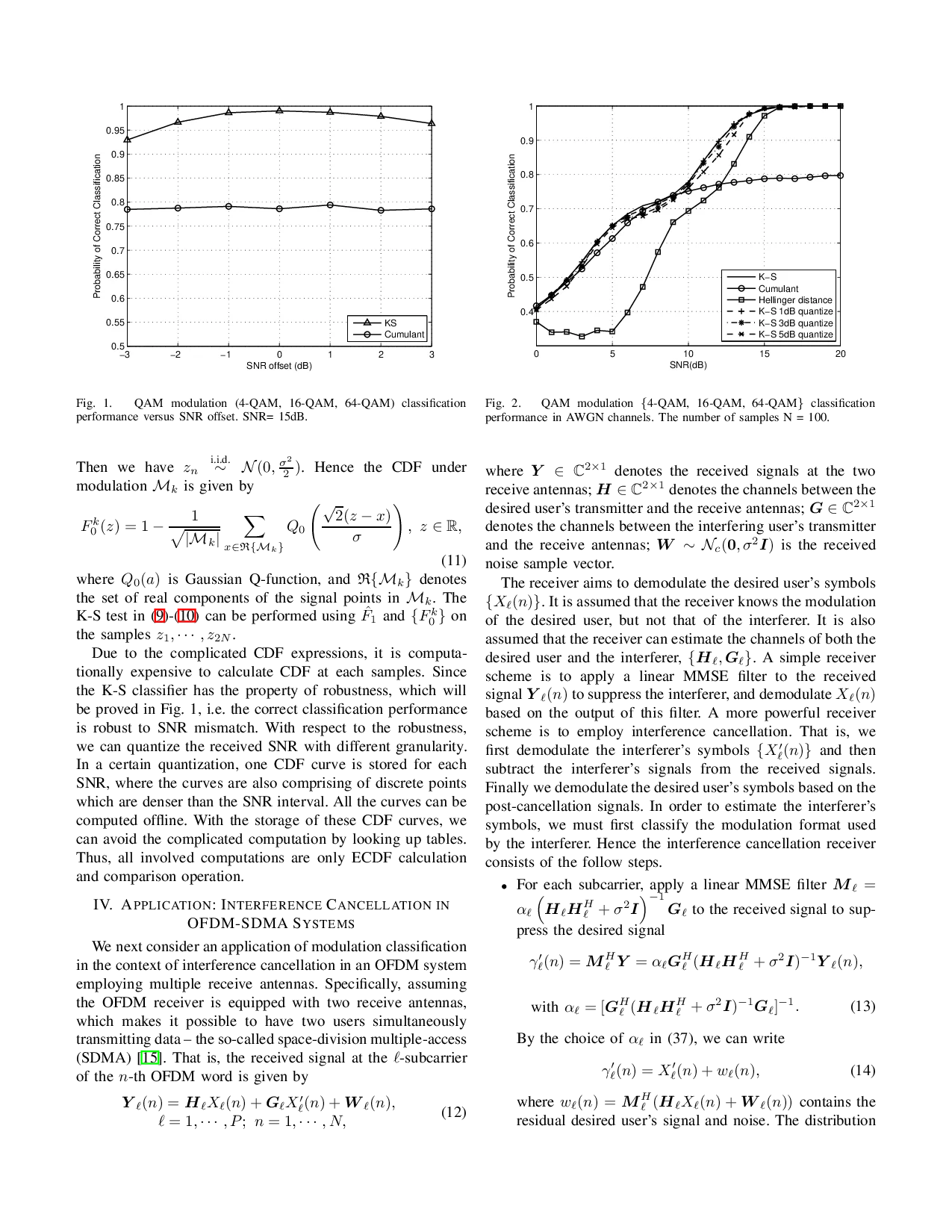
A major practical obstacle is the computational cost of evaluating the theoretical CDF at every sample. To overcome this, the paper introduces a low‑complexity implementation: the signal‑to‑noise ratio (SNR) is quantized into a set of discrete levels, and for each level the CDF curves are pre‑computed offline and stored in lookup tables. During operation, only the ECDF needs to be updated and a table lookup is performed, reducing the online complexity to O(N) additions and comparisons. The authors demonstrate that the K‑S classifier is robust to SNR mismatch; even with ±3 dB SNR offset the performance degradation is modest, and quantization steps as large as 5 dB still preserve most of the gain over cumulant‑based methods.
The technique is applied to an OFDM‑based space‑division multiple‑access (SDMA) system with two receive antennas. After a linear MMSE filter isolates the interfering user’s signal, the filtered output follows an AWGN model, allowing the K‑S classifier to identify the interferer’s modulation. Once identified, the interferer’s symbols are demodulated and subtracted, enabling interference cancellation before the desired user’s symbols are finally detected. Simulation results show that the K‑S‑based interference‑cancellation receiver achieves a bit‑error‑rate (BER) improvement of roughly 2 dB over a cumulant‑based receiver and approaches the performance of an ideal receiver that perfectly removes the interferer.
Extensive Monte‑Carlo simulations compare the K‑S classifier with fourth‑order cumulant classifiers and a Hellinger‑distance‑based classifier (the latter having very high complexity). With only 100 received samples, the K‑S method reaches near‑perfect classification at moderate to high SNR, while the cumulant approach saturates around 0.8 probability of correct classification. The robustness to SNR quantization and mismatch is also verified: even with coarse quantization (5 dB steps) the K‑S classifier remains superior.
In summary, the paper demonstrates that a K‑S‑test‑driven AMC can achieve high classification accuracy with far fewer samples and substantially lower computational load than conventional methods. By leveraging offline CDF tables, the approach becomes practical for real‑time systems such as tactical radios, multi‑antenna OFDM receivers, and any scenario where the modulation format of an interfering signal must be identified quickly and reliably.
Comments & Academic Discussion
Loading comments...
Leave a Comment