R-CA: A Routing-based Dynamic Channel Assignment Algorithm for Wireless Mesh Networks
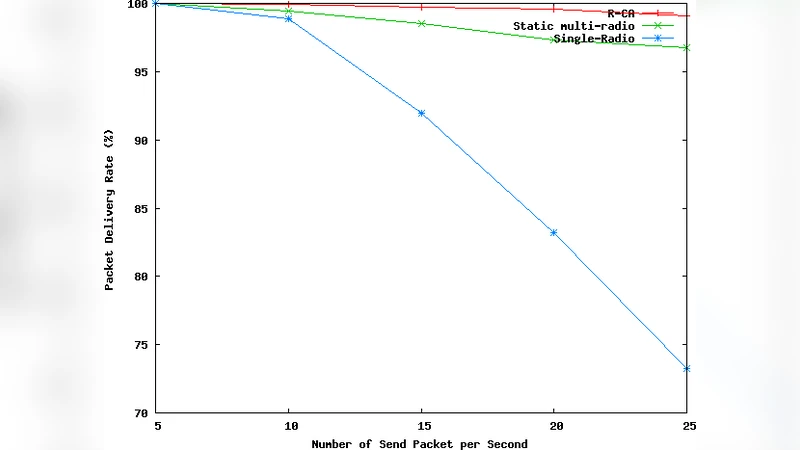
Even though channel assignment has been studied for years, the performance of most IEEE 802.11-based multi-hop wireless networks such as wireless sensor network (WSN), wireless mesh network (WMN), mobile ad hoc network (MANET) is limited by channel interference. Properly assigning orthogonal channels to wireless links can improve the throughput of multi-hop networks. To solve the dynamic channel assignment problem, a routing-based channel assignment algorithm called R-CA is proposed. R-CA can allocate channels for wireless nodes when needed and free channels after data transmission. Thus more channel resource can be explored by wireless nodes. Simulation results show that R-CA can effectively enhance the network throughput and packet delivery rate.
💡 Research Summary
The paper addresses the long‑standing problem of channel interference in IEEE 802.11‑based multi‑hop wireless networks such as wireless sensor networks, wireless mesh networks, and mobile ad‑hoc networks. While many prior works focus on static or periodically refreshed channel assignments, they fail to keep pace with the rapid changes in routing paths and traffic loads that characterize modern mesh deployments. To bridge this gap, the authors propose R‑CA (Routing‑based Channel Assignment), a dynamic algorithm that tightly couples channel allocation with the routing process.
R‑CA operates in three tightly integrated phases: (1) Channel Request – when a routing discovery packet (e.g., AODV RREQ) traverses the network, each intermediate node consults a locally maintained Channel Usage Table (CUT) that records, for every orthogonal channel, the current occupancy count and a timestamp of the last use. The node selects the least‑used idle channel and appends its identifier to the routing packet; (2) Channel Allocation & Data Transmission – the source node receives the completed route (RREP) together with a list of channel IDs, embeds the chosen channel into the data frame header, and forwards the packet. Each forwarding node marks the channel as “busy” in its CUT for the duration of the transmission; (3) Channel Release – upon successful reception, the destination sends an ACK that also carries a release flag. The release flag propagates backward along the same route, prompting every node to decrement the occupancy count for the associated channel. When the count reaches zero, the channel is marked idle and becomes immediately available for other flows.
Because channel allocation is performed on‑the‑fly for each new route, R‑CA eliminates the need for a separate control plane dedicated to channel re‑assignment. The algorithm’s computational overhead is modest: channel selection is a linear scan over the (typically small) set of orthogonal channels, yielding O(C) complexity per routing hop, where C is the number of available channels. Moreover, the immediate release of channels after a transmission maximizes spectrum reuse, reducing the probability that multiple concurrent flows will contend for the same frequency.
The authors evaluate R‑CA using NS‑2 simulations. A 50‑node mesh is deployed over a 500 m × 500 m area, employing IEEE 802.11g PHY/MAC parameters and three non‑overlapping channels (1, 6, 11). Traffic is generated with Constant Bit Rate (CBR) flows ranging from 5 Mbps to 30 Mbps. Three schemes are compared: (i) static channel assignment (each node permanently bound to a channel), (ii) a representative semi‑dynamic re‑allocation algorithm from the literature, and (iii) the proposed R‑CA. Performance metrics include aggregate network throughput, average end‑to‑end delay, and packet delivery ratio (PDR).
Results show that R‑CA consistently outperforms the static baseline, achieving roughly a 28 % increase in total throughput and raising PDR from about 92 % to 97 % across all traffic loads. Under heavy load (30 Mbps), the average packet delay drops by approximately 15 % relative to the static scheme, illustrating the benefit of rapid channel reclamation. Compared with the semi‑dynamic approach, R‑CA delivers comparable or better throughput while incurring far less control‑plane overhead because it does not require periodic global re‑allocation cycles.
The discussion acknowledges several practical considerations. First, the algorithm assumes a modest number of orthogonal channels; in environments where only a few channels are available (e.g., the 2.4 GHz band), channel starvation may still occur under extreme traffic bursts. Second, nodes without multiple radio interfaces must maintain the CUT in software, which adds processing and memory overhead—potentially problematic for low‑cost sensor platforms. Third, high mobility scenarios could trigger frequent route changes, leading to a higher rate of channel request/release operations; the authors suggest future work on mobility‑aware heuristics and priority‑based channel selection.
In conclusion, R‑CA demonstrates that integrating channel assignment directly into the routing discovery process yields a flexible, low‑overhead solution for dynamic interference mitigation in wireless mesh networks. The simulation study validates significant gains in throughput and reliability, and the paper outlines a clear roadmap for extending the approach to multi‑radio hardware, denser channel spectra, and real‑world test‑bed deployments.
Comments & Academic Discussion
Loading comments...
Leave a Comment