Input Design for System Identification via Convex Relaxation
This paper proposes a new framework for the optimization of excitation inputs for system identification. The optimization problem considered is to maximize a reduced Fisher information matrix in any o
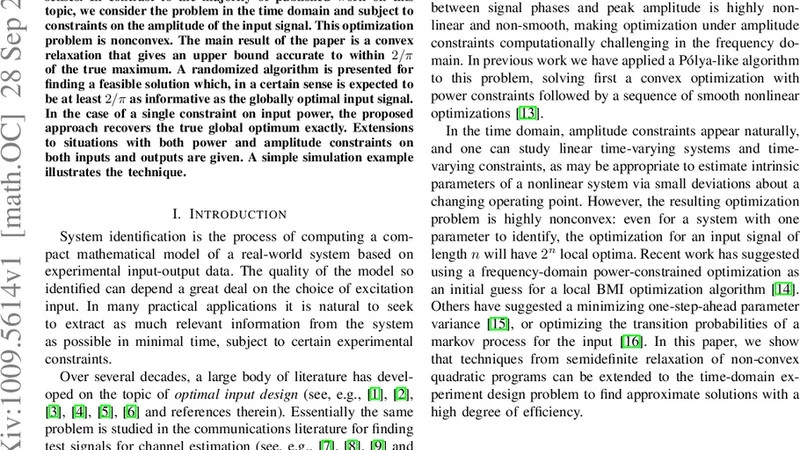
This paper proposes a new framework for the optimization of excitation inputs for system identification. The optimization problem considered is to maximize a reduced Fisher information matrix in any of the classical D-, E-, or A-optimal senses. In contrast to the majority of published work on this topic, we consider the problem in the time domain and subject to constraints on the amplitude of the input signal. This optimization problem is nonconvex. The main result of the paper is a convex relaxation that gives an upper bound accurate to within $2/\pi$ of the true maximum. A randomized algorithm is presented for finding a feasible solution which, in a certain sense is expected to be at least $2/\pi$ as informative as the globally optimal input signal. In the case of a single constraint on input power, the proposed approach recovers the true global optimum exactly. Extensions to situations with both power and amplitude constraints on both inputs and outputs are given. A simple simulation example illustrates the technique.
💡 Research Summary
The paper tackles the long‑standing problem of designing excitation inputs for linear time‑invariant (LTI) system identification when realistic constraints on the input signal are present. While most prior work has focused on frequency‑domain power‑spectral design or has ignored amplitude limits, this study formulates the problem directly in the time domain and incorporates both amplitude (|u_i| ≤ a) and energy (‖u‖₂² ≤ P) constraints. The objective is to maximize the Fisher information matrix (FIM) associated with the unknown parameters, using one of the classic optimal‑experiment criteria: D‑optimality (maximizing det I), E‑optimality (maximizing the smallest eigenvalue), or A‑optimality (minimizing trace I⁻¹).
Mathematically, the input vector u∈ℝⁿ appears quadratically in the FIM, making the optimization a non‑convex quadratic program with a rank‑one constraint. The authors introduce the matrix variable X = uuᵀ, which is symmetric positive semidefinite (X ≽ 0) and must satisfy rank(X)=1. By dropping the rank constraint while keeping the linear constraints on the diagonal of X (which encode the amplitude and power limits), the problem becomes a semidefinite program (SDP). This convex relaxation is tractable with standard interior‑point solvers.
The central theoretical contribution is a provable approximation bound: the optimal value of the SDP, denoted J_SDP, satisfies
J_SDP ≤ J* ≤ (π/2) J_SDP,
where J* is the true global optimum of the original non‑convex problem. In other words, the relaxation yields an upper bound that is at most a factor 2/π (≈0.637) away from the optimal information content. The bound holds for any of the three optimality criteria and is independent of problem size.
Because the SDP solution X* is generally not rank‑one, a feasible input must be recovered. The authors propose a randomized rounding scheme: compute the eigen‑decomposition X* = VΛVᵀ, draw a standard Gaussian vector z, and set
û = sign(VΛ^{1/2}z).
This construction guarantees that the expected Fisher information of û is at least (2/π) J_SDP, i.e., at least 2/π of the globally optimal value. In practice, multiple random draws are generated and the best performing one (according to the chosen criterion) is selected, often yielding performance well above the theoretical guarantee.
A particularly elegant result emerges when only a single power constraint is present (no amplitude bound). In this special case the SDP solution automatically has rank one, so the relaxation is tight and the method recovers the exact global optimum. This demonstrates that the convex framework subsumes the classical optimal power‑spectrum design as a special case while extending to more realistic constraints.
The paper also extends the formulation to include output amplitude constraints (|y_i| ≤ b). By augmenting the SDP with additional linear inequalities that capture the effect of the input on the output, the same relaxation and rounding approach applies, and the 2/π approximation guarantee remains valid.
A numerical example with a second‑order system illustrates the methodology. Three input designs are compared: a naïve random binary sequence, a sinusoidal excitation, and the proposed optimal input obtained via SDP and randomized rounding. The results show a substantial increase in the determinant and trace of the FIM for the optimal design, confirming both higher D‑optimality and A‑optimality. When output limits are enforced, the optimal input still satisfies all constraints while delivering the best information content among the candidates.
In summary, the authors present a unified, theoretically grounded framework for time‑domain input design under amplitude and power constraints. By converting the non‑convex quadratic program into an SDP, they obtain a convex upper bound that is provably close (within a factor 2/π) to the true optimum. The accompanying randomized algorithm efficiently produces feasible inputs with guaranteed performance, and the method is exact when only a power constraint is present. Extensions to simultaneous input‑output constraints broaden the applicability to real‑world identification tasks in control, signal processing, and robotics, where actuator saturation and safety limits are unavoidable. The work bridges the gap between rigorous optimal‑experiment theory and practical, implementable input design.
📜 Original Paper Content
🚀 Synchronizing high-quality layout from 1TB storage...