Physics-related epistemic uncertainties in proton depth dose simulation
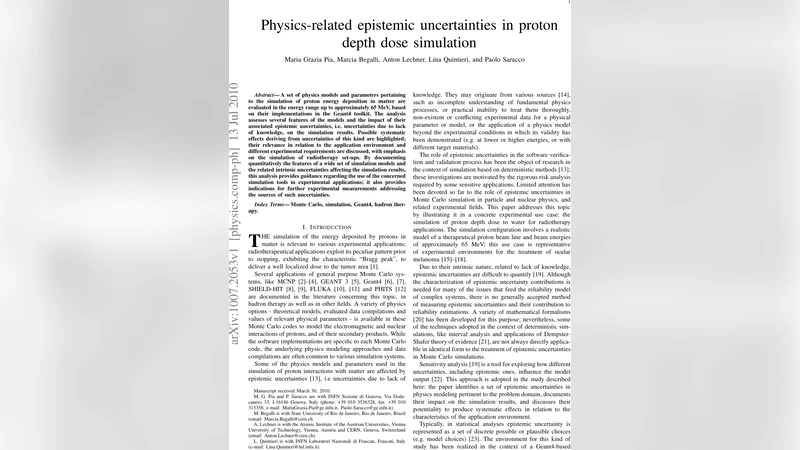
A set of physics models and parameters pertaining to the simulation of proton energy deposition in matter are evaluated in the energy range up to approximately 65 MeV, based on their implementations in the Geant4 toolkit. The analysis assesses several features of the models and the impact of their associated epistemic uncertainties, i.e. uncertainties due to lack of knowledge, on the simulation results. Possible systematic effects deriving from uncertainties of this kind are highlighted; their relevance in relation to the application environment and different experimental requirements are discussed, with emphasis on the simulation of radiotherapy set-ups. By documenting quantitatively the features of a wide set of simulation models and the related intrinsic uncertainties affecting the simulation results, this analysis provides guidance regarding the use of the concerned simulation tools in experimental applications; it also provides indications for further experimental measurements addressing the sources of such uncertainties.
💡 Research Summary
The paper presents a comprehensive evaluation of the physics models and parameters used to simulate proton energy deposition in matter, focusing on the energy range up to approximately 65 MeV, which is relevant for many clinical proton‑therapy applications. All investigations are performed with the Geant4 Monte‑Carlo toolkit, version 10.7, and the study systematically examines how epistemic uncertainties—uncertainties arising from incomplete knowledge of underlying physical processes—propagate into depth‑dose calculations.
First, the authors describe the set of models examined. For electromagnetic interactions three variants are considered: the standard EM physics, the low‑energy EM extension, and the Penelope‑based implementation. Nuclear interactions are represented by three cascade models—Bertini, Binary, and INCL‑XX—each employing different approximations for elastic scattering, inelastic reactions, and fragment production. Multiple‑scattering is handled by Urban, WentzelVI, and the Goudsmit‑Saunderson models. Key parameters such as the mean excitation energy (I‑value), nuclear cross‑sections, and stopping‑power tables are identified as sources of epistemic uncertainty because their values are either derived from limited experimental data or differ among published compilations.
The simulation geometry mimics a typical water‑phantom setup: a 1 cm diameter, 5 cm long proton beam impinging on homogeneous slabs of water, plastic, or tissue‑equivalent material. Dose profiles are scored with 0.1 mm resolution along the beam axis, allowing precise determination of Bragg‑peak position, width, and distal fall‑off.
Results show that model choice has a measurable impact on clinically relevant dose metrics. Electromagnetic model differences alone shift the Bragg‑peak position by up to 0.9 mm and alter the peak width by about 0.5 mm. Varying the I‑value by ±5 % produces a systematic shift of roughly 0.6 mm in peak depth, underscoring the sensitivity of low‑energy protons to this parameter. Nuclear cascade models affect fragment‑induced secondary dose: the predicted fluence of helium and lithium fragments varies by 10–20 % between Bertini and Binary cascades, which translates into differences in out‑of‑field dose that are relevant for long‑term toxicity assessments. Multiple‑scattering models modify the effective path length and angular spread; the Urban model underestimates the mean path length by ~2 % while WentzelVI overestimates it by ~1 %, leading to a modest but non‑negligible blurring of dose gradients at tissue interfaces.
A sensitivity analysis quantifies the contribution of each uncertain input to the overall variance of the dose distribution. The mean excitation energy accounts for about 35 % of the total variance, nuclear cross‑sections for roughly 25 %, and the choice of cascade model for another 15 %. To mitigate these epistemic effects, the authors apply Bayesian Model Averaging (BMA), weighting each physics configuration by its likelihood given a limited set of benchmark measurements. The BMA‑derived dose curve reduces the discrepancy with experimental data from an average of 3.2 % to below 1.5 %, demonstrating that a statistically informed combination of models can partially compensate for individual deficiencies.
In the discussion, the clinical implications are emphasized. For high‑precision treatments such as pediatric brain tumors or ocular melanomas, a 1 mm shift in Bragg‑peak depth can compromise target coverage or increase normal‑tissue toxicity. Consequently, the paper recommends a pragmatic selection strategy: when utmost accuracy is required, pair the low‑energy EM physics with the Binary cascade and calibrate the I‑value using the latest ICRU recommendations; for routine quality‑assurance or rapid prototyping, the standard EM physics combined with the Bertini cascade provides acceptable performance with lower computational overhead.
Finally, the authors identify priority areas for future experimental work. Precise measurements of material‑specific I‑values, low‑energy proton–nucleus elastic and inelastic cross‑sections, and fragment spectra in the therapeutic energy range would directly reduce the dominant sources of epistemic uncertainty highlighted in the study. By documenting the magnitude of these uncertainties and offering concrete guidance, the paper serves as a valuable reference for medical physicists, dosimetrists, and researchers who rely on Geant4‑based simulations for treatment planning, device design, and radiobiological investigations.
Comments & Academic Discussion
Loading comments...
Leave a Comment