Relaying Simultaneous Multicast Messages
The problem of multicasting multiple messages with the help of a relay, which may also have an independent message of its own to multicast, is considered. As a first step to address this general model, referred to as the compound multiple access channel with a relay (cMACr), the capacity region of the multiple access channel with a “cognitive” relay is characterized, including the cases of partial and rate-limited cognition. Achievable rate regions for the cMACr model are then presented based on decode-and-forward (DF) and compress-and-forward (CF) relaying strategies. Moreover, an outer bound is derived for the special case in which each transmitter has a direct link to one of the receivers while the connection to the other receiver is enabled only through the relay terminal. Numerical results for the Gaussian channel are also provided.
💡 Research Summary
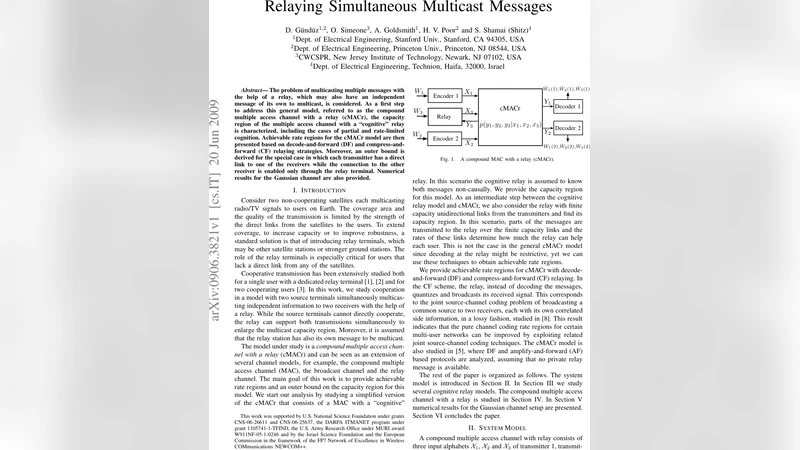
The paper tackles the problem of simultaneously multicasting several independent messages with the assistance of a relay that may also have its own message to broadcast. To formalize this scenario the authors introduce the “compound multiple access channel with a relay” (cMACr), a network consisting of two transmitters, two receivers, and a relay node. Each transmitter wishes to send a common message to both receivers, while the relay can help forward these messages and may also transmit its own independent multicast.
The first major contribution is a complete characterization of the capacity region for a multiple‑access channel (MAC) equipped with a fully cognitive relay – i.e., a relay that knows both transmitters’ messages a priori. By employing superposition coding at the transmitters and joint decoding at the receivers, the authors derive three coupled rate constraints that exactly describe the achievable region. This result extends the classic MAC capacity theorem by adding the relay’s transmission capability.
Next, the paper relaxes the full‑cognition assumption. Two intermediate models are examined: (i) partial cognition, where the relay knows only a subset of the transmitters’ bits, and (ii) rate‑limited cognition, where the relay obtains the messages over a separate link of limited capacity. For each case the authors modify the coding scheme (splitting messages into common and private parts, or using a binning approach for the limited‑rate link) and obtain inner bounds that reduce to the full‑cognition region when the side‑information becomes unrestricted. These results quantify how the amount of side information at the relay influences the overall multicast throughput.
Having established the information‑theoretic limits, the authors propose concrete relaying strategies. The first is Decode‑and‑Forward (DF): the relay fully decodes both users’ messages, re‑encodes them together with its own data, and forwards the composite codeword. DF achieves the full‑cognition region when the relay‑to‑receiver links are strong enough to support reliable decoding. The second strategy is Compress‑and‑Forward (CF): the relay does not attempt full decoding; instead it quantizes its received signal, compresses the quantization index, and transmits this index to the receivers. The receivers then combine the direct observations from the transmitters with the compressed relay observation to recover the original messages. CF is advantageous when the relay‑to‑receiver channels are weak or when the relay’s processing capability is limited. For both DF and CF the paper provides explicit single‑letter expressions for the achievable rate regions, highlighting the role of auxiliary random variables and the trade‑off between compression distortion and forwarding rate.
A special case is examined in depth: each transmitter has a direct link to one of the receivers, while the other receiver can be reached only through the relay. For this topology the authors derive an outer bound on the capacity region using Fano’s inequality and standard MAC converse arguments. The bound matches the DF/CF inner regions in many parameter regimes, especially for symmetric Gaussian channels, thereby demonstrating the near‑optimality of the proposed strategies.
The theoretical findings are illustrated with Gaussian cMACr examples. Numerical simulations vary the transmit power, the relay‑to‑receiver channel gains, and the side‑information rate. The plots reveal that (a) when the relay‑to‑receiver links are strong, DF yields the largest achievable region; (b) when those links are weak or the relay’s side‑information is rate‑limited, CF outperforms DF; and (c) the gap between the inner regions and the outer bound is typically small (on the order of a few tenths of a bit per channel use). These results confirm that the DF and CF schemes are practically relevant for real‑world multicast relay networks.
In summary, the paper provides a comprehensive information‑theoretic framework for simultaneous multicast with a relay, characterizes the capacity under full cognition, extends the analysis to partial and rate‑limited cognition, and offers two concrete relaying protocols (DF and CF) together with an outer bound for a key special case. The work deepens our understanding of how side information at a relay can be exploited, and it lays the groundwork for future extensions such as multiple relays, fading channels, and network‑wide scheduling algorithms.
Comments & Academic Discussion
Loading comments...
Leave a Comment