Quantifying the Availability of TV White Spaces for Cognitive Radio Operation in the UK
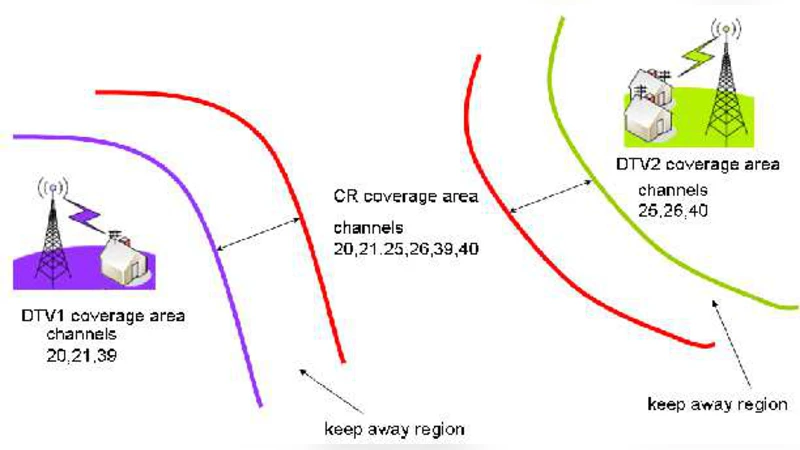
Cognitive radio is being intensively researched for opportunistic access to the so-called TV White Spaces (TVWS): large portions of the VHF/UHF TV bands which become available on a geographical basis after the digital switchover. Using accurate digital TV (DTV) coverage maps together with a database of DTV transmitters, we develop a methodology for identifying TVWS frequencies at any given location in the United Kingdom. We use our methodology to investigate variations in TVWS as a function of the location and transmit power of cognitive radios, and examine how constraints on adjacent channel interference imposed by regulators may affect the results. Our analysis provides a realistic view on the spectrum opportunity associated with cognitive devices, and presents the first quantitative study of the availability and frequency composition of TWVS outside the United States.
💡 Research Summary
The paper presents the first comprehensive, quantitative study of TV White Space (TVWS) availability in the United Kingdom, extending the largely US‑centric body of research on opportunistic spectrum access for cognitive radios (CR). By leveraging high‑resolution digital television (DTV) coverage maps supplied by Ofcom together with a complete database of all DTV transmitters (including location, frequency, power, antenna height, and service area), the authors develop a spatial analysis framework that can identify, for any geographic point, which TV channels are truly free for secondary use.
The methodology proceeds in three stages. First, the DTV coverage maps are processed to reconstruct the exact service contours of each transmitter, taking into account terrain, building density, and standard propagation loss models. Second, a “protection radius” is computed for a prospective CR device based on its transmit power and the regulatory requirement that adjacent‑channel interference (ACI) be avoided. In the UK, regulators mandate a minimum 1 MHz guard band around any channel used by a CR, and the protection radius scales roughly as 0.5 km for 0.1 W, 2 km for 1 W, and 5 km for 10 W devices. Third, for each grid point (1 km spacing) across the country, the algorithm overlays all protection zones, removes the occupied channels, and records the remaining channels as usable TVWS.
Applying this pipeline under three transmit‑power scenarios (0.1 W, 1 W, 10 W) yields several key findings. Power is the dominant factor: as power rises, the protection radius expands and the number of available channels drops sharply—from an average of 12–15 channels at 0.1 W to merely 3–5 channels at 10 W when ACI constraints are enforced. If the adjacent‑channel guard is ignored, the available channel count increases by roughly 20‑35 %, highlighting the regulatory impact on spectrum efficiency.
Geographically, the distribution of TVWS is highly heterogeneous. Dense urban regions such as London, Manchester, and Birmingham exhibit almost no white space because DTV transmitters are densely packed and their protection zones overlap extensively. Conversely, sparsely populated rural and upland areas (e.g., the Scottish Highlands, parts of Wales) retain a rich set of white spaces, with an average of 12–15 usable channels concentrated mainly in the UHF band (600‑800 MHz). The VHF band (174‑230 MHz) contributes little to the UK’s TVWS pool, a contrast to the United States where VHF white spaces are more prevalent.
The authors also compare their UK results with the US FCC’s database‑driven approach. They note that the UK’s more complex topography and stricter ACI protection lead to a 30‑40 % reduction in available channels relative to a comparable US scenario. This underscores the necessity of high‑resolution, country‑specific coverage data rather than relying on generic propagation models.
In the discussion, the paper emphasizes that realistic TVWS assessments must incorporate three intertwined dimensions: transmitter geometry, regulatory guard‑band policies, and CR transmit power. The findings suggest that UK‑based CR deployments will likely need to operate at low power (≤ 1 W) and adopt dynamic spectrum access techniques that respect the tight adjacent‑channel constraints.
Finally, the authors outline future work: integrating real‑time spectrum sensing with the database approach to form a hybrid detection system, exploring adaptive power control to shrink protection zones, and conducting field trials with prototype CR devices to validate the model predictions. The study provides policymakers, spectrum managers, and wireless system designers with a solid empirical foundation for shaping UK‑specific TVWS exploitation strategies.