Ergodic Fading Interference Channels: Sum-Capacity and Separability
The sum-capacity for specific sub-classes of ergodic fading Gaussian two-user interference channels (IFCs) is developed under the assumption of perfect channel state information at all transmitters and receivers. For the sub-classes of uniformly stro…
Authors: Lalitha Sankar, Xiaohu Shang, Elza Erkip
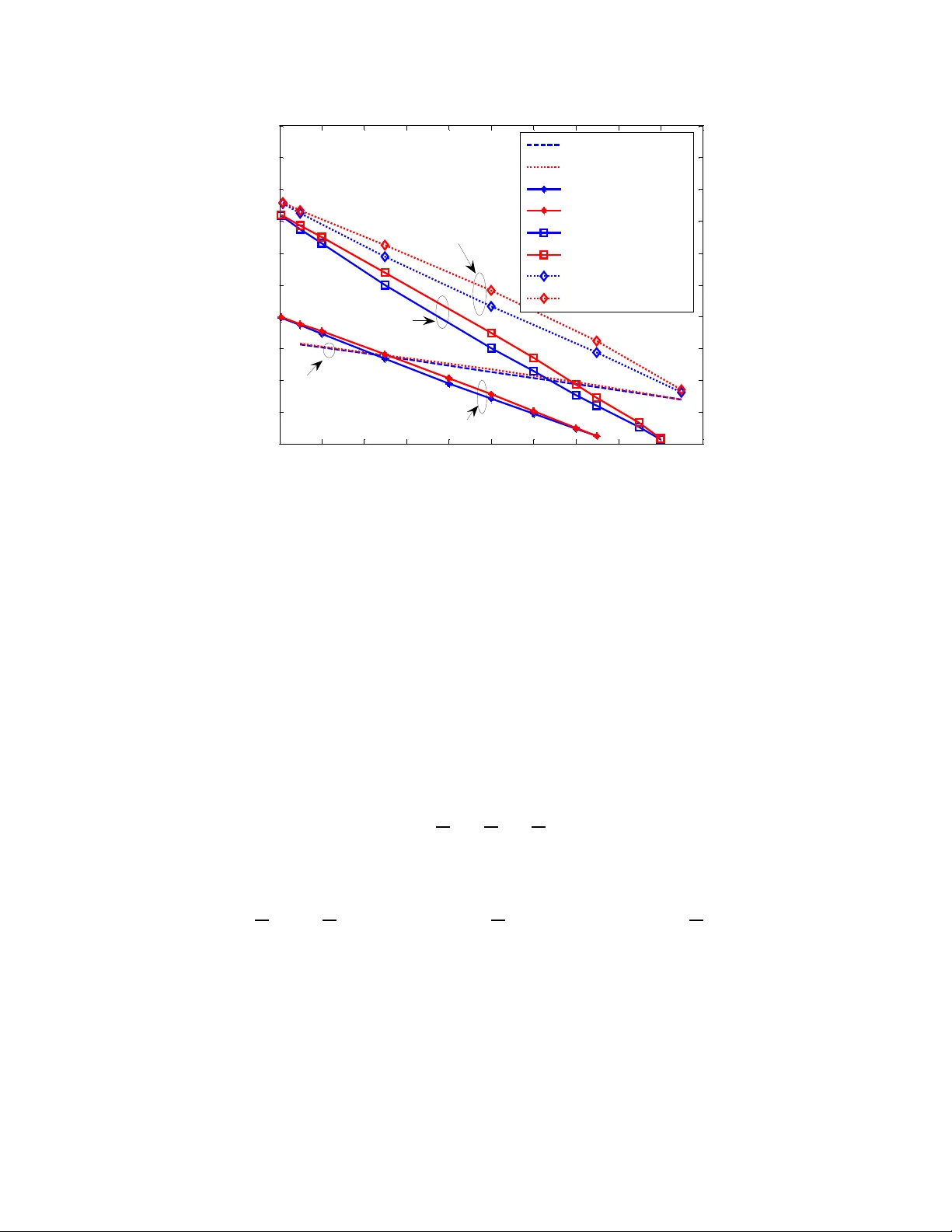
1 Er godic F ading Interfere nce Channels: Sum-Capacity and Separa bility Lalitha Sankar , Member , IEEE, Xiaohu S hang, Memb er , IEEE, Elza Erkip, F ellow , IEEE , a nd H. V inc ent Poor , F ellow , IEEE Abstract — The sum-capacity for specific sub-classes of ergodic fading Gaussian two-user interfer ence channels (IFCs) is de vel- oped under the assumption of perfect channel state inf ormation at all tr an smitters and r eceivers. F or the sub-classes o f un iformly strong (e very fading state is str ong) and ergodic very st rong tw o- sided IFCs (a mix of strong and weak fad ing states satisfying specific fading av eraged conditions) the o p timality of completely decoding the interference, i. e., con verting the IFC to a compound multiple access channel (C- MA C), is pro ved. It is also shown that this capacity-achieving scheme requires encodin g and decodin g jointly acros s all fading states. As an achievable scheme and also as a topic of indep endent in terest, the capacity region and the corresponding optimal power policies for an ergodic fading C-MA C are de veloped. For the sub-class of uniformly weak IFCs (every fading state is weak), genie-aided outer bounds are deve lop ed. The bounds a re shown to be ac h iev ed b y tr eating interference as noise and by separable coding for o n e-sided fading IFCs. Finally , for the sub-class of one-sided h ybrid IFCs (a mix of weak and str on g states that do not satisfy er godic v ery strong conditions), an achiev able scheme inv olving rate splitting and joint coding across all fading state s is develo p ed and is sh own to perfo rm at least as well as a separable coding scheme. Index T erms — In terference channel, ergodic fadin g, stro n g and weak interference, polymatr oids, compound mul tiple access channel, ergodic capacity , separability . I . I N T RO D U C T I O N The interference channel (IFC) models a wir eless network in which every transmitter (u ser) com municates with its u nique intended receiver while causing interf erence to the r emain- ing receivers. Gaussian inter ference ch annels model wireless networks consisting o f two or mo re interferin g transmit- receive pairs (links). The capacity region o f Gaussian I FCs remains an open pro blem. In this paper, we focus on tw o- user fading Gau ssian IFCs, and hencef orth, u se IFCs and Gau ssian IFCs interch angeably . F o r two-user Gaussian n on-fading IFCs, referred to in th e literature as si m ply Gaussian IFCs, capacity results are known only for specific sub-c lasses identified L. Sankar , X. Shang, and H. V . P oor are with the D epartme nt of Elec- trical Engineering, Princeton Uni versity , P rincet on, NJ 08544, USA. email: { lali tha,xshang,poor@princeto n. edu } . E. Erkip is with the Department of Electric al and Computer Engineering, Polytechnic Institute of Ne w Y ork Uni versity , Brooklyn, NY 11201, USA. email: elza@poly .edu. This research was conducted in part when E. Erkip was visiting Princeton Univ ersity . This researc h was supporte d in part by the National Science Foundation under Grants CNS-09-05398 and CC F-06-35177 and in part by a fe llowship from the Princeton Univ ersity Council on Science and T echnology . The materia l in t his paper wa s presented in pa rt at the IEEE Internati onal Sym- posium on Information Theor y , T oronto, Canada, Jul. 2008 and at the 46 th Annual Allerton Confere nce on Communications, Control, and Computing, Montice llo, IL, Sep. 2008. uniquely by the relative strength of the cross- and dire ct links from each transmitter to the uninte nded and intend ed receiver , respectively , an d/or the transmit po wers. Specifica lly , the capacity region is known f or str on g Gaussian IFCs for which the strength o f both cross-links a re larger than that of the co rrespon ding direc t link s and is achieved when b oth receivers deco de both the intended and in terfering m essages [1], [ 2], [3]. A very str ong IFC results when the sum -capacity of a strong Gaussian IFC is th e su m of the interfe rence-fr ee capacities of the two links [2]. In contrast, weak IFCs are those for which the stre ngths of b oth cro ss-links are smaller than that of the correspo nding direct links. Th e capacity region o f weak IFCs remains open in general; ho wever , f or the class of one-sided we ak IFCs in whic h the strength of o ne of the cr oss- links is zer o, the weak sum-cap acity is achieved by ignorin g interferen ce, i.e., by considering the interferen ce as noise while decodin g th e desired sign al at the interfered with receiver [4 ]. More recen tly , the su m-capacity of a class of n oisy or very weak Ga ussian IFCs has been determ ined indep endently in [5], [6], and [7] is shown to be achiev ed when both receivers ignore the ir inter ference. Outer bou nds for IFCs are d ev elo ped in [5], [6], [7], [8] and [9] while se veral achie vable rate regions for Gau ssian IFCs are studied in [10]. The be st kn own inner bo und is due to Han and K ob ayashi (HK) [3 ]. Recently , in [9], an HK-b ased scheme is shown to achieve ev er y rate pair within 1 bit/s/Hz of th e capacity region. In [11], the authors refor mulate the HK region as a u nion of two sets to char acterize the maxim um sum-ra te achieved by Gaussian in puts and without time- sharing. More recently , the approximate capacity of tw o -user Gaussian IFCs is cha racterized using a deterministic ch annel mod el in [ 12]. The sum-cap acity of th e class of no n-fading mu ltiple-inpu t multiple-ou tput (MIMO) IFCs is studie d in [13]. Relati vely fewer results are kn own for p arallel o r fading Gaussian I FCs. Parallel Gaussian IFCs ( PGICs) wher e each parallel sub -chann el is strong is considere d in [ 14] for which the auth ors develop an achievable schem e using in depend ent encodin g an d decoding in each parallel sub-chann el. Sung et al [15] present an achiev ab le sch eme f or a class of one- sided PGICs that inv olves viewing ea ch par allel sub -chann el as an in depend ent stron g or weak on e-sided IFC and coding approp riately fo r that sub-channe l. Th us, for strong and weak parallel sub-ch annels, the inter ference is comp letely decoded and ign ored, respectively . In this pap er , we show that ind e- penden t coding acro ss fading states (viewed as sub-chann els) is in gener al not sum-c apacity optimal. Recently , for PGICs, [16] deter mines the cond itions on the 2 channel coef ficien ts and p ower co nstraints for which in depen- dent transmission across the par allel channels (o ften r eferred to as sub-chann els) an d treating interference as noise is optimal. In [17], tech niques used fo r MIMO IFCs [13] are applied to study the optimality o f coding inde penden tly in each sub - channel (of ten referred to as separab ility) of PGICs. It is worth noting that PGICs are a sp ecial case of ergod ic fading I FCs in which each sub- channel is as sign ed the same weight, i.e., every sub-chan nel occurs with the same probability; furth ermore, they c an also be viewed as a special case o f MIMO IFCs and thus results from MIMO IFCs can be directly app lied to PGICs. For fadin g interferen ce networks with three or mor e users, in [1 8], th e a uthors develop an interfer enc e a lignment coding sche me to show th at th e sum -capacity o f a K -user IFC scales linearly with K in the high sign al-to-no ise ratio (SNR) regime when all link s in th e network have similar channel statistics. In this p aper, we stud y ergodic fading two-user Gaussian IFCs and determin e the sum-capacity an d the correspon ding optimal power policies for specific sub- classes whic h are defined in terms of th e fadin g statistics. Noting th at ergo dic fading IFCs fo rm a weigh ted collection of parallel IFCs (sub- channels), we identify fou r sub -classes that jointly co ntain the set of all ergo dic fading I FCs. W e develop th e sum -capacity for two o f them. F o r th e third sub-class, w e dev elo p the sum- capacity when only one o f the two receivers is affected by interferen ce, i.e., for a one- sided ergod ic fading IFC. For the fourth sub- class we p resent a g eneral ach iev able scheme b ased on join t codin g across fading states. A n atural question that arises in stud ying ergod ic fading and par allel chan nels is the op timality of separable coding , i.e., wh ether encodin g and decodin g ind ependen tly on each sub-chan nel (o r fadin g state) is optimal in ach ieving on e o r more points on the boun dary of the capacity region. For each sub-class of IFCs we consid er , we address the optimality of separable codin g, often re ferred to as sep arability , and demo n- strate that in c ontrast to po int-to-po int [19], mu ltiple-access [20], [21], and b roadcast channels without c ommon messages [22], separable coding is no t n ecessarily sum-capacity o ptimal for ergo dic fading IFCs. The first of the fou r sub-classes is the set of ergodic very str o ng (E VS) IFCs in wh ich each fading state (sub-chan nel) can be either weak or stro ng b u t av er aged over all fadin g states the interf erence at eac h receiver is sufficiently strong that th e two direct links from each transmitter to its intend ed receiv er are the b ottle-necks limiting the sum-ra te. For this sub-class, we show th at re quiring both receivers to decode the sign als from both transmitters is optimal, i.e., the ergodic very strong IFC mod ifies to a two-user ergodic fading compo und multiple- access chann el (C-M A C) in which th e transmitted sign al from each user is intended for both r eceiv er s [23]. T o this end, as an achievable rate region for IFCs and as a problem of indepen dent interest, we develop the capacity r egion and the optimal power policies that achieve them fo r e rgodic fading C-MA Cs (see also [23]). For EVS IFCs we also show th at achieving the sum-capac ity (and the capacity region) req uires transmitting information (encod ing and decod ing) jointly acr oss all fading states, i.e., separable co ding in eac h fading state is strictly subo ptimal. Intuitively , the reason for jo int codin g acr oss fading states lies in the fact that, analogously to parallel broadcast channels wit h common messages [2 4], both tran smitters in the EVS IFCs transmit on ly common m essages in tended fo r b oth r eceiv er s for which independ ent cod ing across the fading states or sub- channels becomes strictly sub-optimal. T o the best of our knowledge this is the first capacity r esult for fading two- user IFCs with a mix of weak and strong states. For such mixed ergodic I FCs, recently , a stra tegy o f er g odic interfer en ce alignment is pr oposed in [25], and is shown to ach iev e th e sum-capacity in [2 6] for a class o f K -user fadin g IFCs with unifor mly distributed p hase and at least K / 2 disjoin t eq ual strength interf erence links. The seco nd sub- class is the set of uniformly str ong ( US ) IFCs in which in every fading state the resulting IFC is strong, i.e., the cross-links have larger fading gains than the dire ct links for each fadin g realization. For this sub-class, we show that the capacity region is the same as that of an ergodic fading C-MA C with the same fading statistics and that achie ving this region requir es joint codin g acro ss all fading states. The third sub-class is the set of uniformly wea k ( UW ) IFCs fo r which in every fading state the resulting IFC is weak. As a first step, we study the on e-sided uniformly weak IFC an d d ev elo p genie-aided ou ter bou nds. W e sho w that the b ounds are tight when the interferin g receiv e r ignore s the weak in terference in every fading state. Furtherm ore, we show that sepa rable coding is optimal for this sub-c lass. The sum-capacity r esults for th e on e-sided c hannel are used to develop outer bou nds f or the two-sided c ase; however , sum- capacity results f or the two-sided case will r equire techniques such as those developed in [16] which deter mine the channel statistics and power policies for which igno ring in terferenc e and sepa rable codin g is optimal. The fina l sub-class is the set of hyb rid IFCs with at least one weak an d o ne stro ng fading state but which do not satisfy the co nditions for EVS I FCs (and b y definition are also n ot US and UW IFCs). The capac ity-achieving strategy for EVS an d US IFCs suggest that a joint c oding strategy across the fading states can potentially take advantage of the strong states to p artially eliminate in terference . T o th is end, for ergod ic fading one -sided IFCs , we propo se a HK- based general joint coding strategy that uses rate-splitting and Gaussian cod ebook s witho ut time-sh aring for all su b-classes of IFCs. In comparison, a one-sided non-fading Gau ssian I FC is either weak or strong and th e sum -capacity is k nown in bo th cases. In fact, for the weak case the sum-capacity is achieved by ignoring th e interference a nd for the strong case it is achieved by decodin g the in terference at the receiver subjec t to the interferen ce. Howe ver , for ergodic fading one- sided IFCs, in additio n to the UW and US sub-classes, we also have to conten d with the hybrid and E VS sub-classes each of which has a unique m ix of weak and stro ng fading states. The HK-based achiev ab le strategy we p ropose applies to all sub- classes of on e-sided IFCs and includ es the capacity- achieving strategies for th e EV S, US, and UW IFCs as special cases. A sub- class of hybr id I FCs is the un iformly mixed ( UM ) 3 Two-use r Erg. Fa ding Two-sided IFCs US IF C : eve ry sub-c h. is strong Two- user Erg. F ading One -sided IFCs EVS IF C : mix of wea k and strong sub-c h annel s Hy brid IFC: non- EVS mix of wea k and strong Mixed IFCs: every sub-ch mixed EVS IF C : mix of wea k and strong sub-cha nnels Hy brid IFC: non-EVS mix of weak and strong UW: weak sub- channels US IF C : eve ry sub-c h. is strong UW: weak sub- channels Fig. 1. A V enn diagram represent ation of the four sub-classes of ergodic fading one- and two-side d IFCs. two-sided IFCs in which a pair of fading st a tes corresponding to the cross-lin k a nd direct link from on e o f the sourc es f orms a strong on e-sided IFC while the c omplemen tary pair f rom the other sour ce is a weak one-sided IFC. For UM IFCs, we show that to achiev e su m-capacity the transmitter that interferes strongly transmits a co mmon message across all fading states a nd the transmitter interf ering weakly transmits a p riv ate message across all fading states. The two different interfering links however re quire joint enco ding and deco ding across all fadin g states to ensure op timal coding at the receiver with stro ng interfe rence. Finally , a n ote o n separability . In [27], Cadambe and Jafar demonstra te the inseparability of parallel interfer ence channels using an exam ple of a thr ee-user frequency selecti ve fading IFC. The authors use interference alignment schemes to show that separ ability is not o ptimal for fading IFCs with three or more users while leaving open the qu estion for the two-user fading IFC. W e ad dressed this question in [28] fo r the er g odic fading one-side d IFC and developed the conditions for th e optimality of separability f or EVS and US on e-sided I FCs. In this paper, we readdre ss this question for all sub-c lasses of fading two-user IFCs. Ou r r esults sug gest th at in gener al bo th one-sided and two-sided IFCs ben efit from transmitting th e same inform ation across all fading states (sub-chan nels), i.e., not ind ependen tly encoding and d ecoding in each fadin g state, thereby exploiting th e fading diversity to mitigate interfe rence. While the d efinitions and pr oofs of the fo ur sub-classes are formally developed in the seq uel, we r efer the r eader to Fig. 1 for a pictorial summ ation of the d ifferent sub-classes, capacity results for spec ific sub-classes, and the o ptimality of joint vs. separable coding in a chieving these cap acity results. The pa per is organ ized as follo ws. In Section II, we present the channel models studied . I n Section II I, we su mmarize o ur main results. T he capacity r egion of an ergo dic fading C-MA C is developed in Section IV . Th e proof s are collected in Section V. W e discuss our results with num erical examples in Section VI a nd co nclude in Section VII. I I . C H A N N E L M O D E L A N D P R E L I M I N A R I E S A. Channel Model A two-sender two-re ceiv er (also referre d to as a two-user) ergodic fading Gaussian IFC consists of two source nodes S 1 and S 2 , and two destination nodes D 1 and D 2 as sho wn in Fig. 2. Source S k , k = 1 , 2 , u ses the c hannel n times to transmit its message W k , which is distrib uted unifo rmly in the set { 1 , 2 , . . . , 2 nR k } and is indepe ndent of the m essage f rom the other sourc e, to its intended receiver , D k , at a rate R k bits per channel use. In each use of the channel, S k transmits the signal X k ∈ C ( C is the co mplex domain) while the destination D k receives Y k ∈ C , k = 1 , 2 , such tha t fo r an input vector X = [ X 1 X 2 ] T , the channel ou tput vector Y = [ Y 1 Y 2 ] T is giv e n by Y = HX + Z (1) where Z = [ Z 1 Z 2 ] T is a noise vector with entr ies that are zero-m ean, u nit variance, circula rly symmetric comp lex Gaussian noise variables and H is a rando m m atrix of fading gains with entries H m,k ∈ C , for all m, k = 1 , 2 , such that H m,k denotes the fading g ain b etween r eceiv er m and transmitter k . W e use h to denote a rea lization of H . W e assume the fading proce ss { H } is stationa ry and ergodic but not necessarily Gaussian. Note that the channel gains H m,k , f or all m and k , are not assumed to be indep endent; howe ver, H is known in stantaneously at all the tr ansmitters and r eceiv er s, i.e., just pr ior to the tran smission in each use of the chan nel. Over n uses of the chan nel, the transmit seq uences { X k,i } are con strained in power according to n X i =1 | X k,i | 2 ≤ nP avg k , for k = 1 , 2 . (2) Since the tran smitters kn ow the fading states of the links on which they tran smit, they can allocate their transmitted signal power accordin g to the chann el state inform ation. The power policy P k ( h ) of u ser k is a fun ction of the fadin g gains H ( i ) = h in chan nel use i and is given by E h | X k,i | 2 H ( i ) = h i = P k ( h ) , k = 1 , 2 . (3) 4 1, 1 h 1,2 h 2 ,2 h 1 : S 2 : S 1 D 2 D 2 , 1 h 1 1 N W X → 1 1 2 ˆ IC : ˆ ˆ C-MA C : ( , ) W W W 2 1 2 ˆ IC : ˆ ˆ C-MAC : ( , ) W W W 2 2 N W X → 1, 1 h 1,2 h 2 ,2 h 1 : D 2 : D (a) Two- sided I FC (b) One- sided IF C 1 1 N W X → 1 : S 2 : S 2 2 N W X → 1 ˆ W 2 ˆ W Fig. 2. The two-user Gaussian two-sided IFC and C-MAC and the two-user Gaussian one-sided IFC. Denoting P ( h ) as a length- two vector o f policies for bo th users, (3) im plies that P ( h ) is a m apping from th e fading state space consisting of the set of all fading states (instantiatio ns) h to the set of non- negativ e real values in R 2 + . While P ( h ) denotes the map for a particu lar fading state, we write P ( H ) to explicitly describe the policy for the en tire set of rand om fading states. Th us, we u se the n otation P ( H ) whe n averaging over all fading states o r describin g a collectio n of p olicies, one for every h . Remark 1: In general, the transmit sequences { X k,i } can be arbitrarily co rrelated su bject to a n average power constrain t in (2). Thus, for any po we r policy P k ( h ) , for all k , (3) defines the constraint on the diag onal elemen ts of th e covariance matrix of { X k,i } . For an ergodic fading channel, (2 ) then simplifies to E [ P k ( H )] ≤ P avg k for all k = 1 , 2 , (4) where the expectation in (4) is taken over the d istribution of H . W e den ote the set of all feasible po licies P ( h ) , i.e., the power p olicies whose en tries satisfy (4), by P . Fin ally , we write P avg to d enote the vector of av e rage power constrain ts with e ntries P avg k , k = 1 , 2 . For the special case in which both recei vers deco de the messages from both transmitters, we obtain a C-MA C (see Fig. 2(a)). A o ne-sided fadin g Gau ssian IFC results when either H 1 , 2 = 0 or H 2 , 1 = 0 with probab ility 1 (see Fig. 2(b) ). W ithout loss o f gen erality , we develop sum-capacity results for a one-sided IFC (Z-IFC) with H 2 , 1 = 0 . The re sults extend naturally to the complemen tary one-side d m odel with H 1 , 2 = 0 . B. Notation Before proceed ing, we summar ize the nota tion used in the sequel. • Random variables ( e.g. H k,j ) are den oted with up percase letters and th eir rea lizations (e.g. h k,j ) with the corre - sponding lowercase letters. • Bold fon t X denotes a ra ndom matrix while bo ld font x denotes a realization of X . • I den otes the identity matr ix. • | X | and X − 1 denote the determin ant an d inverse, respec- ti vely , of the m atrix X . • C N (0 , Σ ) deno tes a circularly symmetric com plex Gaus- sian distribution with zero me an and covariance Σ . • K = { 1 , 2 } deno tes the set of tran smitters. • E ( · ) deno tes expectation ; C ( x ) d enotes lo g(1 + x ) where the logarith m is to the b ase 2; ( x ) + denotes max( x, 0) ; I ( · ; · ) d enotes mutual inf ormation ; h ( · ) den otes differen- tial en tropy; and R S denotes P k ∈S R k for any S ⊆ K . • Thro ughou t the sequ el, we will use the p hrases fading state and sub-cha nnel interchang eably . W e write C IFC ( P avg 1 , P avg 2 ) a nd C C-MAC ( P avg 1 , P avg 2 ) to denote the cap acity regions of an e rgodic fading IFC and C-MA C, respe cti vely; for ease of no tation, we simply use C IFC and C C-MAC in the seque l. Our defin itions of average error prob abilities, capacity regions, and achievable rate pairs ( R 1 , R 2 ) f or both the IFC and C-MA C mirror the standard informa tion-theor etic definition s [29, Chap . 14 ]. Throu ghout the sequel we use th e ter m wa terfilling solution to deno te the capacity ac hieving power policy f or ergodic fad- ing po int-to-p oint channels [ 19]. For m ultiple acce ss ch annels, in add ition to each user waterfilling over its fading link to the common destination, only the u ser with th e b est (largest) channel gain transmits in each ch annel use, i.e ., the chan nel is used oppo rtunistically to maximize the sum capa city , and the resulting power p olicies ar e called op portunistic waterfi lling solutions [ 20]. In ge neral, however , for multi-anten na (e.g. [3 0]) an d m ulti- terminal ( e.g. [31]) channels including th e one studied h ere, the o ptimal p ower policy fo r ea ch u ser is in gene ral de penden t on some or all of the fading links in the network and n ot just on a sin gle link. The resu lting policies h av e be en refer red to in the literatur e as g en eralized wate rfilling (e.g. [3 2], [3 0], [ 33]) ; we ado pt this term inology in the sequel fo r power policies that depend o n mor e than on e fading link. C. Non- fading Ga ussian IFCs: Pr eliminaries Non-fading Gaussian IFCs (for which H = h is not random) can be c lassified by the relative strengths of the interf erence to intended signals at ea ch of the → receivers. A ( two-sided 5 non-fadin g) str ong Gaussian IFC is one in wh ich the cross- link chann el ga ins are larger than the d irect link chann el gain s to th e intend ed receivers [1], i.e., | h j,k | ≥ | h k,k | for all j, k = 1 , 2 , j 6 = k . (5) A strong Gaussian IFC, i.e. , a G aussian IFC for which (5) holds, is very str ong if the cross-link channel gain s domina te the transmit powers such that (see, for examp le, [1], [2]) 2 X k =1 C | H k,k | 2 P avg k ( h ) < C 2 X k =1 | H j,k | 2 P avg j ( h ) ! , for all j = 1 , 2 . ( 6) One can verify in a straigh tforward ma nner th at (6) red uces to the general c onditions f or a very strong I FC (see, f or examp le, [1]) gi ven b y | h 1 , 2 | 2 > | h 2 , 2 | 2 1 + | h 1 , 1 | 2 P avg 1 (7a) | h 2 , 1 | 2 > | h 1 , 1 | 2 1 + | h 2 , 2 | 2 P avg 2 . (7b) the very stron g condition sets an upper bo und on the average transmit power P avg k at u ser k as P avg k < 1 | h k,k | 2 | h k,j | 2 | h j,j | 2 − 1 j 6 = k , j, k ∈ { 1 , 2 } . (8) Note that this also re quires | h k,j | 2 > | h j,j | 2 for all j, k , j 6 = k . A Gau ssian IFC is weak wh en | h k,k | > | h j,k | for all j, k = 1 , 2 , j 6 = k . (9) A Gau ssian IFC is mixed when | h 1 , 2 | ≥ | h 2 , 2 | and | h 1 , 1 | > | h 2 , 1 | (10) or | h 2 , 1 | ≥ | h 1 , 1 | and | h 2 , 2 | > | h 1 , 2 | . (11) D. E r god ic F ad ing Gaussian IFCs: Definition s An ergo dic fading Gaussian IFC is a set of fading states (parallel sub-chann els), and thus, each fading state h can be either very stron g, stron g, o r weak . Sin ce a fadin g IFC can conta in a m ixture of different types of sub-chann els, we intro duce the following d efinitions to classify th e set of all ergo dic fading two-user Gaussian IFCs ( see also Fig. 1). Unless othe rwise stated, we he nceforth simply write IFC to denote a two-user ergod ic fading Gaussian IFC. Definition 1: A u niformly str on g IFC (US IFC) is one in which every fadin g state is stro ng, i.e., every realization h satisfies | h 2 , 1 | ≥ | h 1 , 1 | and | h 1 , 2 | ≥ | h 2 , 2 | (12) Definition 2: An er go dic v ery str ong I FC (EVS IFC) is one in which every fadin g state is either weak o r strong such tha t P 2 k =1 E h C | H k,k | 2 P wf k ( H k,k ) i < E h C P 2 k =1 | H j,k | 2 P wf k ( H k,k ) i , for all j = 1 , 2 . (13 ) where P ( wf ) k ( H kk ) is th e optimal waterfilling policy that achieves the po int-to-po int ergo dic fading capac ity for u ser k in the a bsence o f interfe rence. Definition 3: A u niformly weak IFC (UW I FC) is one in which every fading state is weak , such that the e ntries o f every fading realization h satisfy | h 1 , 1 | > | h 2 , 1 | and | h 2 , 2 | > | h 1 , 2 | (14) Definition 4: A u niformly wea k one-sid ed IFC with H 2 , 1 = 0 is o ne in w hich the entries of ev er y fading realizatio n h satisfy | h 2 , 2 | > | h 1 , 2 | (15) Definition 5: A unifo rmly mixed IFC (UM IFC) is such that the entrie s of ev ery fading realization h satisfy | h 1 , 1 | > | h 2 , 1 | and | h 1 , 2 | ≥ | h 2 , 2 | , (16) i.e., recei vers 1 and 2 see s tr ong and weak i n terferenc e in every fading in stantiation, respectively . Alterna tely , a UM IFC can also b e such that every fading realization h satisfies | h 2 , 1 | ≥ | h 1 , 1 | and | h 2 , 2 | > | h 1 , 2 | . (17) Definition 6: A h ybrid IFC h as at least one weak and one stro ng fading state such that th e co nditions in (6) are not satisfied wh en averaged over all fading states and fo r P k ( H ) = P ( wf ) k ( H kk ) . Definition 7: A cod ing scheme for ergo dic fading ( or par- allel) ch annels is separable if indep endent messages (data) are transmitted in ev e ry fading state. Definition 8: A cod ing scheme for ergo dic fading ( or par- allel) ch annels is insep arable if the same message (data) is transmitted (cod ed jointly) across all fading states. I I I . M A I N R E S U LT S The following theorems summarize th e main contributions of this pape r . W e collect th e capa city results in to two c ate- gories, n amely , theo rems fo r which non-separ able an d sepa- rable codin g schemes ar e optima l fo r IFCs. W e also p resent an ach iev able scheme f or a on e-sided hy brid IFC which is the third su b-section of this section. Th e theorem s fo r EVS and U S IFCs dep end on th e c apacity region of an e rgodic fading Gau ssian C-MAC ; furthermore , since results for the C-MA C are also of indep endent inter est, we begin with the C-MA C cap acity theorem when presentin g our results for the non-sep arable case. The p roof of th e capacity r egion of the C-MA C and the details of determining the capacity achieving power p olicies are inclu ded in Section IV. Th e proof s for th e remaining theorem s, related to IFCs, are co llected in Section V. A. Non-separable Results 1) Ergodic fading C-MAC: An achievable rate region for ergodic fading IFCs results from req uiring bo th receiv e rs to decode the messages from both transmitters, i.e., by conv er ting an IFC to a C-MA C. Th e following theorem summarizes the capacity region C C-MAC of an ergodic fading C-M A C. Theor em 1: The capacity region, C C-MAC ( P avg 1 , P avg 2 ) , of an ergod ic fadin g two-user Gaussian C-MAC with av er age power constraints P k at tra nsmitter k , k = 1 , 2 , is C C-MAC ( P avg 1 , P avg 2 ) = [ P ∈P {C 1 ( P ( H )) ∩ C 2 ( P ( H )) } (18) 6 where f or j = 1 , 2 , we hav e C j ( P ( H )) = { ( R 1 , R 2 ) : R S ≤ E h C X k ∈S | H j,k | 2 P k ( H ) i , for all S ⊆ K . o (19) The o ptimal cod ing scheme requires enco ding and decod ing jointly acr oss all sub-ch annels. Remark 2: The capacity r egion C C-MAC is convex. This follows f rom the convexity of th e set P and th e concavity of the log func tion. Remark 3: C C-MAC is a function of ( P avg 1 , P avg 2 ) du e to the fact that th e unio n in ( 18) is taken over all f easible power policies, i.e. , over all P ( H ) whose entr ies satisfy ( 4). Remark 4: In c ontrast to th e e rgodic fading po int-to-po int and multiple access channels, the ergod ic fadin g C-MA C is not merely a collection of ind epende nt para llel ch annels; in fact encodin g an d decodin g indep endently in each p arallel channel is in gener al sub-optimal as demon strated in Section IV. Cor ollary 1: T he c apacity region C IFC of an ergo dic fading IFC is bou nded as C C-MAC ⊆ C IFC . 2) Er godic V ery Str ong IF Cs: Theor em 2: The capa city r egion of an ergod ic very strong IFC of Definition 2 is C E V S IFC = { ( R 1 , R 2 ) : R k ≤ E h C | H k,k | 2 P wf k ( H k,k ) io , k = 1 , 2 . (20 ) The sum -capacity is 2 X k =1 E h C | H k,k | 2 P wf k ( H k,k ) i (21) where, for k = 1 , 2 , P wf k ( H j,k ) satisfies (13). Th e capacity achieving scheme require s encodin g and decoding jointly across all sub-chan nels at the tran smitters and receivers re - spectiv ely . The o ptimal strategy also requir es both rece i vers to d ecode messages from b oth tran smitters. Remark 5: In d ev e loping the pro of in Section V we show that the condition in (13) is a result of the achievable strategy that simplifies the IFC to a C-MAC, and th erefore is a sufficient condition. F o r the special case of non-fadin g channel gains H = h , a nd P k ( h ) = P avg k , (13) redu ces to (7). I n contrast, th e fading a veraged conditio ns in (13) im ply that not ev er y fading state n eeds to satisfy (7) and in fact, the ergodic very strong channel can be a mix of weak and stro ng fading states provided P ( wf ) satisfies (1 3). Remark 6: The set of U S IFCs for whic h the o ptimal waterfilling policies for th e two interf erence-fr ee lin ks satisfy (13) is strictly a subset of the set o f EVS IFCs. Thus, in general, the sets o f US and EVS IFCs are no t disjoin t. Remark 7: As stated in Theo rem 2, the capacity achieving scheme for EVS I FCs r equires codin g jo intly ac ross all fading states. Coding independent messages (separable coding) across the sub-ch annels is optimal on ly when ev er y fading state is very strong, i.e., satisfies (7), a t the optimal p olicy P ( wf ) . 3) Unifo rmly Str on g I FCs: In th e following theor em, we present the capacity r egion and the sum-capacity of a uni- formly stro ng IFC. Theor em 3: The capa city region of a US I FC of Definition 1 is given by C US IFC ( P avg 1 , P avg 2 ) = C C-MAC ( P avg 1 , P avg 2 ) (22) where C C-MAC ( P avg 1 , P avg 2 ) is the cap acity of an ergodic fading C-MA C with the same chan nel statistics as the IFC. The sum -capacity is max P ( H ) ∈P min min j =1 , 2 n E h C P 2 k =1 | H j,k | 2 P k ( H ) io , P 2 k =1 E h C | H k,k | 2 P k ( H ) ioo . (23) The c apacity achieving scheme requires en coding and de- coding jointly across a ll sub-ch annels at the transmitter s and receivers, respectively , and also requ ires both receivers to decode messag es fro m both transmitters. Remark 8: In con trast to the very strong case o f Theore m 2, every sub-chann el in a US IFC is strong. Remark 9: The unifo rmly strong condition may suggest that separa bility is o ptimal. Howe ver, the capacity ac hieving scheme for the C-MA C requires joint enco ding and d ecoding across all fading states. A strategy where each fadin g state (o r parallel channel) is v ie we d as an ind epende nt IFC, as in [14], will in gen eral be strictly sub-o ptimal. T his is seen directly from comparing (2 3) with the sum-rate ac hieved b y sep arable coding wh ich is giv en b y max P ( H ) ∈P E min min j =1 , 2 n C P 2 k =1 | H j,k | 2 P k ( H ) o , P 2 k =1 C | H k,k | 2 P k ( H ) oo . (24) The sub- optimality of separable cod ing follows directly from the fact that for two rand om variables A ( H ) and B ( H ) , E [min ( A ( H ) , B ( H ))] ≤ min ( E [ A ( H )] , E [ B ( H )])] with equality if and on ly if for every fading instantiation h , A ( H ) (resp. B ( H ) ) dominates B ( H ) ( resp. A ( H ) ). Thus, indepen dent (sep arable) encod ing acr oss the fadin g states is optimal on ly when, at the optimal power policy P ∗ ( H ) , the sum-rate in every sub -channe l in (24) is maxim ized b y the same sum-r ate fun ction. 4) Unifo rmly Mixed IFC: The following theo rem sum ma- rizes the sum-capa city of a class of unifor mly mixed tw o -sided IFC. Theor em 4: F o r a class o f unif ormly mixed ergodic fading two-sided Gaussian IFCs o f Definition 5 tha t satisfy (16) th e sum-capacity is max P ( H ) ∈P n min n E h C P 2 k =1 | H 1 ,k | 2 P k ( H ) i , S ( w, 2) ( P ( H )) oo (25) where S ( w, 2) ( P ( H )) = E " C | H 2 , 2 | 2 P 2 ( H ) 1 + | H 2 , 1 | 2 P 1 ( H ) ! + C | H 1 , 1 | 2 P 1 ( H ) # . (26) 7 The cap acity achieving scheme requires enco ding and decod - ing join tly acro ss all sub-chann els at the transmitters Remark 10 : The sum-capacity f or the un iformly mixed IFC for which (1 7) holds is given by (25) an d (26) after interchang ing the indices 1 and 2 . Remark 11 : At the re ceiv er with stro nger interferen ce in all fading states, the capacity achieving scheme requires joint coding at both transmitters just as f or US IFCs. Thus, despite one of the recei vers ignoring interference, s e parable encodin g is no t op timal here. B. Separable Results 1) Uniformly W eak One-Sided I FC: The fo llowing theorem summarizes the sum -capacity of a on e-sided u niformly weak IFC in which e very fadin g state is weak. Theor em 5: The sum -capacity of a un iformly we ak ergodic fading Gaussian one-sided I FC of Definition 4 is gi ven by max P ( H ) ∈P n S ( w, 1) ( P ( H )) o (27) where S ( w, 1) ( P ( H )) is obtained fr om (2 6) after interch ang- ing the indices 1 and 2 . Remark 12 : For the fadin g one-sided IFC in wh ich | h 1 , 1 | > | h 2 , 1 | an d h 1 , 2 = 0 , th e sum -capacity is giv e n by (27) with the superscript 1 replaced by 2. The e xp ression S ( w, 2) ( P ( H )) is giv e n by (2 6). C. Achievable S chemes and Outer Boun ds 1) Hybrid One-sided IFC: A chievable Scheme Based on Joint Cod ing: For EVS and US IFCs, Theorems 2 and 3 suggest that joint cod ing across all fadin g states is optimal. Particularly fo r EVS IFCs, such joint coding allows one to exploit the strong states in deco ding messages. Relying on this observation, we pr esent a n achievable strategy b ased on joint c oding for all sub- classes of o ne-sided IFCs of Definition 4 ( H 2 , 1 = 0 ) . The encoding scheme in volves rate- splitting at user 2 , i.e., user 2 transm its w 2 = ( w 2 p , w 2 c ) where w 2 p and w 2 c are pri vate and common messages, respecti vely and can be viewed as a Han-Kobayashi schem e with Gaussian co deboo ks and with out time- sharing. Theor em 6: The sum -capacity o f a one-sided hyb rid IFC (Definition 6 with H 2 , 1 = 0) is lower bounded by max P ( H ) ∈P ,α H ∈ [0 , 1] min ( S 1 ( α H , P ( H )) , S 2 ( α H , P ( H ))) (28) where S 1 ( α H , P ( H )) = E " C | H 1 , 1 | 2 P 1 ( H ) 1 + | H 1 , 2 | 2 α H P 2 ( H ) !# + E h C | H 2 , 2 | 2 P 2 ( H ) i , (29) and S 2 ( α H , P ( H )) = E h C | H 2 , 2 | 2 α H P 2 ( H ) i + E " C | H 1 , 1 | 2 P 1 ( H ) + | H 1 , 2 | 2 α H P 2 ( H ) 1 + | H 1 , 2 | 2 α H P 2 ( H ) !# , (30) such that α H is the power fraction allocate d by user 2 in fading state H to tran smitting w 2 p and α H = 1 − α H , α H ∈ [0 , 1 ] . For E VS one-sided IFCs, the sum -capacity is achieved by ch oosing α H = 0 for a ll H p rovided S 1 0 , P ( wf ) ( H ) < S 2 0 , P ( wf ) ( H ) . F o r US one-sided IFCs, the sum-capacity is given by ( 28) for α H = 0 for all H . For UW one-side d IFCs, the sum-capacity is achieved by choo sing α H = 1 and maximizing S 2 (1 , P ( H )) = S 1 (1 , P ( H )) over all fea sible P ( H ) . For a hyb rid one-sided I FC, the achievable sum-rate is max imized by α ∗ H = α ( H ) ∈ (0 , 1] fading state H is weak 0 fading state H is strong. (31) and is given by (28) for this choice of α ∗ H . Remark 13 : The op timal α ∗ H in (31) implies that in general for the hybrid o ne-sided IFCs jo int coding th e transmitted message across all sub -channe ls is optim al. Sp ecifically , the common m essage is tra nsmitted join tly in all sub-chann els while the priv ate message is tra nsmitted on ly in the weak s u b- channels. Remark 14 : The separ ation-based codin g sch eme of [34] is a special case o f the above HK-ba sed cod ing schem e and is obtained by ch oosing α H = 1 and α H = 0 fo r th e wea k a nd strong states, r espectively . T he resulting sum-rate is at most as large as the b ound in (2 8) obtained for α ∗ H ∈ (0 , 1] and α ∗ H = 0 for the weak and strong states, respectively . Remark 15 : In [3 5], a Han -K ob ayashi based scheme using Gaussian codeboo ks and no tim e-sharing is used to d ev elo p an inn er bou nd on the capacity region of a two-sided IFC. 2) Unifo rmly W eak IFC: Sum-Capa city Bo unds: The sum- capacity of a one-sided uniformly weak IFC in Theore m 5 is an upper b ound f or tha t o f a two-side d IFC f or w hich at least on e of two one-sided IFCs that r esult fro m eliminating a cross-link is unifo rmly wea k. Similarly , a bou nd can be o btained fr om the sum -capacity o f the c omplemen tary o ne-sided IFC. Th e following theorem summ arizes this re sult. Theor em 7: F o r a cla ss o f unifo rmly weak ergod ic fading two-sided Gau ssian IFCs for wh ich th e e ntries o f every fading state h satisfy | h 1 , 1 | > | h 2 , 1 | and | h 2 , 2 | > | h 1 , 2 | (32) the sum- capacity is upper b ounde d as R 1 + R 2 ≤ max P ( H ) ∈P min S ( w, 1) ( P ( H )) , S ( w, 2) ( P ( H )) . (33) Remark 16 : For the non -fading case, the sum-rate boun ds in (33) simplify to those obtained in [9, T heorem 3] . I V . C O M P O U N D M AC : C A PAC I T Y R E G I O N A N D O P T I M A L P O W E R P O L I C I E S In this section, we pr ove Theorem 1 which establishes the capacity region of ergodic fading C-MA Cs and discuss the optimal power policies that a chieve the points on the b ounda ry of the capacity region. As stated in Corollary 1, an inner bound on th e sum-cap acity of an I FC can be ob tained by allowing both receivers to de code both messages, i.e., by determining the s u m-capacity o f a C-MAC with the same inter-node links. 8 A. Capacity Re g ion The capacity region of a discre te m emoryless compou nd MA C is developed in [36]. For each choice of input distribu- tion at the two independent sour ces, this capacity re g ion is an intersection of the MAC capacity regions achie ved at the two receivers. The tech niques in [36] can be easily extended to develop the capacity region f or a Gaussian C-MA C with fixed channel gains. For the Gaussian C-MAC, on e can show that Gaussian si g naling achiev es th e ca pacity region u sing the fact that Gau ssian signaling m aximizes the MAC r egion at each receiver . Thus, the Gaussian C-MAC capacity r egion is an intersection of th e Gaussian MAC capacity r egions achieved at D 1 and D 2 . For a stationary and ergodic process { H } , the channel in (1) can be modeled as a parallel Gaussian C-MA C consisting of a co llection of indepen dent Gau ssian C-MAC s, one for each fading state h , with an average transmit power constraint over all parallel ch annels. W e now prove Theorem 1 a nd Corollary 1 stated in Section III-A.1 which gives the capacity r egion of ergodic fading C- MA Cs. Pr oof: W e first pre sent an achievable scheme. Consider a policy P ( H ) ∈ P . The a chiev able scheme in volves re- quiring each transmitter to encode the same message acro ss all sub-chan nels and each recei ver to join tly decode over all su b-chan nels. I ndepen dent co deboo ks ar e used for every sub-chan nel. An error occ urs at re ceiv er j if on e or both messages decoded jointly across all sub -channe ls is differ - ent fr om the transmitted message. Given this en coding and decodin g, th e analysis at e ach receiver mirro rs th at for a MA C receiver [2 9, 14 .3]. In particu lar , o ne can easily ver- ify th at for reliable recep tion of the tran smitted message at receiver j , the rate pair ( R 1 , R 2 ) needs to satisfy the r ate constraints in ( 19) where in de coding w S = { w k : k ∈ S } the mutual information co llected in each sub -chann el is giv en by C P k ∈S | H j,k | 2 P k ( H ) , fo r all S ⊆ K . Thus, for any feasible P ( H ) , the achiev able rate region is given b y C 1 ( P ( H )) ∩ C 2 ( P ( H )) . From th e concavity o f the logarithm function , the achie vable region over all P ( H ) is given b y (18). For th e conv er se, the proo f techniq ue mir rors th e proof for the capacity of an ergodic fading MA C developed in [20, Append ix A]. For any P ( H ) ∈ P , on e can using similar limiting argumen ts to show that fo r asymptotically e rror-free perfor mance at receiv er j , for all j , the ach iev able region has to b e bou nded as R S ≤ E h C P k ∈S | H j,k | 2 P k ( H ) i , j = 1 , 2 . (34) The proo f is completed b y n oting that, due to th e conc avity of the log arithm it suffices to ta ke the union of th e region over all P ( H ) ∈ P . For continu ously distrib ute d fading chann els, we begin our proof by quantizing the fading space to a countably finite num- ber of fading states and using a single cod ebook co mprised of codewords o f length n . Each entry of the length- n cod ew or ds is a vecto r whose entries, gene rated independ ently , are in puts to the sub-chann els, on e f or each su b-chann el. Allowing the quantization to become finer and finer and u sing limiting arguments as in [19] an d [20] comp lete the p roof. Corollary 1 follows from the argument that a rate pair in C C-MAC is achievable f or the IFC sinc e C C-MAC is the cap acity region when bo th messages are de coded at b oth receivers. Remark 17 : An achievable schem e in which in depend ent messages are encoded in each sub-channel, i.e., sepa rable coding, will in gener al not ach iev e the capacity region. Th is is due to the fact that for this separa ble codin g scheme the achiev able ra te in each su b-chann el is a minimum of the rates at eac h r eceiv er . The average of such minima ca n a t mo st be the minim um of th e average rates at e ach receiver , where the latter is achieved by enco ding the same message jo intly acr oss all sub -chann els (see also Rem ark 9). B. Sum-Capacity Optimal P ower P olicies The cap acity region C C-MAC is a u nion of the intersection o f the pen tagons C 1 ( P ( H )) and C 2 ( P ( H )) achieved at D 1 and D 2 , respecti vely , whe re the u nion is over all P ( H ) ∈ P . The region C C-MAC is conv ex, and thus, each po int o n th e b oundar y of C C-MAC is obtained by maximizing the weig hted sum µ 1 R 1 + µ 2 R 2 over all P ( H ) ∈ P , and for all µ 1 > 0 and µ 2 > 0 , subject to (34). In this sectio n, we determine the optimal policy P ∗ ( H ) th at maxim izes the sum-rate R 1 + R 2 when µ 1 = µ 2 = 1 . Using the fact that the rate regions C 1 ( P ( H )) and C 2 ( P ( H )) , for any feasible P ( H ) , are pentag ons, in Figs. 3 and 4 we illustrate the five possible choice s for the sum-ra te resulting from an in tersection o f C 1 ( P ( H ) ) and C 2 ( P ( H )) (see also [31]). Cases 1 and 2 , as shown in Fig. 3 a nd hen ceforth referred to as inac tive cases , ar e such that th e constrain ts on th e two sum - rates are not active in C 1 ( P ( H )) ∩ C 2 ( P ( H )) , i.e., no rate tuple on the sum-rate plan e a chieved at one of the rece i vers lies within or on the boundar y of th e rate region achieved at the oth er receiver . In co ntrast, when the re exists at least one such rate tuple such that the two sum-ra te constraints are activ e in C 1 ( P ( H )) ∩ C 2 ( P ( H )) we o btain a n active ca se . This includes Cases 3 a , 3 b , and 3 c sho wn in Fig. 4 where the sum-rate at D 1 is smaller , larger, or e qual, r espectiv e ly , to tha t achieved at D 2 . By definition , the acti ve set also includ es the bound ary cases in wh ich there is exactly one rate pair that lies within o r on th e bou ndary of the rate r egion achieved a t the other receiver . Ther e ar e six po ssible bound ary c ases ( l , m ) that lie at the intersection of an inactive case l , l = 1 , 2 , and an active case m, m = 3 a, 3 b, 3 c . In gener al, the occurr ence of any one of the d isjoint cases depend s on both the ch annel statistics an d the p olicy P ( H ) . Since it is n ot straightforward to k now a priori th e power allocations that ac hieve a cer tain ca se, we maximize the sum- rate for each case over all allo cations in P an d explicitly check wheth er the op timizing power allocation indeed results in the correspond ing case, i.e. , satisfies the condition s for that case. For exam ple, f rom Fig. 3, Case 1 results only when the sum-rate maxim izing policy P ( wf ) ( H ) satisfies P 2 k =1 C H kk P ( wf ) k ( H ) < C P 2 k =1 H j,k P ( wf ) k ( H ) , for all j = 1 , 2 . 9 1 R 1 R 2 R 2 R (1 ) 1 2 R R S + = ( 2 ) 1 2 R R S + = Fig. 3. Rate regions C 1 ( P ( H )) and C 2 ( P ( H )) and sum-rate for case 1 and case 2. R R R R R R ! " # $ % ( 3 ) ( 3 ) a b S S < & ' ( ) ( 3 ) ( 3 ) b a S S < ( 3 ) ( 3 ) a b S S = Fig. 4. Rate regions C 1 ( P ( H )) and C 2 ( P ( H )) and sum-rate for cases 3 a , 3 b , and 3 c . W e write B i ⊆ P and B l,m ⊆ P to deno te the set of power policies that a chieve case i , i = 1 , 2 , 3 a, 3 b, 3 c , and case ( l , m ) , l = 1 , 2 , m = 3 a, 3 b , 3 c , respectively . Explicitly distinguish ing the bou ndary c ases from the activ e cases ensur es that the sets B i and B l,m are disjoint f or all i and ( l, m ) . As w e will argue shortly , th e o ptimization is simplified when the condition s for each case are defined such that the sets B i and B l,m are disjoin t for all i, l , and m , and thus, are either open or half -open sets such th at n o two sets share a bound ary . Th is in turn implies tha t the power policies resulting in each case satisfy specific con ditions that distinguish th at case f rom all other s. Using these disjoint cases an d the fact that the r ate expr essions in (34) are concave ( log) f unctions of P ( H ) simplifies the optimization to a co n vex o ptimization problem and allows us to develop closed f orm su m-capacity results an d op timal policies for all cases as explained below . W e write P ( i ) ( H ) and P ( l,m ) ( H ) to denote the optimal policies for cases i and ( l , m ) , respecti vely . we also write S ( i ) ( P ( H )) and S ( l,m ) ( P ( H )) to denote the sum-rate bo und achieved f or cases i and ( l , m ) , r espectiv ely , for some P ( H ) ∈ P . Uniquene ss of P ( i ) ( H ) and P ( l,m ) ( H ) : Consider ca se i . The optim al P ( i ) ( H ) is first determin ed by maximizin g th e sum ra te for this case ov e r all P . The resulting su m-rate optimal P ( i ) ( H ) must satisfy th e conditio ns for case i , i. e., we require P ( i ) ( H ) ∈ B i . If P ( i ) ( H ) ∈ B i , the o ptimality of P ( i ) ( H ) follows f rom the fact th at the rate functio n fo r each case is strictly con cave and that the sets B i and B l,m are disjoint for all i and ( l, m ) as a resu lt of wh ich P ( i ) ( H ) does not ma ximize the sum- rate for any oth er case. On the oth er hand, when P ( i ) ( H ) 6∈ B i , we now argue that R 1 + R 2 achieves its maximu m outside B i . The pro of again follows fro m the fact that R 1 + R 2 for all cases is a strictly c oncave fun ction o f P ( H ) fo r all P ( H ) ∈ P . Thus, when P ( i ) ( H ) 6∈ B i , f or every P ( H ) ∈ B i there e x ists a P ′ ( H ) ∈ B i with a larger sum -rate. Combining this with the fact that the sum-rate expressions are contin uous wh ile transitioning from on e case to ano ther at th e bo undar y of the open set B i , en sures that the maximal sum-rate is achiev ed by some P ( H ) 6∈ B i . Similar arguments justify maxim izing the optimal policy for eac h case over all P . Due to the stric t con cavity of the logarithm func tion, a unique P ( i ) ( H ) or P ( l,m ) ( H ) will satisfy the cond itions for its case. The op timal P ∗ ( H ) is giv en by th is P ( i ) ( H ) or P ( l,m ) ( H ) . The optimization problem for case i or case ( l , m ) is given by max P ( H ) ∈P S ( i ) ( P ( H )) or max P ( H ) ∈P S ( l,m ) ( P ( H )) s.t. E [ P k ( H )] ≤ P avg k , k = 1 , 2 , P k ( H ) ≥ 0 , k = 1 , 2 , for all H (35) where S (1) ( P ( H )) = P 2 k =1 E h C | H k,k | 2 P k ( H ) i , (36) 10 * + , - . / 0 1 2 3 4 5 6 7 8 9 : ; < = > ? @ A B C D E F G H I J K L M 1 R 1 R 1 R 2 R 2 R 2 R (1 ) ( 3 ) b S S = N O P Q (1 ) ( 3 ) a S S = (1 ) ( 3 ) c S S = Fig. 5. Rate regions R r ( P ( H )) and R d ( P ( H )) for cases (1,3a), (1,3b), and (1,3c). R S T U V W X Y Z [ \ ] ^ _ ` a b c d e f g h i j k l m n o p q r s t u 1 R 1 R 1 R 2 R 2 R 2 R v w x y ( 2) ( 3 ) a S S = ( 2 ) ( 3 ) b S S = ( 2 ) ( 3 ) c S S = Fig. 6. Rate regions R r ( P ( H )) and R d ( P ( H )) for cases (2,3a), (2,3b), and (2,3c). S (2) ( P ( H )) = 2 P j =1 , 2 P k =1 ,k 6 = j E h C | H j,k | 2 P k ( H ) i (37) S (3 a ) ( P ( H )) = E h C P 2 k =1 | H 2 ,k | 2 P k ( H ) i (38a) S (3 b ) ( P ( H )) = E h C P 2 k =1 | H 1 ,k | 2 P k ( H ) i (38b) S (3 c ) ( P ( H )) = S (3 a ) ( P ( H ) ) , s.t. S (3 a ) ( P ( H )) = S (3 b ) ( P ( H )) ( 39) S ( l,m ) ( P ( H )) = S ( l ) ( P ( H )) , s.t. (40) S ( l ) ( P ( H )) = S ( m ) ( P ( H )) , for all ( l , m ) . (41) Recall that case 3 c results wh en the sum -rate bound s at both receivers are the same . W e ca pture this c onstraint in (39) b y setting S (3 c ) ( · ) as S (3 a ) ( · ) subject to the equality co nstraint on S (3 a ) ( · ) and S (3 b ) ( · ) . Similarly , th e co ndition fo r case ( l, m ) that the sum-rates for cases l an d m are equal is captured in (40). The co nditions f or each ca se are (see Figs 3- 6) given below where for e ach case the co ndition hold s true when ev alu ated at th e optimal p olicies P ( i ) ( H ) and P ( l,m ) ( H ) for cases i and ( l , m ) , respectively . For ease o f notation , we do n ot explicitly den ote the depend ence of S ( i ) and S ( l,m ) on the approp riate P ( i ) ( H ) and P ( l,m ) ( H ) , respectively but use a subscript to indicate that the con ditions ar e evaluated at the optimal p olicies for each case. Case 1 : S (1) P (1) ( H ) < min S (3 a ) , S (3 b ) P (1) ( H ) (42) Case 2 : S (2) P (2) ( H ) < min S (3 a ) , S (3 b ) P (2) ( H ) (43) Case 3 a : S (3 a ) P (3 a ) ( H ) < min S (3 b ) , S (1) , S (2) P (3 a ) ( H ) (44) Case 3 b : S (3 b ) P (3 b ) ( H ) < min S (3 a ) , S (1) , S (2) P (3 b ) ( H ) (45) Case 3 c : S (3 a ) P (3 c ) ( H ) = S (3 b ) P (3 c ) ( H ) < min S (1) , S (2) P (3 c ) ( H ) (46) Case (1 , 3 a ) : S (3 a ) < S (3 b ) P (1 , 3 a ) ( H ) and S (1) < S (3 b ) P (1 , 3 a ) ( H ) (47) 11 Case (2 , 3 a ) : S (3 a ) < S (3 b ) P (2 , 3 a ) ( H ) and S (2) < S (3 b ) P (2 , 3 a ) ( H ) (48) Case (1 , 3 b ) : S (3 b ) < S (3 a ) P (1 , 3 b ) ( H ) and S (1) < S (3 a ) P (1 , 3 b ) ( H ) (49) Case (2 , 3 b ) : S (3 b ) < S (3 a ) P (2 , 3 b ) ( H ) and S (2) < S (3 a ) P (2 , 3 b ) ( H ) (50) Case (1 , 3 c ) : S (3 a ) = S (3 b ) = S (1) < S (2) P (1 , 3 c ) ( H ) (51) Case (2 , 3 c ) : S (3 a ) = S (3 b ) = S (2) < S (1) P (2 , 3 c ) ( H ) . (52) The op timal p olicy for each case is d etermined using Lagrang e m ultipliers and the Karush - K uhn - T ucker (KKT) con- ditions. The sum- capacity op timal P ∗ ( H ) is g iv en by that P ( i ) ( H ) or P ( l,m ) ( H ) that satisfies the conditions o f its c ase in ( 42)-(52). Remark 18 : For cases 1 and 2 , one can expand the ca - pacity exp ressions to verify that the cond itions S ( l ) < min S (3 a ) , S (3 b ) , l = 1 , 2 , imply that S (1) < S (2) and vice- versa. Therefo re, if th e optimal po licy is determined in the order of th e cases in ( 42)-(52), the con ditions fo r cases (1 , 3 c ) and (2 , 3 c ) are tested on ly af ter a ll oth er c ases ha ve be en excluded. Furth ermore, th e two cases are mutu ally exclusive, and thus, ( 51) and (5 2) are simp ly redundant co nditions written for co mpleteness. Remark 19 : For the two-user case the con ditions ca n be written directly from the geometry o f intersecting rate regions for each case. However , for a mor e general K -user C-MAC, the conditions can b e written using the fact that the rate regions for any P ( H ) are polymatroids and that the sum-rate of two intersectin g p olymatro ids is given by the polym atroid intersection lemma. A d etailed analysis of th e rate-region and the optimal policies using the polymatroid in tersection lem ma for a K -user two-receiver network is developed in [31]. C. Computing the Op timal P ower P olicies The fo llowing theorem summar izes the form o f P ∗ ( H ) an d presents an alg orithm to com pute it. The o ptimal policy m axi- mizing ea ch case can be obtained in a straightforward ma nner using standar d constrain ed conv ex m aximization techn iques. The algor ithm exploits the fact that e ach occur rence o f one case excludes all other cases and the case that occurs is the one for whic h the optim al p olicy satisfies the case co nditions. W e refer the re ader to [3 1, Appendix ] for a detailed analy sis. Theor em 8: The o ptimal policy P ∗ ( H ) achieving th e sum - capacity of a tw o -user ergod ic fading C-MAC is obtained by comp uting P ( i ) ( H ) and P ( l,m ) ( H ) starting with cases 1 and 2 , f ollowed by cases 3 a, 3 b, and 3 c , in that order, and finally the bou ndary cases ( l, m ) , in the order that cases ( l, 3 c ) are the last to be optimized, un til f or some case the correspo nding P ( i ) ( H ) o r P ( l,m ) ( H ) satisfies the case con- ditions. The op timal P ∗ ( H ) is given b y the op timal P ( i ) ( H ) or P ( l,m ) ( H ) tha t satisfies its case condition s and falls into one of the fo llowing three categories: I nactive Cases 1 and 2 : T he optimal po licy for th e two users is such that o ne u ser applies waterfilling over its interf erence-fr ee link to one o f th e receivers while the othe r a pplies waterfilling over its link to the other receiver; Cases (3 a, 3 b, 3 c ) : The optim al user policy for both users is opp ortunistic water-filling over its link to destination 2 for case 3 a and to d estination 1 f or case 3 b . For case 3 c , P (3 c ) k ( H ) , for all k = 1 , 2 , takes an op portun istic generalized w ater filling form and depends o n the cha nnel gains of user k at b oth receivers; Bound ary Cases : Th e optima l u ser policies P ( l,m ) k ( H ) , for all k = 1 , 2 , takes an o pportu nistic generalized waterfilling form. Remark 20 : The sum-rate optima l p olicies for a tw o - transmitter two-re ceiv er ergo dic fading channel where on e o f the receiver also acts as a relay is developed in [31]. The analysis here is very similar to that in [31], and thus, we briefly outline the proo f of Th eorem 8 below . Pr oof: Th e optimal policy for each case can be de- termined using Lagrange multiplier s and th e Karush - K uhn - T ucker (KKT) condition s. W e consider the cases separately and explain th e policies for each case. Cases 1 and 2 : From (36) and (37), since th e sum-r ates for ca ses 1 an d 2 ar e a sum of the c apacities o f two p oint- to-poin t n on-inter fering lin ks, the sum- rate op timization fo r these two cases simplifies to that fo r the classic ergodic fading chann el. Th e op timal policies f or each users is thu s the classic p oint-to-p oint waterfilling solution [ 19] over its bottle-neck link, i.e., over the direct interferen ce-free link to th at r eceiv er with the smaller (inter ference- free) ergodic fading c apacity . Th us for cases 1 and 2 , each transmitter waterfills on the (interf erence-f ree) po int-to-p oint link s to its intended an d unin tended receivers, respectively . Thus, f or c ase 1 , P ∗ k ( H ) = P (1) k ( H ) = P wf k ( H k,k ) , and for case 2 , P ∗ k ( H ) = P (2) k ( H ) = P wf k ( H j,k ) , j, k = 1 , 2 , j 6 = k , wher e P wf k ( H j,k ) f or j, k = 1 , 2 , is the waterfilling solutio n over an ergodic fading link whose link gain is the ra ndom v a riable H j,k . Cases (3 a, 3 b, 3 c ) : For cases 3 a and 3 b , fro m ( 38), S (3 a ) ( · ) and S (3 b ) ( · ) are the mu ltiple access sum-capacities fr om both users to re ceiv er s 2 and 1, resp ectiv ely . Thu s, f or these two cases, the optimal u ser p olicies P ∗ k ( H ) , fo r all k , a re th e well- known oppo rtunistic multiuser waterfilling solutions [21], [2 0] over the mu ltiaccess link s to r eceiv er s 1 an d 2, r espectiv ely . W e now briefly de velop the optim ization problem for case 3 c and show how the solution has an opp ortunistic gen eralized waterfilling f orm. From (39) and (4 0), th e KKT cond itions fo r each case x , x = i, ( l , m ) , for all i and ( l , m ) are g iv en as f ( x ) k ( P ( h )) − ν k ln 2 ≤ 0 , with equality for P k ( h ) > 0 , k = 1 , 2 , for all h (5 3) where ν k , k = 1 , 2 , are d ual variables (waterfilling lev e ls) chosen to satisfy the power constrain ts in (3 5) and f ( x ) k ( · ) is specific to e ach case. For c ase 3 c , The f unctions f (3 c ) k ( P ( h )) , 12 k = 1 , 2 , satisfying the KKT conditions in (53) ar e given as f (3 c ) k ( P ( h )) = (1 − α ) f (3 a ) k ( P ( h )) + αf (3 b ) k ( P ( h )) , k = 1 , 2 (54 ) where f (3 a ) k ( P ( h )) = | h 2 ,k | 2 , 1 + 2 X k =1 | h 2 ,k | 2 P k ( h )/ θ ! , k = 1 , 2 , (5 5) f (3 b ) k ( P ( h )) = | h 1 ,k | 2 , 1 + 2 X k =1 | h 1 ,k | 2 P k ( h )/ θ ! , k = 1 , 2 , (56 ) and the Lagrang e mu ltiplier α accounts for the bounda ry condition S (3 a ) ( · ) = S (3 b ) ( · ) (57) and the op timal policy P (3 c ) ( H ) ∈ B 3 c satisfies this c ondition where B 3 c is the set of P ( H ) that satisfy (57). Using (53) it can be shown in a straightfor ward manner that the optima l user po licies are oppor tunistic in for m and ar e g i ven b y f (3 c ) 1 /ν 1 > f (3 c ) 2 /ν 2 : P (3 c ) 1 ( h ) = root o f F (3 c ) 1 | P 2 =0 + , P (3 c ) 2 ( h ) = 0 f (3 c ) 1 /ν 1 < f (3 c ) 2 /ν 2 : P (3 c ) 1 ( h ) = 0 , P (3 c ) 2 ( h ) = root o f F (3 c ) 2 | P 1 =0 + f (3 c ) 1 /ν 1 = f (3 c ) 2 /ν 2 : P (3 c ) 1 ( h ) and P (3 c ) 2 ( h ) obtain ed using an iterative algo rithm (58) where we write F (3 c ) k = f (3 c ) k − ν k ln 2 k = 1 , 2 . (59) Analogou sly to cases 3 a an d 3 b , the scheduling conditions in (58) depen d on both the cha nnel states and the waterfilling lev els ν k at b oth u sers. Howe ver, th e cond itions in (58) a lso depend on the power policies, and thus, the optima l solutions are r eferred to as g eneralized waterfilling solutions. I n [3 1] we show that the optimal user policies can be co mputed using an iterative algorithm which starts by fixin g the power policy of one user , computing th at of th e other , and v ice-versa until the policies conv e rge to the optimal policy; th e convergence proof hinges on the fact th at the maximizing fu nction S (3 c ) ( P ( H )) in (39) is a strictly conca ve function of P 1 ( H ) and P 2 ( H ) and is boun ded from above because of the p ower constraints at the transmitters. The iterativ e algorithm is c omputed for i n creasing values of α ∈ (0 , 1) until the optimal policy satisfies (57) a t the optimal α ∗ . Thus, for case 3 c , P ∗ k ( H ) , for all k , takes an opp ortunistic generalized w ater filling form and depends o n the channel gains for ea ch user at bo th receivers. Bound ary Cases : A bound ary case ( l , m ) results whe n S ( l ) ( · ) = S ( m ) ( · ) l = 1 , 2 , and m = 3 a, 3 b, 3 c. (60) Recall that S ( l ) ( · ) and S ( m ) ( · ) are sum-rates fo r an inactive case l , an d an activ e case m , r espectively . Thus, in addition to the constraints in (35), the maximization problem for these cases includes the additional c onstraint in (60). F or all except the two cases where m = 3 c , the equ ality con dition in (6 0) is repre sented by a Lagran ge multip lier α . The two cases with m = 3 c have two L agrange multipliers α 1 and α 2 to also a ccount for both the equality condition in (60) and the condition S (3 a ) = S (3 b ) . For the different boundary cases, the f unctions f ( l,m ) k ( P ( h )) , k = 1 , 2 , satisfying the KKT conditions in (53) are g iv en as f ( l,m ) k ( P ( h )) = (1 − α ) f ( l ) k ( P ( h )) + αf ( m ) k ( P ( h )) , k = 1 , 2 , m 6 = 3 c (6 1) f ( l, 3 c ) k ( P ( h )) = (1 − α 1 − α 2 ) f ( l ) k ( P ( h )) + α 2 f (3 a ) k ( P ( h )) + α 1 f (3 b ) k ( P ( h )) , k = 1 , 2 . (6 2) For ease of exposition and brevity , we sum marize th e KKT condition s and the optimal policies for case (1 , 3 a ) . It can be shown using (53) tha t the optimal u ser policies P (1 , 3 a ) k ( h ) are oppor tunistic in for m and ar e given by f (1 , 3 a ) 1 ν 1 > f (1 , 3 a ) 2 ν 2 : P (1 , 3 a ) 1 ( h ) = root o f F (1 , 3 a ) 1 | P 2 =0 + , P 2 ( h ) = 0 f (1 , 3 a ) 1 ν 1 < f (1 , 3 a ) 2 ν 2 : P (1 , 3 a ) 1 ( h ) = 0 , P 2 ( h ) = root of F (1 , 3 a ) 2 | P 1 =0 + f (1 , 3 a ) 1 ν 1 = f (1 , 3 a ) 2 ν 2 : P (1 , 3 a ) 1 ( h ) and P 2 ( h ) solved jo intly using an iterative algo rithm (63) where F (1 , 3 a ) k = f (1 , 3 a ) k − ν k ln 2 , for k = 1 , 2 . As in case 3 c , the optimal p olicies take an oppo rtunistic g eneralized waterfilling form and in fact can b e o btained u sing an iterative algorithm as describe d for case 3 c . Remark 21 : The iterative algorithm discussed as an ap- proach to compute the ge neralized waterfilling solution c an also be applied to determine th e optimal policies for all cases (see, for example, [37] where an iterative waterfilling app roach is app lied for MIMO MACs). D. Cap acity Region: Optimal P olicies As mention ed earlier , each p oint on the bo undary of C C-MAC ( P avg 1 , P avg 2 ) is obtain ed b y maximizin g th e weighted sum µ 1 R 1 + µ 2 R 2 over all P ( H ) ∈ P , an d for all µ 1 > 0 , µ 2 > 0 , subject to (3 4). Without loss of g enerality , we assume that µ 1 < µ 2 . Let µ den ote th e pair ( µ 1 , µ 2 ) . The optima l policy P ∗ H ,µ is given by P ∗ H ,µ = ar g max P ∈P ( µ 1 R 1 + µ 2 R 2 ) s.t. ( R 1 , R 2 ) ∈ C C-MAC ( P avg 1 , P avg 2 ) (6 4) where µ 1 R 1 + µ 2 R 2 , d enoted by S ( x ) µ , P ( H ) for case x = i, ( l, m ) , for all i and ( l , m ) , fo r the different cases are 13 giv e n by S (1) µ, P ( H ) = P 2 k =1 µ k E h C | H k,k | 2 P k ( H ) i S (2) µ , P ( H ) = 2 P j =1 2 P k =1 ,k 6 = j µ k E h C | H j,k | 2 P k ( H ) i S ( i ) µ , P ( H ) = µ 1 S ( i ) ( P ( H )) + ( µ 2 − µ 1 ) min j =1 , 2 E h C | H j, 2 | 2 P 2 ( H ) i , i = 3 a, 3 b S (3 c ) µ , P ( H ) = S (3 a ) ( P ( H )) , s.t. S (3 a ) µ , P ( H ) = S (3 b ) µ, P ( H ) S ( l,m ) µ , P ( H ) = S ( l ) ( P ( H )) , for all ( l , m ) s.t. S ( l ) µ , P ( H ) = S ( m ) µ, P ( H ) (65) The expressions fo r µ 2 < µ 1 can be obtained fr om (6 5) by interchang ing the ind exes 1 and 2 in the seco nd term in the expression for S ( i ) µ , P ( H ) , i = 3 a, 3 b . From the conv exity of C C-MAC , every point on the bou ndary is obtain ed from the intersection of two MAC rate regions. From Figs. 3 -6, we see that for cases 1 , 2 , and the boun dary ca ses, the r egion of intersection has a un ique vertex a t which both user rates are no n-zero an d thu s, µ 1 R 1 + µ 2 R 2 will be tangential to that vertex. On the other han d, for cases 3 a , 3 b , and 3 c , the intersecting re g ion is also a pen tagon and thus, µ 1 R 1 + µ 2 R 2 , for µ 1 < µ 2 , is maximized by that vertex at which u ser 2 is decoded after user 1 . The conditio ns for the different cases are giv en b y (4 2)-(52). Note that f or case 1 , since the sum- capacity a chieving policies also achieve the p oint-to-p oint link capacity for eac h u ser to its intended destination, the cap acity region is simply given by the single-user capacity bound s on R 1 and R 2 . The following the orem summa rizes the capacity region of an ergodic fading C-MA C and the o ptimal policies that ach ie ve it for µ 1 < µ 2 . The policies fo r µ 1 > µ 2 can be obtained in a straightfor ward manner . Theor em 9: The o ptimal policy P ∗ ( H ) achieving th e sum - capacity o f a two-user ergodic fading C-MAC is ob tained b y computin g P ( i ) ( H ) and P ( l,m ) ( H ) starting with th e inactiv e cases 1 and 2 , followed by the active cases 3 a, 3 b, and 3 c , in that ord er , an d finally the bou ndary cases ( l , m ) , in the order that cases ( l , 3 c ) are the last to be optimized , u ntil for some case the correspo nding P ( i ) ( H ) o r P ( l,m ) ( H ) satisfies the case condition s. The optimal P ∗ ( H ) is g iv en by the o ptimal P ( i ) ( H ) or P ( l,m ) ( H ) tha t satisfies its case co nditions and falls into one of the f ollowing three categories: Inactive Cases : The optimal po licies for th e two users are such that each user waterfills over its bottle-neck link. Thus fo r c ases 1 an d 2 , e ach transmitter ap plies water- filling on th e (in terference- free) po int-to-p oint lin ks to its intended an d u nintende d receiv er s, respectively . Thus, f or case 1 , P ( ∗ ) k ( H ) = P wf k ( H k,k ) , and for case 2 , P ( ∗ ) k ( H ) = P (2) k ( H ) = µ k P wf k ( H j,k ) , j, k = 1 , 2 , j 6 = k , where P wf k ( H j,k ) for j, k = 1 , 2 , is defined in Theorem 2. Cases (3 a, 3 b, 3 c ) : In genera l, the op timal policies f or all three cases are op portun istic gen eralized waterfilling solutions. Bound ary Cases : The optimal p olicies maxim izing th e co n- strained o ptimization of S ( l,m ) µ 1 ,µ 2 ( P ( H )) are also opportu nistic generalized waterfilling solutions. V . P RO O F S A. Pr oofs for Non- separable IFCs 1) Ergodic VS IFCs: Pr o of of Theorem 2: Conver se: An outer boun d on the sum-ca pacity o f an interf erence channel is given by the sum-capacity of an IFC in which interferen ce has b een eliminated at one o r b oth receivers. On e can v iew it alter nately a s providing each receiver with the co dew o rd of the in terfering tra nsmitter . Thus, from Fano’ s and the data processing inequalities we hav e that the achievable rate mu st satisfy n ( R 1 + R 2 ) − nǫ ≤ I ( X n 1 ; Y n 1 | X n 2 , H n ) (66a) + I ( X n 2 ; Y n 2 | X n 1 , H n ) = I ( X n 1 ; ˜ Y n 1 | H n ) + I ( X n 2 ; ˜ Y n 2 | H n ) (66b) where ǫ → 0 as n → ∞ an d ˜ Y k = H k,k X k + Z k , k = 1 , 2 . (67) The converse proof techn iques d ev elo ped in [1 9, Ap pendix ] for a p oint-to-p oint ergodic fading link in wh ich th e tr ansmit and rece i ved signals are r elated by (67) can be applied directly following (66 b), a nd thus, we have that any achievable rate pair must satisfy R 1 + R 2 ≤ 2 X k =1 E h C | H k,k | 2 P wf k ( H k,k ) i . (68) Achievable Scheme: Corollary 1 states that th e cap acity region of an equ i valent C-MA C is an inner bound on the capacity region of an IFC. Thu s, from Theorem 8 a sum- rate of 2 X k =1 E h C | H k,k | 2 P wf k ( H k,k ) i (69) is achiev able when P ∗ ( H ) = P wf ( H k,k ) satisfies the condi- tion for case 1 in (42), wh ich is equi valent to the requiremen t that P wf ( H k,k ) satisfies (1 3). Finally , since the achiev able boun d on the sum-rate in (69) also ac hiev es the single-user capacities, the capacity region o f an EVS IFC is given by (20). Separability : Achieving the sum-capacity an d the cap acity region of th e C-MAC require s joint en coding and deco ding across all fading states. This observation also carries over to the sub-class of ergo dic very stro ng IFCs. In fact, any strategy where each f ad ing state is vie wed as an independen t IFC will be strictly su b-optimal except for tho se cases where every sub- channel is very strong a t the optima l policy . 2) Unifo rmly Str ong IFC: Pr oo f of Theor em 3: Con verse : In the p roof of Theor em 2, we developed a genie-aided outer bound on the sum- capacity of ergod ic fading I FCs. One can use similar argu ments to write th e bou nds o n the rates R 1 and R 2 , f or every choice of feasible p ower policy P ( H ) , as R k ≤ E h log 1 + | H k,k | 2 P k ( H ) i , k = 1 , 2 . (70) ≤ E h log 1 + | H j,k | 2 P k ( H ) i , j = 1 , 2 , j 6 = k , (71) 14 where (71) f ollows from th e unifo rmly strong condition in (12). W e now p resent two additiona l b ounds in wh ich the genie reveals the interfering sign al to only o ne of the re ceiv er s. Con- sider first the case in which the gen ie r ev eals the interfer ing signal at receiver 2 . On e can then reduce the two-sided IFC to a one -sided IFC, i.e., set H 2 , 1 = 0 . For this g enie-aided on e-sided ch annel, from F ano ’ s in- equality , we hav e that the achiev ab le rate must satisfy n ( R 1 + R 2 ) − nǫ ≤ I ( X n 1 ; Y n 1 | H n ) + I ( X n 2 ; Y n 2 | H n ) . (72a) W e first consider the expression on the right-hand side of (72a) for som e realization h n . W e thus hav e I ( X n 1 ; Y n 1 | H n = h n ) + I ( X n 2 ; Y n 2 | H n = h n ) = I ( X n 1 ; h n 1 , 1 X n 1 + h n 1 , 2 X n 2 + Z n 1 ) + I ( X n 2 ; h n 2 , 2 X n 2 + Z n 2 ) (73) where h n j,k is a d iagonal matrix with diagon al entries denoted as h j,k,i , for all i = 1 , 2 , . . . , n , such th at h j,k,i is the cha nnel gain between transmitter j and receiver k in symb ol time i . Consider the mutual informa tion terms on th e right-han d side of the equa lity in (7 3). W e can expan d these terms as h h n 1 , 1 X n 1 + h n 1 , 2 X n 2 + Z n 1 − h h n 1 , 2 X n 2 + Z n 1 (74a) + h h n 2 , 2 X n 2 + Z n 2 − h ( Z n 2 ) ( a ) ≤ n n X i =1 ( h ( h 1 , 1 ,i X 1 ,i + h 1 , 2 ,i X 2 ,i + Z 1 ,i ) − h ( Z 2 ,i )) (74b) − h h n 1 , 2 X n 2 + Z n 1 + h h n 2 , 2 X n 2 + Z n 2 , where ( a ) follo ws fro m the fact that cond itioning does no t increase entro py . For the unif ormly strong ergodic IFC satis- fying (1 2), i.e., | h 2 , 2 ,i | ≤ | h 1 , 2 ,i | , f or all i = 1 , 2 , . . . , n, the third an d fo urth terms in (74 b) can b e simp lified as − h X n 2 + h n 1 , 2 − 1 Z n 1 + h X n 2 + h n 2 , 2 − 1 Z n 2 (75a) − log h n 1 , 2 + log h n 2 , 2 = − h X n 2 + h n 1 , 2 − 1 Z n 1 (75b) + h X n 2 + h n 1 , 2 − 1 Z n 1 + ˜ Z n − log h n 1 , 2 + log h n 2 , 2 = I ( ˜ Z n ; X n 2 + h n 1 , 2 − 1 Z n 1 + ˜ Z n ) (75c) − log h n 1 , 2 + log h n 2 , 2 ≤ I ( ˜ Z n ; h n 1 , 2 − 1 Z n 1 + ˜ Z n ) (75d) − log h n 1 , 2 + log h n 2 , 2 = h ( Z n 2 ) − h ( Z n 1 ) (75e) = n X i =1 ( h ( Z 2 ,i ) − h ( Z 1 ,i )) (75f) where ˜ Z i ∼ C N 0 , h − 1 2 , 2 ,i 2 − h − 1 1 , 2 ,i 2 , for all i , and the inequality in (75 c) can be obtain ed as I ( ˜ Z n ; X n 2 + h n 1 , 2 − 1 Z n 1 + ˜ Z n ) (76a) = H ( ˜ Z n ) − H ( X n 2 + h n 1 , 2 − 1 Z n 1 + ˜ Z n ) (76b) ≤ H ( ˜ Z n ) − H ( h n 1 , 2 − 1 Z n 1 + ˜ Z n ) (76c) = I ( ˜ Z n ; h n 1 , 2 − 1 Z n 1 + ˜ Z n ) (76d) where (76 c) is d ue to the fact that mixing in creases entr opy , and (75 e) results f rom com bining the two ch annel gains entropy terms with the fir st m utual info rmation term and is analogo us to inv er ting the step in (7 5a). Substituting (75e) in (74b), we thus hav e that for every instantiation, th e n -letter expressions red uce to a sum of single-letter expressions. Over all fading realizations, one can thus write ( R 1 + R 2 ) − ǫ ≤ 1 n n X i =1 I ( X 1 ,i X 2 ,i ; Y 1 ,i | H = h i ) (77) where h i is the fading realizatio n in the i th use of the ch annel. Our analysis fro m here on is similar to th at for the fading MA C stu died in [2 0, Append ix A], and thu s, we om it it. Effecti vely , the an alysis inv olves considerin g an increasing sequence of par titions (quantize d rang es) I k , k = I + , of the alphabet of H , while e nsuring that fo r ea ch k , the transmitted signals are con strained in power . T aking limits app ropriately over n and k , as in [ 20, Ap pendix A], we ob tain R 1 + R 2 − ǫ ≤ E h C P 2 k =1 | H 1 ,k | 2 P k ( H ) i (78) where P ( H ) satisfies (4). One can similarly let H 1 , 2 = 0 and show that R 1 + R 2 − ǫ ≤ E h C P 2 k =1 | H 2 ,k | 2 P k ( H ) i (79) Combining (70), (71), (78), and (7 9), w e see that, for every choice of P ( H ) , the capacity r egion of a unifo rmly strong ergodic fading IFC lies w ithin the capacity region o f a C- MA C f or wh ich the fading states satisfy (12). Thus, over all power policies, we hav e C IFC ( P avg 1 , P avg 2 ) ⊆ C C-MAC ( P avg 1 , P avg 2 ) . (80) Achievable S trate gy : Allo win g both recei vers to decode both messages as stated in Corollary 1 achieves the outer b ound. For the resulting C-MA C, the unifo rmly strong conditio n in (12) limits the in tersection of the rate regions C 1 ( P ( H )) and C 2 ( P ( H )) , fo r any choice of P ( H ) , to one of cases 1 , 3 a , 3 b , 3 c , or th e bounda ry cases (1 , m ) for m = 3 a, 3 b, 3 c, such that (70) defines th e sing le-user rate bounds. The sum-capac ity o ptimal policy for each of the above cases is g i ven by Theo rem 8. Thus, the optimal user policies are single-user waterfilling so lutions wh en the un iformly strong fading IFC also satisfies (1 3), i.e., the optimal policies satisfy the conditions for case 1 . For all o ther cases, th e optimal policies ar e opp ortunistic mu ltiuser alloc ations. Specifically , cases 3 a and 3 b the solutions a re the classical mu ltiuser waterfilling solution s [20]. One can similarly develop the optimal policies that achie ve the capacity region. Here too, for every point µ 1 R 1 + µ 2 R 2 , 15 µ 1 , µ 2 , on the b oundar y of the cap acity region, the o ptimal policy P ∗ ( H ) is e ither P (1) ( H ) or P ( n ) ( H ) o r P (1 ,n ) ( H ) for n = 3 a, 3 b, 3 c . Separability : See Remark 9. 3) Uniformly Mixed IFC: Pr oof of Theorem 4: Th e proof of Theorem 4 f ollows directly fr om boun ding th e sum -capacity a UM IFC by the sum-capacities of a UW o ne-sided IFC and a US on e-sided IFC tha t r esult f rom elim inating link s on e o f th e two interferin g links. Achievability follows fro m using the US coding scheme for the stro ng u ser an d the UW codin g sche me for th e weak user . B. Pr oofs for Separable IFCs 1) Uniformly W e ak One- Sided IFC: Pr o of of Theorem 5: W e now prove Th eorem 5 on the sum- capacity of a sub-class of one-sided ergodic fading I FCs where ev er y sub-c hannel is weak, i.e. , th e ch annel is unifor mly weak. W e show that it is optimal to ignore the interf erence at the unin tended receiver . Con verse : Fr om Fano’ s inequality , any achievable rate pair ( R 1 , R 2 ) mu st satisfy n ( R 1 + R 2 ) − nǫ ≤ I ( X n 1 ; Y n 1 | H n ) + I ( X n 2 ; Y n 2 | H n ) . (81a) W e first consider the expression o n the right-side of (81a) for some instantiatio n h n , i.e ., con sider I ( X n 1 ; Y n 1 | H n = h n ) + I ( X n 2 ; Y n 2 | H n = h n ) = I ( X n 1 ; h n 1 , 1 X n 1 + h n 1 , 2 X n 2 + Z n 1 ) + I ( X n 2 ; h n 2 , 2 X n 2 + Z n 2 ) (82) where h n j,k is a diagonal matrix with diagonal entries h j,k,i , for all i = 1 , 2 , . . . , n . Let N n be a sequence o f in depend ent Gaussian ran dom variables, such that Z 1 ,i N i ∼ C N 0 , 1 ρ i σ i ρ i σ i σ 2 i , (83) and ρ 2 i = 1 − | h 1 , 2 ,i | 2 . | h 2 , 2 ,i | 2 (84) ρ i σ i = 1 + | h 2 , 2 ,i | 2 P 2 ,i . (85) Let X ∗ k,i ∼ C N (0 , P k,i ) for all i . W e bou nd (82) as follows: I ( X n 1 ; Y n 1 | h n ) + I ( X n 2 ; Y n 2 | h n ) ≤ I ( X n 1 ; Y n 1 , h n 1 , 1 X n 1 + N n | h n ) + I ( X n 2 ; Y n 2 | h n ) (86 ) = h h n 2 , 2 X n 2 + Z n 2 − h ( Z n 2 ) + h h n 1 , 1 X n 1 + N n (87) − h ( N n ) + h h n 1 , 1 X n 1 + h n 1 , 2 X n 2 + Z n 1 | h n 1 , 1 X n 1 + N n − h h n 1 , 2 X n 2 + Z n 1 | N n ≤ n X i =1 h h 1 , 1 ,i X ∗ 1 ,i + N i − n X i =1 h ( Z 2 ,i ) (88) − n X i =1 h ( N i ) + h h n 2 , 2 X n 2 + Z n 2 − h h n 1 , 2 X n 2 + Z n 1 | N n + n X i =1 h h 1 , 1 ,i X ∗ 1 ,i + h 1 , 2 ,i X ∗ 2 ,i + Z 1 ,i | h 1 , 1 ,i X ∗ 1 ,i + N i = n X i =1 h h 1 , 1 ,i X ∗ 1 ,i + N i − h ( Z 2 ,i ) − h ( N i ) (89a) + h h 2 , 2 ,i X ∗ 2 ,i + Z 2 ,i − h h 1 , 2 ,i X ∗ 2 ,i + Z 1 ,i | N i + h h 1 , 1 ,i X ∗ 1 ,i + h 1 , 2 ,i X ∗ 2 ,i + Z 1 ,i | h 1 , 1 ,i X ∗ 1 ,i + N i = n X i =1 n log | h 1 , 1 ,i | 2 P 1 ,i + σ 2 i − h ( σ i ) (89b) + log | h 2 , 2 ,i | 2 P 2 ,i + 1 − log | h 1 , 2 ,i | 2 P 2 ,i + 1 − ρ 2 i + log | h 1 , 1 ,i | 2 P 1 ,i + | h 1 , 2 ,i | 2 P 2 ,i + 1 − | h 1 , 1 ,i | 2 P 1 ,i + σ i − 1 | h 1 , 1 ,i | 2 P 1 ,i + ρ i σ i 2 = n X i =1 log | h 2 , 2 ,i | 2 P 2 ,i + 1 (89c) + n X i =1 log 1 + | h 1 , 1 ,i | 2 P 1 ,i 1 + | h 1 , 2 ,i | 2 P 2 ,i ! (89d) where (88) follows from the fact that conditio ning doe s no t increase entropy and that the co nditional entropy is maximize d by Gau ssian sign aling, wh ich we denote fo r every ch annel use i by a rando m variable X ∗ k,i ∼ C N (0 , P k,i ) ; ( 87) fo llows from applying chain rule for the mutual info rmation expressions in ( 86) a nd expanding th e r esulting terms as difference of entropies; (89 a) fo llows from (83) and (84) which imp ly that v ar h − 1 1 , 2 ,i Z 1 ,i | N i = 1 − ρ 2 i | h 1 , 2 ,i | 2 = | h 2 , 2 ,i | − 2 (90) where v ar den otes the v a riance. Ther efore, we h av e h h n 2 , 2 X n 2 + Z n 2 − h h n 1 , 2 X n 2 + Z n 1 | N n (91a) = log h n 2 , 2 − log h n 1 , 2 (91b) = n X i =1 h h 2 , 2 ,i X ∗ 2 ,i + Z 2 ,i − h h 1 , 2 ,i X ∗ 2 ,i + Z 1 ,i | N i ; (91c) and ( 89c) follows fr om substituting (85) in (89b) and simp li- fying the resulting expr essions. Our analysis fr om here on is similar to that for the US IFC (see also [20, Appen dix A]). Effectiv ely , the analysis again in volves con sidering an increasing sequence of partitions (quantized ranges) I k , k = I + , of the alp habet of H , wh ile ensuring that fo r each k , the transmitted signals are constrained in power . T akin g limits appr opriately o ver n and k , and using the fact that th e log e xp ressions in (89 c) are co ncave functions of P k,i , f or all k , and that every feasible power po licy satisfies (4), we obtain R 1 + R 2 − ǫ ≤ E h C | H 2 , 2 | 2 P 2 ( h ) i + E " C | H 1 , 1 | 2 P 1 ( h ) 1 + | H 1 , 2 | 2 P 2 ( h ) !# . (92a) An outer boun d on the sum -rate is obtained by maximizin g over all feasible policies an d is giv en b y (27) and (26). 16 Achievable Strate gy : The outer b ounds can b e ach iev ed by letting re ceiv er 1 ignore ( not decod e) the interfe rence it sees from tran smitter 2 . A veraged over all sub-ch annels, th e su m of the r ates achieved at the two receiv er s for every choice of P ( H ) is giv e n by (92a). The sum-capa city in (27) is then obtained b y maxim izing (92a) over all feasible P ( H ) . Separability : The optimality of separate encodin g and d e- coding across th e sub -chann els follows directly f rom the fact that the sub-chann els are all of the same type, and thu s, indepen dent m essages can be m ultiplexed across the sub- channels. This is in co ntrast to the unifor mly stro ng and the ergodic very strong IFCs in wh ich mixtures of different channel types in bo th cases is explo ited to achieve the sum- capacity by encoding and d ecoding jointly acro ss all sub - channels. Remark 22 : A natur al question is wh ether one ca n extend the techn iques developed her e to th e two-sided UW IFC. In this ca se, o ne would h av e four param eters per c hannel state, namely ρ k ( H ) an d σ 2 k ( H ) , k = 1 , 2 . Thus, for examp le, one can generalize the techniques in [5, Pro of of Th. 2 ] for a fading IFC with no n-negative real H j,k for all j, k , such that H 1 , 1 > H 2 , 1 and H 2 , 2 > H 1 , 2 , to oute r b ound th e sum-r ate by E " C | H 1 , 1 | 2 P 1 ( H ) 1 + | H 1 , 2 | 2 P 2 ( H ) !# + + E " C | H 2 , 2 | 2 P 1 ( H ) 1 + | H 2 , 1 | 2 P 2 ( H ) !# , (93) we r equire that P 1 ( H ) an d P 2 ( H ) satisfy H 1 , 1 H 1 , 2 1 + H 2 2 , 1 P 1 ( H ) + H 2 , 2 H 2 , 1 1 + H 2 1 , 2 P 2 ( H ) ≤ H 1 , 1 H 2 , 2 . (94) This implies that for a given fadin g statistics, e very choice of feasible p ower p olicies P ( H ) m ust satisfy the cond ition in (94). W ith the exception of a few trivial chan nel models, the condition in (94) canno t in g eneral be satisfied by all power policies. One appro ach is to extend the results on s u m-capacity and the related no isy interference condition for PGICs in [16, Proof of Th. 3 ] to ergodic fading IFCs. Despite the fact that ergodic fading channels are simply a weig hted com bination of par allel sub-ch annels, extending the r esults in [16, Proof of Th. 3 ] are not in general straightforward. C. Achievable S chemes and Outer Boun ds 1) Hybrid On e-Sided I FC: P r o of of Theor e m 6: The boun d in (28) can be obtained fr om the fo llowing code construction: user 1 encod es its message w 1 across all sub-channels b y constructing indepe ndent Gaussian cod ebooks for ea ch sub - channel to transmit the same message. On the oth er hand, user 2 tr ansmits two messages ( w 2 p , w 2 c ) jo intly across all sub-chan nels by constructin g indepen dent Gau ssian codebooks for each sub -chann el to transmit the sam e message pair . Th e messages w 2 p and w 2 c are tran smitted at (fading averaged) rates R 2 p and R 2 c , r espectively , su ch that R 2 p + R 2 c = R 2 . Thus, ac ross all sub-ch annels, one may view the encoding as a Han K obay ashi coding sch eme fo r a on e-sided n on-fading IFC in wh ich the two transmitted sign als in eac h u se o f sub - channel H are X 1 ( H ) = p P 1 ( H ) V 1 ( H ) , and (95) X 2 ( H ) = p α H P 2 ( H ) V 2 ( H ) + p α H P 2 ( H ) U 2 ( H ) ( 96) where V 1 ( H ) , V 2 ( H ) , and U 2 ( H ) are independe nt zero-mean unit variance Gau ssian r andom variables, an d for all H , α H ∈ [0 , 1 ] , an d α H = 1 − α H are the po wer fractions allocated for w 2 p and w 2 c , respectively . Thus, over n uses of th e channel, w 2 p and w 2 c are encoded via V n 2 and U n 2 , r espectiv e ly . Receiv er 1 deco des w 1 and w 2 c jointly and receiv er 2 decodes w 2 p and w 2 c jointly acro ss all chann el states p rovided R 2 p ≤ E h C | H 2 , 2 | 2 α H P 2 ( H ) i , ( 97a) R 2 p + R 2 c ≤ E h C | H 2 , 2 | 2 P 2 ( H ) i , (97b) R 1 ≤ E " C | H 1 , 1 | 2 P 1 ( H ) 1 + | H 1 , 2 | 2 α H P 2 ( H ) !# , (98a) R 2 c ≤ E " C | H 1 , 2 | 2 α H P 2 ( H ) 1 + | H 1 , 2 | 2 α H P 2 ( H ) !# , an d (98b) R 1 + R 2 c ≤ E " C | H 1 , 1 | 2 P 1 ( H ) + | H 1 , 2 | 2 α H P 2 ( H ) 1 + | H 1 , 2 | 2 α H P 2 ( H ) !# . (98c) Using Fourier-Motzhkin elimination, we can simp lify the bound s in (97) and ( 98) to obtain R 1 ≤ E " C | H 1 , 1 | 2 P 1 ( H ) 1 + | H 1 , 2 | 2 α H P 2 ( H ) !# (99a) R 2 ≤ E h C | H 2 , 2 | 2 P 2 ( H ) i (99b) R 2 ≤ E h C α H | H 2 , 2 | 2 P 2 ( H ) i (99c) + E " | H 1 , 2 | 2 α H P 2 ( H ) 1 + | H 1 , 2 | 2 α H P 2 ( H ) # R 1 + R 2 ≤ E h C | H 2 , 2 | 2 α H P 2 ( H ) i + (99d) E " C | H 1 , 1 | 2 P 1 ( H ) + | H 1 , 2 | 2 α H P 2 ( H ) 1 + | H 1 , 2 | 2 α H P 2 ( H ) !# . Combining the bounds in (99), f or ev er y cho ice of ( α H , P ( H )) , the sum-rate is given by the min imum of two func tions S 1 ( α H , P ( H )) an d S 2 ( α H , P ( H )) , where S 1 ( P ( H )) is the sum of the bound s on R 1 and R 2 in (99a) and (99 b), respectively , and S 2 ( α H , P ( H )) is the boun d on R 1 + R 2 in (99d). The bound o n R 1 + R 2 from combining (99a) an d (99 c) is at least a s mu ch as (99 d), and hence, is ignored . The ma ximization of th e m inimum of S 1 ( P ( H )) and S 2 ( α H , P ( H )) can be shown to be equiv ale nt to a minimax optimization pro blem (see, for example, [38, II. C]) for which the maximum sum- rate S ∗ is given by th ree cases. The three cases are d efined below . Note th at in eac h case, the optimal 17 P ∗ ( H ) and α ∗ H maximize the smaller of th e two func tions and theref ore ma ximize both in case when the two functions are equ al. The three cases are Case 1 : S ∗ = S 1 ( α ∗ H , P ∗ ( H )) < S 2 ( α ∗ H , P ∗ ( H )) (100a) Case 2 : S ∗ = S 2 ( α ∗ H , P ∗ ( H )) < S 1 ( α ∗ H , P ∗ ( H )) (1 00b) Case 3 : S ∗ = S 1 ( α ∗ H , P ∗ ( H )) = S 2 ( α ∗ H , P ∗ ( H )) (100c) Thus, for Cases 1 and 2 , the minimax po licy is the p olicy maximizing S 1 ( P ( H )) and S 2 ( α H , P ( H )) subject to the condition s in (1 00a) and (100b), respecti vely , while for Case 3 , it is the policy maxim izing S 1 ( P ( H )) subject to the equality constraint in ( 100c). W e n ow consider this maxim ization prob- lem for each sub-class. Before proceed ing, we observe tha t, S 1 ( · ) is maximized fo r α ∗ H = 0 and P ∗ k ( H ) = P ( wf ) k ( H kk ) , k = 1 , 2 . On th e other hand, th e α ∗ H maximizing S 2 ( · ) depend s on the sub-class. Uniformly Str ong : The bou nd S 2 ( α H , P ( H )) in (99d) can be rewritten as E h C | H 2 , 2 | 2 α H P 2 ( H ) i − E h C | H 1 , 2 | 2 α H P 2 ( H ) i + E h C | H 1 , 1 | 2 P 1 ( H ) + | H 1 , 2 | 2 P 2 ( H ) i , (101 ) and th us, when | h 1 , 2 | > | h 2 , 2 | f or every fading instantiation , for ev er y c hoice of P ( H ) , S 2 ( α H , P ( H )) is maximized by α H = 0 , i.e. , w 2 = w 2 c . The sum-capacity is given b y (23) with H 2 , 1 = ∞ (this is eq uiv alent to a genie aidin g one of the receivers there by simplifying the sum-capacity e xp ression in (23) fo r a two-sided IFC to that for a one- sided IFC). Furthermo re, α H = 0 also ma ximizes S 1 ( α H , P ( H )) . In conjunc tion with the outer bounds fo r US IFCs developed earlier, th e US sum- capacity an d the op timal p olicy achieving it are obtaine d via the minimax optim ization pro blem with α ∗ H = 0 such th at every sub-chann el carries the same commo n informa tion. Uniformly W eak : For this s u b-class of chan nels, it is straightfor ward to verify that for α ∗ H = 0 (1 00a) will not be satisfied. Thus, one is left with Cases 2 and 3 . From Theorem 5, we have that α ∗ H = 1 achieves the sum -capacity of one- sided UW IFCs, i. e., w 2 = w 2 p . Furtherm ore, S 2 (1 , P ( H )) = S 1 (1 , P ( H )) , and thus, the co ndition for Case 2 is n ot satisfied, i.e., this sub-class corresponds to Case 3 in the minimax optimization . Th e constrained o ptimization in (100 c) for Case 3 can be solved using Lagran ge multipliers though the solution is relatively easier to develop using techniques in Theorem 5. Er god ic V ery S tr ong : As mentioned before , S 1 ( · ) is max- imized for α ∗ H = 0 and P ∗ k ( H ) = P ( wf ) k ( H kk ) , k = 1 , 2 , i.e. when w 2 = w 2 c and each user applies waterfilling on its intend ed link. From ( 100) , we see that th e sum-capacity of EVS IFCs is ach iev ed provided the condition for Case 1 in (100) is satisfied. Note that this maximizatio n does not r equire the sub-chann els to be UW or US. Hybrid : When the con dition for Case 1 in (100) with α ∗ H = 0 is satisfied, we ob tain an EVS IFC. On the o ther h and, wh en this condition is n ot satisfied, th e optim ization simplifies to considerin g Cases 2 and 3, i. e., α ∗ H 6 = 0 fo r all H . Using the linearity of expectation , we can write th e expressions for S 1 ( · ) and S 2 ( · ) as sum s of expectations of th e approp riate bound s over the collection of weak an d stron g sub-cha nnels. Let S ( w ) k ( · ) and S ( s ) k ( · ) denote the e x pectation over the weak and strong sub-chan nels, respec ti vely , for k = 1 , 2 , su ch that S k ( · ) = S ( w ) k ( · ) + S ( s ) k ( · ) , k = 1 , 2 . Consider Case 2 first. For tho se sub- channels which are strong, o ne ca n use (1 01) to show that α ∗ H = 0 maxi- mizes S ( s ) 2 ( · ) . Su ppose we ch oose α ∗ H = 1 to maximize S ( w ) 2 ( · ) . From the UW analysis ear lier , S ( w ) 2 (1 , P ( H )) = S ( w ) 1 (1 , P ( H )) , an d therefo re, (100b) is satisfied only when S ( s ) 2 (0 , P ( H )) < S ( s ) 1 (0 , P ( H )) . This req uirement may not hold in gen eral, and thus, to satisfy (100 b ), we req uire th at α ∗ H ∈ (0 , 1] for tho se H that represent weak sub -channe ls. Similar arguments h old for Case 3 too thereby ju stifying (31) in Theo rem 6. Remark 23 : The bou nds in (97) are written assuming su- perposition cod ing of the commo n an d pr iv ate messages at transmitter 2 . Th e r esulting bo unds fo llowing Fourier-Motzkin elimination remain unchan ged even if we inclu ded an add i- tional bo und on R 2 c at re ceiv er 2 in (97). 2) Unifo rmly W eak IF C: Pr oof of Th eor em 7: T he proof of Theorem 7 follows d irectly from bo unding th e sum-capacity a UW IFC by th at of a UW one- sided IFC that results from eliminating o ne of the interfering links (elimin ating an interfering lin k can o nly imp rove the capa city o f the network). Since two complem entary o ne-sided IFCs can be ob tained thusly , we ha ve tw o o uter bounds o n t h e sum-capacity of a UW IFC deno ted by S ( w, 1) ( P ( H )) an d S ( w, 2) ( P ( H )) in ( 33), where S ( w, 1) ( P ( H )) and S ( w, 2) ( P ( H )) are the boun ds for one-sided UW IFCs with H 2 , 1 = 0 a nd H 1 , 2 = 0 , respectively . V I . D I S C U S S I O N A. Computing the Optima l P olicies When the chan nel statistics are assumed to be kn own a priori, the optimal policies for those sub-classes for which the sum- capacity is kn own can b e comp uted beforeh and. Furthermo re, since the transmitters are also assumed to know the instantaneo us cha nnel state inform ation, allocation f rom the optimal po licies which are a fu nction of the fading states can be d one in each time symbol. Computing th e o ptimal policies for discrete chann els is re lati vely straightfo rward using standa rd o ptimization techn iques (as summar ized briefly for the C-M A C mod el). For continuo us f ad ing models, a closed form expression may n ot alw ays be easy to d eriv e and numerical ap proache s may be need ed. In the examples we present shortly , we q uantize a Ray leigh fading chan nel into a large num ber ( ∼ 1 0,000) of d iscrete states and determine the optimal p olicies for this mo del. B. Illustr a tion of Results W e now pr esent a n example f or which the chann el states satisfy the EVS c ondition. Without loss of generality we assume that the direct links ar e non -fading. W e a ssume that the cross-links are ind epende nt and iden tically distributed Rayleigh faded links, i.e., H j,k ∼ C N 0 , σ 2 / 2 for all j 6 = 18 k , j, k = 1 , 2 . Thus, for the case in which the fading statis tics and a verage po wer constraints P avg k satisfy the E VS conditions in (1 3), it is op timal for tran smitter k to tr ansmit at P avg k . Finally , we set P avg 1 = P avg 2 = P avg . For com putationa l ease, for the plo ts below we finely quan tize the Rayleigh fading channel to a large n umber of states ( 10 , 000) and e valuate the maximum average p ower P avg for which th e EVS con dition holds fo r a chosen σ 2 . From ( 8), we see th at fo r a n on-fading very stro ng I FC w ith a g i ven ch annel g ain, the very strong c ondition sets an upper bound on th e a vera ge transmit power P avg k . In the ergodic case, not e very fadin g state is requ ired to be strong or very strong for the EVS con ditions to be satisfied. Howe ver, one can expect that for the E VS cond ition to be satis fied (on av er age), th e channel s tatistics must bound the a verage po we r analogo usly to the non-fading bound in (8). Our first plot seeks to unde rstand the relation ship between the fading v ar iance σ 2 and the average transmit power P avg . For every choice of the Ray leigh fading variance σ 2 , w e d etermine P avg max , th e maximum P avg , f or which th e E VS cond itions in (1 3) hold. The r esulting feasible P avg vs. σ 2 region is plotted in Fig. 7(a). Our numerical results indic ate tha t for v er y sm all v alues of σ 2 , i.e., σ 2 < 1 . 5 , wh ere the cumulative distribution of fading states with | H j,k | < 1 is close to 1 , the E VS con dition cannot be satisfied b y any finite v alu e of P avg , howe ver small. As σ 2 increases the reby incr easing the likelihood of | H j,k | > 1 , P avg increases too . One can thus view P avg max for the EVS IFCs in Fig. 7 as an equ iv alent fading-averaged bound . Also plo tted in Fig. 7( b) is the EVS sum-capacity achieved a t P avg max , the m aximum P avg for every cho ice of σ 2 . A natur al issue that a rises is th e rate loss resulting if sub- optimal schemes such as time-sharing and interference as noise were used. However , fo r interfer ence as noise scheme, no effecti ve algorithm exists to comp ute the su m-rate maximizin g power policies and th e p roblem is par ticularly intr actable for a large number of fading states as approxima ted for the Rayleigh fading channel here. T o this end , we compare the EVS sum- capacity with a relativ e ly simpler ach iev able scheme of tim e- sharing. For th e specific symmetric setup we consider , sharing the bandwid th equ ally betwe en the two u sers m aximizes the sum-rate. This is shown as the dashed curve in Fig . 7(b). As expected, the rate lo ss of time-sharing relativ e to the EVS sum-capacity is appro ximately half. W e next c ompare the ef fect of jo int and separate coding for one-sided EVS and US I FCs. For computation al simp licity , we consider a discre te fading model where the non-z ero cross-link fading state takes values in a binary set { h 1 , h 2 } while th e direct links ar e non-fadin g unit gain s. For a one-side d EVS IFC, we cho ose ( h 1 , h 2 ) = (0 . 5 , 3 . 5) and P avg 1 = P avg 2 = P avg max where P avg max is the maximu m p ower for which the EVS condition s in (13) are satisfied. Note that only o ne of the condition s ar e rele vant since it is a on e-sided IFC. In Fi g . 8, the EVS sum-cap acity is plo tted a long with the sum -rate ach iev ed by indepen dent c oding in each sub-chann el as a fu nction of the probab ility p 1 of the fading state h 1 . Here indep endent co ding means that each sub-cha nnel is viewed as a n on-fading one- sided I FC an d the su m-capacity achieving strategy f or each 0 0. 1 0.2 0. 3 0. 4 0. 5 0. 6 0. 7 0. 8 0. 9 1 0 1 2 3 4 5 6 7 8 9 10 p 1 = P r( h 1 ) R 1 + R 2 (bits / channe l use) Ind. : ( h 1 , h 2 )= (1. 2 5, 1. 75 ) Join t : ( h 1 , h 2 )= (1. 25, 1 . 75 ) Ind. : ( h 1 , h 2 )= (0. 5 , 2 . 0) Join t . : ( h 1 , h 2 )= (0. 5 , 2 . 0) Ind. : ( h 1 , h 2 )= (0. 5 , 3 . 5) Join t : ( h 1 , h 2 )= (0. 5, 3. 5) Ind. : ( h 1 , h 2 )= (1. 2 5, 3. 75 ) Join t : ( h 1 , h 2 )= (1. 25, 3 . 75 ) US E V S E V S US Fig. 8. Plot comparing the sum-capaciti es and the sum-rates achie ved by separabl e coding for differen t v alues of ( h 1 , h 2 ) that result in either an EVS or a US IFC. sub-chan nel is applied. As expected, as p 1 → 0 or p 1 → 1 , the sum-rate achieved by separable coding ap proach es th e joint co ding scheme. Thus, the difference between the optimal join t codin g a nd the su b- optimal independ ent coding sch emes is the largest when both fading states are equally likely . I n con trast to this exam ple where the g ains from join t coding are not negligible, we also plot in Fig. 8 the sum- capacity and sum -rate achieved b y indepen dent coding for an EVS I FC with ( h 1 , h 2 ) = ( 0 . 5 , 2 . 0) for which the rate d ifference is very sma ll. Thus, as expected, joint codin g is advantageo us when the variance of the cro ss- link fading is large an d the transmit powers ar e small enoug h to result in an EVS IFC. In the same plot, we also compar e the sum-cap acity with th e sum-rate achieved by a separab le scheme for two US IFCs, o ne given by ( h 1 , h 2 ) = ( 1 . 25 , 1 . 75) and th e other by ( h 1 , h 2 ) = ( 1 . 25 , 3 . 75) . As with the EVS e x - amples, here too, the rate dif fere nce b etween the o ptimal joint strategy and the, in general, sub-op timal independen t strategy increases with increasing variance of the fading distribution. One can similar ly co mpare the performa nce o f in depend ent and jo int co ding fo r two-sided E VS a nd US IFCs. In th is ca se, the more general HK scheme needs to be considered in each fading state for the indepen dent codin g case. In gener al, the observations on separability fo r the o ne-sided IFC also extend to the two-sided IFC. Finally , we demon strate sum-r ates ach iev able by Theo rem 6 fo r a hyb rid one-sided I FC. As b efore, for comp utational simplicity , we consider a discrete fading mo del where the cross-link fading states take values in a binary set { h 1 , h 2 } while the dir ect lin ks ar e non-fadin g unit gain s. W itho ut lo ss of gen erality , we choose ( h 1 , h 2 ) = (0 . 5 , 2 . 0) an d assume P avg 1 = P avg 2 = P avg . The sum-rate ach iev ed by the prop osed HK-like scheme, denoted R ( H K ) sum , is determined as a function of the probab ility p 1 of the weak state h 1 . For each p 1 , using the fact that a hybrid IFC is by definition one fo r which the EVS co ndition is not satisfied, we choo se P avg ( p 1 ) = 19 0 5 10 15 20 0 2 4 6 8 10 12 Rayleigh fading (cross−links) variance ( σ 2 ) Average Transmit Power P avg (a ) : Plot o f P a v g vs. σ 2 EVS: Feasible Power−variance region Max. Avg. Tx. Power for EVS 0 5 10 15 20 0 1 2 3 4 5 6 7 8 Rayleigh fading (cross−links) variance ( σ 2 ) R 1 + R 2 (b): EVS Sum−Cap. vs. Time−sharing Sum−Rate EVS Sum−Capacity Equal time−sharing P avg 1 = P avg 2 = P avg P avg 1 = P avg 2 = P avg Fig. 7. Feasible power -varia nce regio n for EVS and EVS sum-capacit y . 0.1 0.2 0.3 0.4 0.5 0.6 0.7 0.8 0.9 2 2.5 3 3.5 4 4.5 Probability p 1 of weak state h 1 R 1 + R 2 (bits/ch. use) (a): Plot of R 1 + R 2 vs. p 1 0.2 0.4 0.6 0.8 1 −0.1 0 0.1 0.2 0.3 0.4 0.5 0.6 0.7 0.8 0.9 Probability p 1 of weak state h 1 α h 1 * , α h 2 * (b): Plot of α h 1 * , α h 2 * vs. p 1 Interference−free Outer Bound Han−Kobayashi based Independent Coding α h 2 * α h 2 * P 1 ( p 1 ) = P 2 ( p 1 ) = P ( p 1 ) h 1 = 0.5 h 2 = 2.0 Fig. 9. Sum-rate vs. p 1 for HK-based and separable coding schemes and plots of optimal po wer frac tions fo r th e HK-based sch eme. P avg E V S max ( p 1 ) + 1 . 5 where P avg E V S max ( p 1 ) is the maximum P avg for which the EVS con ditions hold for th e chosen p 1 and ( h 1 , h 2 ) . In Fig. 9(a), we plot R ( H K ) sum as a fun ction of p 1 . W e also plot the largest sum-rate outer bound s R ( OB ) sum obtained by assuming inte rference- free links from the users to the receivers. Finally , for comparison , we plot the sum-r ate R ( I nd ) sum achieved by a separable co ding scheme in each sub-ch annel. This separ able coding scheme is simply a special case of the HK-based join t coding scheme p resented for hyb rid one- sided IFCs in T heorem 6 obtained b y choo sing α ∗ H = 0 and α ∗ H = 1 in the stro ng an d wea k sub -channe ls, resp ectiv ely . Thus, R ( I nd ) sum ≤ R ( H K ) sum as demonstrate d in the plot. In Fig . 9(b), the fractions α ∗ h 1 and α ∗ h 2 in the h 1 (weak) and the h 2 (strong) states, respectively , are plotted. As expected, α ∗ h 2 = 0 ; on the other han d, α ∗ h 1 varies between 0 and 1 such that for p 1 → 1 , α ∗ h 1 → 1 and for p 1 → 1 , α ∗ h 1 → 1 . Thus, when either the weak or the strong state is domin ant, the p erforma nce of the HK-ba sed co ding schem e ap proach es that of th e separab le scheme in [34]. V I I . C O N C L U S I O N S W e ha ve developed the sum- capacity o f specific sub-classes of ergodic fadin g IFCs . Th ese sub-classes include the er g odic very strong (mixture of weak a nd stron g sub-ch annels satis- fying the EVS co ndition), the u niform ly strong (collec tion of strong sub-channels), th e uniformly weak one-sided (collection of weak one-sided sub-cha nnels) IFCs , and the uniform ly mixed ( mix of UW and US o ne-sided IFCs) two-sided IFCs. Specifically , we have shown that requirin g bo th receiv er s to decode both messages, i.e., simplifying the IFC to a compou nd MA C, achiev es the sum-capacity and the capacity re g ion o f the EVS and US ( one- and two-sided ) IFCs. For both sub-classes, achieving the sum-cap acity req uires encod ing and decoding 20 jointly acr oss all sub-ch annels. In contrast, fo r the UW one-sided IFCs, we have used genie-aide d methods to sho w that th e sum-cap acity is achie ved by ig noring interferen ce at the interfe red receiver an d with indepen dent co ding across fading states. T his appro ach also allowed us to de velop ou ter bound s on the two-sided UW IFCs. W e hav e combin ed the UW and US one-sided IFCs results to develop th e sum-ca pacity for the unif ormly mixed two-sided IFCs and have sho wn that joint codin g is optimal. For the final sub-class of hybrid one-sided IFCs with a mix of weak and stron g sub -channe ls that do not satisfy the EVS condition s, using the fact that th e stron g sub -channels can be exploited, we hav e propo sed a Han-Kobayashi based achiev able scheme that allows partial interfer ence cancellatio n using a joint coding scheme. Under the assumptio n of no time-sharing , we h av e shown that the sum-rate is max imized by transmitting only a commo n message on the strong sub- channels and transmitting a p riv ate me ssage in addition to th is common m essage in the weak sub-ch annels. Proving the opti- mality of this scheme for the hybrid sub-class remain s open. Howe ver , we h av e also shown that the proposed join t co ding scheme applies to all sub -classes o f o ne-sided IFCs, and therefor e, enc ompasses the sum-capacity achieving schemes for th e EVS, US, an d UW sub-classes. Analogou sly with the non -fading IFCs, the ergodic c apacity of a two-sided I FC continu es to remain un known in g eneral. Howe ver , additio nal complexity arises f rom the fact that the fading states can in g eneral be a mix o f weak and strong IFCs. A direct result of this complexity is that, in con trast to the non-fadin g case, the sum -capacity of a one- sided fading IFC remains open f or the h ybrid sub-class. The problem similarly remains open for the two-sided fading IFC. An additional challenge fo r the two-sided IFC is th at of developing tighter bound s for the un iformly weak c hannel. A related q uestion that ar ises is wh ether un like the sub -classes for wh ich we h av e developed capacity results her e, the ch annel ph ase inform ation will be pertin ent to the remainin g sub-classes. R E F E R E N C E S [1] H. Sat o, “The capac ity of Gaussian interference channel under strong interfe rence, ” IEEE T rans. Inform. Theory , vol. 27, no. 6, pp. 786–788, Nov . 1981. [2] A. B. Carleia l, “ A case where interf erence does not reduce capacit y , ” IEEE T rans. Inform. Theory , vol. 21, no. 5, pp. 569–570, Sept. 1975. [3] T . S. Han and K. Ko bayashi, “ A new achie v able rate region for the interfe rence channel, ” IEEE T rans. Inform. Theory , vol. 27, no. 1, pp. 49–60, J an. 1981. [4] M. Costa, “On the Gaussian interference channel, ” IEEE T rans. Inform. Theory , vol. 31, no. 5, pp. 607–615, Sept. 1985. [5] X. Shang, G. Kramer , and B. Chen, “ A new outer bound and the noisy interfe rence sum-rate capacity for Gaussian interfere nce channels, ” IEEE T rans. Inform. Theory , vol. 55, no. 2, pp. 689–699, Feb . 2009. [6] A. Motahari and A. K handani , “Ca pacity bounds for the Gaussian interfe rence channel, ” IEEE T rans. Inform. Theory , vol. 55, no. 2, pp. 620–643, Feb. 2009. [7] S. Annapureddy and V . V eerav alli, “Gaussian interfe rence networks: Sum ca pacity in the lo w interfere nce regime and ne w outer bo unds on the capac ity region , ” Feb . 20 08, submit ted t o IEEE T rans. Inform. Theory . [8] G. Kramer, “Outer bounds on the capac ity of Gaussian interfere nce channe ls, ” IEEE T rans. Inform. Theory , vol. 50, no. 3, pp. 581–586, Mar . 2004. [9] R. Etkin, D. N. C. Tse, and H. W ang, “Gaussia n inte rference channel capac ity to within one bit, ” IEEE T rans. Inform. Theory , vol. 54, no. 12, pp. 5534–5562, Dec. 2008. [10] I. Sason, “On achie va ble rate regions for the Gaussian interfe rence channe l, ” IEEE T rans. Inform. Theory , vol. 50, no. 6, pp. 1345–135 6, June 2004. [11] Y . W eng and D. Tuni netti, “On Gaussian interfere nce channels with mixed interference , ” in P r oc. 2008 IEEE Intl. Symp. Inform. Theory , T oronto, ON, Canada, July 2008. [12] G. Bresler and D. N. C. T se, “The two-use r Gaussian interferenc e channe l: a deterministic vie w , ” Eur o. T rans. T elecomm. , v ol. 19 , no. 4, pp. 333–354, June 2008. [13] X. Shang, B. Chen, G. Kramer, and H. V . Poor , “On the capac ity of MIMO interferenc e channels, ” in Pr oc. 46th Annual Allerton Conf . on Commun., Contr ol, and Computing , Monticell o, IL, Sept. 2008. [14] S. T . Chung and J. M. Ci offi, “The capac ity re gion of frequenc y-selecti ve Gaussian interferenc e channels under strong interference , ” IEEE T rans. Commun. , vol. 55, no. 9, pp. 1812–1820, Sept. 2007. [15] C. W . Sung, K. W . K. L ui, K. W . Shum, and H. C. So, “Sum capacity of one-sided parallel Gaussian interference channel s, ” IEEE T rans. Inform. Theory , vol. 54, no. 1, pp. 468–472, J an. 2008. [16] X. Shang, B. Chen, G. Kramer , and H. V . Poor , “Noisy-interfer ence sum-rate capac ity of paral lel Gaussian interferen ce channels, ” Feb. 2009, arxi v .org e-print 0903.0595. [17] S. W . Choi and S. Chung, “On the separabil ity of parallel Gaussian interfe rence channels, ” in Proc . IE EE Int. Symp. Inform. Theory , Seoul, South Korea, June 2009. [18] V . R. Cadambe and S. A. Jafar , “Interfe rence alignment and spatial degre es of freedom for the k user inter ference channel, ” IEEE T rans. Inform. Theory , vol. 54, no. 8, pp. 3425–3441, Aug. 2008. [19] A. Goldsmith and P . V araiya, “Capaci ty of fading channels with channel side information, ” IEEE T rans. Inform. Theory , vol. 43, no. 6, pp. 1986– 1992, Nov . 1997. [20] D. N. C. Tse and S. V . Hanly , “Multia ccess fadin g channels - part I: polymatroid structure, optimal resource allocati on and throughput capac ities, ” IEEE T rans. Inform. Theory , vol. 44, no. 7, pp. 2796–2815, Nov . 1998. [21] R. Knopp and P . Humblet, “Information capacit y and po wer control in single-cell m ultiuse r communicati ons, ” in Pr oc. IEE E Intl. Conf. Commun. , Seattle, W A, June 1995. [22] D. N. C. Ts e, “Optimal power alloca tion ov er para llel Gau s sian broad- cast channels, ” http:/ /www .eecs.berkele y .edu/ ∼ dtse/broadcast2.pdf . [23] L . S ankar , E. Erkip, and H. V . Poor , “Sum-capac ity of erg odic fading interfe rence and compound multiaccess channels, ” in Proc. 2008 IEEE Intl. Symp. Inform. Theory , T oronto, ON , Canada, July 2008. [24] N. Jindal and A. Goldsmith, “Optimal power allocation for parallel broadca st channels w ith indepen dent and common information, ” in Proc. 2004 IE EE Int. Symp. Inform. Theory , Chicago, IL, June 2004. [25] B. Nazer , M. Gastpar , S. Jafar , and S. V ishwanat h, “Ergodic interferenc e alignmen t, ” in Proc . 2009 IEEE Int. Symp. Inform. Theory , Seoul, South Ko rea, June 2009. [26] S. Jafar , “The ergodic capaci ty of interfe rence networks, ” Feb . 2009, arxi v .org e-print 0902.0838. [27] V . R. Ca dambe and S. A. Jafar , “Multiple access outerbounds and the insepara bility of paralle l interfe rence ch annels, ” Feb. 2008, arxiv eprint at http://arxi v . org/c s/0802.2125 . [28] L . Sankar , X. Shang, E. Erkip, and H. V . Poor, “Ergodic two-user interfe rence channe ls, ” in Pr oc. 2008 IEEE Intl. Symp. Inform. Theory , T oronto, ON, Canada, July 2008. [29] T . M. Cover and J. A. Thomas, Elements of Information Theory . New Y ork: Wil ey , 1991. [30] F . P ´ erez-Cr uz, M. R. D. Rodrigues, and S. V erd ´ u, “General ized mer- cury/w aterfilling for multiple-inp ut m ultipl e-output channel s, ” in Pr oc. 45th A nnual A llerton Conf. on Commun., Contr ol, and Computing , Montice llo, IL, Sept. 2007. [31] L . Sankar , Y . Liang, N. B. Mandayam, and H. V . Poor, “Fading multiple access rela y channel s: Achie vab le rates and opportunisti c scheduling, ” Feb . 2009, arxi v .org e-print 0902.1220. [32] R. S. Cheng and S. V erdu, “Gaussian multiple-ac cess channels with intersymbol interfer ence: Capacit y regi on and multiuser water-fil ling, ” IEEE T rans. Inform. Theory , vol. 39, pp. 773–785, May 1993. [33] O. Kaya and S. Ulukus, “ Achie ving the capacity region boundary of fadi ng cdma channels via generali zed iterat ive waterfill ing, ” IEEE T rans. W ireless Comm. , vol. 5, no. 11, pp . 3215–3223, Nov . 2006. [34] C. Sung, K. Lui, K. Shum, and H. So, “Sum capaci ty of one-sided parall el Gaussian interference channe ls, ” IEEE T rans. Inform. Theory , vol. 54, no. 1, pp. 468–472, Ja n. 2008. [35] D. T uninetti, “Gaussia n fadin g interfer ence channels: Po wer control, ” in Pr oc. 42nd Annual Asilomar Conf . Signals, Systems, and Computers , Paci fic Gro ve, CA, Nov . 2008. 21 [36] R. Ahlswede, “The capacity re gion of a channel wit h two senders and two recei vers, ” Ann. Pr ob. , vol. 2, pp. 805–814, Oct. 1974. [37] W . Y u and W . Rhee, “Iterati ve wate r-filling for Gaussian vector multiple- access channels, ” IEEE T rans. Inform. Theory , vol. 50, no. 1, pp. 145– 152, Jan. 2004. [38] H. V . Poor , A n Intr oduction to Signal Detection and Estimation, 2nd. Ed. New Y ork: Springer , 1994. L alitha Sankar(S’92, M’07) recei ved the B.T ech degree from the Indian Institut e of T echnology , Bombay , the M.S. degre e from the Univ ersity of Maryland , and the Ph.D degree from Rutgers Uni versity in 2007. Prior to her doctoral studies, Dr . Sanka r was a Senior Member of T echnical Staf f at A T &T Shannon Laboratori es. She is currently a Research Scholar at Princeton Uni versity . Dr . Sankar’ s research int erests include wirel ess communication s , netw ork informa tion theo ry , and information pri vac y and secrec y . Dr Sankar was a receipient of a Science and T echnology Postdoctoral Fello wship from the Coun cil on Science and T echnology at Princeton Uni- versi ty during 2007-2010. For her doc toral w ork, Lalit ha recei ved the 2007- 2008 Electrical E ngineer ing Academic Achie vement A ward from Rutgers Uni versity . X iaohu Shang(S’07, M’09) recei ved the B.S. and M.S. degrees in electronic s and information enginee ring from Huazhong Uni versity of Science and T echnology , Wuhan , China, in 1999 and 2002, respecti vely . From 2002 to 2003, he work ed at Guoxin Lucent T echnolog ies Netw ork T echnologies Co., Ltd., Shanghai, China. In 2007, he worke d as a summer intern student at Communicat ions and Statistic al Scien ces Re s earch Department of Bell-Labs, Alcate l-Lucent, Murray Hill, NJ. He re ceiv ed the Ph.D. degree in Electric al Engineeri ng from S yracuse Uni versity , Syracuse, NY , in 2008. From 2008 to 2010, he was wit h Princeton Uni versity , Princeton , NJ, as a postdoctora l research associate. Since Aug. 2010, he has been with Bell Labs, Alcatel - Lucent, Holmdel, NJ, as a research scientist. His area of interest mainly focuses on multi-user information theory and MIMO systems. Dr . Shang recei ved Graduate School All Univ ersity Doctoral Prize, and W ilbur R. LeP age A ward, Syracuse Uni versity , Apr . 200 9. E lza Erkip (S’93-M’96-SM’0 5-F’11) recei ved the B.S. de gree in elect rical and electronic s enginee ring from the Middle E ast T echnica l Uni versity , Ankara, T urkey , and the M.S. and Ph.D. degree s in elect rical engine ering from Stanford Uni versity , Stanford, CA. Currently , she is an associa te professor of electric al and computer engineering at Polytechnic Institut e of Ne w Y ork Uni versity , Brookl yn. In the pa st, she has held positio ns at Ri ce Uni versity , Houston, TX, and at Prin ceton Univ ersity , Princeton, NJ. He r research interest s are in information theory , communication theory , and wireless communica- tions. Dr . Erkip recei ved the National Science Foundation CAREER A ward in 2001, the IEE E Communicatio ns Society Rice Paper Prize in 2004, and the ICC Communication Theory Symposium Best Paper A ward in 2007. She co-authored a paper that recei ved the ISIT Student Paper A ward in 2007. She was a Finalist for The New Y ork Academy of Sci ences Bl ava tnik A wards for Y oung Scienti sts in 2010. Currentl y , she is an associate editor of the IEEE T ransactions on Information Theory a nd a T echnical Co-Chair of W iOpt 2011. She was an associate editor of the IE EE Transacti ons on Communications during 2006-2009, a publica tions editor of the IEEE Tra nsactions on Information Theory during 2006-2009 and a guest editor of IEEE Signal Processing Magazine in 2007. She was the co-chair of the GLOBECOM Communication Theory Symposium in 2009, the publ ications chair of ITW T aormina in 2009, the MIMO Communication s and Signal Processing T echnic al Area chair of the Asilomar Conference on S ignals, Systems, and Co m puters in 2007, and the technica l program co-chair of the Communicat ion Theory W orkshop in 2006. H . Vi ncent Poor (S’72, M’77, SM’82, F’87) recei ved the Ph.D. degre e in elect rical engineering and computer s cienc e from Princet on Uni versity in 1977. From 1977 until 1990, he was on the facul ty of the Uni versity of Illinoi s at Urbana-Champai gn. Since 1990 he has been on the fac ulty at Princet on, where he is the Dean of Engineerin g and Applied Science , and the Micha el Henry Strater Uni versity Professor of Elect rical Engineering. Dr . Poor \ ’ s research interests are in the areas of stochast ic analysis, statistica l signal processing and information theory , and their applicatio ns in wireless netw orks and related fields. Among his public ations in these a reas are Quick est Detect ion (Cambridge Univ ersity Press, 2009), co-auth ored with Olympia Hadjili adis, and Inf ormation Theore tic Securit y (Now Publishers, 2009), co- authore d with Yi ngbin L iang and Shlomo Shamai. Dr . Poor is a member of the N ationa l Academy of Engi neering, a Fellow of the Am erica n Aca demy of Arts and Sciences, and an Internat ional Fel low of the Royal Academy of Engineerin g (U. K.). He is also a Fello w of the Institut e of Mathe m atica l Statistic s, the Optic al Society of A merica, and other organ izations. In 1990, he serve d as Preside nt of the IEEE Information T heory Society , in 2004-07 as the Editor-in-Ch ief of these Transacti ons, and in 2009 as Genera l Co-cha ir of the IEEE Interna tional Symposium on Information Theory , held in Seoul, Sout h Korea . He rece ive d a Guggenh eim Fello wship in 2002 and the IEEE Educa tion Medal in 2005. Rece nt recogniti on of his work include s the 2008 Aaron D. W yner Distinguished Service A ward of the IEE E Information Theory Society , the 2009 Edwin How ard Armstrong Achie vement A ward of the IE EE Communicati ons Society , the 2010 IET Ambrose Fleming Medal for Achiev ement i n Communicati ons, an d the 2011 IEEE E ric E. Sumner A ward. 1 Er godic F ading Interfere nce Channels: Sum-Capacity and Separability Lalitha Sankar , Member , IEEE, Xiaohu Shang, Member , IEEE, Elza Erkip, Senior Member , IEEE, and H. V incent Poor , F ellow , IEEE Abstract The su m-capacity of ergo dic fading Gaussian two-user in terference channels ( IFCs) is developed under the assumption of perfect channel state information at all transmitters and receivers. For the sub- classes of u niformly str o ng (every fading state is stron g) and er go dic very str ong two-sided IFCs ( a mix of strong an d wea k fading states satisfyin g spe cific fading av er aged cond itions) the o ptimality o f co mpletely decodin g the interf erence, i.e., conv er ting the IFC to a compo und multiple acc ess chan nel (C-MAC), is proved. It is also shown that this capacity-ach ieving schem e requ ires encodin g and decod ing jo intly across all fading states. As an achie vable sch eme and a lso as a topic o f indepen dent intere st, the cap acity region and the co rrespond ing optimal power policies for an ergo dic fading C-MAC are developed. F or th e sub-class of u niformly weak IFCs (every f ad ing state is weak), genie-aided outer b ounds are developed. The boun ds are sho wn to be ach iev ed by ign oring interfere nce an d separable cod ing f or one-sided fading IFCs. Finally , for the sub-class of one- sided hybrid IFCs ( a mix of weak an d stron g states that do not satisfy ergodic very strong c ondition s), an achiev able scheme in volving rate splitting and joint cod ing across all fading states is developed and is shown to perfor m at least as well as a separab le coding scheme. L. Sankar , X. Shang, and H. V . Poor are wi th the Department of Electrical Engineering, Princeton Univ ersity , Princeton, NJ 08544, US A. email: { lalitha,xshang,poor@princeton.ed u } . E. E rkip is with the Department of E lectrical and Computer Engineering, Polytechnic Institute of New Y ork Unive r sity , Brooklyn, NY 11201, USA. email: elza@poly .edu. This research was co nducted in part when E. Erkip w as visiting Princeton Uni versity . This research was supported in part by the National Science Foundation under Grant CNS-06-25637 and i n part by a fello wship from the Princeton Univ ersity Council on S cience and T echnology . The material i n this paper was presented in part at the IEE E International S ymposium on Information T heory , T oronto, C anada, Jul. 2008 and at the 46 th Annual Allerton Conference on Communications, Con tr ol, and Comp uting, Monticello, IL, Sep. 2008. October 22, 2018 DRAFT 2 Index T erms Interfer ence channel, ergodic fading, stron g and weak inter ference. I . I N T R O D U C T I O N The interference c hannel (IFC) models a wireless n etwork where every t ran smitter (user) communica tes with its unique intended receiv er while causing interference to the remaining receivers. For the two-user IFC, the topic o f s tudy in this pa per and h enceforth simply referred to as an IFC, the capa city region is not known in g eneral even whe n the chan nel is time-in variant, i.e., non-fading. Capac ity results are known only for specific c lasses of no n-fading two-user IFCs wh ere the clas ses are ide ntified b y the relati ve streng th of the cha nnel ga ins o f the interfering cross -links an d the intended direct links . Thus, strong and wea k IFCs refer to the cases where the ch annel g ains o f the cros s-links are at least as large as thos e of the direct links and vice-versa. The c apacity region for the clas s of strong Gaus sian IFCs is developed indep endently in [1], [2], [3] and can be achieved when both receivers decode both the intend ed and interfering message s. I n con trast, for the we ak cha nnels, the sum-capac ity can be achieved b y ign oring interferenc e w hen the cha nnel gains of one of the cross-links is zero, i.e., for a one-sided IFC [4]. More recen tly , the su m-capacity of a class of noisy or very weak Gaussian IFCs has been de termined indep endently in [5], [6], and [7]. Outer bounds for the IFC a re developed in [8] an d [9 ] wh ile several achievable rate regions for the Gaussian IFC a re s tudied in [10]. The best known inner bound is due to Han and K o bayash i (HK) [3]. Recently , in [ 9 ] a simple HK typ e scheme is s hown to ac hiev e every rate pair within 1 bit/s/Hz of the c apacity region. In [11], the authors reformulate the HK region as a sum of two sets to charac terize the maximum s um-rate a chieved b y Gaussian inputs and withou t time-sharing. More rece ntly , the approx imate capacity of two-user Gaussian IFCs is characterized using a deterministic c hannel model in [12]. The sum-capacity o f the class of non-fading MIMO IFCs is studied in [13]. Relati vely fe we r results are kno wn for parallel or f ading IFCs. In [14], the authors dev e lop an achievable scheme of a class of two-user parallel Gauss ian IFCs where each para llel chann el i s strong u sing independ ent enc oding a nd decod ing in e ach parallel c hannel. In [15], S ung et al. presen t an a chiev ab le scheme for a class of one-sided two-user parallel Gaussian IFCs. The achiev able sc heme in volves enc oding and decoding signals over each para llel channel ind epende ntly suc h tha t, depending on whethe r a parallel channe l is we ak or strong (including v e ry strong) one-sided IFC, the interference in that channel is e ither October 22, 2018 DRAFT 3 viewed as n oise o r co mpletely dec oded, respe cti vely . In this pap er , we show that independe nt cod ing across s ub-channe ls is in ge neral not sum-capa city optimal. Recently , for pa rallel G aussian IFCs, [16] de termines the c onditions on the chann el c oefficients an d power constraints for which indep endent trans mission a cross sub-cha nnels and treating interference as noise is o ptimal. T echnique s for MIMO IFCs [13] a re app lied to study separab ility in pa rallel Gaus sian IFCs (PGICs) in [17]. It is worth noting that PGICs are a sp ecial case of ergodic fading IFCs in which each su b-channe l is as signed the sa me weight, i.e., occ urs with the s ame probab ility; furthermore, they can a lso be viewed as a spe cial cas e of MIMO IFCs and thus results from MIMO IFCs can be d irectly applied. For fading interference networks with three or more users, in [18], the authors d ev e lop an interfer en ce alignment coding sch eme to show that the su m-capacity of a K -user IFC scales linearly with K in the high sign al-to-noise ratio (SNR) regime when all links in the ne twork have s imilar chan nel statistics. In this pap er , we study e r g odic fading two-user Gaus sian IFCs and de termine the sum-capa city a nd the correspond ing optimal p ower po licies for specific s ub-classe s, whe re we de fine e ach sub-class b y the fading statistics. N oting tha t e r go dic fading IFCs a re a weighted collection of parallel IFCs (su b- channe ls), we iden tify four sub-classes that jointly contain the set of all er g odic fading IFCs. W e develop the sum-ca pacity for two of them. For the third sub-clas s, we d ev e lop the sum-ca pacity wh en only one of the two receivers is af fec ted by interferenc e, i.e., for a one-sided ergodic fading IFC. While the fou r sub-class es are formally define d in the s equel, we refer the rea der to Fig. 1 for a pictorial repres entation. An overvie w of the capacity results is illustrated in the se quel in Fig. 7. A natural ques tion that arises in stud ying ergodic fading and parallel cha nnels is the op timality of separable coding , i.e ., whethe r encoding an d decod ing independ ently o n ea ch sub-cha nnel is optimal in achieving one or more points on the b oundary of the c apacity region. For each sub-clas s o f IFCs we consider , we address the optimality o f s eparable c oding, often referred to as s eparability , and demonstrate that in c ontrast to p oint-to-point, multiple-acc ess, and b roadcast chan nels without commo n messa ges [19], [20], [21 ], se parable cod ing is n ot n ecess arily sum-ca pacity optimal for ergodic fading IFCs. The first of the four sub -classes is the set of er god ic very strong (EVS) IFCs in which each sub-cha nnel can be either weak or strong b u t averaged over all fading states (sub-ch annels) the interferenc e at each receiv e r is sufficiently strong that the two direct links from ea ch transmitter to its intended rec eiv er are the bottle-necks limit ing the sum-rate. For this sub-class, w e show that requiring both rece i vers to d ecode the signals from both transmitters is optimal, i.e., the ergodic very strong IFC modifies to a two-user ergodic fading compo und multiple-acces s chan nel (C-MA C ) in which the transmitted signal from each user is October 22, 2018 DRAFT 4 intended for bo th receivers [22]. T o this end , as an achiev a ble rate region for IFCs and as a proble m of independ ent interest, we d evelop the cap acity region and the op timal power policies that a chieve them for ergodic fading C-MA Cs (see also [22 ]). For EVS IFCs we also show t h at ach ieving the sum-capa city (an d the cap acity region) requires transmitting information (encoding and dec oding) jointly across all sub-chann els, i.e., se parable coding in ea ch sub-ch annel is strictly sub-optimal. Intuitively , the reason for joint co ding across channels lies in the fact that, ana logous to parallel broadc ast channels with common mes sages [23], b oth transmitters in the EVS IFCs transmit only co mmon messages intended for both rec eiv e rs for whic h independent c oding across sub-ch annels becomes strictly sub-op timal. T o the b est of our knowledge this is the first c apacity result for fading two-user IFCs with a mix of weak and strong sub-chan nels. For su ch mixed ergodic IFCs, recently , a strategy of ergodic interference alignment is p roposed in [24], and is shown to a chieve the sum-capa city in [25] for a class of K -us er fading IFCs with uniformly distributed phase a nd at least K/ 2 disjoint equ al strength interference links. The s econd su b-class is the set of uniformly str ong ( US ) IFCs in which ev e ry s ub-chann el is strong, i.e., the cros s-links have larger fading gains than the direct links for each fading realization. For this sub-class , we show that the capac ity region is the sa me as that of an ergodic fading C-MA C with the same fading statistics and that ac hieving this region req uires joint co ding across all sub-cha nnels. The third sub-class is the set of uniformly we ak ( UW ) IFCs for which every sub-ch annel is weak . As a first ste p, we study the o ne-sided uniformly weak IFC a nd develop g enie-aided outer bounds . W e show that the bounds a re tight when the interfering rec eiv er ign ores the weak interferenc e in e very sub-channel. Furthermore, we s how tha t se parable c oding is optimal for this sub-class. The s um-capacity results for the one-sided channel are used to develop outer bou nds for the two-sided case; howe ver , sum-ca pacity results for the two-sided cas e will require tec hniques such a s those d ev e loped in [16] that also determine the channe l statisti c s and power p olicies for which ignoring interference and separab le coding is optimal. The final s ub-class is the set o f hybrid IFCs for which the sub -channels are a mix of strong and we ak such that the re is a t leas t one weak and one s trong s ub-chann el but are not E VS IFCs (an d b y d efinition also not US and UW IFCs). The capac ity-achieving s trategy for EVS and US IFCs sugge st that a joint coding strategy across the sub-cha nnels c an p otentially take advantage of the strong s tates to pa rtially eliminate interference. T o this end, for er g odic fading on e-sided IFCs , we propose a g eneral joint c oding strategy that uses rate-splitting and Gaussian c odebook s without time-sharing for a ll sub -class of IFCs. For two-sided IFCs, the cod ing strategy we p resent gen eralizes to a two-sided HK-bas ed scheme with Gaussian c odeboo ks an d no time-sharing that is presented and s tudied in [26]. October 22, 2018 DRAFT 5 In the non -fading c ase, a one -sided non-fading IFC is either weak or strong and the sum-ca pacity is known in both cases . In f act, for the weak case the sum-capacity is achieved by igno ring the interference and for t he strong case it is achieved b y decoding the interference at the recei ver subject to the interf e rence. Howe ver , for ergodic fading one-sided IFCs, in addition to the U W and US sub -classes, we also have to c ontend with the hy brid and EVS sub-clas ses each of which h as a uniqu e mix of weak and strong sub-chan nels. The HK-bas ed achievable strategy we propo se applies to all sub-classe s of one-side d IFCs and inc ludes the ca pacity-achieving strategies for the EVS, US, and UW as s pecial cas es. The sub-clas s of uniformly mixed ( UM ) IFCs obtained b y overlapping two co mplementary o ne-sided IFCs, one of which is uniformly strong and the other uniformly weak, belongs to the s ub-class of h ybrid (two-sided) IFCs. For UM IFCs, we s how tha t to ach iev e s um-capacity the transmitter that interferes strongly trans mits a commo n messag e across all sub -channels while the weakly interfering transmitter transmits a priv ate mes sage ac ross a ll s ub-chann els. The two dif ferent interfering links howev e r require joint encoding and decoding a cross all sub-ch annels to e nsure op timal cod ing at the rec eiv er with strong interference. Finally , a no te on separab ility . In [27], Cada mbe a nd Jafar d emonstrate the inseparab ility of parallel interference chan nels using an exa mple of a three-user frequency selective fading IFC. The a uthors use interference alignment sc hemes to s how that sepa rability is not optimal for fading IFCs with three o r more use rs wh ile leaving op en the question for the two-user fading IFC. W e address ed this que stion in [28] for the ergodic fading one-sided IFC an d developed the con ditions for the op timality of separab ility for EVS and US one -sided IFCs. In this pape r , we rea ddress this ques tion for all sub-class es o f fading IFCs. Our resu lts sug gest that in g eneral b oth one -sided and two-sided IFCs be nefit from transmitting the s ame information ac ross all sub-channe ls, i.e., not indepen dently encod ing and decoding in eac h sub-chan nel, thereby exploiting the fading div e rsity to mitigate interference . The pap er is organized as follows. In Section II, we pres ent the cha nnel models stud ied. In Section III, we s ummarize our main results. The capac ity region of an ergodic fading C-MA C is developed in Section IV. T he proofs are collec ted in Section V. W e discus s our results with nu merical examples in Section VI and con clude in Section VII. I I . C H A N N E L M O D E L A N D P R E L I M I N A R I E S A two-sender two-recei ver (also referred to as the two-user) ergodic fading Gaus sian IFC consists of two s ource nodes S 1 and S 2 , and two destination nodes D 1 and D 2 as shown in Fig. 2. Sou rce S k , k = 1 , 2 , use s the chan nel n times to transmit its messa ge W k , which is distributed uniformly in the set October 22, 2018 DRAFT 6 Two- user Erg. F ading Two- sided IF Cs US IF C: ev ery sub-c h. is strong Two- user Erg . Fading One- sided I FCs EVS IF C: mix of we ak and strong sub-c hannels Hy brid IFC: non-EVS mix of we ak and strong Mixed IFCs: every sub-ch mixed EVS IF C : mix of we ak and strong sub-ch annels Hy brid IFC: non-EVS m ix of weak an d strong UW: weak sub- channels US IF C: eve ry sub-c h. is strong UW: weak sub- channels Fig. 1. A V enn diagram representation of the four sub -classes of ergo dic fading one- and two-sided IFCs. 1, 1 h 1,2 h 2 ,2 h 1 : S 2 : S 1 D 2 D 2 , 1 h 1 1 N W X → 1 1 2 ˆ IC : ˆ ˆ C-MA C : ( , ) W W W 2 1 2 ˆ IC : ˆ ˆ C-MAC : ( , ) W W W 2 2 N W X → 1, 1 h 1,2 h 2 ,2 h 1 : D 2 : D (a) Two- sided I FC (b) One- sided IF C 1 1 N W X → 1 : S 2 : S 2 2 N W X → 1 ˆ W 2 ˆ W Fig. 2. The tw o-user Gaussian two-sided IFC and C-MA C and the two-user Gau ssian one-sided IFC. { 1 , 2 , . . . , 2 B k } and is indep endent of the messag e from the other source, to its intended recei ver , D k , a t a rate R k = B k /n bits per chan nel u se. In ea ch use of the chan nel, S k transmits the s ignal X k while the destination D k receiv e s Y k , k = 1 , 2 . For X = [ X 1 X 2 ] T , the chann el o utput vec tor Y = [ Y 1 Y 2 ] T is g i ven by Y = HX + Z (1) where Z = [ Z 1 Z 2 ] T is a nois e vector wi th entries that a re z ero-mean, un it variance, circularly symmetric complex Gaussian noise variables an d H is a rand om matrix of fading ga ins with en tries H m,k , for all October 22, 2018 DRAFT 7 m, k = 1 , 2 , s uch that H m,k denotes the fading gain betwee n receiv er m and transmitter k . W e use h to denote a rea lization of H . W e a ssume the fading proc ess { H } is s tationary and e r go dic but not ne cessa rily Gaussian . Note that the c hanne l gains H m,k , for all m and k , are not a ssumed to be ind epende nt; ho wever , H is k nown instan taneous ly at all the transmitters and receivers. Over n uses o f the ch annel, the transmit sequ ences { X k ,i } are co nstrained in power acco rding to n X i =1 | X k ,i | 2 ≤ n P k , for all k = 1 , 2 . (2) Since the transmitters know the fading states of the links on which they transmit, they can allocate the ir transmitted signal power acc ording to the chann el state information. A p ower policy P ( h ) is a mapping from the fading state spa ce cons isting of the set of all fading sta tes (instantiations) h to the se t of non - negati ve real values in R 2 + . T he entries o f P ( h ) are P k ( h ) , the power policy at us er k , k = 1 , 2 . While P ( h ) denotes the map for a particular fading state, we write P ( H ) to explicitly de scribe the p olicy for the entire set of random fading states. Thu s, we us e the no tation P ( H ) when averaging over all fading states or de scribing a c ollection of policies, o ne for every h . The entries of P ( H ) are P k ( H ) , for all k . For an ergodic fading c hannel, (2) then simplifies to E [ P k ( H )] ≤ P k for all k = 1 , 2 , (3) where the expec tation in (3) is over the distribution of H . W e denote the set of all fe asible policies P ( h ) , i.e., the power policies whos e entries satisfy (3), by P . Finally , we write P to deno te the vector of average power constraints with e ntries P k , k = 1 , 2 . For the special case whe re b oth receivers de code the mess ages from b oth transmitters, we obtain a compoun d MA C (see Fig. 2(a)). A o ne-sided f ad ing Gaussian IFC re sults wh en either H 1 , 2 = 0 o r H 2 , 1 = 0 (se e Fig. 2(b)). W ithout loss of generality , we develop sum-cap acity res ults for a on e-sided IFC (Z-IFC) with H 2 , 1 = 0 . The results extend naturally to the co mplementary one-sided mo del with H 1 , 2 = 0 . A two-sided IFC can be viewed as a c ollection of two complemen tary o ne-sided IFCs, one with H 1 , 2 = 0 and the other with H 2 , 1 = 0 . W e write C IFC P 1 , P 2 and C C-MA C P 1 , P 2 to deno te the capac ity region of an ergodic fading IFC and C-MA C, respec ti vely . Our definition of average error probabilities, cap acity regions, and ac hiev able rate pairs ( R 1 , R 2 ) for both the IFC a nd C-MA C mirror the stand ard information-theoretic defi nitions [29, Chap. 14]. Non-fading IFCs can be classifie d by the relative strengths of the interfering to inten ded signa ls at each of the rece i vers. A (two-sided non-fading) str o ng IFC is one in wh ich the cros s-link chan nel gains October 22, 2018 DRAFT 8 are larger than the d irect link cha nnel gains to the intended receivers [1], i.e., | H j,k | > | H k ,k | for a ll j, k = 1 , 2 , j 6 = k. (4) A s trong IFC is ve ry s tr ong if the cross -link ch annel gains domina te the transmit powers such that (see for e.g ., [1], [2]) 2 P k =1 C | H k ,k | 2 P k ( H ) < C 2 P k =1 | H j,k | 2 P j ( H ) for all j = 1 , 2 , (5) where for the non-fading IFC, P k ( H ) = P k in (2). One can verif y tha t (5) implies (4), i.e., a very strong IFC is also strong. A non-fading IFC is wea k whe n (4) is not sa tisfied for all j, k , i.e., neither of the two complementary one-sided IFCs tha t a two-sided IFC can be d ecompos ed into are strong . A non-fading IFC is mixed when o ne of co mplementary one-side d IFCs is wea k while the other is s trong, i.e., | H 1 , 2 | > | H 2 , 2 | a nd | H 2 , 1 | < | H 1 , 1 | (6) or | H 1 , 2 | > | H 2 , 2 | and | H 2 , 1 | < | H 1 , 1 | . (7) An e r g odic fading IFC is a collection of parallel sub-channels (fading states), a nd thus, each sub- channe l can be either very strong, strong, o r weak . Since a fading IFC can co ntain a mixture of different types of sub-cha nnels, we introduce the following d efinitions to classify the s et o f all ergodic fading two-user Gauss ian IFCs (see also F ig. 1). Unless othe rwise stated , we h enceforth simply write IFC to denote a two-user ergodic fading Gaus sian IFC. Definition 1: A uniformly str ong IFC is a collection of strong sub-cha nnels, i.e., both cros s-links in each su b-channe l satisfy (4). Definition 2: An er godic very s tr ong I F C is a collection of weak and strong ( inc luding very s trong) sub- channe ls for which (5) is satisfie d when averaged over all fading states an d for P k ( H ) = P ( wf ) k ( H k k ) , where P ( wf ) k ( H k k ) is the op timal waterfilling policy that achieves the point-to-point cap acity for user k in the a bsenc e o f interference . Definition 3: A un iformly weak IFC is a collection of weak su b-channe ls, i.e ., in eac h sub-cha nnel both cros s-links do not satisfy (4). Definition 4: A uniformly mixed IFC is a pair o f two comp lementary one -sided IFCs in which one of them is uniformly wea k and the other is uniformly s trong. October 22, 2018 DRAFT 9 Definition 5: A hybr id IFC is a collection o f we ak a nd strong su b-channe ls with at least one weak and o ne strong s ub-chann el that do not satisfy the conditions in (5) when av erag ed over all fading states and for P k ( H ) = P ( w f ) k ( H k k ) . Since a n ergodic fading cha nnel is a collection of parallel sub-chan nels (fading sta tes) with d if ferent weights, throughout the seq uel, we use the terms fading states and sub-cha nnels interc hangea bly . In contrast to the one-sided IFC, we simply write IFC to de note the two-sided model. Before proce eding, we su mmarize the notation used in the s equel. • Random vari a bles (e.g. H k ,j ) are de noted with upperca se letters and their realizations (e.g. h k ,j ) with the co rresponding lowercase letters. • Bold fon t X den otes a random matrix wh ile bo ld font x d enotes an instantiation of X . • I de notes the iden tity matrix. • | X | and X − 1 denotes the d eterminant and in verse of the matrix X . • C N (0 , Σ ) de notes a circularly symmetric complex Gaus sian distribution with zero mean and co - variance Σ . • K = { 1 , 2 } de notes the se t of transmitters. • E ( · ) denotes expectation; C ( x ) denotes log (1 + x ) where the logarithm is to the b ase 2, ( x ) + denotes max ( x, 0) , I ( · ; · ) denotes mutua l information, h ( · ) denotes differential entropy , and R S denotes P k ∈S R k for any S ⊆ K . I I I . M A I N R E S U LT S The follo wing theorems summa rize the main c ontrib u tions of this paper . The proof for the c apacity region of the C-MA C is presen ted in Section IV as are the details o f d etermining the capac ity achieving power policies . The proofs for the r e maining theorems, related to I FC s, are collected in Se ction V. Throughou t the sequel we write waterfilling solution to denote the cap acity achieving power policy for ergodic fading po int-to-point chan nels [19]. A. Er godic fading C-MAC An achievable rate r egion for ergodic fading IFCs results from allo wing both receivers to deco de the messag es from both transmitters, i.e., by con verting an IFC to a C-MA C. Th e following theorem summarizes the s um-capacity C C-MA C of a n ergodic fading C-MA C. October 22, 2018 DRAFT 10 Theorem 1 : Th e capac ity region, C C-MA C P 1 , P 2 , of an ergodic fading two-user Gaus sian C-MA C with average power constraints P k at transmitter k , k = 1 , 2 , is C C-MA C P 1 , P 2 = [ P ∈P {C 1 ( P ( H )) ∩ C 2 ( P ( H )) } (8) where for j = 1 , 2 , we have C j ( P ( H )) = ( ( R 1 , R 2 ) : R S ≤ E " C X k ∈S | H j,k | 2 P k ( H ) !# , for all S ⊆ K ) . (9) The o ptimal cod ing sc heme requires encod ing a nd de coding jointly across all sub-ch annels. Remark 1 : The ca pacity region C C-MA C is con vex. This follo ws from the con vexity of the set P and the concavity of the log function. Remark 2 : C C-MA C is a function of P 1 , P 2 due to the fact that union in (8 ) is over all feas ible po we r policies, i.e ., over all P ( H ) whose e ntries satisfy (3). Remark 3 : In con trast to the ergodic fading point-to-point a nd multiple access channels, the ergodic fading C-MA C is not merely a collection of ind epende nt parallel channe ls; in fact e ncoding a nd decoding independ ently in ea ch p arallel ch annel is in ge neral su b-optimal as demons trated later in the seq uel. Cor ollary 1: The capa city region C IFC of a n ergodic fading IFC is b ounded as C C-MA C ⊆ C IFC . B. Er godic V ery Strong IFCs Theorem 2 : Th e ca pacity region of an ergodic very s trong IFC is C E V S IFC = n ( R 1 , R 2 ) : R k ≤ E h C | H k ,k | 2 P w f k ( H k ,k ) i , k = 1 , 2 o . (10) The s um-capacity is 2 X k =1 E h C | H k ,k | 2 P w f k ( H k ,k ) i (11) where, for all k , P w f k ( H j,k ) is the optimal waterfilling solution for an (interference -free) ergodic fading link be tween transmitter k and receiver k suc h that, P w f ( H k ,k ) satisfies 2 X k =1 E h C | H k ,k | 2 P w f k ( H k ,k ) i < min j =1 , 2 E " C 2 X k =1 | H j,k | 2 P w f k ( H k ,k ) !# . (12) The capa city ach ievi n g sc heme requires encoding and deco ding jointly ac ross all sub-ch annels a t the transmitters a nd rec eiv e rs respectively . T he o ptimal s trategy also requires b oth rece i vers to de code messag es from both transmitters. October 22, 2018 DRAFT 11 Remark 4 : In the seq uel we sho w that the c ondition in (12) is a result of the achievable strategy , and the refore is a su f fic ient cond ition. For the s pecial ca se o f fixed (non-fading) cha nnel ga ins H , and P ∗ k = P 1 , (12 ) redu ces to the g eneral c onditions for a very strong IFC (see for e .g., [1]) given by | H 1 , 2 | 2 > | H 2 , 2 | 2 1 + | H 1 , 1 | 2 P 1 (13a) | H 2 , 1 | 2 > | H 1 , 1 | 2 1 + | H 2 , 2 | 2 P 2 . (13b) In co ntrast, the fading a verag ed conditions in (12) imply that not ev e ry sub-chann el needs to s atisfy (13) and in fact, the ergodic very strong ch annel c an be a mix o f weak and strong c hannels provided P ( w f ) satisfies (12). This in turn implies that not every p arallel sub-ch annel nee ds to be a s trong (non-fading) Gaussian IFC. Remark 5 : The set of strong f a ding IFCs for which every sub-cha nnel is str o ng a nd the optimal waterfilling policies for the t wo interference-free links satisfy (12) is s trictly a subset of the set of ergodic very strong IFCs . Remark 6 : As stated in Theorem 2, the capacity achieving sc heme for EVS IFCs requires cod ing jointly acros s all sub-cha nnels. Coding independ ent messages (separable coding ) across the sub-ch annels is o ptimal only when every su b-channe l is very strong at the optimal policy P ( wf ) . C. Uniformly Str ong IFC In the following theorem, we pres ent the ca pacity region a nd the sum-cap acity of a uniformly strong IFC. Theorem 3 : Th e c apacity region o f a uniformly s trong fading IFC for which the entries o f every fading state h satisfy | h 1 , 1 | ≤ | h 2 , 1 | and | h 2 , 2 | ≤ | h 1 , 2 | (14) is g i ven by C U S IFC P 1 , P 2 = C C-MA C P 1 , P 2 (15) where C C-MA C P 1 , P 2 is the c apacity of a n ergodic fading C-MA C with the same chan nel statistics as the IFC. The sum-cap acity is max P ( H ) ∈P min ( min j =1 , 2 n E h C P 2 k =1 | H j,k | 2 P k ( H ) io , 2 X k =1 E h C | H k ,k | 2 P k ( H ) i ) . (16) The capa city ach ievi n g sc heme requires encoding and deco ding jointly ac ross all sub-ch annels a t the transmitters and receivers, resp ectiv e ly , and also requires both receivers to d ecode messag es from both transmitters. October 22, 2018 DRAFT 12 Remark 7 : In contrast to the very strong cas e, every sub-cha nnel in a uniformly s trong fading IFC is strong. Remark 8 : The uniformly s trong condition may sugge st tha t separability is optimal. Howe ver , the capac ity ac hieving C-MA C approa ch req uires joint encod ing and dec oding acros s all sub-chann els. A strategy whe re ea ch sub-channel is vie we d a s an independent IFC, as in [14], wil l in general be strictly sub- optimal. This is seen directly from c omparing (16) with the sum-rate a chieved by co ding indep endently over the sub-ch annels which is g i ven by max P ( H ) ∈P E min min j =1 , 2 n C P 2 k =1 | H j,k | 2 P k ( H ) o , 2 X k =1 C | H k ,k | 2 P k ( H ) )) . (17) The sub-optimality of independe nt en coding foll ows directly from the f a ct that for tw o rand om v a riables A ( H ) and 6 B ( H ) , E [min ( A ( H ) , B ( H ))] ≤ m in ( E [ A ( H )] , E [ B ( H )])] with e quality if and only if for every fading instantiation h , A ( H ) (resp . B ( H ) ) dominates B ( H ) (resp. A ( H ) ). Thus, indepen dent (separable) en coding across su b-channe ls is o ptimal only when, a t P ∗ ( H ) , the sum-rate in every su b- channe l in (17) is maximized by the same sum-rate func tion. D. Uniformly W e ak One-Sided IFC The followi n g theorem summarizes the sum-capa city of a one-side d uniformly weak IFC in which ev e ry sub-chan nel is we ak. Theorem 4 : Th e sum-capa city of a uniformly wea k e r g odic fading Ga ussian one-sided IFC for which the entries of every fading state h satisfy | h 2 , 2 | > | h 1 , 2 | (18) is g i ven by max P ( H ) ∈P n S ( w, 1) ( P ( H )) o (19) where S ( w, 1) ( P ( H )) = E " C | H 1 , 1 | 2 P 1 ( H ) 1 + | H 1 , 2 | 2 P 2 ( H ) ! + C | H 2 , 2 | 2 P 2 ( H ) # . (20) Remark 9 : One could a lternately consider the fading one-sided IFC in which | h 1 , 1 | > | h 2 , 1 | a nd h 1 , 2 = 0 for the su m-capacity is g i ven by (19 ) with the su perscript 1 replac ed b y 2. The expre ssion S ( w, 2) ( P ( H )) is g i ven by (20) after swapping the indexes 1 and 2 . October 22, 2018 DRAFT 13 E. Uniformly Mixed IFC The following theo rem summarizes the sum-capa city of a c lass of uniformly mixed two-sided IFC. Theorem 5 : For a c lass of uniformly mixed ergodic fading two-sided Ga ussian IFCs for wh ich the entries of every fading state h satisfy | h 1 , 1 | > | h 2 , 1 | and | h 2 , 2 | ≤ | h 1 , 2 | (21) the sum-capa city is max P ( H ) ∈P n min E h C P 2 k =1 | H 1 ,k | 2 P k ( H ) i , S ( w , 2) ( P ( H )) o (22) where S ( w, 2) ( P ( H )) is g i ven by (20) by swapping ind exes 1 and 2 . Remark 1 0: One could alternately con sider the fading IFC in whic h | h 1 , 1 | ≤ | h 2 , 1 | an d | h 2 , 2 | > | h 1 , 2 | . The s um-capacity is given b y (22) after swapping the indexes 1 and 2 . Remark 1 1: For the s pecial cas e of H k ,k = √ S N Re j φ kk and H j,k = √ I N R e j φ jk , j 6 = k , wh ere φ j,k for all j and k is independe nt and distrib uted u niformly in [ − π , π ] , the sum-ca pacity in The orems 3 and 5 can also be ac hiev e d by ergodic interference alignment as s hown in [25]. F . Uniform ly W ea k IFC The s um-capac ity of a one-sided u niformly wea k IFC in Th eorem 4 is an uppe r bound for that of a two-sided IFC for which at leas t one of two on e-sided IFCs that res ult from eliminating a cross-link is un iformly weak. Similarl y , a boun d c an be obtained from the sum-capa city o f the complementary one-sided IFC. Th e following theorem summarizes this resu lt. Theorem 6 : For a class of uniformly weak e r go dic fading two-sided Gaus sian IFCs for which the entries of every fading state h satisfy | h 1 , 1 | > | h 2 , 1 | and | h 2 , 2 | > | h 1 , 2 | (23) the sum-capa city is upp er boun ded as R 1 + R 2 ≤ max P ( H ) ∈P min S ( w , 1) ( P ( H )) , S ( w , 2) ( P ( H )) . (24) Remark 1 2: For the non-fading case , the sum-rate bo unds in (24) simplify to thos e obtained in [9, Theorem 3]. October 22, 2018 DRAFT 14 G. One-sided IFC: General Achievable Scheme For EVS a nd US IFCs, Theorems 2 and 3 sugge st that joint co ding across all sub-chan nels is optimal. Particularly for EVS, su ch joint coding allo ws one to exploit the s trong states in decod ing mes sages . Relying on this ob servation, we presen t an achiev a ble strategy based on joint co ding all sub -classes of one-sided IFCs wit h H 2 , 1 = 0 . The en coding sche me in volves rate-splitti n g at use r 2 , i . e., u ser 2 transmits w 2 = ( w 2 p , w 2 c ) where w 2 p and w 2 c are priv ate a nd common messa ges, respectiv e ly an d can be v iewed as a Ha n-K oba yashi s cheme with Ga ussian code books and without time-sharing. Theorem 7 : Th e sum-ca pacity of a one-side d IFC is lower bound ed by max P ( H ) ∈P ,α H ∈ [0 , 1] min ( S 1 ( α H , P ( H )) , S 2 ( α H , P ( H ))) (25) where S 1 ( α H , P ( H )) = E " C | H 1 , 1 | 2 P 1 ( H ) 1 + | H 1 , 2 | 2 α H P 2 ( H ) !# + E h C | H 2 , 2 | 2 P 2 ( H ) i , (26) S 2 ( α H , P ( H )) = E h C | H 2 , 2 | 2 α H P 2 ( H ) i + E " C | H 1 , 1 | 2 P 1 ( H ) + | H 1 , 2 | 2 α H P 2 ( H ) 1 + | H 1 , 2 | 2 α H P 2 ( H ) !# , (27) such that α H is the power allocated by user 2 in fading state H to transmitting w 2 p and α H = 1 − α H , α H ∈ [0 , 1] . For EVS o ne-sided IFCs, the s um-capac ity is achiev ed by cho osing α H = 0 for all H provided S 1 0 , P ( wf ) ( H ) < S 2 0 , P ( wf ) ( H ) . For US on e-sided IFCs, the sum-capacity is giv en by (25) for α H = 0 for a ll H . For UW one-side d IFCs, the sum-cap acity is a chieved b y cho osing α H = 1 and ma ximizing S 2 (1 , P ( H )) = S 1 (1 , P ( H )) over all feasible P ( H ) . For a hybrid one -sided IFC, the achiev a ble s um-rate is maximized by α ∗ H = α ( H ) ∈ (0 , 1] sub -channel H is weak 0 sub-cha nnel H is strong . (28) and is g i ven by (25) for this choice o f α ∗ H . Remark 1 3: The o ptimal α ∗ H in (28) implies that in general for the hybrid one-sided IFCs joint coding the transmitted me ssage across all s ub-chann els is optimal. Spec ifically , the c ommon me ssage is transmitted jointly in all sub-chan nels while the pri vate messag e is transmitted only in the weak sub-chan nels. Remark 1 4: The sepa ration-based co ding sc heme of [30] is a special ca se of the above HK-based coding sche me a nd is obtaine d by choos ing α H = 1 and α H = 0 for the weak and s trong states, respectively . The resulting s um-rate is at most as large as the boun d in (25) obtained for α ∗ H ∈ (0 , 1] a nd α ∗ H = 0 for the weak and strong s tates, res pectiv e ly . October 22, 2018 DRAFT 15 Remark 1 5: In [26], a Han-Kobayashi ba sed sch eme using Gaussian c odeboo ks and no time-sharing is u sed to develop an inner bound on the capacity region of a two-sided IFC. I V . C O M P O U N D M AC : C A PAC I T Y R E G I O N A N D O P T I M A L P O L I C I E S As stated in Corollary 1, a n inner bou nd on the sum-ca pacity of an IFC ca n be o btained b y allowing both r e ceivers to decode both messages, i.e. , by determining t h e sum-capacity of a C-MA C with the s ame inter -nod e links. In this Sec tion, we prove Theo rem 1 which establishes the capac ity region of ergodic fading C-MA Cs and disc uss the optimal power policies that ach iev e every po int on the boun dary of the capac ity region. A. Capacity Re gion The capa city region of a d iscrete memoryless compou nd MA C is developed in [31]. For e ach choice of input distribution at the two indepe ndent s ources, this capacity region is an intersection of the MA C capac ity regions achie ved at the tw o rece i vers. The techniques in [31] can be easily extended to dev elop the capac ity region for a Gaus sian C-MA C with fixed c hannel g ains. For the Gaussian C-MA C, one c an show that Gaussian signa ling ach iev es the c apacity region using the fact that Gaussian s ignaling ma ximizes the MA C region at each rece i ver . Thus, the Gaussian C-MA C capac ity region is an intersection of the Gaussian MA C c apacity regions ach iev ed at D 1 and D 2 . For a stationary and ergodic proces s { H } , the channe l in (1) can be mode led a s a parallel Gaussian C-MA Cs cons isting o f a collection o f indepe ndent Gaussian C-MA Cs, one for ea ch fading state h , wit h an average transmit power constraint over all parallel channe ls. W e now prove The orem 1 stated in S ection III-A which gives the capa city region of e r go dic fading C-MA Cs . Pr oof o f The orem 1 W e first pres ent an ac hiev able scheme. Consider a policy P ( H ) ∈ P . The a chiev ab le s cheme in volves requiring ea ch transmitter to encode the s ame mes sage acros s all su b-channe ls and each rec eiv er to joi n tly decode over all sub-chan nels. Independent code books are us ed for ev e ry sub-chann el. An error occurs at receiv e r j if o ne or b oth messa ges decoded jointly a cross all su b-channe ls is dif ferent from the transmitted messag e. Giv e n this encod ing and decoding, the ana lysis at each recei ver mi rrors that for a MA C receiv er [29, 14.3] and on e can easily verify that for reliable reception of the transmitted messa ge at rece i ver j , the rate pair ( R 1 , R 2 ) ne eds to satisfy the rate con straints in (9) w here in dec oding w S = { w k : k ∈ S } the information co llected in each s ub-chann el is giv en by C P k ∈S | H j,k | 2 P k ( H ) , for a ll S ⊆ K . October 22, 2018 DRAFT 16 z { | } ~ 1 R 1 R 2 R 2 R (1 ) 1 2 R R S + = ( 2 ) 1 2 R R S + = Fig. 3. Rate re gions C 1 ( P ( H )) and C 2 ( P ( H )) and sum-rate for case 1 and case 2. Thus, for any feasible P ( H ) , the achievable rate region is giv en by C 1 ( P ( H )) ∩ C 2 ( P ( H )) . From the concavity of the log function, the ac hiev able region over all P ( H ) is given b y (8). For the con verse , the proof technique mirrors the proof for the capacity of a n er go dic fading MA C developed in [20 , Appen dix A]. For any P ( H ) ∈ P , one ca n using similar limiting arguments to show that for asymptotically error -free performance at rec eiv er j , for all j , the ac hiev able region has to be bounde d a s R S ≤ E h C P k ∈S | H j,k | 2 P k ( H ) i , j = 1 , 2 . (29) The proof is co mpleted by n oting tha t due to the con cavity of the log it suffices to take the u nion of the region over a ll P ( H ) ∈ P . Remark 1 6: An achiev a ble scheme in w hich inde penden t messages are encod ed in ea ch sub-ch annel, i.e., se parable coding, will in gen eral not ac hiev e the ca pacity region. Th is is d ue to the fact that for this s eparable coding s cheme the achievable rate in each s ub-chann el is a minimum of the rates at ea ch receiv e r . T he av erag e of such minima can at most be the minimum of the average rates at eac h receiver , where the latter is achieved b y enc oding the same me ssage jointly ac ross all sub -channels. Corollary 1 follows from the ar gume nt that a rate p air in C C-MA C is achiev able for the IFC s ince C C-MA C is the cap acity region wh en both mess ages are d ecoded at both rece i vers. B. Sum-Capacity Optimal P olicies The ca pacity region C C-MA C is a union of the intersection o f the pentagons C 1 ( P ( H )) a nd C 2 ( P ( H )) achieved at D 1 and D 2 , resp ectiv ely , where the union is ov er all P ( H ) ∈ P . The region C C-MA C is con vex, and thus, ea ch point on the bounda ry o f C C-MA C is obtaine d by maximizing the weighted s um October 22, 2018 DRAFT 17 R R R R R R ( 3 ) ( 3 ) a b S S < ¡ ¢ £ ( 3 ) ( 3 ) b a S S < ( 3 ) ( 3 ) a b S S = Fig. 4. Rate re gions R r ( P ( H )) and R d ( P ( H )) and sum-rate for cases 3 a , 3 b , and 3 c . µ 1 R 1 + µ 2 R 2 over all P ( H ) ∈ P , and for a ll µ 1 > 0 , µ 2 > 0 , s ubject to (29). In this section, we determine the o ptimal polic y P ∗ ( H ) t h at maximizes the sum-rate R 1 + R 2 when µ 1 = µ 2 = 1 . Us ing the fact that the ra te regions C 1 ( P ( H )) and C 2 ( P ( H )) , for a ny feasible P ( H ) , are p entagons , in Figs. 3 and 4 we illustrate the five possible choices for the sum-rate resulting from an intersec tion of C 1 ( P ( H )) and C 2 ( P ( H )) (see a lso [32]). Cases 1 and 2 , as sho wn in Fig. 3 and hen ceforth referred to as ina ctive cases , a re s uch that the constraints on the two sum-rates are not active in C 1 ( P ( H )) ∩ C 2 ( P ( H )) , i.e., no rate tuple on the sum-rate plane achieved at one of the receiv ers lies within or on the boundary of the rate region achieved at the other receiver . In contrast, when there exists a t least one such rate tuple such that the two sum- rates constraints are acti ve in C 1 ( P ( H )) ∩ C 2 ( P ( H )) are the active cases . This includes Case s 3 a , 3 b , a nd 3 c s hown in Fig. 4 wh ere the s um-rate at D 1 is smaller , larger , or e qual, respe cti vely , to tha t achieved at D 2 . By defin ition, the active se t also include the bounda ry case s in which there is exactly one rate pair that lies within or on the b oundary of the rate region achieved at the other rec eiv er . There are six poss ible b oundary ca ses that lie a t the intersection of an ina cti ve ca se l , l = 1 , 2 , and an active case n, n = 3 a, 3 b, 3 c . Th ere are six suc h bou ndary cas es that we denote as cases ( l , n ) , l = 1 , 2 , and n = 3 a, 3 b, 3 c . In gene ral, it is n ot pos sible to know a priori the type of intersection that will maximize the sum- capac ity . Thus , the sum-rate for ea ch c ase has to be ma ximized ov e r all P ( H ) ∈ P . T o simplify optimization a nd obtain a unique solution, we explicitly cons ider the six boundary ca ses as distinct from the ac ti ve case s thereby ensu ring that the s ubsets of power policies resulting in the diff e rent cas es a re disjoint, i.e., no power policy results in mo re than one case . Th is in turn implies that the power policies October 22, 2018 DRAFT 18 ¤ ¥ ¦ § ¨ © ª « ¬ ® ¯ ° ± ² ³ ´ µ ¶ · ¸ ¹ º » ¼ ½ ¾ ¿ À Á Â Ã Ä Å Æ Ç 1 R 1 R 1 R 2 R 2 R 2 R (1 ) ( 3 ) b S S = È É Ê Ë (1 ) ( 3 ) a S S = (1 ) ( 3 ) c S S = Fig. 5. Rate re gions R r ( P ( H )) and R d ( P ( H )) for cases (1,3a), (1,3b), and (1,3c). Ì Í Î Ï Ð Ñ Ò Ó Ô Õ Ö × Ø Ù Ú Û Ü Ý Þ ß à á â ã ä å æ ç è é ê ë ì í î ï 1 R 1 R 1 R 2 R 2 R 2 R ð ñ ò ó ( 2) ( 3 ) a S S = ( 2 ) ( 3 ) b S S = ( 2 ) ( 3 ) c S S = Fig. 6. Rate re gions R r ( P ( H )) and R d ( P ( H )) for cases (2,3a), (2,3b), and (2,3c). resulting in e ach case s atisfy s pecific co nditions that distinguish that case from all others. For example, from Fig. 3, Case 1 results only when P 2 k =1 C H k k P ( w f ) k ( H ) < C P 2 k =1 H j,k P ( wf ) k ( H ) , for all j = 1 , 2 . Using thes e disjoint cases and the fact that the rate expressions in (29) are con cave functions of P ( H ) allo ws us to develop closed form sum-ca pacity results and o ptimal policies for all ca ses. Obs erve that c ases 1 a nd 2 do no t sh are a bo undary since such a transition (see Fig. 3) requires pa ssing through case 3 a or 3 b or 3 c . Fina lly , note that Fig. 4 illustrates two sp ecific C 1 and C 2 regions for 3 a , 3 b , and 3 c . The c onditions for ea ch case are sh own in Figs. 3-6. Let P ( i ) ( H ) and P ( l,n ) ( H ) denote t he optimal policies for cases i and ( l, n ) , r e spectively . Let S ( i ) ( P ( H )) and S ( l,n ) ( P ( H )) d enote the sum-rate achieved for ca ses i and ( l, n ) , respectively , for some P ( H ) ∈ P . October 22, 2018 DRAFT 19 The o ptimization prob lem for case i or c ase ( l , n ) is given by max P ( H ) ∈P S ( i ) ( P ( H )) or max P ( H ) ∈P S ( l,n ) ( P ( H )) s.t. E [ P k ( H )] ≤ P k , k = 1 , 2 , P k ( H ) ≥ 0 , k = 1 , 2 , for all H (30) where S (1) ( P ( H )) = P 2 k =1 E h C | H k ,k | 2 P k ( H ) i S (2) ( P ( H )) = P 2 k =1 E h C | H j,k | 2 P k ( H ) i , j, k = 1 , 2 , j 6 = k S ( i ) ( P ( H )) = E h C P 2 k =1 | H j,k | 2 P k ( H ) i , for ( i, j ) = (3 a, 2) , (3 b, 1) S (3 c ) ( P ( H )) = S (3 a ) ( P ( H )) , s.t. S (3 a ) ( P ( H )) = S (3 b ) ( P ( H )) S ( l,n ) ( P ( H )) = S ( l ) ( P ( H )) , s.t. S ( l ) ( P ( H )) = S ( n ) ( P ( H )) . for all ( l , n ) . (31) The cond itions for ea ch c ase are (se e Figs 3-6) given below whe re for ea ch cas e the condition ho lds true when evaluated at the o ptimal policies P ( i ) ( H ) a nd P ( l,n ) ( H ) for cases i an d ( l , n ) , respectively . For e ase of notation, we do not explicitly denote the de penden ce of S ( i ) and S ( l,n ) on the appropriate P ( i ) ( H ) and P ( l,n ) ( H ) , res pectiv e ly . Case 1 : S (1) < m in S (3 a ) , S (3 b ) (32) Case 2 : S (2) < m in S (3 a ) , S (3 b ) (33) Case 3 a : S (3 a ) < m in S (3 b ) , S (1) , S (2) (34) Case 3 b : S (3 b ) < m in S (3 a ) , S (1) , S (2) (35) Case 3 c : S (3 a ) = S (3 b ) < m in S (1) , S (2) (36) Case (1 , 3 a ) : S (3 a ) < S (3 b ) and S (1) < S (3 b ) (37) Case (2 , 3 a ) : S (3 a ) < S (3 b ) and S (2) < S (3 b ) (38) Case (1 , 3 b ) : S (3 b ) < S (3 a ) and S (1) < S (3 a ) (39) Case (2 , 3 b ) : S (3 b ) < S (3 a ) and S (2) < S (3 a ) (40) Case (1 , 3 c ) : S (3 a ) = S (3 b ) = S (1) < S (2) (41) Case (2 , 3 c ) : S (3 a ) = S (3 b ) = S (2) < S (1) . (42) October 22, 2018 DRAFT 20 The optimal po licy f o r each ca se is determined using La grange multipliers and the Ka rush - K uhn - T ucker (KKT) conditions. T he sum-capacity o ptimal P ∗ ( H ) is g i ven by that P ( i ) ( H ) or P ( l,n ) ( H ) that s atisfies the conditions of its case in (32)-(42). Remark 1 7: For c ases 1 a nd 2 , one c an expa nd the c apacity expression s to verify that the c onditions S ( l ) < min S (3 a ) , S (3 b ) , l = 1 , 2 , imply that S (1) < S (2) and vice-versa. Therefore, if the optimal policy is determined in the order of the c ases in (32)-(42), the con ditions for cases (1 , 3 c ) and (2 , 3 c ) are tested o nly after all other cas es hav e been exclud ed. Furthermore, the two cas es are mutually exclusiv e , and thu s, (41) and (42) simply redunda nt conditions written for completene ss. Remark 1 8: For the two-user case the conditions ca n be writt e n directly from the geometry o f in- tersecting rate regions for eac h ca se. Howe ver , for a more gene ral K -us er C-MA C, the con ditions c an be written using the fact tha t the rate regions for any P ( H ) are polymatroids and tha t the sum-rate o f two intersecting polymatroids is g i ven by the polymatroid intersection lemma . A detailed analysis o f the rate-region a nd the op timal policies using the polymatroid intersection lemma for a K -user two-r e ceiv e r network is developed in [33]. The follo wing t h eorem summarize s the form of P ∗ ( H ) and p resents an algorithm to compute it. The optimal policy maximizing each cas e can be o btained in a straightforward man ner using standa rd constrained c on vex max imization techniqu es. The algorithm exploits the fact that e ach the occuren ce of one case e x cludes a ll other c ases and the c ase tha t occurs is the one for which the optimal policy satisfies the case c onditions. W e refer the reade r to [33, Appendix] for a detailed an alysis. Theorem 8 : Th e optimal policy P ∗ ( H ) achieving the s um-capac ity of a two-user ergodic fading C- MA C is obtained b y c omputing P ( i ) ( H ) and P ( l,n ) ( H ) starting with ca ses 1 an d 2 , followed b y cases 3 a, 3 b, and 3 c , in tha t orde r , and finally the boun dary case s ( l , n ) , in the order that c ases ( l , 3 c ) a re the last to be optimized, until for some case the corresponding P ( i ) ( H ) or P ( l,n ) ( H ) satisfies the cas e conditions. The o ptimal P ∗ ( H ) is g i ven by the optimal P ( i ) ( H ) or P ( l,n ) ( H ) that satisfies its case conditions and falls into one of the following three categories: Cases 1 and 2 : T he optimal policies for the two u sers are such that each user w a ter -fills over its bottle-neck link, i.e., over the direct link to that rec eiv er with the smaller (interference-free) e r go dic fading capacity . Thus for cases 1 and 2 , each transmitter water-fil ls on the (interference-free) point-to- point links to its intended an d unintended receiv e rs, respecti vely . Thus, for case 1 , P ( ∗ ) k ( H ) = P (1) k ( H ) = P w f k ( H k ,k ) , an d for cas e 2 , P ( ∗ ) k ( H ) = P (2) k ( H ) = P w f k H { 1 , 2 }\ k,k , k = 1 , 2 . where P w f k ( H j,k ) for October 22, 2018 DRAFT 21 j, k = 1 , 2 , is defi ned in Theorem 2. Cases ( 3 a, 3 b, 3 c ) : For cas es 3 a and 3 b , the optimal us er policies P ∗ k ( H ) , for all k , are o pportunistic multiuser waterfilling solutions over the multiacc ess links to receiv e rs 1 a nd 2, resp ectiv e ly . For cas e 3 c , P ∗ k ( H ) , for all k , takes an opportunistic no n-waterfilling form and depe nds on the channe l ga ins f o r each user a t both receivers. Boundar y Cases : The optimal user po licies P ∗ k ( H ) , for all k , are o pportunistic no n-waterfilling solu- tions. Remark 1 9: The sum-rate optimal policies for a two-transmitter two-receiv er er g odic fading cha nnel where one of the receiver also acts as a relay is developed in [33]. Th e analysis here is very similar to that in [33], and thus, we briefly outline the intuition behind the results in the proof below . Pr oof: The optimal po licy for each case can be de termined in a straightforward manner using Lagrange multipliers and the Karush - K uhn - T u cker (KKT) co nditions. Furthermore, not includ ing a ll or some of the c onstraints for ea ch cas e in the maximization problem simplifies the determination of the solution. For ca ses 1 a nd 2 , S (1) and S (2) , respe cti vely , are sum of two bottle-neck point-to-point links, and thus, a re maximized by the single-user waterfilling p ower po licies, one for each bo ttle-neck link. For cases 3 a an d 3 b , the optimization is equiv alen t to maximizing the su m-capacity at o ne of the rece i vers. Thus, app lying the results in [20, L emma 3.10] (se e also [34]), for thes e two cas es, o ne ca n show that sum-capac ity achie ving policies are oppo rtunistic w a terfilling solutions that exploit the multiuser di versity . For case 3 c , the s um-rate S (3 a ) is maximized subject to the cons traint S (3 a ) = S (3 b ) . Thus, for this case, the KKT conditions can be used t o show that while opportunistic s cheduling of the users ba sed o n a function of their fading states to both rece i vers is optimal, the optimal policies are no lon ger waterfilling solutions. The sa me ar gument also h olds for the bound ary ca ses ( l, n ) where S ( l ) is maximized s ubject to S ( l ) = S ( n ) . In all case s, the optimal p olicies can be determined using an iterati ve proced ure in a manner akin to the iterati ve waterfilli ng a pproach for f ad ing MA Cs [35]. See [33, Appen dix] for a detailed proof. C. Capacity Re gion: Optimal P olicies As mentioned ea rlier , each point o n the bounda ry of C C-MA C P 1 , P 2 is o btained b y maximizing the weighted sum µ 1 R 1 + µ 2 R 2 over all P ( H ) ∈ P , an d for all µ 1 > 0 , µ 2 > 0 , su bject to (29). W ithout loss of generality , we as sume that µ 1 < µ 2 . Let µ denote the pair ( µ 1 , µ 2 ) . The optimal policy P ∗ H ,µ October 22, 2018 DRAFT 22 is g i ven by P ∗ H ,µ = arg max P ∈P ( µ 1 R 1 + µ 2 R 2 ) s.t. ( R 1 , R 2 ) ∈ C C-MA C P 1 , P 2 (43) where µ 1 R 1 + µ 2 R 2 , de noted by S ( x ) µ , P ( H ) for c ase x = i, ( l, n ) , for all i and ( l , n ) , for the dif ferent cases are given b y S (1) µ , P ( H ) = P 2 k =1 µ k E h C | H k ,k | 2 P k ( H ) i S (2) µ , P ( H ) = P 2 k =1 µ k E h C | H j,k | 2 P k ( H ) i , j, k = 1 , 2 , j 6 = k S ( i ) µ , P ( H ) = µ 1 S ( i ) ( P ( H )) + ( µ 2 − µ 1 ) min j =1 , 2 E h C | H j, 2 | 2 P 2 ( H ) i i = 3 a, 3 b S (3 c ) µ , P ( H ) = S (3 a ) ( P ( H )) , s.t. S (3 a ) µ, P ( H ) = S (3 b ) µ, P ( H ) S ( l,n ) µ , P ( H ) = S ( l ) ( P ( H )) , s.t. S ( l ) µ, P ( H ) = S ( n ) µ, P ( H ) . for all ( l , n ) . (44) The expression s for µ 2 < µ 1 can be o btained from (44) by interchanging the indexes 1 an d 2 in the second term in the expression for S ( i ) µ , P ( H ) , i = 3 a, 3 b . From the conv exity of C C-MA C , ev e ry point on the bounda ry is obtained from the intersection of two MA C rate regions. From Figs. 3-6, we see that for cases 1 , 2 , and the bou ndary cases , the region of intersec tion has a unique vertex at which both user rates are non -zero and thus, µ 1 R 1 + µ 2 R 2 will be tange ntial to that vertex. On the other h and, for cases 3 a , 3 b , and 3 c , the intersec ting region is also a pentag on and thus , µ 1 R 1 + µ 2 R 2 , for µ 1 < µ 2 , is maximized by that vertex at which user 2 is d ecode d after us er 1 . The con ditions for the diff e rent cas es are given by (32)-(42). Note that for case 1 , s ince the s um-capac ity ac hieving policies also achieve the point-to-point link capacities for each user to its intende d destination, the capacity region is simply gi ven by the s ingle-user ca pacity bound s on R 1 and R 2 . The following theo rem summarizes the ca pacity region of an ergodic fading C-MA C an d the optimal policies that a chieve it for µ 1 < µ 2 . Th e policies for µ 1 > µ 2 can b e obtained in a straightforward manner . Theorem 9 : Th e optimal policy P ∗ ( H ) achieving the s um-capac ity of a two-user ergodic fading C- MA C is obtained by c omputing P ( i ) ( H ) and P ( l,n ) ( H ) starti ng with t h e ina cti ve cases 1 and 2 , follo we d by the active case s 3 a, 3 b, an d 3 c , in that order , and fi nally the bou ndary cas es ( l , n ) , in the order tha t cases ( l , 3 c ) are the las t to be optimized, until for some case the correspond ing P ( i ) ( H ) or P ( l,n ) ( H ) satisfies the case conditions. Th e optimal P ∗ ( H ) is given by the o ptimal P ( i ) ( H ) or P ( l,n ) ( H ) that satisfies its cas e co nditions and falls into one of the follo wing three categories: Inactive Cases : The optimal policies for the two users are such that eac h us er water-fills over its bottle- neck link. Thus for cases 1 and 2 , ea ch trans mitter water-fills on the (interference-free) point-to-point links to its inten ded and unintended receivers, resp ectiv e ly . Thus, for ca se 1 , P ( ∗ ) k ( H ) = P w f k ( H k ,k ) , October 22, 2018 DRAFT 23 and for case 2 , P ( ∗ ) k ( H ) = P (2) k ( H ) = µ k P w f k H { 1 , 2 }\ k,k , k = 1 , 2 , whe re P w f k ( H j,k ) for j, k = 1 , 2 , is d efined in The orem 2. Cases (3 a, 3 b, 3 c ) : For ca ses 3 a and 3 b , the optimal p olicies are opportunistic mult ius er s olutions g i ven in for the sp ecial ca se where the minimum sum-rate and single-user rate for us er 2 a re ach ie ved at the same receiver . Othe rwise, the so lutions for all three c ases are opp ortunistic non-waterfilling solutions . Boundar y Cases : The o ptimal policies ma ximizing the constrained optimization o f S ( l,n ) µ 1 ,µ 2 ( P ( H )) a re also op portunistic non -waterfilli n g solutions. V . P RO O F S A. Er godic VS IFCs: Pr o of of Th eorem 2 W e now prove Theorem 2 on the su m-capacity o f a sub-class of ergodic fading IFCs with a mix of weak and strong su b-channe ls. The capac ity ac hieving scheme requires both receiv e rs to deco de b oth messag es. 1) Con verse: An o uter boun d on the su m-capacity of an interference chan nel is given by the su m- capac ity of a IFC in which interference ha s been eliminated at one or both receivers. One can view it alternately as providing each recei ver with the codeword of the interfering transmitter . Thus, from Fano’ s and the data proc essing inequa lities we have that the achievable rate must satisfy n ( R 1 + R 2 ) − nǫ ≤ I ( X n 1 ; Y n 1 | X n 2 , H n ) + I ( X n 2 ; Y n 2 | X n 1 , H n ) (45a) = I ( X n 1 ; ˜ Y n 1 | H n ) + I ( X n 2 ; ˜ Y n 2 | H n ) (45b) where ˜ Y k = H k ,k X k + Z k , k = 1 , 2 . (46) The con verse proof tec hniques developed in [19, Appen dix] for a point-to-point ergodic fading link in which the transmit and rece i ved signals are related by (46) c an be apply directly follo wing (45b), an d thus, we have that any achiev a ble rate p air mus t satisfy R 1 + R 2 ≤ 2 X k =1 E h C | H k ,k | 2 P w f k ( H k ,k ) i . (47) 2) Achievable Scheme: Corollary 1 states that t h e capac ity region of an equiv alen t C-MA C is an inner bound on the cap acity region of an IFC. Th us, from The orem 8 a sum-rate of 2 X k =1 E h C | H k ,k | 2 P w f k ( H k ,k ) i (48) October 22, 2018 DRAFT 24 is achievable wh en P ∗ ( H ) = P w f ( H k ,k ) satisfies the c ondition for case 1 in (32), which is equ i valent to the req uirement that P w f ( H k ,k ) satisfies (12 ). The c onditions in (12) imply that waterfilling over the two po int-to-point links from each use r to its receiv e r is optimal wh en the fading averaged rate achieved b y e ach trans mitter at its intended re ceiv e r is strictly smaller than the rate it ac hiev e s in the pre sence of interference at the unintende d rece i ver , i.e., the channe l is very strong on average. Finally , since the ac hiev able bound on the sum-rate in (48) also ach iev es the s ingle-user c apacities, the capac ity region of a n EVS IFC is given by (10). 3) Separability: Achieving the sum-capacity and the cap acity region of the C-MA C requires joint encoding and d ecoding a cross all su b-channe ls. This ob servation also carries over to the sub-class of ergodic very strong IFCs that are in general a mix of wea k and strong sub-ch annels. In fact, any strategy where eac h sub-chann el is viewed a s an independ ent IFC will be strictly sub -optimal except for those cases where every sub-chann el is very strong at the op timal policy . B. Uniformly Str on g IFC: Pr oof of Theo r em 3 W e n ow show that the strategy of allo wing bo th rec eiv ers to deco de both messa ges achieves the sum- capac ity for the su b-class of fading IFCs in wh ich every fading state (su b-channe l) is strong, i.e., the entries of h s atisfy | h 1 , 1 | < | h 2 , 1 | and | h 2 , 2 | < | h 1 , 2 | . 1) Con verse: In the Proof of Th eorem 2 , we de velope d a genie-aided outer bound o n the sum-capac ity of e r go dic fading IFCs. One c an use similar arguments to write the b ounds o n the rates R 1 and R 2 , for ev e ry choice of feasible power policy P ( H ) , as R k ≤ E h log 1 + | H k ,k | 2 P k ( H ) i , k = 1 , 2 . (49) ≤ E h log 1 + | H j,k | 2 P k ( H ) i , j = 1 , 2 , j 6 = k, (50) where (50) follows from the un iformly strong condition in (14). W e now presen t two additional bo unds where the g enie reveals the interfering signa l to only one of the rece i vers. Conside r first the ca se where the ge nie reveals t h e interfering s ignal at rec ei ver 2 . One can then red uce the two-sided IFC to a on e-sided IFC, i.e ., set H 2 , 1 = 0 . For this genie-aide d one-sided cha nnel, from Fano’ s ine quality , we h av e that the ach iev able ra te must satisfy n ( R 1 + R 2 ) − nǫ ≤ I ( X n 1 ; Y n 1 | H n ) + I ( X n 2 ; Y n 2 | H n ) . (51a) October 22, 2018 DRAFT 25 W e first cons ider the expres sion on the right-side of (51a) for some instantiation h n . W e thus h av e I ( X n 1 ; Y n 1 | H n = h n ) + I ( X n 2 ; Y n 2 | H n = h n ) = I ( X n 1 ; h n 1 , 1 X n 1 + h n 1 , 2 X n 2 + Z n 1 ) + I ( X n 2 ; h n 2 , 2 X n 2 + Z n 2 ) (52) where h n j,k is a diagonal ma trix with diagonal entries h j,k ,i , for all i = 1 , 2 , . . . , n . C onsider the mu tual information terms on the right-side of the equality in (52). W e c an expa nd these terms as h h n 1 , 1 X n 1 + h n 1 , 2 X n 2 + Z n 1 − h h n 1 , 2 X n 2 + Z n 1 (53a) + h h n 2 , 2 X n 2 + Z n 2 − h ( Z n 2 ) ( a ) ≤ n n X i =1 ( h ( h 1 , 1 ,i X 1 ,i + h 1 , 2 ,i X 2 ,i + Z 1 ,i ) − h ( Z 2 ,i )) (53b) − h h n 1 , 2 X n 2 + Z n 1 + h h n 2 , 2 X n 2 + Z n 2 , (53c) where ( a ) is from the fact that con ditioning does not increase entropy . For the u niformly strong ergodic IFC satisfying (14), i.e ., | h 2 , 2 ,i | ≤ | h 1 , 2 ,i | , for all i = 1 , 2 , . . . , n, the third and fourth terms in (53 b) ca n be s implified a s − h X n 2 + h n 1 , 2 − 1 Z n 1 + h X n 2 + h n 2 , 2 − 1 Z n 2 (54a) − log h n 1 , 2 + log h n 2 , 2 = − h X n 2 + h n 1 , 2 − 1 Z n 1 + h X n 2 + h n 1 , 2 − 1 Z n 1 + ˜ Z n (54b) − log h n 1 , 2 + log h n 2 , 2 = I ( ˜ Z n ; X n 2 + h n 1 , 2 − 1 Z n 1 + ˜ Z n ) − log h n 1 , 2 + log h n 2 , 2 (54c) ≤ I ( ˜ Z n ; h n 1 , 2 − 1 Z n 1 + ˜ Z n ) − log h n 1 , 2 + log h n 2 , 2 (54d) = h ( Z n 2 ) − h ( Z n 1 ) (54e) = n X i =1 ( h ( Z 2 ,i ) − h ( Z 1 ,i )) (54f) where ˜ Z i ∼ C N 0 , h − 1 2 , 2 ,i 2 − h − 1 1 , 2 ,i 2 , for all i , and the ineq uality in (54) results from the fact that mixing inc reases entropy . Substituting (54e) in (53b), we thus have that for every insta ntiation, the n -letter expressions reduce to a s um of single-letter expressions . Over a ll fading ins tantiations, one ca n thus write ( R 1 + R 2 ) − ǫ ≤ I ( X 1 ( Q ( n )) X 2 ( Q ( n )) ; Y 1 ( Q ( n )) | H ( Q ( n )) Q ( n )) (55) where Q ( n ) is a random variable distrib uted uniformly on { 1 , 2 , . . . , n } . October 22, 2018 DRAFT 26 Our analys is from here on is exactly similar to that for a fading MA C in [20, Appe ndix A], a nd thus, we omit it in the interest of s pace. Effecti vely , the analys is in volves co nsidering an increa sing sequ ence of partitions (quan tized ra nges) I k , k = I + , of the a lphabet of H , wh ile ensu ring that for each k , the transmitted signals are co nstrained in power . T aking limits app ropriately ov e r n and k , as in [20, Ap pendix A], we o btain R 1 + R 2 − ǫ ≤ E h C P 2 k =1 | H 1 ,k | 2 P k ( H ) i (56) where P ( H ) satisfie s (3). One c an similarly let H 1 , 2 = 0 and sh ow that R 1 + R 2 − ǫ ≤ E h C P 2 k =1 | H 2 ,k | 2 P k ( H ) i (57) Combining (49), (50), (56), and (57), we see that, for ev e ry choice of P ( H ) , the c apacity region of a uniformly strong ergodic fading IFC lies within the cap acity region of a C-MA C for which the fading states s atisfy (14). Thus , over all power policies, we have C IFC P 1 , P 2 ⊆ C C-MA C P 1 , P 2 . (58) 2) Achievable Strate gy : Allowing bo th rec eiv e rs to decode bo th me ssages as s tated in Corollary 1 achieves the outer bou nd. For the resulting C-MA C, the uniformly strong con dition in (14) limits the intersection of the rate regions C 1 ( P ( H )) and C 2 ( P ( H )) , for any ch oice of P ( H ) , to on e of cas es 1 , 3 a , 3 b , 3 c , or the b oundary c ases (1 , n ) for n = 3 a, 3 b, 3 c, s uch that (49) d efines the single-user rate bounds . The sum-capac ity op timal policy for e ach of the a bove c ases is gi ven by Theorem 8 . Thus, the optimal user policies are single-us er waterfilling solutions w hen the uniformly strong fading IFC also sa tisfies (12), i.e., the optimal p olicies sa tisfy the conditions for case 1 . F or a ll othe r c ases, the optimal policies a re opportunistic multiuser alloca tions. Spe cifically , c ases 3 a and 3 b the solutions are the class ical multiuser waterfilling solutions [20]. One can similarly develop the optimal po licies that ac hiev e the c apacity region. Here too, for every point µ 1 R 1 + µ 2 R 2 , µ 1 , µ 2 , on the bounda ry of the capa city region, the op timal policy P ∗ ( H ) is either P (1) ( H ) or P ( n ) ( H ) or P (1 ,n ) ( H ) for n = 3 a, 3 b, 3 c . 3) Separability: See Remark 8. October 22, 2018 DRAFT 27 C. Uniformly W e ak One-Sided IFC: P r oof of The or e m 4 W e n ow prov e Theorem 4 on the sum-ca pacity of a sub-class of one-sided e r go dic fading IFCs where ev e ry s ub-channe l is wea k, i.e., the c hannel is un iformly weak. W e show tha t it is optimal to igno re the interference a t the unintende d receiver . 1) Con verse: From Fano’ s inequality , any ac hiev able rate pa ir ( R 1 , R 2 ) mus t sa tisfy n ( R 1 + R 2 ) − nǫ ≤ I ( X n 1 ; Y n 1 | H n ) + I ( X n 2 ; Y n 2 | H n ) . (59a) W e first cons ider the expres sion on the right-side of (59a) for some instantiation h n , i.e ., con sider I ( X n 1 ; Y n 1 | H n = h n ) + I ( X n 2 ; Y n 2 | H n = h n ) = I ( X n 1 ; h n 1 , 1 X n 1 + h n 1 , 2 X n 2 + Z n 1 ) + I ( X n 2 ; h n 2 , 2 X n 2 + Z n 2 ) (60) where h n j,k is a diagon al matri x with diagona l entri e s h j,k ,i , for all i = 1 , 2 , . . . , n . Let N n be a sequ ence of inde pende nt Gau ssian rando m variables, such that Z 1 ,i N i ∼ C N 0 , 1 ρ i σ i ρ i σ i σ 2 i , (61) and ρ 2 i = 1 − | h 1 , 2 ,i | 2 . | h 2 , 2 ,i | 2 (62) ρ i σ i = 1 + | h 2 , 2 ,i | 2 P 2 ,i . (63) October 22, 2018 DRAFT 28 W e boun d (60) as follo ws : I ( X n 1 ; Y n 1 | h n ) + I ( X n 2 ; Y n 2 | h n ) ≤ I ( X n 1 ; Y n 1 , h n 1 , 1 X n 1 + N n | h n ) + I ( X n 2 ; Y n 2 | h n ) (64a) = h h n 2 , 2 X n 2 + Z n 2 − h ( Z n 2 ) + h h n 1 , 1 X n 1 + N n − h ( N n ) (64b) + h h n 1 , 1 X n 1 + h n 1 , 2 X n 2 + Z n 1 | h n 1 , 1 X n 1 + N n − h h n 1 , 2 X n 2 + Z n 1 | N n ≤ n X i =1 h h 1 , 1 ,i X ∗ 1 ,i + N i − n X i =1 h ( Z 2 ,i ) − n X i =1 h ( N i ) + h h n 2 , 2 X n 2 + Z n 2 (64c) − h h n 1 , 2 X n 2 + Z n 1 | N n + n X i =1 h h 1 , 1 ,i X ∗ 1 ,i + h 1 , 2 ,i X ∗ 2 ,i + Z 1 ,i | h 1 , 1 ,i X ∗ 1 ,i + N i = n X i =1 h h 1 , 1 ,i X ∗ 1 ,i + N i − h ( Z 2 ,i ) − h ( N i ) + h h 2 , 2 ,i X ∗ 2 ,i + Z 2 ,i (64d) − h h 1 , 2 ,i X ∗ 2 ,i + Z 1 ,i | N i + h h 1 , 1 ,i X ∗ 1 ,i + h 1 , 2 ,i X ∗ 2 ,i + Z 1 ,i | h 1 , 1 ,i X ∗ 1 ,i + N i = n X i =1 n log | h 1 , 1 ,i | 2 P 1 ,i + σ 2 i − h ( σ i ) + log | h 2 , 2 ,i | 2 P 2 ,i + 1 (64e) − log | h 1 , 2 ,i | 2 P 2 ,i + 1 − ρ 2 i + log | h 1 , 1 ,i | 2 P 1 ,i + | h 1 , 2 ,i | 2 P 2 ,i + 1 − | h 1 , 1 ,i | 2 P 1 ,i + σ i − 1 | h 1 , 1 ,i | 2 P 1 ,i + ρ i σ i 2 = n X i =1 ( log | h 2 , 2 ,i | 2 P 2 ,i + 1 + log 1 + | h 1 , 1 ,i | 2 P 1 ,i 1 + | h 1 , 2 ,i | 2 P 2 ,i !) (64f) where (64c) follows from the fact tha t cond itioning doe s not increa se entropy an d that the conditional entropy is maximized by Gaus sian signaling, i.e., X ∗ k ,i ∼ C N (0 , P k ,i ) , (64d) follows from (61) an d (62) which imply v ar h − 1 1 , 2 ,i Z 1 ,i | N i = 1 − ρ 2 i | h 1 , 2 ,i | 2 = | h 2 , 2 ,i | − 2 (65) and the refore, h h n 2 , 2 X n 2 + Z n 2 − h h n 1 , 2 X n 2 + Z n 1 | N n (66a) = log h n 2 , 2 − log h n 1 , 2 (66b) = n X i =1 h h 2 , 2 ,i X ∗ 2 ,i + Z 2 ,i − h h 1 , 2 ,i X ∗ 2 ,i + Z 1 ,i | N i ; (66c) and (64 f) follows from sub stituting (63) in (64e) a nd simplifying the re sulting exp ressions. Our analys is from here on is s imilar to that for the US IFC (see a lso [20, App endix A]). Effecti vely , the analysis inv olves c onsidering an increas ing se quence of partitions (quantized ranges) I k , k = I + , October 22, 2018 DRAFT 29 of the alphabe t of H , w hile ensuring that for each k , the transmitted sign als are constrained in power . T aking limit s appropriately over n and k , and using the fact that the log exp ressions in (64f) are con cave functions o f P k ,i , for all k , and that every feas ible power policy satisfie s (3), we obtain R 1 + R 2 − ǫ ≤ E " C | H 2 , 2 | 2 P 2 ( h ) + C | H 1 , 1 | 2 P 1 ( h ) 1 + | H 1 , 2 | 2 P 2 ( h ) !# . (67a) An outer bound on the sum-rate is obtained by maximizing over a ll feasible policies and is gi ven by (19) and (20 ). 2) Achievable Strat egy: T he o uter boun ds can b e ac hiev e d by letting recei ver 1 ign ore (not decode) the interference it s ees from transmitter 2 . A veraged over all sub -channels, the sum of the rates achieved a t the two rec eiv ers for ev e ry choice of P ( H ) is giv en b y (67a). The sum-ca pacity in (19) is then ob tained by max imizing (67a) over all fea sible P ( H ) . 3) Separability: The o ptimality of sepa rate en coding an d de coding across the su b-channe ls follows directly from the fact that the sub-chan nels are all of the sa me type, and thus, ind epende nt mess ages can be multiplex e d acros s the sub-ch annels. Th is is in contrast to the uniformly strong and the ergodic very s trong IFCs where mixtures of different chan nel types in both ca ses is exploited to ach iev e the sum-capac ity by enc oding and deco ding jointly a cross all sub-cha nnels. Remark 2 0: A n atural q uestion is whether one ca n extend the tec hniques developed h ere to the two- sided UW IFC. In this case, on e w o uld have four parameters per channel state, namely ρ k ( H ) and σ 2 k ( H ) , k = 1 , 2 . Thus, for example, on e can ge neralize the techniques in [5, Proof of Th. 2] f o r a f a ding IFC with non -negati ve real H j,k for all j, k , s uch that H 1 , 1 > H 2 , 1 and H 2 , 2 > H 1 , 2 , to o uter bound the sum-rate by E " C | H 1 , 1 | 2 P 1 ( H ) 1 + | H 1 , 2 | 2 P 2 ( H ) ! + C | H 2 , 2 | 2 P 1 ( H ) 1 + | H 2 , 1 | 2 P 2 ( H ) !# , (68) we require that ρ k ( H ) an d σ 2 k ( H ) , for a ll H , sa tisfy H 1 , 1 H 1 , 2 1 + H 2 2 , 1 P 1 ( H ) + H 2 , 2 H 2 , 1 1 + H 2 1 , 2 P 2 ( H ) ≤ H 1 , 1 H 2 , 2 . (69) This implies tha t for a gi ven fading statistics, every choice of feas ible power policies P ( H ) must satisfy the c ondition in (69 ). W ith the exception of a few tri vial channel mode ls, the condition in (69) c annot in general b e s atisfied by all p ower policies. One approac h is to extend the results o n s um-capac ity and the related noisy interference condition for P GICs in [16, Proof of Th. 3] to er godic fading IFCs. Despite the fact that ergodic fading c hanne ls are s imply a weighted c ombination of pa rallel sub-cha nnels, extending the results in [16, Proof of T h. 3] a re not in gene ral straightforward. October 22, 2018 DRAFT 30 D. Uniformly Mixed IFC: Proof of The or e m 5 The proof of Theorem 6 follo ws directly from boun ding the sum-capa city a UM IFC by the sum- capac ities of a UW o ne-sided IFC and a US one -sided IFC that resu lt from eliminating links one of the two interfering links. Achievabili ty follows from using the US coding sch eme for the strong use r and the UW c oding s cheme for the weak u ser . E. Uniformly W e ak IFC: Pr oo f of The or e m 6 The proof of Theorem 6 follo ws directly from bou nding the sum-cap acity a UW IFC by tha t of a UW on e-sided IFC that results from e liminating one of the interfering links (eliminating an interfering link c an o nly improve the capa city of the network). Since two c omplementary one-sided IFCs can be obtained thus, we hav e two outer bounds on the sum-ca pacity of a UW IFC den oted by S ( w, 1) ( P ( H )) and S ( w, 2) ( P ( H )) in (24), where S ( w , 1) ( P ( H )) and S ( w , 2) ( P ( H )) are the bounds for one -sided UW IFCs with H 2 , 1 = 0 and H 1 , 2 = 0 , resp ectiv ely . F . Hy brid One -Sided IFC: Pr oo f of The or e m 7 The b ound in (25) can be o btained from the follo wing code con struction: user 1 e ncodes its messa ge w 1 across all sub -channels by constructing inde penden t Gau ssian cod ebooks for each su b-channe l to transmit the same mes sage. On the other hand, use r 2 transmits two mes sages ( w 2 p , w 2 c ) jointly a cross all sub-chan nels by constructing indepe ndent Gaus sian co debook s for each sub-cha nnel to transmit the same mess age pair . The messag es w 2 p and w 2 c are transmitted a t (fading averaged) rates R 2 p and R 2 c , respectively , such tha t R 2 p + R 2 c = R 2 . Thus , across a ll sub-c hannels, one ma y view the en coding as a Han K oba yashi c oding s cheme for a on e-sided non-fading IFC in which the two transmitted signa ls in each us e of sub -channel H are X 1 ( H ) = p P 1 ( H ) V 1 ( H ) (70) X 2 ( H ) = p α H P 2 ( H ) V 2 ( H ) + p α H P 2 ( H ) U 2 ( H ) (71) where V 1 ( H ) , V 2 ( H ) , an d U 2 ( H ) are inde penden t zero-mean un it variance Gaus sian random variables, for all H , α H ∈ [0 , 1] and α H = 1 − α H are the power fractions a llocated for w 2 p and w 2 c , res pectiv e ly . Thus, over n uses of the ch annel, w 2 p and w 2 c are en coded via V n 2 and U n 2 , res pectively . Receiver 1 de codes w 1 and w 2 c jointly and receiver 2 dec odes w 2 p and w 2 c jointly across a ll channe l October 22, 2018 DRAFT 31 states p rovided R 2 p ≤ E h C | H 2 , 2 | 2 α H P 2 ( H ) i (72a) R 2 p + R 2 c ≤ E h C | H 2 , 2 | 2 P 2 ( H ) i (72b) R 1 ≤ E " C | H 1 , 1 | 2 P 1 ( H ) 1 + | H 1 , 2 | 2 α H P 2 ( H ) !# (73a) R 2 c ≤ E " C | H 1 , 2 | 2 α H P 2 ( H ) 1 + | H 1 , 2 | 2 α H P 2 ( H ) !# (73b) R 1 + R 2 c ≤ E " C | H 1 , 1 | 2 P 1 ( H ) + | H 1 , 2 | 2 α H P 2 ( H ) 1 + | H 1 , 2 | 2 α H P 2 ( H ) !# . (73c) Using Fourier-Motzhkin elimination, we can simplify the bounds in (72) and (73) to obtain R 1 ≤ E " C | H 1 , 1 | 2 P 1 ( H ) 1 + | H 1 , 2 | 2 α H P 2 ( H ) !# (74a) R 2 ≤ E h C | H 2 , 2 | 2 P 2 ( H ) i (74b) R 2 ≤ E h C α H | H 2 , 2 | 2 P 2 ( H ) i + E " | H 1 , 2 | 2 α H P 2 ( H ) 1 + | H 1 , 2 | 2 α H P 2 ( H ) # (74c) R 1 + R 2 ≤ E h C | H 2 , 2 | 2 α H P 2 ( H ) i + E " C | H 1 , 1 | 2 P 1 ( H ) + | H 1 , 2 | 2 α H P 2 ( H ) 1 + | H 1 , 2 | 2 α H P 2 ( H ) !# . (74d) Combining the b ounds in (74), for every choice of ( α H , P ( H )) , the sum-rate is giv e n by the minimum of two functions S 1 ( α H , P ( H )) an d S 2 ( α H , P ( H )) , w here S 1 ( P ( H )) is the s um of the b ounds on R 1 and R 2 in (74a) and (74b), respectively , and S 2 ( α H , P ( H )) is the bound on R 1 + R 2 in (74d). The bound on R 1 + R 2 from co mbining (74a) an d (74c) is a t least a s muc h as (74 d), and he nce, is ignored. The maximization of the minimum o f S 1 ( P ( H )) and S 2 ( α H , P ( H )) can be shown to be e quiv alent to a minimax optimization problem (se e for e.g., [ 3 6, II.C]) for which the ma ximum sum-rate S ∗ is gi ven by three cas es. The three cases are defi ned below . Note that in eac h ca se, the optimal P ∗ ( H ) and α ∗ H maximize the s maller of the two functions and therefore maximize b oth in c ase when the two functions are eq ual. The three cas es are Case 1 : S ∗ = S 1 ( α ∗ H , P ∗ ( H )) < S 2 ( α ∗ H , P ∗ ( H )) (75a) Case 2 : S ∗ = S 2 ( α ∗ H , P ∗ ( H )) < S 1 ( α ∗ H , P ∗ ( H )) (75b) Case 3 : S ∗ = S 1 ( α ∗ H , P ∗ ( H )) = S 2 ( α ∗ H , P ∗ ( H )) (75c) October 22, 2018 DRAFT 32 Thus, for Cases 1 and 2 , the minimax policy is the policy maximizing S 1 ( P ( H )) and S 2 ( α H , P ( H )) subject to the conditions in (75 a) and (75b ), respec ti vely , while for Case 3 , it is the po licy ma ximizing S 1 ( P ( H )) sub ject to the equality cons traint in (75c). W e n ow conside r this maximization p roblem for each sub -class. Before proce eding, we observe that, S 1 ( · ) is max imized for α ∗ H = 0 a nd P ∗ k ( H ) = P ( wf ) k ( H k k ) , k = 1 , 2 . On the o ther ha nd, the α ∗ H maximizing S 2 ( · ) depend s o n the su b-class. Uniformly Str ong : The boun d S 2 ( α H , P ( H )) in (74 d) can be rewr itten as E h C | H 2 , 2 | 2 α H P 2 ( H ) i − E h C | H 1 , 2 | 2 α H P 2 ( H ) i + E h C | H 1 , 1 | 2 P 1 ( H ) + | H 1 , 2 | 2 P 2 ( H ) i , (76) and thus, when Pr[ | H 1 , 2 | > | H 2 , 2 | ] = 1 , for every c hoice of P ( H ) , S 2 ( α H , P ( H )) is maximized by α H = 0 , i.e., w 2 = w 2 c . The sum-capac ity is giv en by (16) with H 2 , 1 = ∞ (this is e quiv alent to a genie aiding on e of the receivers thereby s implifying the sum-cap acity exp ression in (16) for a two-sided IFC to that for a one-sided IFC). Furthermore, α H = 0 also maximizes S 1 ( α H , P ( H )) . In co njunction with the outer bou nds for US IFCs developed earlier , the US sum-capa city and the o ptimal policy a chieving it are obtaine d via the minimax optimization problem with α ∗ H = 0 suc h that ev ery sub-cha nnel c arries the same commo n information. Uniformly W eak : For this sub -class of ch annels, it is straightforward to verify tha t for α ∗ H = 0 (75a) will not b e satisfied . Thus, one is left with Cases 2 an d 3 . From Theorem 4, we h ave tha t α ∗ H = 1 a chieves the su m-capacity of one-sided UW IFCs, i.e., w 2 = w 2 p . Furthermore, S 2 (1 , P ( H )) = S 1 (1 , P ( H )) , and thus, the condition for Case 2 is not satisfied, i.e., this sub-class correspo nds to Cas e 3 in the minimax optimization. T he co nstrained optimization in (75c ) for Case 3 can be solved using La grange multipliers though the solution is relati vely ea sier to develop using techn iques in Th eorem 4. Er g odic V ery Str on g : As mentioned before, S 1 ( · ) is maximized for α ∗ H = 0 and P ∗ k ( H ) = P ( wf ) k ( H k k ) , k = 1 , 2 , i.e. when w 2 = w 2 c and e ach u ser waterfills on its intende d link. From (75) , we see that the sum-capac ity of EVS IFCs is achieved provided the condition for Case 1 in (75) is sa tisfied. Note that this ma ximization doe s not require the s ub-channe ls to be UW or US. Hybrid : When the con dition for Ca se 1 in (75) with α ∗ H = 0 is satisfied, we obtain an EVS IFC. On the othe r hand, whe n this co ndition is no t satisfied , the optimization simplifies to conside ring Cas es 2 and 3, i.e., α ∗ H 6 = 0 for all H . Using the linearity of expectation, we ca n write the expressions for S 1 ( · ) and S 2 ( · ) as su ms of expectations o f the appropriate bound s over the collection of weak an d strong sub-chan nels. Let S ( w ) k ( · ) and S ( s ) k ( · ) den ote the expe ctation over the weak an d strong s ub-chann els, respectively , for k = 1 , 2 , suc h that S k ( · ) = S ( w ) k ( · ) + S ( s ) k ( · ) , k = 1 , 2 . October 22, 2018 DRAFT 33 Consider Case 2 first. For those sub-chan nels which a re strong, one can use (76) to show that α ∗ H = 0 maximizes S ( s ) 2 ( · ) . Suppose we choose α ∗ H = 1 to max imize S ( w ) 2 ( · ) . From the UW a nalysis earlier , S ( w ) 2 (1 , P ( H )) = S ( w ) 1 (1 , P ( H )) , and therefore, (75b) is satisfied only when S ( s ) 2 (0 , P ( H )) < S ( s ) 1 (0 , P ( H )) . This requirement may no t hold in gene ral, a nd thus, to satisfy (75b), we require that α ∗ H ∈ (0 , 1] for those H that represent weak sub-channels. Similar arguments hold for Case 3 too thereb y justifying (28) in Theo rem 7. Remark 2 1: The bounds in (72 ) are writt e n assuming supe rposition c oding of the c ommon and pri vate messag es at transmitter 2 . The resulting bo unds following Fourier-Motzkin elimination remain unchan ged ev e n if we includ ed an add itional bound o n R 2 c at rec eiv er 2 in (72). V I . D I S C U S S I O N As in the non-fading case (see [9] for a detailed development o f outer bo unds), the outer bou nds and capac ity results we ha ve obtained are in ge neral tailored to specific regimes of fading statistics. Our results can b e summarized b y two V en n d iagrams, on e for the two-sided a nd on e for the one -sided, as shown in Fig. 7. T a king a Han -K obay ashi vie w-point, the diagrams show that transmitting co mmon messag es is optimal for the EVS and US IFCs, i.e., w k = w k c , k = 1 , 2 . Similarly , choo sing only a pri vate messag e at the interfering transmitter , i.e. , w 2 = w 2 p for H 2 , 1 = 0 and w 1 = w 1 p for H 1 , 2 = 0 , is optimal for the one -sided UW IFC. For the mixed IFCs, it is optimal for the strong ly a nd the weakly interfering users to transmit on ly common an d only pri vate mess ages, res pectively . For the remaining hybrid IFCs and two-sided UW IFCs, the most g eneral a chiev able strategy results from generalizing the HK sc heme to the fading model, i.e., ea ch transmitter in the two-sided IFC trans mits priv ate a nd common me ssage s while only the interfering transmitter do es so in the one -sided mod el. These results are summarizes in Fig. 7 . Th e sub -classes for which either the su m-capacity or the e ntire capacity region is known are also indicated in the Figure. W e no w present examples of co ntinuous and discrete f ad ing process for which the channel states satisfy the EVS condition. W ithout loss of ge nerality in both examples we as sume that the direct links are non-fading. Thus , for the case where the fading statistics a nd av era ge power c onstraints P k satisfy the EVS conditions in (12), it is op timal for transmitter k to trans mit a t P k . For the c ontinuous mod el, we assume that the cross -links are indep endent and identica lly distributed Rayleigh f ad ed links, i.e ., H j,k ∼ C N 0 , σ 2 / 2 for all j 6 = k , j, k = 1 , 2 . For the discrete model, we a ssume that the c ross-link fading states take values in a binary s et { h 1 , h 2 } . Fina lly , we set P 1 = P 2 = P . For ev e ry cho ice of the Rayleigh fading variance σ 2 , we de termine the maximum P for wh ich the October 22, 2018 DRAFT 34 1 1 2 2 US IFCs: Sep. sub-opt. opt.: , c c w w w w = = Two- user Erg. F ading Two- sided IF Cs UW: a ch. scheme : , 1 , 2 k kp w w k = = 1 1 2 2 EVS IF Cs: Sep. sub- opt imal , c c w w w w = = Hy brid IF C s: ach. sche me: HK 2 2 US IF C s: Sep. sub-opt. opt: c w w = 2 , 1 Two-user Erg. Fading One-sided IFCs ( 0) H = 2 2 UW: Sep. optimal opt: p w w = 2 2 EVS IF C s: Sep. sub-optima l opt.: c w w = 2 2 2 Hy brid IFC: HK- based ach. schem e ( , ) p c w w w = 1 2 1 2 Mixed IFCs: ( , ) or ( , ) p c c p w w w w Capacity Region Sum- Capacity Capacity Region Fig. 7. Overvie w of cap acity results for two-sided and one-sided er godic fading IFCs. EVS conditions in (12) hold. Th e resulting fea sible P vs. σ 2 region i s plotted in Fig. 8(a). Our nume rical results indicate that for very s mall values of σ 2 , i.e., σ 2 < 1 . 5 , where the cumu lati ve d istrib ution of fading states with | H j,k | < 1 is close to 1 , the E VS c ondition ca nnot be satisfied by a ny finite value o f P , howe ver sma ll. As σ 2 increases thereby increasing the likelihood of | H j,k | > 1 , P inc reases too. Also plotted in Fig. 8 (b) is the EVS sum-capacity achieved at P max , the ma ximum P for every choice of σ 2 . Furthermore, since the Ra yleigh fading channe l allows er g odic interference alignment [24], we compa re the EVS sum-cap acity with the sum-rate a chieved by e r g odic interference alignmen t for ev ery choice of σ 2 and the corresponding P max . This ac hiev able s cheme, who se su m-rate is the same as that achieved when the users are time-duplexed, is close r to the s um-capacity only for small values o f σ 2 . T his is to be expec ted as EVS IFCs ach iev e the largest p ossible degrees of free dom, which is 2 for a two-user IFC while the sch eme of achieves at mos t one degree of freedom. From (12), one c an verify that for a non-fading very strong IFC, the very strong c ondition sets an upper b ound on the average transmit power P k at use r k as P k < H k ,j / | H 1 , 1 | 2 | H 2 , 2 | 2 − 1 j 6 = k, j, k ∈ { 1 , 2 } . (77) One can view the upper bound on P for the EVS IFCs in Fig. 8 as an equ i valent f a ding-averaged b ound. W e next compa re the effect of joint and s eparate coding for one-sided EVS and US IFCs. For computational simplicit y , we co nsider a discrete fading model where the no n-zero c ross-link f ad ing state take values in a binary set { h 1 , h 2 } while the direct links are no n-fading unit gains. For a one-sided October 22, 2018 DRAFT 35 0 5 1 0 15 20 0 2 4 6 8 10 12 Ra y le ig h fadi n g (c ros s -l in k s ) v a ria nc e ( σ 2 ) Av era ge Transmit P ow er ô õ ö ÷ ø ù ú û ü ý þ ÿ 0 5 1 0 1 5 20 0 1 2 3 4 5 6 7 8 Ray l ei g h fadi n g (c ros s -l in k s ) v a rian c e ( σ 2 ) R 1 + R 2 (b): E V S S um -Ca p. an d E rg . Int . A li gn . S u m -R a t e E V S : F ea s ib le P ow er-v a ria n c e re gi on M a x . A v g. Tx . P o wer for E V S E rg. Int. A li g nm en t : S um -Rat e E V S : S u m -Ca pac it y ! " # $ % & ' ( ) Fig. 8. Feasible Po wer-v ariance region for EVS, EVS sum-capacity , and Erg odic Interference Alignmen t S um-Rate. EVS IFC, we c hoose ( h 1 , h 2 ) = (0 . 5 , 3 . 5) a nd P 1 = P 2 = P max where P max is the maximum power for which the EVS conditions in (12) a re satisfie d (note tha t only on e of the co nditions are relev ant since it is a one-sided IFC). In Fig. 9, the EVS sum-ca pacity is plotted along with the s um-rate achieved by indepe ndent cod ing in eac h s ub-channe l as a function of the prob ability p 1 of the fading s tate h 1 . Here inde penden t coding mea ns that ea ch sub-ch annel is viewed as a no n-fading one-sided IFC a nd the sum-capac ity achieving strategy for each sub -channel is applied. As expected, a s p 1 → 0 or p 1 → 1 , the sum-rate a chieved by sepa rable cod ing a pproache s the joint coding sch eme. T hus, the difference between the optimal joint co ding and the sub-optimal indep endent coding sch emes is the lar gest when both f a ding states a re e qually likely . In contrast to this example where the ga ins from joint coding are no t negligible, we also plot in Fig. 9 the sum-capa city and sum- rate achieved by indep endent coding for an EVS IFC with ( h 1 , h 2 ) = (0 . 5 , 2 . 0) for which the rate dif ferenc e is very small. Thus, a s expec ted, joint cod ing is advantageou s w hen the vari a nce o f the cross- link fading is lar ge and the trans mit powers are small e nough to result in an EVS IFC. In the sa me plot, we also compare the sum-ca pacity with the su m-rate achieved by a s eparable sc heme for two US IFCs, one given b y ( h 1 , h 2 ) = (1 . 25 , 1 . 75) a nd the other by ( h 1 , h 2 ) = (1 . 25 , 3 . 75) . As with the EVS examples, h ere too, the rate dif ference between the optimal j o int strategy and the, in gen eral, sub-optimal independ ent s trategy increase s with incre asing variance of the fading distributi o n. October 22, 2018 DRAFT 36 0 0. 1 0 . 2 0 . 3 0 . 4 0. 5 0 . 6 0. 7 0. 8 0. 9 1 0 1 2 3 4 5 6 7 8 9 10 p 1 = P r( h 1 ) R 1 + R 2 (bits / c han nel us e) Ind. : ( h 1 , h 2 )= (1 . 2 5, 1. 7 5) Join t : ( h 1 , h 2 )= (1 . 2 5, 1. 7 5) Ind. : ( h 1 , h 2 )= (0 . 5 , 2 . 0) Join t . : ( h 1 , h 2 )= (0 . 5 , 2 . 0) Ind. : ( h 1 , h 2 )= (0 . 5 , 3 . 5) Join t : ( h 1 , h 2 )= (0 . 5 , 3 . 5) Ind. : ( h 1 , h 2 )= (1 . 2 5, 3. 7 5) Join t : ( h 1 , h 2 )= (1 . 2 5, 3. 7 5) US E V S E V S US Fig. 9. P lot comparing the sum-capacities and the sum-rates achie ved by separab le coding for different values of ( h 1 , h 2 ) that result in either an EVS or a US IF C. One can similarly compare the performanc e of independ ent and joint coding for two-sided EVS and US IFCs. In this c ase, the more gene ral HK sche me n eeds to be cons idered in e ach sub-chan nel for the independ ent c oding case . In general, the obse rvati o ns f o r the one -sided also extend to the two-sided IFC. Finally , we de monstrate sum-rates achievable b y The orem 7 for a hybrid on e-sided IFC. As b efore, for comp utational simplicity , we c onsider a discrete fading model wh ere the c ross-link fading states take values in a binary se t { h 1 , h 2 } while the direct li n ks are non-f a ding un it gains. W ithout loss of g enerality , we ch oose ( h 1 , h 2 ) = (0 . 5 , 2 . 0) and assume P 1 = P 2 = P . The s um-rate achieved by the p roposed HK-like sc heme, d enoted R ( H K ) sum , is de termined as a function of the proba bility p 1 of the we ak state h 1 . For each p 1 , us ing the fact tha t a hybrid IFC is b y definition one for which the EVS condition is not satisfied, we choo se P ( p 1 ) = P E V S max ( p 1 ) + 1 . 5 where P E V S max ( p 1 ) is the maximum P for which the EVS conditions hold for the cho sen p 1 and ( h 1 , h 2 ) . In Fig. 1 0(a), we plot R ( H K ) sum as a function of p 1 . W e also p lot t h e la r ge st sum-rate oute r b ounds R ( OB ) sum obtained by as suming interferenc e-free links from the users to the rece i vers. Finally , for comparison, we plot the sum-rate R ( I nd ) sum achieved by a sepa rable co ding s cheme in e ach sub-chan nel. Th is s eparable coding scheme is simply a spe cial case of the HK-bas ed joint cod ing scheme p resented for h ybrid one- October 22, 2018 DRAFT 37 0. 2 0. 4 0. 6 0. 8 1 2 2. 5 3 3. 5 4 4. 5 P roba bi l it y p 1 of we ak s t a t e h 1 R 1 + R 2 (bits / c h. us e) (a): P l ot of R 1 + R 2 v s . p 1 0. 2 0. 4 0. 6 0. 8 1 -0. 1 0 0. 1 0. 2 0. 3 0. 4 0. 5 0. 6 0. 7 0. 8 0. 9 P ro ba bi l it y p 1 of we ak s t a t e h 1 α h 1 * , α h 2 * (b): P l ot of α h 1 * , α h 2 * v s . p 1 α h 1 * α h 2 * O ut e r B ou nd HK -ba s ed Ind. C od in g h 1 = 0. 5 h 2 = 2. 0 * + , - . / 0 1 2 3 4 5 6 7 8 9 : ; < Fig. 10. Sum-Rate vs. p 1 for HK-based scheme and Separable coding scheme and plots of optimal po wer fractions for HK-based scheme. sided IFCs in Theo rem 7 o btained by choosing α ∗ H = 0 and α ∗ H = 1 in the str o ng a nd we ak sub -channels, respectively . Thus , R ( I nd ) sum ≤ R ( H K ) sum as demon strated in the plot. In Fig. 10(b), the fractions α ∗ h 1 and α ∗ h 2 in the h 1 (weak) and the h 2 (strong) states, resp ectiv e ly , are plotted. As expected, α ∗ h 2 = 0 ; on the other hand, α ∗ h 1 varies between 0 an d 1 such that for p 1 → 1 , α ∗ h 1 → 1 a nd for p 1 → 1 , α ∗ h 1 → 1 . Thus, when either the we ak or the s trong state is domina nt, the p erformance of the HK-ba sed coding scheme approach es that of the sepa rable scheme in [30]. V I I . C O N C L U S I O N S W e have de veloped the su m-capacity of specific su b-classes of ergodic fading IFCs. These su b-classes include the ergodic very strong (mixture of weak and s trong sub -channels satisfying the EVS co ndition), the uniformly strong (collection of s trong sub-chan nels), the un iformly we ak one-side d (collection of weak one-sided sub-chann els) IFCs, and the uniformly mix e d (mix of UW and US one -sided IFCs) two-sided IFCs. Specifica lly , we have shown that requiring both receivers to decod e both messa ges, i.e., simplifying the IFC to a c ompound MA C, ach iev es the sum-ca pacity and the ca pacity region of the EVS and US (on e- an d two-sided) IFCs. For bo th sub-clas ses, ac hieving the sum-ca pacity requires enc oding and d ecoding jointly acros s all sub-ch annels. October 22, 2018 DRAFT 38 In c ontrast, for the UW one-sided IFCs , we have used genie-aided me thods to show that the su m- capac ity is achie ved by ignoring interference at the interfered recei ver and with indep endent coding across su b-channe ls. This app roach also allo wed us to develop outer boun ds on the two-sided UW IFCs. W e c ombined the UW and US o ne-sided IFCs results to develop the su m-capacity for the uniformly mixed two-sided IFCs and showed that joint c oding is optimal. For the fina l su b-class of hybrid o ne-sided IFCs with a mix of we ak a nd strong sub-ch annels that do not sa tisfy the EVS con ditions, using the fact that the strong sub-chan nels can b e exploited, we have proposed a Ha n-K oba yashi based achiev a ble sc heme that allows partial interference cance llation using a joint coding sc heme. Ass uming no time-sharing, we have shown that the su m-rate is ma ximized by transmitting only a common mes sage on the strong sub-cha nnels and trans mitting a priv ate mes sage in addition to this common mes sage in the wea k sub-chann els. Proving the optimality of this sch eme for the h ybrid s ub-class remains ope n. Howev er , we h av e also shown that the p roposed joint c oding sc heme applies to all sub-classes of one-sided IFCs, and therefore, encompass es the sum-capacity a chieving scheme s for the EVS, US, and UW s ub-classe s. Analogous ly with the non-fading IFCs , the ergodic cap acity of a two-sided IFC continues to remain unknown in general. Howe ver , add itional complexity a rises from the fact that the su b-channe ls c an in general b e a mix of we ak a nd strong IFCs. A direct resu lt of this complexity is that, in contrast to the non-fading c ase, the sum-capac ity of a one-sided fading IFC rema ins open for the hybrid sub-class. The problem similarly remains open for the two-sided fading IFC. An additional cha llenge for the two-sided IFC is that of developing tighter boun ds for the uniformly weak ch annel. R E F E R E N C E S [1] H. S ato, “The capacity of Gaussian interference channel under strong interference, ” IEE E T rans. Inform. Theory , v ol. 27, no. 6, pp. 786–78 8, Nov . 1981. [2] A. B. Carleial, “ A case where interference does not reduce capacity , ” IEEE T rans. Inform. Theory , vol. 21, no. 5, pp. 569–57 0, Sept. 197 5. [3] T . S. Han and K. K obayashi, “ A new achiev able rate region for the interference channel, ” IEEE T rans. Inform. Theory , vol. 27, no. 1, pp. 49–60, Jan. 1981. [4] M. Costa, “On the Gaussian interference channel, ” IEEE T rans. Inform. Theory , vo l. 31, no. 5, pp. 607–615 , Sept. 198 5. [5] X. Shang, G. Kramer , and B. Chen, “ A new outer bound and the noisy interference sum-rate capacity for G aussian interference chan nels, ” IEEE T rans. on Inform. Theory , vol. 55, no. 2, pp. 689–699 , Feb . 2009. [6] A. Motahari and A. Khandani, “Capacity bounds for the Gaussian interference cha nnel, ” IEEE Tr ans. on Inform. Theory , vol. 55, no. 2, pp. 620–643, Feb . 200 9. [7] S. Annapureddy and V . V eerava l li, “Gaussian interference networks: Sum capacity in t he lo w interference regime and new outer boun ds on the capacity region, ” Feb . 2008, submitted to the IEEE T rans. Inform. Theory . October 22, 2018 DRAFT 39 [8] G. Kramer , “Outer bound s on the capacity of Gaussian interference channels, ” IEEE Tr ans. on Inform. Theory , vol. 50, no. 3, pp. 581–58 6, Mar . 2004 . [9] R. Etkin, D . N. C. Tse, and H. W ang, “Gaussian interference channel capa cit y to wit hin one bit, ” IEE E T rans. on Inform. Theory , v ol. 54, no. 1 2, pp. 5534–5 562, Dec. 20 08. [10] I. Sason, “On achiev able rate regions for the Gaussian interference channel, ” IEEE Tr ans. on Inform. Theory , vol. 50, no. 6, pp. 1345–1 356, June 2004. [11] Y . W eng and D. Tuninetti, “On Gaussian interference channels with mixed interference, ” in Pr oc. 2008 IEEE Intl . Symp. Inform. Theory , T oronto, ON, Canada, July 2008 . [12] G. Bresler and D. N. C . T se, “The t wo-user Gaussian interference channel: a deterministic view , ” Eur o. T rans. T elecomm. , vol. 19, no. 4, pp. 333–354, June 2008. [13] X. Shang, B. Chen, G. Kramer , and H. V . Poor , “On the capacity of MIMO interference channels, ” in P r oc. 46 th Annual Allerton Conf . on Commun., Control, and Computing , Monticello, IL, Sept. 200 8. [14] S. T . Chung and J. M. Cioffi, “The capacity region of frequency-selecti ve Gaussian interference channels under strong interference, ” IEEE T rans. Comm. , vol. 55, no. 9, pp . 1812–1820, Sept. 2007. [15] C. W . S ung, K. W . K. Lui, K. W . S hum, and H. C. So, “Sum capacity of one-sided parallel Gaussian interference channels, ” IEEE T rans. on Inform. Theory , vo l. 54, no. 1, pp. 468– 472, Jan. 2 008. [16] X. Shang, B. Chen, G. Kramer , and H. V . Poor , “Noisy-interference sum-rate capacity of parallel Gaussian interference channels, ” Feb . 2009, arxi v .org e-print 0903.0595. [17] S. W . Choi and S. Chung, “On the separability of parallel Gaussian interference channels, ” in Pr oc. IEEE Int. Symp. Inform. Theory , S eoul, South K orea, June 2009. [18] V . R. Cadambe and S . A. Jafar , “Interference alignment and spatial degrees of f reedom for the k user interference channel, ” IEEE T rans. on Inform. Theory , vo l. 54, no. 8, pp. 3425 –3441, Aug. 2008. [19] A. Goldsmith and P . V araiya, “Capacity of fading channels with chann el side information, ” IEE E T rans. Inform. Theory , vol. 43, no. 6, pp. 1986–199 2, Nov . 1997 . [20] D. N. C. T se and S. V . Hanly , “Multiaccess fading channels - part I: polymatroid structure, optimal resource allocation and throug hput capacities, ” IEEE T rans. Inform. Theory , v ol. 44, no. 7 , pp. 2796–28 15, Nov . 1998. [21] D. N. C. Tse, “Optimal power allocation over parallel Gaussian broadcast channels, ” http://www . eecs.berke l ey .edu/ dtse/broadcast2.pd f. [22] L. Sankar , E . Erkip, and H. V . Poor , “Sum-capacity of er godic fading interference and compound multiaccess channels, ” in Pr oc. 2 008 IEE E I ntl. Symp. Inform. Theory , T oronto, ON, Canada , July 2008. [23] N. Jindal and A . Goldsmith, “Optimal power allocation for parallel broadcast channels with independent and common information, ” in Pr oc. 20 04 IEEE Int. Symp . Inform. Theory , Chicago, IL, June 2004. [24] B. Nazer , M. Gastpar , S. Jafar , and S. V ishwanath, “Ergodic interference alignment, ” in Pro c. 2009 IEEE Int. Symp. Inform. Theory , Seoul, S outh Korea, Ju ne 2009. [25] S. Jafar , “The erg odic capacity of interference networks, ” Feb . 2009, arxi v .org e-p ri nt 09 02.0838. [26] D. T uninetti, “Gaussian f ading interference channels: po wer control, ” in Pr oc. 42nd Annual Asilomar Conf . Signals, Systems, and Compu ters , Pacific Gro ve, CA, No v . 200 8. [27] V . R. C adambe and S . A. Jafar , “Multiple access outerbounds and the inseparability of parallel interference channels, ” Feb. 2008, arxi v eprint at http://arxiv .org/cs/0802.212 5. October 22, 2018 DRAFT 40 [28] L. Sankar , X. Shang , E. Erkip, and H. V . P oor , “Ergo dic two-user interference channels, ” in Proc. 2008 IEEE Intl. Symp. Inform. Theory , T oronto, ON, Canada, July 2008 . [29] T . M. Cov er and J. A . Thomas, Elements of Information T heory . Ne w Y ork: W iley , 1991. [30] C. S ung, K. Lui, K. Shum, and H. So, “Sum capacity of on e-sided parallel Gaussian interference channels, ” IEEE Tr ans. Inform. Theory , vol. 54, no. 1, pp. 46 8–472, Jan. 2008. [31] R. Ahlswede, “The capacity region of a channel with two senders and two receive r s, ” Ann. Pro b. , vol. 2, pp. 805–814, Oct. 1974 . [32] L. Sankar , Y . Liang, H. V . Poor , and N. B. Mandayam, “Opportunistic communication s in orthogonal multiaccess relay channels, ” in Pr oc. Int. Symp. Inf. T heory , Nice, France, July 20 07. [33] L. Sankar , Y . L iang, N. B . Mandayam, and H. V . Poor, “Opportunistic communications in fading multi-access relay channels, ” Feb . 2009, arxi v .org e-print 0902.1220. [34] R. Knopp and P . Humblet, “Information capacity and po wer control in single-cell multiuser communications, ” in Pr oc. IEEE Intl. Conf. Commun. , S eattle, W A, June 19 95. [35] W . Y u and W . Rhee, “Iterativ e water-filling for Gaussian vector multiple-access channels, ” IEEE T rans. Inform. Th. , vol. 50, no. 1, pp. 145–15 2, Jan. 2004 . [36] V . Poor , An Intro duction to Signal Detection and Estimation, 2nd. E d. Springer , 1994. October 22, 2018 DRAFT
Original Paper
Loading high-quality paper...
Comments & Academic Discussion
Loading comments...
Leave a Comment