Ergodic Capacity Analysis of Amplify-and-Forward MIMO Dual-Hop Systems
This paper presents an analytical characterization of the ergodic capacity of amplify-and-forward (AF) MIMO dual-hop relay channels, assuming that the channel state information is available at the destination terminal only. In contrast to prior resul…
Authors: Shi Jin, Matthew R. McKay, Caijun Zhong
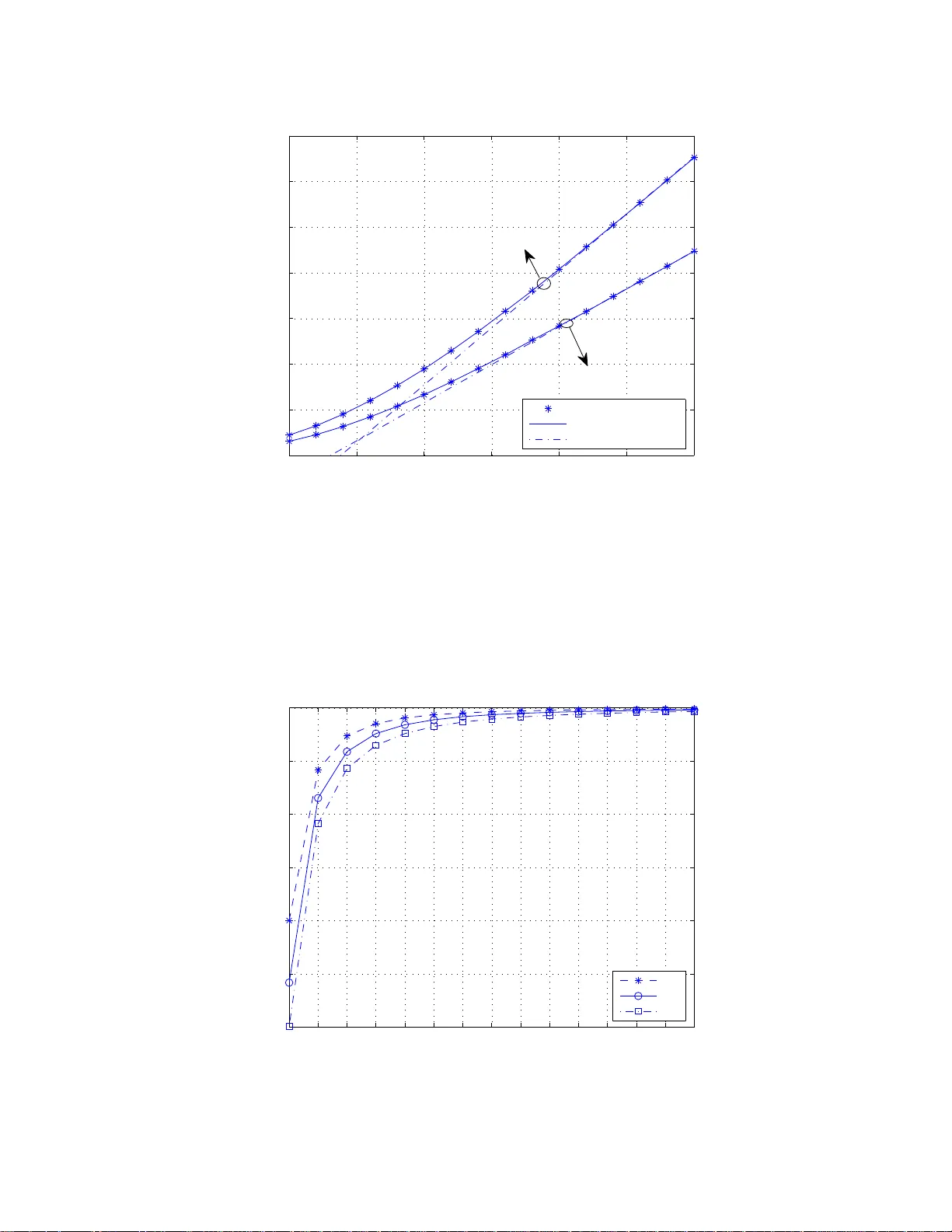
Er godic Capacity Analysis of Amplify-and-F orward MI MO Dual-Hop Systems Shi Jin ∗ ‡ , Matthew R. M cKay † , Caijun Zhon g ∗ , and Kai-Kit W ong ∗ ∗ Adastral Park Research Campus, University College Lo ndon, United King dom † Dept. of Electronic and Compu ter Engineer ing, Hong K ong University of S c ience & T ech nology , Hong K on g ‡ National Mobile Communicatio ns Research Laborator y , Southeast University , Nanjin g, China Abstract This paper presents an analytical ch aracterization of th e ergodic capacity of a mplify-and-f orward (AF) MIMO dual-ho p relay channels, assuming that the cha nnel state inf ormation is avail a ble at the d estination terminal only . In co ntrast to prior results, our expressions apply for arbitr ary numbers o f anten nas and arbitrary relay configur ations. W e deriv e an e xp ression for the e x act ergodic capacity , simplified closed-form expressions for the high SNR regime, and tight closed-form upper and lo wer bou nds. These results are made possible to em ploying recent tools fro m finite-dimensional random matrix the ory to derive ne w closed -form expressions for various statistical prop erties of the equi valent AF MIMO dual-hop relay channel, such as the distribution of an uno rdered eigenv alu e and certain r andom d eterminant p roperties. Based on th e a nalytical capacity expressions, we in vestigate the imp act of the system and ch annel chara cteristics, such a s the antenna co nfiguration and the r elay power gain. W e also de monstrate a numbe r of interesting relationships between the dual-ho p AF MIMO r elay chann el and co n ventional p oint-to-point MIMO channels in various asymptotic regimes. Index T erms Multiple-inp ut m ultiple-output (M IMO), amplify -and-forward ( AF), ergodic capacity . Corresponding Author : Shi Jin Adastral Park Rese arch Campus , Univ ersity College Lo ndon Martlesham Heath, I P 5 3 RE, United Kingdom E-mail: shijin@adastral.ucl.ac.u k, jinshi@seu.edu.c n 1 I . I N T R O D U C T I O N The r e lay chann el, firs t introduced in [1, 2], ha s been considered in rec ent years a s a means to improve the coverage and reliabilit y , and to reduce the inte rf e rence in w ir e less networks [3– 11]. Generally s peaking, there are three main types of relaying protoc ols: d ecode-and-forward (DF), comp ress-and-forward (CF), and amplify-and-forward (AF). Of thes e protocols, the AF a pproach is the simplest scheme , in wh ich cas e the sources transmit messages to the relay s, which then simply scale their receiv e d s ignals according to a power con straint and forward the s caled signa ls onto the destinations. Point-to-point multiple-input multiple-output (MIMO) communication sys tems have also been receiving considerab le attention in the last decad e due to their potential for providing linear c apacity growth and significant performance improvements over conv e ntional s ingle-input single-output (SISO) sy stems [12, 13]. Re cently , the ap plication of MIMO tec hniques in c onjunction with relaying protocols ha s become a topic of increasing interest as a mean s of ac hie ving further performance improvements in wireles s networks [14–18] In this pape r we in vestigate the ergodic ca pacity of AF MIMO dua l- h op s ystems. This problem has been rec ently c onsidered in various settings. In [19], the er god ic c apacity of AF MIM O dual-hop s ystems was e xa mined for a lar g e numbers o f relay anten nas K , and was s ho wn to scale with log K . Asymptotic ergodic capacity results were also obtained in [20] by means of the replica metho d from statistical phys ics. In [21, 22], the asy mptotic ne tw ork cap acity was examined as the number of so urce/desination a ntennas M and relay a ntennas K grew lar ge with a fixed-ratio K/ M → β using tools from large-dimensional random matrix theo ry . It was demons trated that for β → ∞ , the relay network b eha ved e qui valently to a point- to-point MIMO link. Th e re sults of [21, 22] we re further elabo rated in [23] where a ge neral as ymptotic ergodic capacity formula w as presented for mu lt i-level AF relay networks. Recently , the asymptotic mean and variance of the mutual information in correlated Ray leigh fading was s tudied in [24]. All o f these prior c apacity results, h o wever , were deri ved by employing asymptotic me thods (i.e. by letting the system dimensions grow to infinity). T o the bes t of our knowledge, the re appear to b e no ana lytical e r godic capac it y res ults which apply for AF MIMO du al hop systems with arbitrary fi nite a ntenna and relaying configurations . In this p aper we d eri ve new exact a nalytical results, s imple clos ed-form high SNR expre ssions, and tight closed-form upp er an d lower bou nds on the ergodic cap acity o f AF MIMO dua l-hop systems . In contrast to previous res ults, our expressions ap ply for a n y finite number of MIMO anten nas and for arbitrary n umbers of relay anten nas. Th e results are bas ed h ea v il y on the theory of finite-dimension al random matrices. In particular , our exact ergodic capacity results are based on a new exact expression which w e deriv e for the exact unordered eigen value distribution of a certain product of finite-dimensional 2 random ma tri c es, correspo nding to the equiv alent cas caded AF MIMO relay channel. In prior work [22], a n asymptotic express ion was obtained for this unordered eige n value density . Howe ver , that asymp toti c result, which serves as an ap proximation for finite-dimensional syste ms, was rather complicated an d req uired the numerical computation of a certain fi xed-point equa tion. Our result, in contrast, i s a simple exact close d- form expression, in volving only standard functions which can be eas il y an d efficiently e valuated. In addition to t h e unordered eigen value distribution, we also prese nt a nu mber of ne w random determinant properties (such as the expe cted characteristic polynomial) of the equiv ale nt c ascaded AF MIMO relay c hannel. These results are su bsequently employed to de ri ve simplified close d-form express ions for the ergodic c apacity in the high S NR regime, as well as tight u pper and lower boun ds. Again, these ra ndom de termi n ant prope rt ies are exact clos ed-form analytica l results which apply for arbitrary a ntenna a nd relaying config urations, and are expresse d in terms of stand ard functions which a re e asy to comp ute. As a by-prod uct of thes e deriv ations, we also present some ne w unified expres sions for the expected characteristic polynomial and expected log-de terminant of semi-correlated W ishart and pseudo-W ishart ran dom matrices. Based on our analytical expressions, w e in vestigate the e f fect of the dif feren t sys tem and chann el param- eters on the ergodic capac it y . For example, we show that whe n either the numbe r of source, destination, or relay an tennas, or the the relay gain grows large, the AF MIMO dual-hop ca pacity ad mit s a simple interpretation in terms of the er god ic cap acity of co n ventional single-hop s ingle-user MIMO channels. I n the high SNR regime, we present simple closed -f orm expressions for the key p erformance parame ters—t h e high SNR slope an d the h igh SNR power offset—which rev ea l the intuiti ve res ult that the multiplexing gain is determined by the minimum of the number of antenn as at the so urce, de stination, and relay , whereas the power o f fset is a more intricate function which depe nds on all three. For example, we s ho w tha t by adding more antennas at the destination, whilst keep ing the numb er of source an d destination antennas fi x e d, may lead to a significant improvement in the high SNR power offset; howe ver the relativ e gain beco mes less significant as the initial numb er o f destination an tennas is increa sed. Our ana lytical expressions also reveal the interes ti n g result that the ergodic capa city of AF MIMO du al-hop channels is upp er bounded by the capac it y of a SI S O a dditi ve white Gauss ian noise (A WGN) channel. The remainder of this paper is or ganized as follo ws. Sec tion II presents the AF MIMO dual-hop system model under consideration. S ection III presen ts our new random matrix theory contributions, which are subseq uently used to de ri ve t h e exact, high SNR , a nd up per an d lower bo und expression s for the ergodic capac it y in S ections IV an d V. Sec tion VI su mmarizes the main res ults of the paper . All o f the main mathematical proofs h a ve been placed in the Appendices . 3 n s n n r H 1 H 2 Source Relay Des tinatio n d Fig. 1 . Schematic diag ram of a MIMO du al-hop sy stem, whe re the re is no d ir e ct link between s ource and destination. I I . S Y S T E M M O D E L W e employ the s ame AF MIMO dual-hop system mo del as in [21, 22]. In pa rt icu lar , suppose that there are n s source anten nas, n r relay a ntennas and n d destination antennas, w hich we r e present by t he 3 - tup le ( n s , n r , n d ) . All terminals operate in ha lf- du plex mode, a nd as suc h co mmunication occu rs from sou rce to relay and from relay to destination in two sepa rate time slots. It is a ssumed that there is no d ir e ct communication link betwee n the so urce an d d estination, a s sketched in Fig. 1. The end -t o-e nd input-output relation of t h is c hannel is then gi ven by y = H 2 FH 1 s + H 2 Fn n r + n n d (1) where s is the transmit symbol vector , n n r and n n d are the rela y a nd de stination noise vectors respe cti vely , F = p α/ ( n r (1 + ρ )) I n r ( α corresponds to the overall power gain of the relay te rmi na l) is the forwarding matrix at the relay terminal wh ich simply forwards sc aled v e rsions of its received s ignals, and H 1 ∈ C n r × n s and H 2 ∈ C n d × n r denote the c hannel matrices of the first ho p and the second hop respectiv e ly , where their entries a re ass umed to be zero mea n circular sy mmetri c complex Gaus sian (ZMCSCG) rand om variables of unit variance. The inp ut symbols are chose n t o be ind ependent and identically distrib uted (i.i.d.) ZMCSCGs and the pe r antenna power is as sumed to be ρ/n s , i.e., E ss † = ( ρ/n s ) I n s . The add iti ve noise at the relay a nd destination are assu med to b e white in both space and ti me and are mode led as ZMCSCG with unit variance, i.e ., E n n n r n † n r o = I n r and E n n n d n † n d o = I n d . W e assume that the source and relay have no c hannel state information (CSI), and that the de stination has perfect k no wledg e of both H 2 and H 2 H 1 . The ergodic capacity (i n b/s/Hz) of the AF MIMO dual-hop system des cribed ab ov e can be wri tten as [20–22] C = 1 2 E log 2 det I + R s R − 1 n (2) 4 where R s and R n are n d × n d matrices gi ven by R s = ρa n s H 2 H 1 H † 1 H † 2 (3) and R n = I n d + a H 2 H † 2 (4) respectively , wit h a = α n r (1 + ρ ) . (5) Using the identity det ( I + AB ) = det ( I + BA ) , (6) (2) can be alternatively expresse d as foll ows C ( ρ ) = 1 2 E log 2 det I n s + ρa n s H † 1 H † 2 R − 1 n H 2 H 1 . (7) Next, we utilize the singular v alue decompos it ion to wri te H 2 = U 2 D 2 V † 2 , where D 2 = diag λ 1 , . . . , λ min( n d ,n r ) (8) is an n d × n r diagonal matrix, with diag onal elements pe rtaining to the increasing ordered s ingular values, and U 2 ∈ C n d × n d and V 2 ∈ C n r × n r are u nitary matrices containing the respectiv e eigen vectors. Since H 1 is in variant under left and right unitary transformation, the ergodic capacity in (7) ca n b e further simplified as C ( ρ ) = 1 2 E log 2 det I n r + ρa n s H † 1 ΨH 1 (9) where Ψ = diag n λ 2 1 1+ aλ 2 1 , . . . , λ 2 n r 1+ aλ 2 n r o , n r ≤ n d , diag λ 2 1 1+ aλ 2 1 , . . . , λ 2 n d 1+ aλ 2 n d , 0 , . . . , 0 | {z } n r − n d , n r > n d . (10) It is then e asily es tablished that C ( ρ ) = 1 2 E log 2 det I n s + ρa n s ˜ H † 1 L ˜ H 1 (11) 5 where ˜ H † 1 ∼ C N n s ,q ( 0 , I n s ⊗ I q ) , with q = min ( n d , n r ) , and L = d iag λ 2 i / 1 + aλ 2 i q i =1 . (12) Equiv alently , we c an now wri te C ( ρ ) = s 2 Z ∞ 0 log 2 1 + ρa n s λ f λ ( λ ) dλ (13) where s = min ( n s , q ) , λ denotes an un ordered eigenv alue of the ran dom matrix ˜ H † 1 L ˜ H 1 , an d f λ ( · ) denotes the correspon ding proba bili ty density fun ction (p.d .f.). Although the distributi on o f λ ha s b een well-studied in the asymptotic an tenna regime [21, 22], currently there are no exact closed -f orm expres sions for f λ ( · ) which apply for arbitrary finite-antenna systems. I I I . N E W R A N D O M M A T R I X T H E O RY R E S U L T S In this se ction, we deri ve a new exact c losed-form express ion for the unordered eigenv alue d istr ibution f λ ( · ) of the random matrix ˜ H † 1 L ˜ H 1 . W e also present a number of other key results, such a s random determinant properties, which will prove use ful in subseq uent de ri vations. It is conv en ient to defi ne the follo wing notation: α i = λ 2 i , β i = λ 2 i / 1 + aλ 2 i ( i = 1 , . . . , q ) , and p = max ( n d , n r ) . T o derive the unordered eigen value distributi on f λ ( · ) , we fi rst need to estab li s h some key p reli mina ry results, as gi ven belo w . Lemma 1: The mar ginal p.d.f. o f an un ordered e igen value λ of ˜ H † 1 L ˜ H 1 , co nditioned on L , is given by f λ | L ( λ ) = 1 s Q q i q res pecti vely; the latt e r case 1 being a complicated expression in terms of d eterminants with en tr ies depen ding on the in verse of a certain V ande rmonde matrix. Here, Le mma 1 presents a s impler and more c omputationally-ef ficie nt un ified expression, which applies for arbitr a ry n s and q . T o remove the conditioning on L in Lemma 1 , it is nece ssary to establish a closed-form expres sion for 1 For this case ( n s > q ), the random matrix ˜ H † 1 L ˜ H 1 has reduced rank and the corresponding distribution, conditione d on L , is commonly referred to as pseudo -W ishart [26]. 6 the joint p.d.f. of β 1 , · · · , β q . W e will a lso require the p.d.f. o f an arbitrarily selec ted β ∈ { β 1 , · · · , β q } . These results a re g i ven in the followi n g le mma. Lemma 2: The joint p.d.f. of { 0 ≤ β 1 < · · · < β q ≤ 1 /a } i s given by f ( β 1 , . . . , β q ) = K q Y i q − n s . (26) Pr oof: See Ap pendix I-D. This theorem presents a new expression for the expec ted characteristic polynomial of a complex semi- correlated cen tr a l W isha rt ma tr ix. In prior work [31, 32 ], a lt e rnati ve expressions were obtained via a dif fer- ent ap proach (i.e. by exploiting a classical cha racteristic p olynomial expansion for the determinan t) . Those results, howev er , in volved summations over subsets of numbers, with each term in volving d eterminants of partitioned matrices. In contrast, our result in Le mma 1 is more computa ti o nally-ef ficient, in volving only a single determinant with s imple en tri e s. Moreover , it is more amenab le to the further an alysis in this paper , leading to the following i mp ortant the orem. 2 When q < n s , { ∆ } m,n = β n − 1 m “ 1 + ρa n s β m ( n s − q + n ) ” . 10 Theorem 2: Th e unc onditional expe cted determinant of I n s + ( ρa/n s ) ˜ H † 1 L ˜ H 1 is gi ven by E det I n s + ρa n s ˜ H † 1 L ˜ H 1 = K det ¯ Ξ (27) where ¯ Ξ is a q × q ma tri x with entries ¯ Ξ m,n = a 1 − τ ϑ τ − 1 ( a ) , n ≤ q − n s a 1 − τ ϑ τ − 1 ( a ) + ρ n s ( n s − q + n ) ϑ τ ( a ) , n > q − n s (28) with τ = p − q + m + n , an d ϑ τ ( a ) = Γ ( τ ) U ( τ , p + q , 1 /a ) . (29) Pr oof: Uti lizing L emma 3 , [33, Lemma 2] an d (112) yields the desired res ult. Lemma 4: Let Φ = ˜ H † 1 L ˜ H 1 , q ≥ n s , L ˜ H 1 ˜ H † 1 , q < n s . (30) The expected log-determinant of Φ , conditioned on L , is gi ven by E { ln d et ( Φ ) | L } = s X k =1 ψ ( n s − s + k ) + q P k = q − s +1 det ( Y k ) Q q i 0 for x ∈ [0 , ∞ ) , it is c lear that the high SNR power o f fset L ∞ ( · ) in (58) is a d ecreasing function of k , thereby confirming the intuiti ve n otion tha t adding more antennas to the destination terminal has the ef fect of impro ving the er g odic c apacity . Example 1: W ith resp ect to β = 1 , L ∞ (1 , 1 , 2 ) = L ∞ (1 , 1 , 1 ) − 2 . 58 dB (59) L ∞ (1 , 1 , 3 ) = L ∞ (1 , 1 , 1 ) − 3 . 46 dB (60) L ∞ (1 , 1 , ∞ ) = L ∞ (1 , 1 , 1 ) − 5 . 08 dB (61) where L ∞ (1 , 1 , 1) = 7.57 dB. 4 This conclusion is easily established by noting that d / d x ( g l ( x )) = e x [ E l +1 ( x ) − E l ( x )] , and using [36, Eq. 5.1.17]. 16 0 5 10 15 20 25 30 0 2 4 6 8 10 12 14 SNR, ρ (dB) Ergodic Capacity (bps/Hz) Monte Carlo Exact Analytical High SNR Analytical (3,4,5) (2,4,3) Fig. 5 . Comparison of exact ana lyti c al, high SNR a nalytical, and Monte Carlo s imulati o n results for ergodic capa city of AF MIMO dual-hop systems wi th dif feren t antenna c onfigurations. Results are shown for α/ρ = 2 . 1 2 3 4 5 6 7 8 9 10 11 12 13 14 15 −3 −2.5 −2 −1.5 −1 −0.5 0 n d High SNR Power Offset Shift, δ (n d , k) (dB) k=1 k=2 k=4 Fig. 6 . High SNR power o f fset s hift , in dec ibels, obtaining by a dding either (a) one an tenna to the destination, (b) two an tennas to the destination, or (c) four antennas to the destination. Results are shown for n s = n r = 1 and α/ρ = 2 . 17 Fig. 6 illustrates the relationship in Corollary 5 , where the high SNR p o wer offset shift δ ( n d , k ) is plotted against n d , for k = 1 , k = 2 , and k = 4 . As expected, for a fixed value of k , δ ( n d , k ) is an increas ing function of n d , approac hing a limit of 0 dB as n d → ∞ . T able I and T able II p resent the high SNR power off s et as a function of n d and n r respectively , for n s = 2 . W e see that when n d (resp. n r ) is small, then a s mall increase in n d (resp. n r ) y ields a s ignificant improvement in terms of the high SNR power offset. Howe ver , in agree ment with Fig. 6, adding more and more antennas y ields diminishing returns. 2) L ar ge Source P ower , F ixe d R elay P ower: Here we take ρ → ∞ and keep α fixed. T hen, noting tha t ρa | ρ →∞ → α/n r , the e r godic capacity reduces to lim ρ →∞ C ( ρ ) = s 2 E log 2 1 + α n s n r ˜ λ (62) where ˜ λ denotes an un ordered eigenv alue of ˜ H † 1 ˜ L ˜ H 1 . Using Cor ollary 2 , we can ev alua te this constant as lim ρ →∞ C ( ρ ) = K ln 2 q X l =1 q X k = q − s +1 ¯ G l,k F l,k (63) where F l,k = Z ∞ 0 ln 1 + α n s n r y y ( n s +2 k + p + l − 2 q − 3 ) / 2 K p + l − n s − 1 (2 √ y ) dy . (64) T o ev a luate the remaining integral in (62), we first expres s the logarithm in terms o f the Meijer G-function as [37, Eq. 8. 4.6.5] log 2 1 + α n s n r ˜ λ = 1 ln 2 G 1 , 2 2 , 2 α n s n r ˜ λ 1 , 1 1 , 0 (65) and then app ly the integral relationsh ips [27 , Eq. 7. 821.3] and [27, Eq. 9.31.1]. T his leads to the following closed-form expression for the ergodic capac ity of AF MIMO du al-hop sy stems as the s ource power ρ grows large for fixed relay po wer α , lim ρ →∞ C ( ρ ) = K 2 ln 2 q X l =1 q X k = q − s +1 ¯ G l,k Γ ( n s − q + k ) × G 4 , 1 2 , 4 n s n r α 0 , 1 , k + p + l − q − 1 , n s + k − q , 0 , 0 . (66) This result shows that if we fi x α and take ρ large, then the e r godic c apacity of AF MIMO dua l- ho p systems remains bounded (as a function of α ). This c onfirms the intuitiv e notion that the capacity is restricted by the weakest link in the relay netw ork; in this case, t h e relay-de stination link. 18 0 5 10 15 20 25 30 0 2 4 6 8 10 12 14 SNR, ρ (dB) Ergodic Capacity (bps/Hz) Monte Carlo Exact Analytical Upper Bound Lower Bound (2,4,3) (3,4,5) Fig. 7 . Comparison of b ounds, exact analytical, high SNR ana lyti c al, and Monte Carlo simulation r e sults for ergodic capa city of AF MIMO dual-hop sy stems with dif feren t antenn a confi gurations. Results are shown for α/ρ = 2 . V . T I G H T B O U N D S O N T H E E R G O D I C C A P AC I T Y In order to obtain further simplified clos ed-form results, in this section we deri ve ne w upper and l ower bounds on t h e er godic capacity . A. Upp er Bo und The following the orem presents a new tight upper bound on the e r godic ca pacity of AF MIMO dual-hop systems. Theorem 5: Th e ergodic capacity of AF MIMO dual-hop systems i s upp er boun ded by C ( ρ ) ≤ C U ( ρ ) = 1 2 log 2 K d et( ¯ Ξ ) (67) where ¯ Ξ is defined in (28). Pr oof: Application of Jens en’ s inequ alit y gives 5 C ( ρ ) 6 1 2 log 2 E det I n s + ρa n s ˜ H † 1 L ˜ H 1 . (68) The result no w follo ws by using Theor e m 2 . 5 Note that this inequality has also been applied in the ergodic capacity analysis of single-user single-hop MIMO systems (see eg. [32, 38, 39]). 19 Fig. 7 compares the closed-form upper bound (67) with the exact a nalytical er godic capa city bas ed on (39) and (40), for two diff e rent AF MIMO dua l-hop sys tem c onfigurations. The resu lt s a re shown as a function o f SNR ρ , with α = 2 ρ . W e see that t he closed -f o rm upper boun d is very tight for all SNRs, for both sys tem config urations conside red. Moreover , we s ee that in the l ow SNR regime (e.g. ρ ≈ 5 dB), the upper bound and exac t capacity curves coinc ide. The en suing corollaries prese nt some exa mple scen arios for which the upper b ound (67) reduce s to simplified forms. Cor ollary 6: For the c ase n s → ∞ , C U ( ρ ) becomes lim n s →∞ C U ( ρ ) = 1 2 log 2 K det( ¯ Ξ 1 ) (69) where ¯ Ξ 1 is a q × q matrix with entries ¯ Ξ 1 m,n = a 1 − τ ϑ τ − 1 ( a ) + ρa 1 − τ ϑ τ ( a ) . (70) Pr oof: The proo f is straightforward and is omitted. This result shows that in AF MIMO dual-hop sys tems, whe n the nu mbers of an tennas at bo th the relay and destination remain fixed, the ergodic capa city remains boun ded as the numb er of sou rce antenna s gro ws lar g e. This is in agreement wit h the results i n Se ction IV -A.1. Note that for the scen arios n r → ∞ and n d → ∞ , simplified close d-form results c an also be obtained b y taking the corresponding limits in (69 ) o r , a lt e rnati vely , by using the equiv alent single-hop MIMO capacity relations in (42 ) an d (44), and applying kno wn upper bounds for single-hop MIMO channels in [40]. W e omit these e x pressions here for the sake of bre vity . Cor ollary 7: Let n r = 1 . Then, C U ( ρ ) reduces to C n r =1 U ( ρ ) = 1 2 log 2 1 + ρn d e 1+ ρ α E n d +1 1 + ρ α . (71) When n d → ∞ , C n r =1 U ( ρ ) becomes lim n d →∞ C n r =1 U ( ρ ) = 1 2 log 2 (1 + ρ ) . (72) When α → ∞ , C n r =1 U ( ρ ) becomes lim α →∞ C n r =1 U ( ρ ) = 1 2 log 2 (1 + ρ ) . (73) Pr oof: See Ap pendix II-D. This shows the interesting result tha t, if a s ingle relay antenna i s employed, then when either the numbe r of destination antennas n d or the relay gain α gro ws lar ge, the e r godic capacity is upper bounded by the capac it y of an A WGN SISO channel. 20 Cor ollary 8: In the high SNR r egime, (i.e. as ρ → ∞ ) f o r fix e d relay gain α , C U ( ρ ) becomes lim ρ →∞ C U ( ρ ) = 1 2 log 2 K det( ˜ Ξ ) (74) where ˜ Ξ is a q × q ma tri x with entries n ˜ Ξ o m,n = Γ ( τ − 1) , n ≤ q − n s , Γ ( τ − 1) 1 + α n s n r ( n s − q + n ) ( τ − 1) , n > q − n s . (75) Pr oof: See Ap pendix II-E. This expression is c learly much simpler than the exact er g odic capacity expression giv en for this regime in (66). B. Low er Bo und The following theorem presen ts a new tight lower b ound on the ergodic capa city of AF MIMO dual-hop systems. Theorem 6: Th e ergodic capacity of AF MIMO dual-hop systems i s lower bo unded b y C ( ρ ) ≥ C L ( ρ ) = s 2 log 2 1 + ρa n s exp 1 s s X k =1 ψ ( n s − s + k ) + K q X k = q − s +1 det ( W k ) (76) where W k is defined a s i n (35). Pr oof: See Ap pendix II-F. In F ig. 7, this clos ed-form lo we r bound is comp ared with the exact ergodic capacity of AF MIMO dua l- h op systems. Re sults are shown for dif ferent system co nfigurations. The lower bound is clearly seen to be tight for the entir e rang e of SNRs. Moreover , in t h e high SNR regime ( e .g. ρ ≈ 15 dB), we see t h at the lower bound and e xa ct capac it y curves coincide. The en suing corollaries prese nt some example sce narios for which the lower bound (76) reduc es to simplified forms. Cor ollary 9: For the c ase n s → ∞ , C L ( ρ ) reduces to lim n s →∞ C L ( ρ ) = s 2 log 2 1 + ρa exp K s q X k =1 det ( W k ) !! . (77) Pr oof: See Ap pendix II-G. Again, we no te that for the sce narios n r → ∞ and n d → ∞ , simplified close d-form results can also be obtained b y taking the co rr e sponding limits i n (69) or , alternati vely , by using (42) an d (44), and applying known lower b ounds for single-hop MIMO channels i n [40]. Cor ollary 10: For the case n r = 1 , C L ( ρ ) reduces to C n r =1 L ( ρ ) = 1 2 log 2 1 + ρα n s (1 + ρ ) exp ψ ( n s ) + ψ ( n d ) − e (1+ ρ ) /α n d − 1 X l =0 E l +1 1 + ρ α !! . (78) 21 0 5 10 15 20 25 30 0.8 1 1.2 1.4 1.6 1.8 2 Relay Gain, α (dB) Ergodic Capacity (bps/Hz) Exact Analytical Exact Analytical (High α Approx) Lower Bound Lower Bound (High α Approx) Upper Bound Upper Bound (High α Approx) Fig. 8 . Comparison of c apacity bounds, high α approximation, and exact analytical res ults for dif ferent relay gains. Results are shown for n r = 1 , n s = 2 , n d = 4 and ρ = 10dB . When n s → ∞ , C n r =1 L ( ρ ) becomes lim n s →∞ C n r =1 L ( ρ ) = 1 2 log 2 1 + ρα 1 + ρ exp ψ ( n d ) − e (1+ ρ ) /α n d − 1 X l =0 E l +1 1 + ρ α !! . (79) When n d → ∞ , C n r =1 L ( ρ ) becomes lim n d →∞ C n r =1 L ( ρ ) = 1 2 log 2 1 + ρα n s (1 + ρ ) exp ψ ( n s ) + ψ 1 + ρ α . (80) When α → ∞ , C L ( ρ ) becomes lim α →∞ C n r =1 L ( ρ ) = 1 2 log 2 1 + ρ n s exp ( ψ ( n s )) . (81) Pr oof: See Ap pendix II-H. As also o bserved from the up per bound in Coroll a ry 7 , this result shows that for a system with a single relay antenn a, whe n the relay gain α gro ws l a r ge, the er godic ca pacity of an AF MIMO d ual-hop c hannel is lo wer bounded by t h e capacity of an A WGN SISO channel ( with sc aled average SNR). Fig. 8 plots the close d-form upper bound (71), closed-form lo we r bou nd (78 ), and the exac t analytical ergodic c apacity base d on (39) and (40), for an AF MIMO dual-hop system with n r = 1 . The results are presente d as a function of the relay gain α . W e see that both the u pper an d lower bou nds are quite tight for the entire range of α c onsidered. The a symptotic approximations for the u pper and lo we r b ounds, based on (73) and (81) respec ti vely , are also shown for further comparison, and are seen to conv e r ge for 22 0 5 10 15 20 25 30 0 0.2 0.4 0.6 0.8 1 1.2 1.4 1.6 1.8 2 SNR, ρ (dB) Ergodic Capacity (bps/Hz) Exact Analytical Exact Analytical (High SNR Approx) Upper Bound Upper Bound (High SNR Approx) Lower Bound Lower Bound (High SNR Approx) Fig. 9 . Co mparison of capac it y bounds , high SNR app roximations, and exact analytical resu lt s . Results are sho wn for a system co nfiguration (3 , 4 , 2) and α = 2 . moderate v a lues of α (e.g. within α ≈ 20 dB). Cor ollary 11: In the high SNR regime, (i.e. as ρ → ∞ ) for fixed relay gain α , C L ( ρ ) becomes lim ρ →∞ C L ( ρ ) = s 2 log 2 1 + α n r n s exp K s q X k = q − s +1 det ˜ W k , (82) where ˜ W k is a q × q ma tr ix with entries n ˜ W k o m,n = Γ ( τ − 1) , n 6 = k Γ ( τ − 1) [ ψ ( n s − q + n ) + ψ ( τ − 1)] , n = k . (83) Pr oof: See Ap pendix II-I. As for the h igh SNR upper boun d presented in (74), this close d-form l ower bound express ion is s impler than the exact ergodic ca pacity expres sion gi ven for this regime in (66) . Fig. 9 dep icts the closed-form high SNR approximations for the exact er god ic capacity , as well as the respective uppe r and lo wer boun ds, ba sed on (65), (74), and (82) resp ecti vely . For comparison, curves are also p resented for the upper b ound (67), lower bound (76), an d the exact analytical e r godic capa city b ased in (39) and (40). Res ults a re shown for an AF MIMO dual-hop system with c onfiguration (3 , 4 , 2) . Clearly , the analytical high SNR approximations are seen to be very accurate for e ven moderate SNR le vels (e.g. ρ ≈ 20 dB). 23 V I . C O N C L U S I O N S This pape r ha s presented an analytical charac terization of the ergodic capacity of AF MIMO dual-hop relay chan nels un der t h e common assumption that CSI is av ailable at the de stination t e rminal, but not at the relay o r the source terminal. W e de ri ved a new exact expression for the ergodic capac ity , a s well as simplified and i n sightful c losed-form exp ressions for the h igh SNR regime. Simpli fie d closed-form upp er and lo wer bounds were also p resented, which were s ho wn to be tight for all SNRs. The analytical res ults were made poss ible by fi rst employing random matrix theo ry tech niques to de ri ve new expression s for the p. d.f. o f an unordered eigen value, as well as random determinan t results for the eq ui valent AF MIMO dual-hop relay c hannel, described by a ce rtain produ ct of fi nite-dimensional complex random matrices. The analytical r e sults were validated throug h comp arison with numerical simulations. V I I . A C K N O W L E D G E M E N T The authors would like to thank Dr . V enia min I. Morgenshtern for providing the source code use d to generate the asymptotic e igen value distributions in Fig. 4. A P P E N D I X I P RO O F S O F N E W R A N D O M M AT R I X T H E O RY R E S U L T S A. Proof of Lemma 1 T o p ro ve this lemma, it is con venien t to give a separate treatment for the two cas es, q < n s and q ≥ n s . 1) T he q < n s Case: For this c ase, an expression for the p.d.f. f λ | L ( · ) has been given previously as [25] f λ | L ( λ ) = q P l =1 q P k =1 λ n s − q + k − 1 e − λ/β l ˜ D l,k q det ( L ) n s − q +1 Q q i =1 Γ ( n s − i + 1) Q q i
Original Paper
Loading high-quality paper...
Comments & Academic Discussion
Loading comments...
Leave a Comment