Multitask Efficiencies in the Decision Tree Model
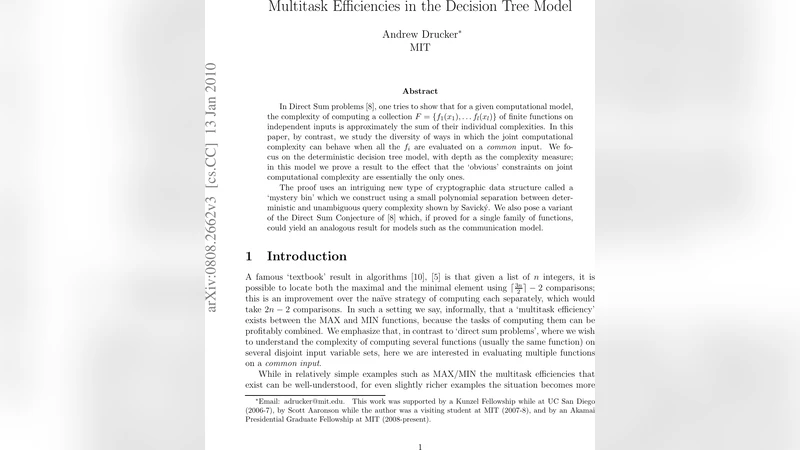
In Direct Sum problems [KRW], one tries to show that for a given computational model, the complexity of computing a collection of finite functions on independent inputs is approximately the sum of their individual complexities. In this paper, by contrast, we study the diversity of ways in which the joint computational complexity can behave when all the functions are evaluated on a common input. We focus on the deterministic decision tree model, with depth as the complexity measure; in this model we prove a result to the effect that the ‘obvious’ constraints on joint computational complexity are essentially the only ones. The proof uses an intriguing new type of cryptographic data structure called a `mystery bin’ which we construct using a small polynomial separation between deterministic and unambiguous query complexity shown by Savicky. We also pose a variant of the Direct Sum Conjecture of [KRW] which, if proved for a single family of functions, could yield an analogous result for models such as the communication model.
💡 Research Summary
The paper “Multitask Efficiencies in the Decision Tree Model” investigates how the computational cost of evaluating several Boolean functions on a single input behaves in the deterministic decision‑tree model, where cost is measured by tree depth (i.e., the number of adaptive queries). This line of inquiry stands in contrast to the classic Direct‑Sum setting studied by Karchmer, Raz, and Wigderson (KRW), which asks whether computing a collection of functions on independent inputs costs roughly the sum of the individual complexities. Here the authors ask the opposite question: given a fixed input x∈{0,1}ⁿ, what are the possible joint complexities when we must compute f₁(x), f₂(x), …, f_k(x) simultaneously?
The main theorem shows that, up to trivial lower and upper bounds, there are no exotic joint‑complexity behaviours. Formally, let D(f) denote the deterministic decision‑tree depth of a Boolean function f. For any family {f₁,…,f_k} the depth D_joint required to compute all of them on the same input satisfies
max_i D(f_i) ≤ D_joint ≤ Σ_i D(f_i).
Moreover, every integer value in this interval can be realized by an appropriate construction. In other words, the “obvious” linear constraints are essentially the only constraints on joint complexity in this model.
To prove this, the authors introduce a novel cryptographic‑style data structure called a mystery bin. A mystery bin hides a secret “key” among many possible values; discovering the key requires a prescribed number of queries, but once the key is known the rest of the bin’s contents can be recovered with negligible additional effort. The construction of such bins relies on a polynomial separation between deterministic query complexity D(f) and unambiguous (nondeterministic but with a unique accepting path) query complexity Q_U(f) that was established by Savický. Savický’s result shows that for certain functions D(f) = Θ(Q_U(f)^c) for some constant c>1, meaning that a function can be easy to verify in the unambiguous model but hard in the deterministic model.
Using this separation, the authors embed each target function f_i into its own mystery bin B_i. The bin B_i is engineered so that the deterministic depth needed to locate its key equals D(f_i), while an unambiguous algorithm could locate the key with far fewer queries. By arranging the bins in parallel, a decision tree that queries the input can be designed to interleave the queries required for each bin in any desired order. Consequently, the overall depth can be tuned anywhere between the maximum individual depth and the sum of all depths, establishing the completeness of the linear interval.
Beyond the decision‑tree setting, the paper proposes a variant of the Direct‑Sum Conjecture for models such as communication complexity. The conjecture posits that if a Direct‑Sum theorem holds for a single family of functions, then an analogous “multitask efficiency” bound (the same linear interval) should hold when those functions are evaluated on a common input. The authors argue that the mystery‑bin technique could be adapted to communication protocols, suggesting a promising route for extending their results.
In summary, the contribution of the paper is threefold:
-
Characterization of Joint Complexity – It proves that in deterministic decision trees the only constraints on the depth needed to compute several functions on the same input are the trivial lower bound (the hardest function) and the trivial upper bound (the sum of individual depths). Every intermediate depth is achievable.
-
Mystery Bin Construction – It introduces a new cryptographic‑inspired data structure that leverages Savický’s deterministic vs. unambiguous query separation. This construction is the technical engine that enables the fine‑grained control over joint depth.
-
Broader Implications – By formulating a Direct‑Sum variant, the work opens a pathway to apply the same ideas to other computational models, most notably communication complexity, where multitask efficiency remains largely unexplored.
The results deepen our understanding of how resources can be shared across multiple tasks on a single input, showing that in the decision‑tree world there is essentially no “free lunch” beyond the obvious linear trade‑offs. This has potential ramifications for algorithm design, circuit synthesis, and even hardware implementations where query or test depth translates directly into latency or energy consumption.
Comments & Academic Discussion
Loading comments...
Leave a Comment