Co-ordinate Interleaved Distributed Space-Time Coding for Two-Antenna-Relays Networks
Distributed space time coding for wireless relay networks when the source, the destination and the relays have multiple antennas have been studied by Jing and Hassibi. In this set-up, the transmit and the receive signals at different antennas of the …
Authors: J. Harshan, B. Sundar Rajan
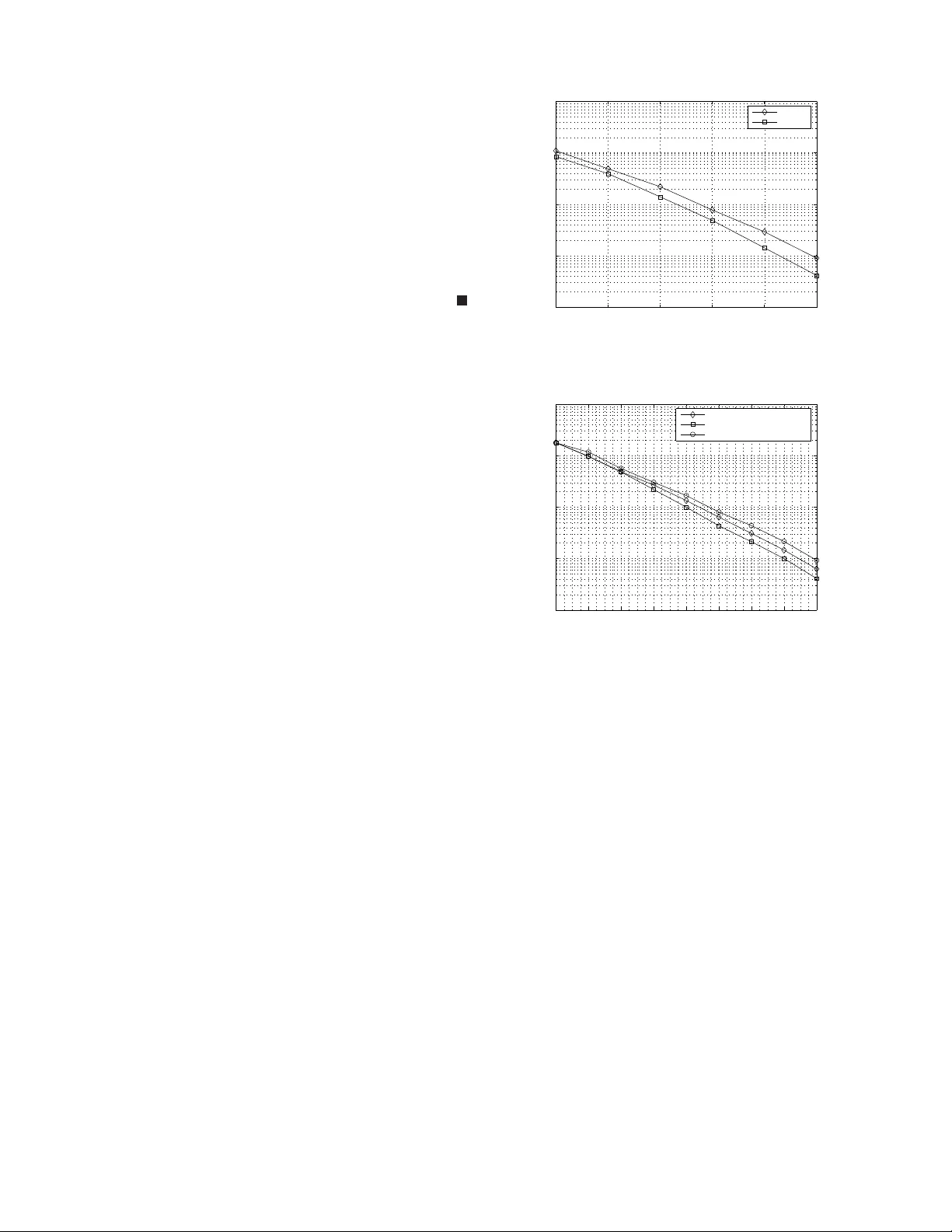
IEEE TRANSACTIONS ON WIRELESS COMMUNICA TIONS , V OL. XX, NO. XX, XXXX 1 Co-ordinate Interlea v ed Distrib ute d Space-T ime Coding for T wo-Ante nna-Relays Networks Harshan J and B. Sundar Rajan, Senior Member , I EEE Abstract —Distributed space time coding for wireless relay networks wh en th e source, the destination and the relays hav e multiple antennas hav e been studied by Jing and Hassibi. In this set-up, the transmit and the receiv e signals at d ifferent antennas of t he same rela y are p roces sed and designed ind ependently , ev en though the anten nas are colocated. In this p aper , a wireless rela y network with single antenna at the so urce and the destination and two antenn as at each of the R relay s is considered. A new class of distributed space time block codes called Co-ordinate Interlea ved Distributed Space-Time Codes (CIDSTC) ar e introduced where, in t he first phase, the sour ce transmits a T -length complex vector to all the r elays and in the second phase, at each re lay , the in- phase and qu adrature co mponent vectors of the receiv ed complex vector s at the two antennas are interlea ved and processed befo re fo rwarding them to the destination. Co mpared to the sch eme proposed by Jing-Hassibi, f or T ≥ 4 R , wh ile providing the same asymptotic diversity order of 2 R , CIDSTC scheme is shown to prov ide asymptotic coding gain with the cost of negligible incr ease in t he processing complexity at the relays. Howev er , for moderate and large values of P , CIDSTC scheme is shown to provide more diversity than that of the sch eme proposed by Jing-Hassibi. CIDSTCs ar e shown to be fully div erse pro vided the i nfor mation symbols take value from an app ropriate multi-dimensional signal set. Index T erm s —Cooperativ e communication, distributed space- time codin g, co-ordinate interlea ving, codin g gain. I . I N T RO D U C T I O N A N D P R E L I M I N A R I E S Co-operative d i versity is proved to be an efficient means of achie ving spatial di versity in wireless networks wit hou t the need o f multiple anten nas at the ind i vidual nodes. In compariso n with sin gle u ser c olocated mu ltiple antenn a trans- mission, co-o perative commun ication is based on the relay channel model wher e a set of distributed antennas belonging to multiple users in the ne twork co-op erate to encode the signal transmitted fro m the source and fo rward it to the destinatio n so that the requir ed diversity o rder is ach iev ed [2], [3], [4], [5]. In [6], the idea of space- time codin g d evised fo r point to point co-located multiple anten na systems is applied for a wireless relay network with single antenn a no des and PEP (Pairwise error probability) of such a scheme w as derived. It is shown th at in a relay network with a single so urce, a single This work w as supported through grants to B.S. Ra jan; partly by the IISc-DRDO program on Adv anced Resea rch in Mathemat ical Engineeri ng, and partly by the Council of Scientific & Industrial Research (CSIR, India) Research Grant (22(0365)/04/EMR- II). The m ateria l in this paper was presente d in parts at the IEEE Global telecommunica tion conference (GLOBECOM 2007), W ashingto n D.C., USA, Nov . 26-30, 2007. Harshan J and B. Sundar Rajan are with the Departmen t of E lectr ical Communi- catio n Engineering, Indian Institut e of Science, Bangalore-5600 12, India. Email: { ha rshan,bsrajan } @e ce.iisc.ernet.in. Manuscript recei v ed August 08, 2007; re vised Novembe r 03, 2007. destination with R sing le antenna relays, distributed space time coding (D STC) ach iev es the d iv ersity of a co located multiple antenna system with R tr ansmit antennas and one receive antenna, asymptotically . Subsequen tly , in [7], th e idea o f [6] is extend ed to relay networks where the source, the destinatio n and the relays have multiple antennas. But, co-oper ation between t he multiple antennas o f each relay is no t u sed, i.e., the coloca tedness of the anten nas is not exploited. Hen ce, a to tal o f R relays eac h with a single antenna is assumed in t he network instead of a total of R antenna s in a smaller numb er of relays. W ith this set up, for a network with M a ntennas at the source, N antennas at the destinatio n and a total o f R antennas at R r elays, for large values of P , the PEP of the network , varies with P as 1 P min ( M ,N ) R if M 6 = N and ( log 1 / M e P ) P ! M R if M = N . In particular, the PEP o f the s cheme in [7] for large P wh en specialized to M = N = 1 with 2 R antennas at relay s is upper-boun ded b y , 32 R T ( ρ ′ ) 2 2 R ( log e ( P )) 2 R P 2 R (1) where ( ρ ′ ) 2 is the minimum singular v alue of ( S − S ′ ) H ( S − S ′ ) where S and S ′ are the two d istinct codewords of a distributed space time block code and P is the total power per chan nel use used by all the relays for transmitting an inf ormation vector . Follo wing the work of [7], construc tions o f distributed space time block codes for network s with multiple antenna nod es are presented in [8], [9]. W e refer co operative diversity schem es in which multiple antennas of a relay do n ot co- operate i.e when th e tr ansmitted vector f rom every antenna is f unction of only the rece i ved vector in that an tenna, or whe n ev ery relay h as only on e antenna as Regular Distributed Space-Time Codin g (RDSTC). The key idea in the pr oposed scheme is the notion of vector coordin ate interleaving defined below: Definition 1: Given tw o com plex v ectors y 1 , y 2 ∈ C T , we define a Coordin ate I nterleaved V ector Pair of y 1 , y 2 , deno ted as CIVP { y 1 , y 2 } to be the pair o f complex vectors { y ′ 1 , y ′ 2 } , where y ′ 1 , y ′ 2 ∈ C T , gi ven by y ′ 1 = Re y 1 + j Im y 2 , y ′ 2 = Re y 2 + j Im y 1 , 2 IEEE TRANSACTIONS ON WIRELE SS COMMUNICA TIONS , VOL. XX, NO. XX, XXXX or equi valently , y ′ 1 = ( y 1 + y ∗ 1 + y 2 − y ∗ 2 ) / 2 , (2) y ′ 2 = ( y 2 + y ∗ 2 + y 1 − y ∗ 1 ) / 2 . (3) The no tion of coo rdinate interleaving of two co mplex v ari- ables has been used in [10] to obtain single-symbo l dec od- able STBCs with h igher rate than the well known complex orthog onal designs. Definition 1 is an extension of the ab ove technique to two com plex vectors. The idea o f vector co- ordinate interlea ving has been used in [1 1] in order to o btain better di versity results in f ast fading MIMO channels. In this paper , we show that mu ltiple a ntennas at the rela ys can be e xploited to improve the perform ance of the network. T ow ards this end , a single a ntenna sou rce an d a single antenna destination with two an tennas at ea ch of the R r elays is considered . Also , the two pha se protocol as in [ 7] is assumed where the first p hase consists of transmission o f a T length complex vector from the source to all the relays ( not to the destination) and the second ph ase consists of transmission of a T len gth complex vector fro m each of the antenn as of the relays to the destination , as shown in Fig.1. The mo dification in the proto col we introd uce is that the two received vectors at the two antenna s of a relay during the first p hase is coordin ate interleaved as defined in Definition 1. The n, m ultiplying the coordin ate interleaved vector with the pr edecided anten na spe- cific T × T unitary m atrices, each antenn a produces a T length vector th at is tran smitted to the destination in the second phase. The collectio n of all such vectors, as columns of a T × 2 R matrix constitutes a codeword matrix and collectio n of all such codeword matrices is referred as coo rdinate interleaved distributed space time code (CIDSTC). Th e co ntributions o f this paper may be summ arized as follows in mo re specific terms: • For T ≥ 4 R , an upp er bound on the PEP of o ur schem e with fully diverse CIDSTC, at large v alues of the total power P is deriv ed. • For T ≥ 2 R, the PEP of th e RDSTC sch eme in [7] with fully diverse DSTBC is upp er b ounded by th e expression giv en in (1). Comparing this bound , with ours, fo r equal number o f 2 R an tennas, a term [ log e ( P )] R appears in th e numerato r of the PEP exp ression of our schem e instead of the term [ log e ( P )] 2 R . This imp rovement in the PEP comes just by vector co-or dinate interleaving at every relay the comp lexity of which is negligible. • I t is shown that CIDSTC schem e pr ovides asymptotic coding gain compare d to the co rrespond ing RDSTC scheme. • CIDST C in variables x 1 , x 2 · · · x T is shown not to pro - vide fu ll diversity if the variables x 1 , x 2 · · · x T take values from any 2-dim ensional signal set. • M ulti-dimension al signal sets are shown to p rovide fu ll div ersity for CIDSTCs whose c hoice dep ends on th e design in use. • T he number o f channel uses needed in the p roposed scheme is at least 4 R where as only 2 R is ne eded in an RDSTC schem e. With T = 4 R fo r both the schemes, throu gh simulation, it is sho wn that CIDSTC g g g 11 21 1i 1R g g 2i g 2R f f f f f f 21 2i 2R 11 1i 1R . . . . . . . . Source Destination Relays Fig. 1. W ireless relay network with tw o-antenna -relays giv es impr oved B ER (Bit Erro r Rate) perfo rmance over that of RDSTC scheme. Notations: Thr ough out the paper, bold face letters and capital boldface letters are used to rep resent vectors and matrices respectively . For a complex matr ix X , the matr ices X ∗ , X T , X H , d et [ X ] , || X || 2 F , Re X and Im X d enote the conjug ate, transpose, co njugate transp ose, determin ant, Frobenio us norm, real p art and imaginar y part of X resp ecti vely . I T and 0 T denotes the T × T identity matrix and the T × T zer o matrix resp ectiv ely . Absolute value o f a co mplex number x , is denoted by | x | an d E [ x ] is used to d enote the exp ectation of the r andom variable x. A circularly symm etric co mplex Gaussian rando m vector x with mean µ and covariance matrix Γ is denoted by x ∼ C G ( µ, Γ ) . The set of all integers an d complex n umbers are den oted b y Z and C respectiv ely an d j is used to denote √ − 1 . Thr ough out the paper log ( . ) refers to lo g e ( . ) . The re maining content of the paper is organized as follows: In Section II, the signal model and a formal d efinition of CIDSTC is given along with an illustrative example. The pairwise er ror p robability (PEP) expression for a CIDSTC is o btained in Section III using which it is shown that (i) CIDSTC scheme g iv es asy mptotic di versity g ain eq ual to the total number of anten nas in the relays and ( ii) offers asymp- totic co ding g ain co mpared to the corr espondin g RDSTCs. Constructions of CIDSTCs along with cond itions on th e fu ll div ersity o f CIDSTCs are provided in Section IV. In Section V, simulation results a re presen ted to illustrate the superiority of CIDSTC schemes. C onclu ding remarks an d possible d irections for further work constitute Section VI. I I . S I G N A L M O D E L The chann el fro m the source node to the i -th antenn a of the j -th relay is denoted as f ij and the chan nel fro m the i -th antenna of the j -th relay to the destination nod e is r epresented by g ij for i = 1 , 2 and j = 1 , 2 , · · · , R as shown in Fig.1. The follo wing a ssumptions ar e made in our system mo del: • All the nodes are subjected to h alf d uplex con straint. • Fading coefficients f ij , g ij are i.i.d C G (0 , 1 ) with co her- ence time interval, T . • All the nodes are synchron ized at the s ymbo l level. HARSHAN and RAJ AN: CO-ORDINA TE INTER LEA VE D DISTRIBUTED SP ACE-TIME CODING FOR TWO-ANTENNA-RELA YS NE TWORKS 3 • De stination kno ws all the fading coefficients f ij , g ij . In the first pha se the so urce transmits a T leng th com plex vector from the codeboo k S = { s 1 , s 2 , s 3 , · · · , s L } con sisting of inf ormation vectors s l ∈ C T such that E s H l s l = 1 f or all l = 1 , · · · , L , so that P 1 is the average tran smit power used at the so urce every chan nel use. When the information vector s is transmitted, the received vector at the i -th antenna of the j -th relay is gi ven by r i,j = p P 1 T f ij s + n ij , i = 1 , 2 and j = 1 , 2 , · · · , R where n ij ∼ C G (0 , I T ) is the additive no ise vector at the i -th antenn a of the j -th relay . In th e second pha se, all the relay n odes are schedu led to transmit T length vectors to the de stination simultaneo usly . In g eneral, the tran smitted signals fro m the different anten nas of the same relay can be design ed as a fu nction of the r eceiv ed signals at both the antenn as of the relay . W e u se one such techniq ue which is very simple; every relay manufactur es a CIVP using the received vectors r 1 j and r 2 j as g i ven in (2) and (3), i.e., r ′ 1 j r ′ 2 j = C IVP { r 1 j , r 2 j } . It is straight fo rward. to verify that E ( r ′ ij ) H ( r ′ ij ) = (1 + P 1 ) T . Each relay is equ ipped with a p air of fixed T × T unitary matrices A 1 j and A 2 j , one for each antenna and process the ab ove CIVP as follows: The 1 st and the 2 nd antennas of the j -th relay ar e scheduled to transmit t 1 j = s P 2 (1 + P 1 ) A 1 j r ′ 1 ,j and t 2 j = s P 2 (1 + P 1 ) A 2 j r ′ 2 ,j (4) respectively . The average power transmitted by each antenna of a rela y per ch annel use is P 2 . Th e vector received at the destination is given by y = R X j =1 ( g 1 j t 1 j + g 2 j t 2 j ) + w (5) where w ∼ C G (0 , I T ) is the additive noise at the destination. Using (4) in (5), y can be written as y = s P 1 P 2 T (1 + P 1 ) Sh + n where • T he additive n oise, n in the above e quiv alent MIM O channel is g i ven by , n = s P 2 (1 + P 1 ) R X j =1 ( g 1 j A 1 j n ′ 1 j + g 2 j A 2 j n ′ 2 j ) + w with n ′ 1 j , n ′ 2 j = CIVP { n 1 j , n 2 j } . Since n ij ∼ C G (0 , I T ) , we have n ′ ij ∼ C G (0 , I T ) . • T he equi valent channel h is giv en b y h = [ d 1 d 2 · · · d R ] T ∈ C 4 R (6) where d j = [ g 1 j k 1 j g 1 j k 2 j g 2 j k 1 j − g 2 j k 2 j ] fo r j = 1 , · · · , R an d k 1 j = ( f 1 j + f 2 j ) / 2 , k 2 j = ( f ∗ 1 j − f ∗ 2 j ) / 2 . • T he T × 4 R matrix, S = [ A 11 s A 11 s ∗ A 21 s A 21 s ∗ . . . A 2 R s A 2 R s ∗ ] is the equ iv alent codeword matrix. Henceforth, by code- word matrix will be mean t only this equ i valent T × 4 R matrix ev en though the transmitted v ectors from the 2 R antennas constitute a T × 2 R matrix. The collection C of codeword matrices shown below when s runs ov er the codeboo k S , C = { [ A 11 s A 11 s ∗ A 21 s A 21 s ∗ . . . A 2 R s A 2 R s ∗ ] } (7 ) will be called the Co- ordinate Interleaved Distrib uted Space- T ime code (CIDSTC). Pr oposition 1: The random v ariables k ij for all i = 1 , 2 and j = 1 , · · · , R. are independent and also k ij ∼ C G (0 , 1 / 2) . Pr oof: Th e p roof is straight forward. Example 1: Consider R = 1 an d T = 4 . Let the r elay specific u nitary matrices A 11 and A 21 be A 11 = 1 0 0 0 0 1 0 0 0 0 1 0 0 0 0 1 ; A 21 = 0 j 0 0 1 0 0 0 0 0 0 j 0 0 1 0 . The equiv alent channel i s h = [ g 11 k 11 g 11 k 21 g 21 k 11 − g 21 k 21 ] T . The CIDSTC is the collection of 4 × 4 matrices gi ven by , C = { [ A 11 s A 11 s ∗ A 21 s A 21 s ∗ ] : s ∈ S } and to be e xplicit, with s = [ x 1 , x 2 , x 3 , x 4 ] T where x 1 , x 2 , x 3 , x 4 are complex variables which may take values from a signal set lik e QAM, PSK etc. C = x 1 x ∗ 1 j x 2 j x ∗ 2 x 2 x ∗ 2 x 1 x ∗ 1 x 3 x ∗ 3 j x 4 j x ∗ 4 x 4 x ∗ 4 x 3 x ∗ 3 . I I I . PA I RW I S E E R RO R P RO B A B I L I T Y Since the relay specific matrice s A ij are unitary , w an d n ′ ij are independen t Gaussian random variables and since g ij are known at the rec ei ver , n is a Gaussian random vecto r with E [ n ] = 0 T and E nn H = 1 + P 2 (1+ P 1 ) P R j =1 ( | g 1 j | 2 + | g 2 j | 2 ) I T . Assume that S is a cod e word in the CIDSTC gi ven in (7). When both k ij and g ij are known, y | S is also a Gaussian random vecto r with E [ y | S ] = q P 1 P 2 T (1+ P 1 ) Sh and E yy H | S = (1 + P 2 (1+ P 1 ) P R j =1 ( | g 1 j | 2 + | g 2 j | 2 )) I T . The maximum likelihoo d (ML) decoding is given by arg min S || y − s P 1 P 2 T (1 + P 1 ) Sh || 2 F . (8) A. Chernoff b ound o n th e PEP . Lemma 1: Assume S , S ′ ∈ C , where C is a CIDSTC. W ith the ML decodin g a s in (8), the proba bility o f decodin g to S ′ 4 IEEE TRANSACTIONS ON WIRELE SS COMMUNICA TIONS , VOL. XX, NO. XX, XXXX when S is transmitted given that k ij , g ij are known at the destination has the following Chern off b ound [6]: P S → S ′ k ij , g ij ) ≤ e − ( P ′ h H U h ) (9) where U = ( S − S ′ ) H ( S − S ′ ) and P ′ = P 1 P 2 T 4(1+ P 1 + P 2 g ) where g = P R j =1 ( | g 1 j | 2 + | g 2 j | 2 ) . W e refer to a CIDSTC as fully diverse if U is a full rank matrix for every codeword pair . Lemma 2: If U is of full rank and the minimu m singular value of U is d enoted by ρ 2 , then the PEP in (9) a veraged over k ij satisfies P S → S ′ g ij ) ≤ R Y j =1 4 1 2 + P ′ ρ 2 g j 2 (10) where g j = | g 1 j | 2 + | g 2 j | 2 . Pr oof: See Append ix A. The power allocation pro blem of ou r mod el is the same as the on e con sidered in [6] with 2 R single an tenna relay s. As intro duced in the resu lt of Lemm a 1, P ′ = P 1 P 2 T 4(1+ P 1 + P 2 g ) where g = P R j =1 ( | g 1 j | 2 + | g 2 j | 2 ) has the gamma d istribution with mean and variance being 2 R . F or very large v alues of R , we can make the appr oximation g ≈ 2 R and hence P ′ = P 1 P 2 T 4(1+ P 1 + P 2 2 R ) . Since for e very cha nnel u se, the po wer used at the source an d every antenn a of a relay a re P 1 and P 2 respectively , total power P is P 1 + 2 RP 2 . Therefore, P ′ = P 1 P 2 T 4(1 + P 1 + P 2 2 R ) ≤ P 2 T 32 R (1 + P ) . Thus, P ′ achieves the ab ove equality whe n P 1 = P 2 and P 2 = P 4 R . Since we have used th e appr oximation g ≈ 2 R , the above power allocation is v alid only for large values of R as in [6]. W ith this optimum p ower allo cation, when P >> 1 , we ha ve ( from [ 6 ]) , P ′ = P 1 P 2 T 4(1 + P 1 + P 2 g ) ≃ P T 8(2 R + g ) . B. Derivation of Diversity or der for Lar ge R The upper-bound on the PEP in (10) needs to be av eraged over g 1 j ’ s and g 2 j ’ s to ob tain the d i versity o rder of the CIDSTC schem e. A simple appro ximate derivation of the div ersity order con sidering large n umber of relays in the network is p resented. When R is large, g ≃ 2 R with high probab ility and P ′ ≃ P T 32 R . Theor em 1: Assume T ≥ 4 R and the CIDSTC is fully div erse. For large to tal tran smit power P , th e pr obability of decodin g to S ′ when S is transmitted is upp er bou nded as P S → S ′ ≤ 64 R T ρ 2 2 R ( log ( P )) R P 2 R . (11) Pr oof: See Append ix B. The term ( log ( P )) R P 2 R in the right hand side of (11) can be written as P − 2 R (1 − log ( log ( P )) 2 log ( P ) ) . Hen ce, the diversity of the wireless relay network with CIDSTC is 2 R 1 − log ( log ( P )) 2 log ( P ) whereas the diversity of the schem e in [7] is 2 R 1 − log ( log ( P )) log ( P ) . Asymptotically , both the expressions 1 − log ( log ( P )) log ( P ) and 1 − log ( log ( P )) 2 log ( P ) can b e taken to be equ al, and hen ce the diversity g ain is approx imately 2 R in both the schemes. Howe ver , for moderate values of P , the secon d term is larger than the first one an d this difference depend s on P. So, our schem e perfo rms better than the one in [7] by an amount that depends on P . The PEP of the schem e in [7] fo r large P whe n spe cialized to M = N = 1 with 2 R antennas at relays is upper-bound ed by (1). Using (1) and (11), the fr actional ch ange in PEP of CIDSTC with r espect the on e in [7] can b e wr itten as 1 − 2 ρ ′ ρ 2 R 1 log ( P ) R ! . (12) For a specified PEP , the following scenarios may occur: The total power , P, required b y the C IDSTC may be smaller than that of the RDSTC o r vice- verse. In the former case, since we have alrea dy shown that the PEP of CIDST C dro ps at a faster rate than RDSTC, the value of P requ ired to achieve a PEP below the specified PEP will be lesser for CIDSTC compared to RDSTC. In the ev ent of th e latter case, from ( 12) we see that, depen ding o n the value of ρ ′ ρ the correspo nding value of P for CIDSTC f or th e specified PEP may be more o r less than that of the value for RDSTC. Howe ver , at large P , ( log ( P )) R dominates the above ratio an d hence the expression in (12) increases with incr ease in P . Upper-bound s on the PEP in (1) and (11) ar e plotted for R = 5 , T = 2 0 , using different values of ρ ′ and ρ in Figure 2, Figure 3 and Figu re 4 ov er s everal values of the total power , P . Figures 2 - 4 p rovide u seful informa tion on th e PEP behavior of RDSTC an d CIDSTC for different values of ρ and ρ ′ . In par ticular , these figu res provide inf ormation on the power lev els beyond which CIDSTC star ts out pe rformin g RDSTCs and the power lev els be low which RDSTCs o utperfo rms CIDSTCs. It is to be noted that the p ower level at which the crossover in the perform ance between the two schem es takes place de pends o n the v alues of ρ and ρ ′ . I t is also inter esting to observe that irrespe cti ve of the values of ρ and ρ ′ , there exists a sufficiently large total power ˆ P such that for P > ˆ P , CIDSTC ou tperform s RDS TC. Howe ver , the plo t shows that for all practical purposes, asymp totic coding g ain provid ed b y CIDSTC is meanin gful o nly fo r th e case whe n ρ ′ < ρ . In Figures 2, 3 and 4, the upper-bou nds on the PEP in (1) and (1 1) are comp ared at lower values of P also. Since th e upper-boun ds on the PEP is deri ved assuming a lar ge value of P , the above plots m ay not provide actual b ehavior of ou r scheme at lower v alues of P , which corresponds to PEP in HARSHAN and RAJ AN: CO-ORDINA TE INTER LEA VE D DISTRIBUTED SP ACE-TIME CODING FOR TWO-ANTENNA-RELA YS NE TWORKS 5 15 20 25 30 35 40 45 50 55 10 −40 10 −35 10 −30 10 −25 10 −20 10 −15 10 −10 10 −5 10 0 P in db PEP RDSTC CIDSTC Fig. 2. PEP comparison : R = 5, T = 20, ρ ′ = 2 , ρ = 1 . 5 10 15 20 25 30 35 40 10 −25 10 −20 10 −15 10 −10 10 −5 10 0 P in db PEP RDSTC CIDSTC Fig. 3. PEP comparison : R = 5, T = 20, ρ ′ = 1 . 5 , ρ = 2 . the r ange of 10 − 1 to 10 − 5 . Plots in the above figur es show that RDSTC outperfo rms CIDSTC at lower values of P f or the cases when ρ ′ > ρ and ρ ′ = ρ , but we cau tion the read er once again to note that these plots may not pr ovide the corr ect informa tion sin ce the derived bound is no longer valid at lower power values. 10 15 20 25 30 35 40 10 −25 10 −20 10 −15 10 −10 10 −5 10 0 P in db PEP RDSTC CIDSTC Fig. 4. PEP comparison : R = 5, T = 20, ρ ′ = 2 , ρ = 2 . C. Receiver complexity of CIDSTC From the results of Th eorem 1, a n ecessary c ondition on the full di versity of CIDSTC is T ≥ 4 R . This implies that the number of complex variables transmitted from the sou rce to r elays in the first pha se is at least twice the total num ber of ante nnas at all the relay s. Therefo re, CIDSTC is a design in at least 4 R complex variables where as a RDSTC for the same setup is a de sign in at least 2 R v ariables. W ith this, the ML decoder for CIDSTC h as to decode at least 4 R complex variables ev ery co dew ord use wher e as the ML deco der o f RDSTC h as to decode at least 2 R symbols every co dew ord use. Thus CIDSTC increases the ML d ecoding comp lexity at the rece i ver ev en thoug h the additional complexity in perfor ming co -ordina te interleaving of symbols at the relays is v ery marginal. I V . O N T H E F U L L D I V E R S I T Y O F C I D S T C In this section, w e provide cond itions on the signal set such that the CIDSTC in variables x 1 , x 2 , · · · x T is fully di verse. First, we show th at CIDSTC in variables x 1 , x 2 , · · · x T is not fu lly diverse if the variables take values fr om any 2- dimensiona l signal set. T owards that end, let X RDSTC be a fully di verse RDSTC for 2 R relay s and T = 4 R gi ven by , X RDSTC = [ A 1 s A 2 s · · · A 2 R s ] 4 R × 2 R where s = [ x 1 , x 2 , · · · x T ] T and x i take values from some 2-dimen sional signal set. Using the above RDSTCs, we can construct a CIDSTC f or R relays each h aving two an tennas by assignin g th e relay matrices of RDSTC to every antenn a of our setup . Th erefore, CIDST C is of the f orm, X CIDSTC = [ A 11 s A 11 s ∗ A 21 s A 21 s ∗ · · · A 2 R s A 2 R s ∗ ] 4 R × 4 R where s ∗ = [ x ∗ 1 , x ∗ 2 , · · · x ∗ T ] T . By permu ting the colu mns, X CIDSTC can be written as, X CIDSTC = h X RDSTC X ′ RDSTC i (13) where, X ′ RDSTC = [ A 1 s ∗ A 2 s ∗ · · · A 2 R s ∗ ] 4 R × 2 R . From (1 3), every codeword S of X CIDSTC is of the form S = [ S 1 S 2 ] where S 1 ∈ X RDSTC and S 2 ∈ X ′ RDSTC . From Section III, a C IDSTC, C is said to be fully di verse if ∆ S = S − S ′ is full ran k, fo r every S , S ′ ∈ C , such that S 6 = S ′ . The dif ference matr ix o f tw o codew ords is giv en by , ∆ S = [∆ S 1 ∆ S 2 ] . (14) where ∆ S 1 = S 1 − S ′ 1 and S 1 , S ′ 1 ∈ X RDSTC such that S 1 6 = S ′ 1 . Also, ∆ S 2 = S 2 − S ′ 2 and S 2 , S ′ 2 ∈ X ′ RDSTC such that S 2 6 = S ′ 2 . Since X ′ RDSTC and X RDSTC are fully div erse, ∆ S 1 and ∆ S 2 are full ran k. ∆ S 1 = [ A 1 (∆ s ) A 2 (∆ s ) · · · A 2 R (∆ s )] 4 R × 2 R . (15) ∆ S 2 = [ A 1 (∆ s ) ∗ A 2 (∆ s ) ∗ · · · A 2 R (∆ s ) ∗ ] 4 R × 2 R (16) 6 IEEE TRANSACTIONS ON WIRELE SS COMMUNICA TIONS , VOL. XX, NO. XX, XXXX where ∆ s = [∆ x 1 , ∆ x 2 , · · · ∆ x 4 R ] T . The following p roposition shows th at ∆ S is not full rank even if ∆ S 1 and ∆ S 2 are full ran k. Pr oposition 2: If variables x i ’ s take value from a 2- dimensiona l signal set, then CIDSTC is no t fu lly di verse. Pr oof: Sup pose comp lex variables x i ’ s take value fr om any 2-dime nsional signal set, then ∆ s can p ossibly take values such that ∆ x 1 = ∆ x 2 · · · = ∆ x 4 R ∈ C . Since ∆ S 1 , ∆ S 2 ∈ C 4 R × 2 R , som e of the rows of ∆ S 1 are linear ly depen dent. Also, id entical rows of ∆ S 2 will also b e linearly depen dent. Therefo re, ∆ S 1 and ∆ S 2 together make the corresp onding rows of ∆ S lin early dependent. Example 2: For the CIDSTC in Example 1, if ∆ x 1 = ∆ x 2 · · · = ∆ x 4 = ∆ x , then ∆ S is gi ven by , ∆ S = ∆ x ∆ x ∗ j ∆ x j ∆ x ∗ ∆ x ∆ x ∗ ∆ x ∆ x ∗ ∆ x ∆ x ∗ j ∆ x j ∆ x ∗ ∆ x ∆ x ∗ ∆ x ∆ x ∗ It can be ob served that the first and the third r ow o f ∆ S are linearly depend ent and hence CIDSTC in Example 1 is not fully di verse. From the results o f the Proposition 2, full div ersity of CIDSTC can be obtain ed by making the real v ariables x iI , x iQ for i = 1 , 2 , · · · T take values f rom a n approp riate multi- dimensiona l signal set. In particular, th e signal set n eeds to be chosen su ch that such that ∆ S is full ra nk fo r every pair of co dew ords. The d eterminant o f ∆ S will be a poly nomial in variables ∆ x iI , ∆ x iQ for i = 1 , 2 , · · · T . Ther efore, a signal set has to be chosen to make determ inant of ∆ S no n-zero for ev ery pair of codewords. A particular choice of the signal set depend s on the design in use. Howe ver , it is to be noted that, more than o ne multi d imensional signal set can provide full div ersity f or a given design. In the rest of this section, we pr ovide a multi-dim ensional signal set, Λ for th e CIDSTC, C in Examp le 1 such that, when the v ariables x 1 I , x 1 Q , · · · x 4 I , x 4 Q take values from Λ , the C IDSTC is fully diverse. T owards that direction, real and imaginary comp onents of det [∆ S ] f or any pair of co dew ords is gi ven in (17) and (18) respectiv ely . Full di versity fo r the code in Exam ple 1 can be obtain ed by using a signa l set which is car ved out of a ro tated Z 8 lattice such that eithe r the real or the imaginary com ponen ts o f det [∆ S ] is non zer o for a ny pair of codewords [16 ]. In gener al, the variable z i ’ s of the vector z = [ z 1 , z 2 · · · z 8 ] T ∈ Z 8 can take values fro m Ξ say , a M - P AM set wh ere M is any na tural number . The 8 -dim ensional real vector z is ro tated using th e generato r , G of a rotated Z 8 lattice to generate a lattice point l = [ x 1 I x 1 Q · · · x 4 I x 4 Q ] as l = Gz using which a complex vector [ x 1 x 2 x 3 x 4 ] is tra nsmitted to all the relays. The signal set Λ is iden tified using com puter search as ( G , Ξ) . As an example, z i ’ s is allowed to take v alues fr om Ξ = { 1 , − 1 } a nd the generator of the lattice, G is found to be in (19). The matrix G in (19) is obtaine d usin g computer search. Throu gh simulations, it h as been verified th at if the vector [ x 1 I x 1 Q · · · x 4 I x 4 Q ] takes value fro m the ab ove signal set ( G , Ξ) , then the d eterminan t of ∆ S is non zero f or any pair of code words of C and hence C is f ully d iv erse. In general, 20 22 24 26 28 30 10 −5 10 −4 10 −3 10 −2 10 −1 P in db BER RDSTC CIDSTC Fig. 5. BER comparison of CIDSTC with RDSTC for R = 2 and T = 8. 20 22 24 26 28 30 32 34 36 10 −5 10 −4 10 −3 10 −2 10 −1 P in db BER structured RDSTC CIDSTC RDSTC with Random coding Fig. 6. BER comparison of CIDSTC with RDSTC for R = 1 and T = 4. for CIDSTCs of any dime nsion, approp riate sig nal sets needs to b e designed so as to ma ke the code fully diverse. V . S I M U L AT I O N S In this section, we provide simu lation results for the per - forman ce comparison of CIDSTC and RDSTC for a wireless network with two relay no des (Figure 5) and a single rela y node (Figure 6). Optimal power allocation strategy discussed in Subsection III-A has been used in our simulation setup though the strategy is not optimal for smaller v alues of R . Even though the power allocation used is not optima l, CIDSTCs are found to p erform be tter than their cor respondin g RDSTCs. W e ha ve used the Bit Error Rate (BER) which correspon ds to errors in decoding every bit as erro r ev ents of interest. For the network with 2 relays, since we need T ≥ 4 R , for CIDSTC, we use th e channel cohe rence time of T = 8 channel use for both th e schemes. The real an d imaginary parts o f informatio n sym bols are chosen equip robably f rom a 2- P AM signal set { − 1 , 1 } and are appro priately scaled to m aintain the unit nor m condition. Simulations are carried ou t using the linear designs in variables x 1 , x 2 · · · x 8 as given in (20) and (21) for RDSTC and CIDSTC respectively . It can be verified that design in (21) is of the required for m given in (7). HARSHAN and RAJ AN: CO-ORDINA TE INTER LEA VE D DISTRIBUTED SP ACE-TIME CODING FOR TWO-ANTENNA-RELA YS NE TWORKS 7 Re det [∆ S ] = 4 (∆ x 1 I ∆ x 3 Q − ∆ x 1 Q ∆ x 3 I ) 2 − 4 (∆ x 2 Q ∆ x 4 I − ∆ x 2 I ∆ x 4 Q ) 2 and (17) Im det [∆ S ] = − 4 (∆ x 1 I ∆ x 4 Q − ∆ x 1 Q ∆ x 4 I ) 2 − 4 (∆ x 2 I ∆ x 3 Q − ∆ x 3 I ∆ x 2 Q ) 2 +8 (∆ x 1 I ∆ x 2 Q − ∆ x 1 Q ∆ x 2 I ) (∆ x 3 I ∆ x 4 Q − ∆ x 3 Q ∆ x 4 I ) . (18) G = 2 6 6 6 6 6 6 6 6 4 − 0 . 4081 0 . 4726 0 . 1809 − 0 . 3955 − 0 . 1556 − 0 . 2860 − 0 . 2408 0 . 5070 − 0 . 3256 − 0 . 0526 − 0 . 6611 0 . 3368 − 0 . 5730 − 0 . 0934 − 0 . 0510 0 . 0329 − 0 . 3481 0 . 0745 0 . 1031 0 . 330 3 0 . 2050 0 . 0771 0 . 7672 0 . 3421 − 0 . 3844 − 0 . 0969 − 0 . 2606 − 0 . 6933 0 . 0365 0 . 207 4 0 . 3121 − 0 . 3905 − 0 . 3905 − 0 . 1319 0 . 6135 0 . 1962 − 0 . 3501 − 0 . 2271 0 . 0040 − 0 . 4909 − 0 . 3832 − 0 . 0759 0 . 1271 0 . 1629 0 . 089 2 0 . 7841 − 0 . 4096 0 . 1193 − 0 . 2931 0 . 4104 − 0 . 2385 0 . 2690 0 . 599 9 − 0 . 2462 − 0 . 2212 − 0 . 3834 − 0 . 2710 − 0 . 7532 − 0 . 0468 − 0 . 0540 0 . 3372 − 0 . 3654 − 0 . 1917 0 . 2649 3 7 7 7 7 7 7 7 7 5 . (19) The d esign in (20) is four g roup de codable, i.e., the variables can be p artitioned into f our gro ups and th e ML decodin g can be carried out fo r each group o f variables indepen dently of the v ariables in the gr oups and th e variables of each g roups need to be jointly decoded [14]. The cor respondin g f our group s of real variables are, { x 1 I , x 4 Q , x 5 I , x 8 Q } , { x 1 Q , x 4 I , x 5 Q , x 8 I } , { x 2 I , x 3 Q , x 6 I , x 7 Q } , { x 3 I , x 2 Q , x 7 I , x 6 Q } . W e u se sphere decod ing algorith m for ML decod ing [1 5]. Thou gh the design in (20) is four g roup decodab le, the design in ( 21) is no t f our group ML deco dable. Full diversity is obtain ed by making e very grou p of real variables choose values from a r otated Z 4 lattice constellation [16] whose g enerator g i ven by , G = − 0 . 431 6 − 0 . 2863 0 . 5 857 − 0 . 6234 − 0 . 685 6 − 0 . 4520 − 0 . 544 5 0 . 1707 − 0 . 447 9 0 . 8285 − 0 . 206 8 − 0 . 2647 − 0 . 378 2 0 . 1649 0 . 5 636 0 . 7157 . 2 6 6 6 6 6 6 6 6 4 x 1 x ∗ 4 x 5 x ∗ 8 x 2 x ∗ 3 x 6 x ∗ 7 x ∗ 3 − x 2 x ∗ 7 − x 6 − x ∗ 4 x 1 − x ∗ 8 x 5 x 5 x ∗ 8 x 1 x ∗ 4 x 6 x ∗ 7 x 2 x ∗ 3 x ∗ 7 − x 6 x ∗ 3 − x 2 − x ∗ 8 x 5 − x ∗ 4 x 1 3 7 7 7 7 7 7 7 7 5 (20) 2 6 6 6 6 6 6 6 6 4 x 1 x ∗ 1 x ∗ 4 x 4 x 5 x ∗ 5 x ∗ 8 x 8 x 2 x ∗ 2 x ∗ 3 x 3 x 6 x ∗ 6 x ∗ 7 x 7 x ∗ 3 x 3 − x 2 − x ∗ 2 x ∗ 7 x 7 − x 6 − x ∗ 6 − x ∗ 4 − x 4 x 1 x ∗ 1 − x ∗ 8 − x 8 x 5 x ∗ 5 x 5 x ∗ 5 x ∗ 8 x 8 x 1 x ∗ 1 x ∗ 4 x 4 x 6 x ∗ 6 x ∗ 7 x 7 x 2 x ∗ 2 x ∗ 3 x 3 x ∗ 7 x 7 − x 6 − x ∗ 6 x ∗ 3 x 3 − x 2 − x ∗ 2 − x ∗ 8 − x 8 x 5 x ∗ 5 − x ∗ 4 − x 4 x 1 x ∗ 1 3 7 7 7 7 7 7 7 7 5 (21) BER compar ison of the two sch emes using the above designs is sho wn in Figure 5. The plot sho ws that CIDST C in (2 1) perfor ms be tter than the RDSTC in (2 0) by c lose to 1.5 to 2 db. Simulation results com paring the BER p erforman ce o f CID- STC in Examp le 1 with its co rrespond ing RDSTC is shown in Figure 6. Full diversity is o btained by choo sing a rotated Z 8 lattice co nstellation ( Section IV) whose generator is given by (19). The plot shows the superiority of the d esign in Example 1 over its RDSTC counterp art by 1 db . Simulation results comparin g the BER perfor mance of CIDSTC in Example 1 with RDSTC fro m random coding is also shown in Figure 6 which shows the superior ity of CIDSTC by 1 .75 - 2 db at larger values o f P . V I . D I S C U S S I O N The technique of co -ordin ate interleaved distributed space- time codin g at th e relays was introdu ced for wireless relay networks having R relays each having two antenn as. For T ≥ 4 R , we have shown that CIDSTC provides coding gain comp ared to the schem e when transmit and r eceiv e signals at different anten nas of the same re lay ar e p rocessed indepen dently . This improvement is at the co st of only a marginal add itional comp lexity in processing at the rela ys. Condition on the full diversity o f CIDSTCs is also presented. Some of the po ssible direction s for future work is to extended the above techniqu e to relay networks where the source and the destinatio n no des have m ultiple an tennas. Also, if the relays have mo re than two anten nas then a g eneral linear processing need to be emp loyed in th e pla ce of CIVP and new perfo rmance bo unds n eed to be deri ved. A P P E N D I X A P R O O F O F L E M M A 2 The channel h as given in (6) can b e written as th e pr oduct Gk of G and k whe re G = d iag { g 11 , g 11 , g 21 , g 21 , g 12 , . . . , g 1 R , g 1 R , g 2 R , g 2 R } and k = [ k 11 , k 21 , k 11 , − k 21 , k 12 . . . , k 1 R , k 2 R , k 1 R , − k 2 R ] T . Since U is H ermitian and positive definite, we can write U = V H DV , where D is diago nal matrix containin g the eigen values of U , in (9). Since , U is of full rank, the right hand side of the resulting follo wing PE P e xpression P S → S ′ g ij ) ≤ E e − ( P ′ k H G H V H DVGk ) . can be upper-bound ed by replacing D b y ρ 2 I 4 R , where ρ 2 is the minimum singular value of U . T hen, we have, P ′ ρ 2 k H G H Gk = P R j =1 P ′ ρ 2 g j ( | k 1 j | 2 + | k 2 j | 2 ) 8 IEEE TRANSACTIONS ON WIRELE SS COMMUNICA TIONS , VOL. XX, NO. XX, XXXX where g j = | g 1 j | 2 + | g 2 j | 2 . Since the set of ran dom variables | k ij | 2 are indepen dent (from Proposition 1) and distributed as 2 e − 2 | k ij | 2 , we have, P S → S ′ g ij ) ≤ Q R j =1 Q 2 i =1 E h e − P ′ ρ 2 g j ( | k ij | 2 ) i , and hence P S → S ′ g ij ) ≤ R Y j =1 2 Y i =1 Z ∞ 0 2 e − (2+ P ′ ρ 2 g j ) | k ij | 2 d | k ij | 2 leading to P S → S ′ g ij ) ≤ Q R j =1 4 h 1 2+ P ′ ρ 2 g j i 2 . This completes the proof . A P P E N D I X B P R O O F O F T H E O R E M 1 From (10) we hav e P S → S ′ g ij ) ≤ Q R j =1 4( 1 2+ P ′ ρ 2 g j ) 2 where g j = | g 1 j | 2 + | g 2 j | 2 . Since | g ij | 2 are exponentially d istributed independen t rand om variables, the rando m variable g j = | g 1 j | 2 + | g 2 j | 2 has th e Gamma distrib ution, p ( g j ) = g j e − g j . Since g j are indep endent, we o mit the sub script j and from (10) we get P S → S ′ ≤ h 4 E ( 1 2+ P ′ ρ 2 g ) 2 i R P S → S ′ ≤ " 4 Z ∞ 0 1 2 + P ′ ρ 2 g 2 g e − g dg # R . (22) Let α = P ′ ρ 2 . By change of v ariables in the integral in ( 22) as t = 2 + αg we have P S → S ′ ≤ 4 α 2 e 2 α R Z ∞ 2 1 t e − t α dt − Z ∞ 2 1 t 2 e − t α dt R and further , chang ing − t α to t, P S → S ′ ≤ 4 α 2 e 2 α R " Z −∞ − 2 α 1 t e t dt + 2 α Z −∞ − 2 α 1 t 2 e t dt # R . (23) Using the chain rule o f integration , f or any integer m we can write the recu rsi ve relation , Z −∞ − 2 α 1 t m +1 e t dt = 1 m " Z −∞ − 2 α 1 t m e t dt + α 2 m ( − 1) m # . Z −∞ − 2 α 1 t 2 e t dt = " Z −∞ − 2 α 1 t e t dt − α 2 # . (24) Applying (24) in (23), we have P ` S → S ′ ´ ≤ » 4 α 2 e 2 α – R " Z −∞ − 2 α 1 t e t dt + 2 α " Z −∞ − 2 α 1 t e t dt − α 2 ## R . ≤ 4 α 2 e 2 α R " Z −∞ − 2 α 1 t e t dt + 2 α Z −∞ − 2 α 1 t e t dt − 1 # R . (2 5) W e know tha t − E i ( − 2 α ) = Z −∞ − 2 α 1 t e t dt is the expon ential integral fu nction [ 13], [6 ]. As in [6 ], for large P , − E i ( − 2 α ) = − E i ( − 64 R P T ρ 2 ) = log ( P ) + O (1) ≃ log ( P ) and e 2 α ≃ 1 . Hen ce, (25) can be written as P S → S ′ ≤ 64 R P T ρ 2 2 R log ( P ) + 64 R P T ρ 2 log ( P ) − 1 R ≤ 64 R P T ρ 2 2 R ( log ( P )) R 1 + 64 R P T ρ 2 R . (26) Considering the most significant term of P in (26), P S → S ′ ≤ 64 R T ρ 2 2 R ( log ( P )) R P 2 R . (27) This c ompletes the p roof. R E F E R E N C E S [1] Harshan J and B. Sundar Rajan, ”Co-ordinate Int erlea ved Distri buted Space-T ime Codin g for T wo- antenna Rela y Networks, ” in the Procee dings of IEEE GLOBECOM 2007 , W ashington D.C., USA, Nov . 26-30, 2007. [2] A. Sendo naris, E. Erkip, and B. Aazang, “User coope ration div ersity-P art 1:Systems desc ription, ” IEEE T r ans. comm. , vol . 51, pp, 1927-1938, Nov 2003. [3] A. Sendo naris, E. Erkip, and B. Aazang, “User coope ration div ersity-P art 2:impleme ntation aspects and performance analysis, ” IEEE T rans. inform theory . , vol . 51, pp. 1939-1948, Nov 2003. [4] J. M. L aneman, G. W . W orne ll, “Distrib uted space time coded protoc ols for expl oiting coop erati ve dive rsity in wire less network” IEEE T rans. Inform. Theory . , vol . 49, pp. 2415-2425, Oct. 2003. [5] R. U. Nabar , H. Bolcskei and F . W . Kneubuhler , “Fa ding rela y channel s: performanc e limits and space time signal design, ” IEE E J ournal on Selec ted Ar eas in Commun ., vol . 22, no. 6, pp. 1099-1109, Aug. 2004. [6] Y indi Jing , Babak Hassibi, ”Distrib uted space time coding in wirel ess relay net works” IEEE T rans W ir eless communicati on, vol. 5, No 12, pp. 3524-3536, Dece mber 2006. [7] Y indi Jing, Babak Hassibi, ”Coopera ti ve div ersity in wireless relay netw orks with multipl e-antenn a nodes” submitted to IEE E T rans Signal pr ocessing , 2006. [8] Frederique Oggier , Babak Hassibi, ”A Coding Scheme for Wire less Networ ks with Multiple Antenna No des and no Cha nnel Informati on”, ICASSP 07 , Haw aii. [9] F . Oggi er , B. Hassibi. ”An Algebraic Codi ng Scheme for Wi reless Rel ay Networ ks with Multiple -Antenna Nodes” , submitted to IEEE T ran s Signal pr ocessing , 2006. [10] Zafar Ali Khan, Md., and B. Sundar Rajan, ”Single Symbol Maximum Likel ihood Decodable Linear STBCs”, IEEE T rans. on Info.The ory , vol. 52, No. 5, pp.2062-209 1, May 2006. [11] J.Wu and S.Blostein, ”Space-ti me line ar dispersion using co-ordinate interl eavin g” in the proc of IEEE ISIT 2006. pp. 386-390. [12] S. Y ang and J.-C. Belfiore , ”Di versit y of MIMO Multihop Rela y Chan- nels – Part I: Amplify-a nd-Forwa rd, ” submitte d to IEEE T ransactions on Informatio n Theory , April 2007. Also a va ilable on Arxiv cs.IT/07043969. [13] I.S. Gradshte yn and I. M. Ryzhik, T able of integ rals, seri es and prod- ucts, Academic pr ess, 6th editi on 2000 . HARSHAN and RAJ AN: CO-ORDINA TE INTER LEA VE D DISTRIBUTED SP ACE-TIME CODING FOR TWO-ANTENNA-RELA YS NE TWORKS 9 [14] G. Susinder Rajan and B. Sundar Rajan, “ A Non-ortho gonal distrib uted space-t ime protocol, Part-I: Si gnal model and design crit eria and Pa rt- II: Code construction and DM-G Tra deof f, ” Proceeding s of ITW 2006, Chengdu, China, Oct. 22-26, pp. 385-389 and pp. 488-492, 2006. [15] Emanuele V ite rbo and Joseph Boutros, “Uni versa l lattice code decoder for fading channels” , IEEE T rans. Inform theory . , vol. 45, No. 5, pp.1639- 1642, July 1999. [16] http:// www1.tlc.polit o.it/ ∼ viterbo/rotations/rotations.html . [17] Kiran T , B.Sundar Rajan. ”Dist ribute d Space-time codes with Reduced decodin g comple xity”, ISIT 2006 . Harshan J was born in Karnataka, India. He recei v ed the B.E. degre e from Vi svesv araya T e chnologic al Univ ersity , Karnataka in 2004. He was working with R obert Bosc h (India ) Ltd, India till December 2005. He is currently a Ph.D. student in the Department of Electrical Communicati on Engineeri ng, India n Institute of Science, Bangalore, India. His research interests includ e wireless communicat ion, information theory , space-time coding and coding for multiple acce ss channels and relay channe ls. B. Sundar Rajan (S’84-M’91-SM’98) was born in T a mil Nad u, India. He rec ei ved the B.Sc. de gree in mathematics from Madras Univ ersity , Madras, India, the B.T ec h degree in electr onics from Madras Institut e of T echn ology , Madras, and the M.T ech and Ph.D. degree s in electric al enginee ring from the Indian Institute of T ec hnology , Kanpur , India, in 1979, 1982, 1984, and 1989 respec ti vely . He was a fa culty member with the Departme nt of Electric al Engineeri ng at the India n Institute of T echnolo gy in Delhi, India, from 1990 to 1997. Sinc e 1998, he has been a Professor in the Department of Electric al Communicati on Engineer ing at the Indian Institute of Science, Bang alore, India. His primary research intere sts include s pace-t ime coding for MIMO c hannels, distribu ted s pace- time coding and coope rati ve communica tion, coding for multipl e-acce ss an d relay channe ls, with emphasis on algebr aic techniques. Dr . Rajan is an Associa te Editor of the IE EE T ransaction s on Informati on Theory , an E ditor of the IEEE Transact ions on W ireless Communic ations, and an Edito rial Board Member of Internationa l Journal of Informatio n and Coding Theory . He served as T e chnical Program Co-Chair of the IEE E Information Theory W orkshop (ITW’02), held in Bangalore , in 2002. He is a Fellow of Indian National Academy of Engineering and recipien t of the IETE Pune Center’ s S.V .C Aiya A w ard for T el ecom Education in 2004. Also, Dr . Rajan is a Member of the American Mathemat ical Socie ty .
Original Paper
Loading high-quality paper...
Comments & Academic Discussion
Loading comments...
Leave a Comment