Cellular Systems with Full-Duplex Compress-and-Forward Relaying and Cooperative Base Stations
In this paper the advantages provided by multicell processing of signals transmitted by mobile terminals (MTs) which are received via dedicated relay terminals (RTs) are studied. It is assumed that each RT is capable of full-duplex operation and rece…
Authors: Oren Somekh, Osvaldo Simeone, H. Vincent Poor
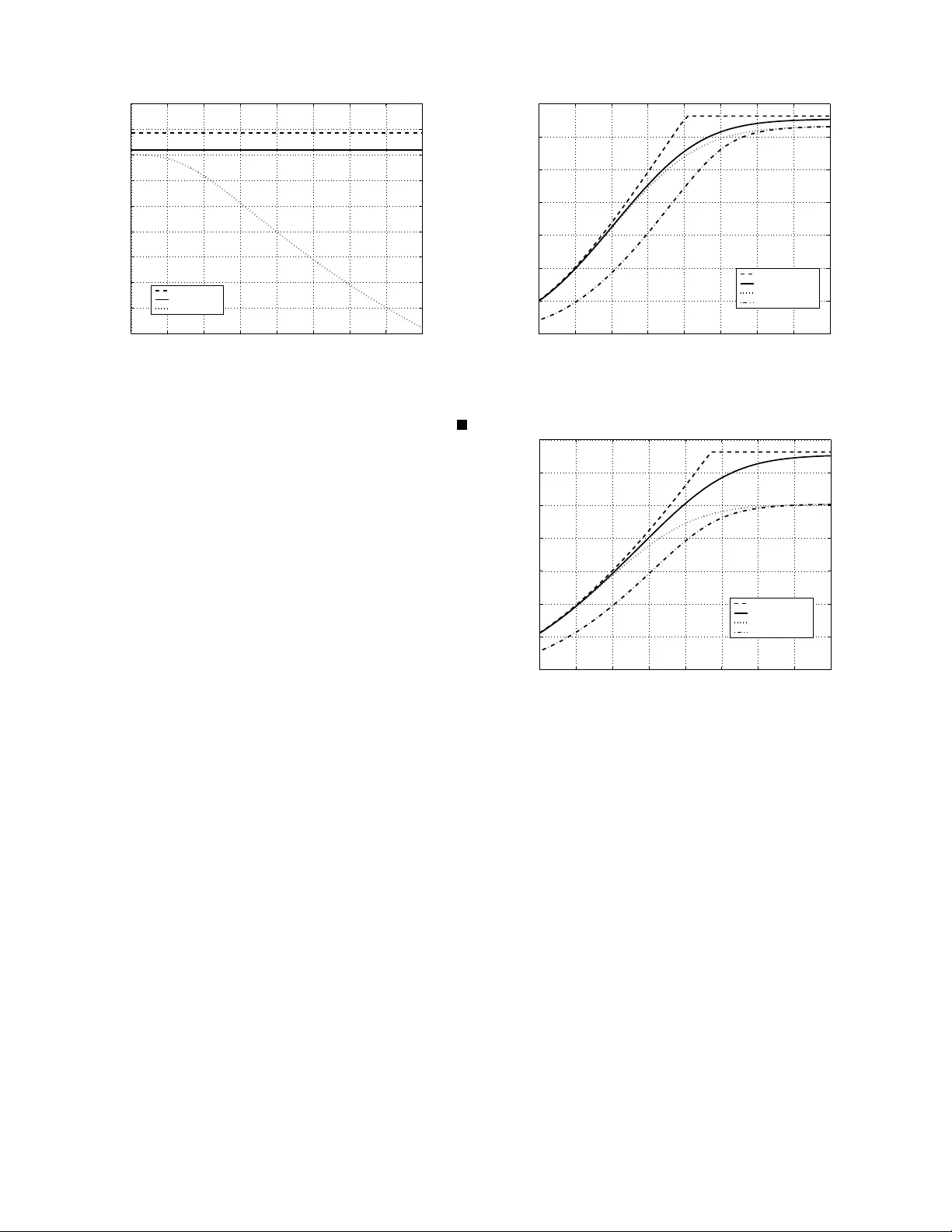
Cellular Systems with Full-Duple x Compress-and-F orwa rd Relaying and Coo perati v e Base Stations Oren Somekh ∗ , Osv aldo Simeone † , H. V incent Poor ∗ , and Shlomo Shamai (Shitz) ‡ ∗ Departmen t of Electrical Eng ineering, Prin ceton University , Pr inceton, NJ 085 44, USA, { orens, poor } @prin ceton.edu † CWCSPR, Department o f Elec trical an d Com puter En gineering , NJIT , Ne wark, NJ 07102 , USA, o svaldo.simeone@njit.edu ‡ Departmen t of Electrical Eng ineering, T echnion, Haifa 32 000, Israel, sshlomo @ee.technion .ac.il Abstract — In this paper the advantages pro vided by mul- ticell processing of signals transmitted by mobile terminals (MTs) which ar e recei ved via dedicated relay terminals (R Ts) are studied. It is assumed th at each R T is capable of full- duplex operation and receiv es the transmission of adjacent relay term inals. Focusing on intra-cell TDMA and non-fading channels, a simplifi ed r elay-aided uplink cellular model based on a model intro duced by W yner is consid ered. Assuming a nomadic application in whi ch the RTs ar e oblivious to the M Ts’ codebooks, a f orm of distributed compress-and-forwa rd (CF) scheme with d ecoder side infor mation is employ ed. Th e per -cell sum-rate of the CF scheme is derived and is given as a solution of a simple fixed point equ ation. This achieva ble rate rev eals that the CF scheme is able to completely eliminate the in ter -r elay interference, and it approaches a “cut-set-like” upp er bound for strong RTs transmission power . The CF rate is also shown to surpass the rate of an amplify-and-forward scheme via numerical calculations for a wide range of the system parameters. I . I N T RO D U C T I O N T echn iques for providing high data rate services and better coverage in ce llular m obile commun ications are c urrently being investigated by many research g roups. In this pap er , we stu dy the com bination of two cooperatio n-based tec hnolo- gies that are p romising cand idates f or ach ieving such goals, extending p revious work in [1] - [4 ]. The first is relayin g, whereby the signal transmitted by a mob ile terminal (MT) is forwarded by a dedicated relay te rminal (R T) to the intended base station (BS) [ 5]. The secon d tech nology o f interest her e is m ulticell proce ssing (MCP), which allows the BSs to jointly decode the received signals, equ iv alently creating a distributed receiving an tenna arr ay [6]. The perfor mance gain provided by this tech nology within a simp lified cellular mod el was fir st studied in [7] , under the assumption that BSs are connected by an ideal back bone (see [8] for a survey on MCP). Recently , the interplay b etween these two tech nologies has been investigated for amp lify-and -forward (AF) a nd decod e- and-fo rward (DF) protocols in [1][4] and [2][ 3], respectiv ely . The basic f ramework employed in these works is the W yner uplink cellular model i ntrodu ced in [7]. According to the linear variant of this mod el, cells ar e arranged in a linear geometry and on ly adjacent cells interfere with each oth er . Moreover, inter-cell inter ference is described by a single par ameter α ∈ [0 , 1 ] , which defin es th e gain experien ced b y sign als trav e lling to interfered cells. Notwithstanding its simplicity , th is model Cell m Cell m-1 BSs: Cell m+1 RTs: MTs: CP Backhaul: 1 s t L a g 2 n d L a g P S f r a g r e p l a c e m e n t s α α α α β β β γ γ γ µ µ µ µ η η η η Fig. 1. Schemati c diagram. captures the essential stru cture of a cellular system an d it provides insigh t into the sy stem performan ce. In this work we adopt a similar setup to the one presented in [4], in wh ich dedicated fu ll-duplex (FD) R Ts are added to th e ba sic lin ear W yn er u plink c hannel m odel and the signal path between adjacent R T s is consider ed (i.e., inter -r elay interferen ce). W ith coverage extension in mind, we focu s on distant users ha vin g no direct connec tion to the BSs. Assuming a nomadic a pplication in which the R Ts are oblivious to the MTs’ codeboo ks, a form of distributed compr ess-and-fo rward (CF) schem e with decode r side in formation , similar to that of [11], is a nalyzed. It is noted that this sch eme resemb les the si ngle-user multiple-relay CF scheme co nsidered in [9, Thm. 3]. Focusing on a setu p with infinitely large numbe r of cells, the achiev ab le p er-cell sum-r ate of the CF scheme is derived using the method s applied in [10]. The achievable rate, which is gi ven as a solu tion of a simple fixed p oint equ ation, shows that the CF scheme completely eliminates the inter- relay inter ferences. Moreover the rate is shown to app roach a “cut-set-like” u pper bound for strong R Ts transmission power . Finally , the per formanc e of the CF scheme is co mpared numerically with the p erform ance of an AF scheme, recently reported in [4], revealing th e superiority of th e CF scheme for a wide ran ge o f the system parameters. I I . S Y S T E M M O D E L W e c onsider the up link of a cellu lar system with a dedicated R T for each tr ansmitting MT . W e focus on a scenar io with no fading and ad opt a circu lar version of the linear cellular up link channel presented by W yner [7]. R Ts are add ed to th e basic W yner model fo llowing the analysis in [4] (see Fig. 1 fo r a schematic diag ram of a single ce ll within the setup and its inter-cell interaction ). The system includes M iden tical cells arr anged on a circle, with a single MT active in eac h ce ll at a given time (intr a- cell TDMA protoco l), and a dedicated single R T to relay the signals from the MT to the BS ( there is no dir ect con nection between MTs a nd BSs). Ac cording ly , each R T receives the signals o f the lo cal MT , the two adjacent MTs, and the two ad jacent R Ts, with ch annel power g ains β 2 , α 2 , and µ 2 respectively . Likewis e, each BS rec ei ves the sig nals of the local R T , and the two adjacent R Ts, with channel power gains η 2 and γ 2 respectively . The r eceiv e d signals at the R Ts and BSs are affected by i.i.d. zero-mean complex Gaussian additi ve noise processes with powers σ 2 1 and σ 2 2 , respecti vely . It is assumed that th e MTs use indep endent r andomly gener ated complex Gaussian co deboo ks with zero-m ean and power P , whereas the R T s are subjected to an average tran smit power constraint Q . Th e R Ts are assum ed to be o blivious of th e MTs codebo oks (nomad ic a pplication), an d that no coop eration among MTs is allowed. In add ition, the R Ts ar e assumed to be capa ble o f recei ving an d transmitting simultaneo usly (i.e., perfect echo-can cellation). It is noted that the propag ation delays between the different nodes of the system a re negligible with re spect to the symb ol du ration. Fin ally , it is assumed that the BSs are connec ted to a centr al processor (CP) via an ideal backhau l network, and th at the channe l path gain s and noise powers are known to the BSs, MTs, and CP . I I I . P R E L I M I N A R I E S A. W yner’s Model - Sum- Rate Capac ities Putting aside th e inter-relay interferen ce paths a nd the lac k of joint M CP among th e R Ts, the mesh n etwork of Fig. 1 is composed o f two W yn er mod els (or two “ W yner lags”) [7]. The close r elations of th e curren t setup an d the W y ner mo del renders th e following definitions usef ul in the sequel. The per-cell sum-rate cap acity of the linea r (or circ ular) W yner uplink chann el with infinitely large nu mber of ce lls ( M → ∞ ), no u ser co operation , optimal MCP , signal- to-noise ratio ( SNR) ρ , inter-cell inter ference factor a (e.g . α or η in Fig. 1 ), an d local path g ain b (e.g. β or γ in Fig. 1), is gi ven by [7] R w ( a, b, ρ ) = Z 1 0 log 2 ` 1 + ρH ( f ) 2 ´ d f . (1) where H ( f ) = b + 2 a cos 2 π f . Wh en tr ansmitter fu ll coo p- eration is allowed the per-cell su m rate capacity of the above channel is achieved by “waterfilling” solutio n and is given by R wf w ( a, b, ρ ) = Z 1 0 log 2 1 + „ ν − 1 H ( f ) 2 « + H ( f ) 2 ! d f s . t . Z 1 0 „ ν − 1 H ( f ) 2 « + = ρ , (2) where ( x ) + = min { x, 0 } . B. U pper B ound Denoting ρ 1 = P /σ 2 1 and ρ 2 = Q/σ 2 2 as the SNRs over the first “MT -R T ” and second “R T - BS” lags, resp ectiv ely , we have th e fo llowing bound. Proposition 1 The p er-cell sum- rate of a ny scheme employed in th e r elay-aided W yner cir cular u plink channel with infin ite number o f cells M → ∞ and no MT co operation, is u pper bound ed by R ub = min n R w ( α, β , ρ 1 ) , R wf w ( η , γ , ρ 2 ) o . (3) Pr oof: (ou tline) T he rate expression is easily derived by considerin g two cu t-sets, one separatin g the MTs from th e R Ts and the oth er separating the R Ts from th e BSs (or CP). W e refer to this b ound as “cut-set-like” bound since we also account fo r the assumptio n of n o MTs coop eration in the first lag. It is n oted that the u pper bou nd continues to hold even if we allow multiple MTs to be simultaneou sly ac ti ve in each cell (a ssuming a total-cell tran smit p ower of P ). Since both arguments of ( 3) increase with SNR it is easily verified th at R ub → ρ 1 →∞ R wf w ( η , γ , ρ 2 ) a nd that R ub → ρ 2 →∞ R w ( α, β , ρ 1 ) . C. Amp lify-and-F orwar d Scheme As a reference result, we consider the AF scheme with MCP ana lyzed in [4] fo r a similar in finite setup. For the AF scheme we make an add itional assumption regarding the relaying delay , nam ely that the R Ts amplify and forward the received signals with a delay o f λ ≥ 1 symbols (an integer). Interpr eting the cellular up link chan nel m odel with AF and MCP as a 2D linear time in variant system, and applying the 2D extension of Szeg ¨ o’ s theorem [7], the following resu lt is derived in [4]. Proposition 2 An a chievable per -cell sum-rate of AF relaying with op timal MCP an d no spe ctral shaping, employed in the r elay- aided infinite linear W yner uplink cha nnel, is given by R af = Z 1 0 log A + B + p ( A + B ) 2 − C 2 B + √ B 2 − C 2 ! d f , (4) wher e A , P g 2 ( β + 2 α cos 2 π f ) 2 ( γ + 2 η cos 2 π f ) 2 B , σ 2 1 g 2 ( γ + 2 η cos 2 π f ) 2 + σ 2 2 (1 + 4 g 2 µ 2 cos 2 2 π f ) C , 4 σ 2 2 g µ cos 2 π f . Furthermore , the o ptimal r elay gain g o is the u nique solution to th e equation σ 2 r ( g ) = Q wher e σ 2 r ( g ) = ( P β 2 + σ 2 1 ) g 2 p 1 − (2 µg ) 4 + 4 P α 2 g 2 p 1 − (2 µg ) 2 + 1 − (2 µg ) 2 (5) ) ( ) 1 ( 1 , ) 1 ( 1 , m m W X ) ( ) 1 ( 3 , ) 1 ( 3 , m m W X ) ( ) 1 ( 2 , ) 1 ( 2 , m m W X ) 1 ( 2 , m Y ) 1 ( 1 , m Y ) 1 ( 3 , m Y ) 2 ( 2 , ) 1 ( 1 , m m W Y → Block 1 Block 3 Block 2 Transmit Receive Compress Transmit Receive Decode Decompress and Decode ) 2 ( 3 , ) 1 ( 2 , m m W Y → ) ( ) 2 ( 2 , ) 2 ( 2 , m m W X ) ( ) 2 ( 2 , ) 2 ( 3 , m m W X CP BS RT MT ) 2 ( 2 , m Y ) 2 ( 3 , m Y } , { } { 2 , ) 2 ( 2 , ) 2 ( 2 , m m m T W Y → } , { } { 3 , ) 2 ( 3 , ) 2 ( 3 , m m m T W Y → } { } { ) 1 ( 1 , ) 2 ( 2 , m m W W → } { } , { ) 1 ( 2 , 2 , ) 2 ( 3 , m m m W T W → Fig. 2. CF s cheme diagram. is th e r elay outpu t power . It is shown in [4] th at the optimal gain is achiev ed wh en the relays use th eir f ull power Q , and that g o − → Q →∞ 1 / (2 µ ) . In addition, R af is not in terferenc e limited and it is inde pendent of the ac tual R T delay value λ . I V . D I S T R I BU T E D C O M P R E S S - A N D - F O RW A R D S C H E M E Here we describe the p roposed CF-based transmission scheme, which organiz es tr ansmission in to succ essi ve blo cks (or cod ew or ds) o f N symbo ls, as sketched in Fig . 2. It shou ld be remar ked th at tran smission in the AF scheme presented in the previous section spans only one b lock (with some o ( N ) symbols margin due to the delay λ an d the filter e ffecti ve response time). For this r eason, while in the AF schem e the R Ts need to maintain on ly symbo l synchro nization, for the CF scheme to be discussed below , block synchr onization is also necessary . W ith ( · ) (1) , ( · ) (2) denoting the a ssociation to the first “MT - R T” and second “R T -BS” lags, respectively , the received sign al at the m th R T in a n arb itrary sym bol of the n th block is Y (1) m,n = β X (1) m,n + α ( X (1) [ m − 1] ,n + X (1) [ m +1] ,n ) + T m,n + Z (1) m,n , (6) where [ k ] , k mod M , X (1) m,n are the signals transmitted by the MTs (to be de fined in the sequ el), Z (1) m,n denotes the additive no ise a t th e R T , and the inter -relay inte rference is T m,n = µ ( X (2) [ m − 1] ,n + X (2) [ m +1] ,n ) . (7) The recei ved signal at the m th BS is Y (2) m,n = γ X (2) m,n + η ( X (2) [ m − 1] ,n + X (2) [ m +1] ,n ) + Z (2) m,n , (8) where X (2) m,n are the sign als tr ansmitted by th e R Ts, and Z (2) m,n denotes the add itiv e noise at the BS. The proposed C F scheme works as follows (see Fig. 2 where shadowed boxes indicate zero time pro cessing). The basic idea is to have the R T s comp ress the signal Y (1) m,n received in any n th block (say n = 2 in Fig. 2) and forward it in th e ( n + 1) th block ( e.g., n + 1 = 3) via a channel c odeword X (2) m,n +1 , by exploiting the side in formatio n available at the CP abou t the compressed signals Y (1) m,n . In fact, with the propo sed scheme, in the n th b lock, the CP d ecodes the ch annel co dew o rds X (2) m,n transmitted by th e R Ts, and these are co rrelated with the signal Y (1) m,n (6) via T m,n (7). Based on this side info rmation, distributed CF is implemented at the R Ts accordin g to [11] via standard vector qu antization and binn ing. A more formal description of the CF scheme is p resented b elow . Code Construction : 1) At the MTs : each m th MT generates a rate- R cf Gaussian r andom chan nel co deboo k X (1) m accordin g to C N (0 , ρ 1 ) (no op timality is claimed); 2) At the RTs : 2.a) Each R T gener ates a ra te- R w ( η , γ , ρ 2 ) Gaussian rand om channel cod ebook X (2) m accordin g to C N (0 , ρ 2 ) ; 2.b) Each R T gener ates a rate- ˆ R = I ( Y (1) m ; U m ) Gaussian quantizatio n codebo ok U m accordin g to the margina l distribution induced by U m = Y (1) m + V m , (9) where the quantiza tion no ises V m are i.i.d. zero-m ean com - plex Gaussian in depend ent of all other rando m variables (no o ptimality is claimed). Each quantizatio n codebo ok is random ly partitio ned into 2 N R w ( η, γ ,ρ 2 ) bins, each of size 2 N ( ˆ R − R w ( η, γ ,ρ 2 )) ; Encoding at the MTs : each MT sends its message W (1) m,n ∈ W (1) = { 1 , . . . , 2 N R cf } b y tran smitting the N sym- bol vector X (1) m,n = X (1) m ( W (1) m,n ) over the first “MT - R T” lag; Processing a t the RTs : 1) Comp r essing : each R T employs vector quantizatio n usin g standard joint typicality arguments via the quan tization cod ebok U m , to compress the pr eviou sly received vector Y (1) m,n − 1 into U m,n with the correspo nding bin ind ex W (2) m,n ; 2 ) E ncoding : each R T sends its bin in - dex W (2) m,n ∈ W (2) = { 1 , . . . , 2 N R w ( η, γ ,ρ 2 ) } b y tran smitting X (2) m,n = X (2) m ( W (2) m,n ) over the second “R T -BS” lag; Decoding at the CP : 1) Deco ding the bin indices : the CP collects the rece i ved signal vectors Y (2) M ,n (where M = { 0 , 1 , . . . , M − 1 } ) from a ll the BSs thro ugh th e back- haul link s. T hen it d ecodes the resulting multiple-acce ss cha n- nel ( MA C) u sing stand ard method s (e.g., [1 2]) to recover an estimate ˆ W (2) M ,n ; 2) Comp osing the side in formation : the CP uses the d ecoded bin ind ices ˆ W (2) M ,n to co mpose the side info r- mation vector s ˆ T M ,n , whe re ˆ T m,n = µ ( ˆ X (2) [ m − 1] ,n + ˆ X (2) [ m +1] ,n ) , to be used in the next b lock; 3) Decoding the MTs messages : The CP uses the p r evious sid e informatio n ˆ T M ,n − 1 and looks for a unique joint typical triplet { X (1) M ,n − 1 , U M ,n , ˆ T M ,n − 1 } within the bins ind icated by ˆ W (2) M ,n , acc ording to the joint distribution induced by ( 6), to recover ˆ W (1) M ,n − 1 . V . S U M - R AT E A NA LY S I S Here we derive th e per-cell su m-rate (o r sym metric rate) achiev ab le via the p roposed CF scheme . Proposition 3 An achievable p er-cell su m-rate of the CF scheme employed in th e r elay-a ided W yn er cir cular uplink channel with infinite number o f cells M → ∞ , is given by R cf = R w “ α, β , ρ 1 (1 − 2 − r ∗ ) ” , (10) wher e r ∗ ≥ 0 is the u nique solution to the following fixed point equation R w “ α, β , ρ 1 (1 − 2 − r ∗ ) ” = R w ( η , γ , ρ 2 ) − r ∗ . (11) 0 0.1 0.2 0.3 0.4 0.5 0.6 0.7 0.8 1.8 2 2.2 2.4 2.6 2.8 3 3.2 3.4 3.6 Per−Cell Sum−Rates ( σ 2 1 = σ 2 2 =0 [dB] , P=10 [dB], Q=20, α = η =0.2, β = γ =1) Inter−Relay Interference Factor µ R [bits/channel use] Upper Bound CF MCP AF MCP Fig. 3. Rates vs. the inter-rela y interference facto r µ (symmetrical hops). Pr oof: (outline) See App endix A. It is con cluded tha t th e rate R cf is inde penden t of the inter- relay interferen ce. Moreover , the CF scheme per forms as if there are no inter-relay inter ferences (i.e . µ = 0 ) and its rate coincides with th e resu lts o f [10] interp reting th e second “R T -BS” lag as the backhau l n etwork with limited capa city C = R w ( η , γ , ρ 2 ) . Also n ote, that the resu lt hold s even if we relax the R T pe rfect echo-can cellation assump tion a s long as the CP is aware of the residual ech o p ower gain. Since R w is giv en in an implicit in tegral fo rm ( 1), we can not solve the fixed po int equation (11) an alytically . Never- theless, since R w ( α, β , ρ 1 (1 − 2 − r )) is mono tonic in r , (11) is easily so lved numerically . It is also evident that the CF rate increases with the relay power Q . Hence, as with the AF scheme full relay power usage is optimal. It is easily verified th at whe n ρ 1 → ∞ then r ∗ → 0 , and R cf does not ach iev e th e up per bou nd (3). This is since R cf → ρ 1 →∞ R w ( η , γ , ρ 2 ) ≤ R wf w ( η , γ , ρ 2 ) . On the other extreme when ρ 2 → ∞ th en r ∗ → ∞ , and R cf achieves th e upper bound R cf → ρ 2 →∞ R w ( α, β , ρ 1 ) . I n the next sectio n, nu merical results r ev e al that the CF schem e o utperfo rms th e AF scheme over a wide rang e of the system p arameters. V I . N U M E R I C A L R E S U LT S In Fig. 3 the per-cell sum-rates of the CF and AF schemes are plotted alo ng with the upp er bou nd (3), as fu nctions of the in ter-relay interferen ce factor µ f or ρ 1 = P /σ 2 = 1 0 [dB], ρ 2 = Q / σ 2 = 20 [dB], σ 2 1 = σ 2 2 = σ 2 = 1 , α = η = 0 . 2 , and β = γ = 1 . I t is noted tha t the AF cu rve is p lotted with optimal relay gain (resu lting in a f ull usag e of the relay power Q ). Examining the figure, the ben efits of th e CF scheme are evident in view of the deleteriou s effect of in creasing in ter- relay interferen ce µ on the AF rate; the CF sch eme provides almost twic e the bits per chann el use than the AF rate, fo r strong in ter-relay interfer ence lev els. Also visible from the figure is the proximity of th e CF rate to the up per bo und (less than 0.2 bits per ch annel use) which for this setting is dominated by th e rate of the fir st “MT -R T” lag. 0 5 10 15 20 25 30 35 40 0 1 2 3 4 5 6 7 Per−Cell Sum−Rates ( σ 2 1 = σ 2 2 =0 [dB], Q=20 [dB] , α = η =0.2, β = γ =1) MT Transmit Power P [dB] R [bits/channel use] Upper Bound CF MCP AF MCP ( µ =0) AF MCP ( µ =0.8) Fig. 4. Rates vs. the MT s transmission powe r P (symmetrical hops). 0 5 10 15 20 25 30 35 40 0 1 2 3 4 5 6 7 Per−Cell Sum−Rates ( σ 2 1 = σ 2 2 =1 [dB], Q=20 [dB] , α =0.6, β =1, η =0.2, γ =1) MT Transmit Power P [dB] R [bits/channel use] Upper Bound CF MCP AF MCP ( µ =0) AF MCP ( µ =0.8) Fig. 5. Rates vs. the MT s transmission power P (asymmetrical hops). Figures 4 and 5 presen t the CF an d AF rate cur ves an d the upper-boun d as fun ctions of the MTs power P , for ρ 2 = Q / σ 2 = 20 [dB], σ 2 1 = σ 2 2 = 1 , and β = γ = 1 . Here, we f ocus on two scenarios: (a) a setting with sym metrical first and seco nd lags, i.e. α = η = 0 . 2 , a nd (b) a setting with asymmetrical lags, i.e. α = 0 . 6 , η = 0 . 2 . In bo th figu res we inclu de the AF rate curves fo r the two extrem es µ = 0 and µ = 0 . 8 , wh ich repr esent weak and stro ng in ter-relay interferen ce scenarios, respectively . It is noted that any AF rate curve with 0 < µ < 0 . 8 is confined between these two curves. Examinin g the fig ures it is observed th at the CF p erforms well (within on e bit pe r channel use o f the up per boun d) in both scenarios over the entire displayed ra nge of MTs power P . On the oth er hand, the AF scheme per forms well in both scenarios only for low inter-relay interference le vels and low MTs power P . Other re sults (not presente d h ere) show that the AF scheme is slightly ben eficial over th e CF sch eme under certain cond itions ( e.g., h igh P , and asymmetr ical lags α = 0 . 2 , η = 0 . 6 ). V I I . C O N C L U D I N G R E M A R K S In this work we h av e con sidered a simp lified two-ho p cellu- lar setup with FD relays an d in ter-relay in terference. Focusing on no madic app lication, a f orm of distributed CF with d ecoder side info rmation scheme, has been analyzed. W e have d erived the ach ie vable per-cell sum -rate for an infinitely large number of cells, and have shown that the CF sche me totally elimina tes the inter-relay interfe rence. Numerical results reveal that the CF ra te curves are ra ther close to a “cut-set-like” up per bound , and also demon strate the sup eriority o f the propo sed CF scheme over the MCP AF scheme o f [4], for a wide r ange of the system parame ters. A P P E N D I X A. P r oof of P r oposition 2 ( Outline) W e fo cus on the d ecoding stage at th e CP for th e n th block (recall Fig . 2) . Since the rate of th e ch annel codebo oks used by the R Ts on the second lag is eq ual to the per-cell capacity R w of the corr esponding W yner chann el (see Sec. III-A), the CP is able to cor rectly d ecode W (2) M ,n − 1 from the previous b lock and W (2) M ,n from the current with high probab ility . Based on the f ormer, it can also build an accurate estimate ˆ T M ,n − 1 . As per Fig. 2, the CP the n attempts to decode the m essages W (1) M ,n − 1 . In the following, th e variables of interest are Y (1) m,n − 1 , U m,n and X (1) m,n − 1 which are denoted for simplicity as Y m , U m and X m . T o elabo rate, we n ote that, due to the quan tization ru le (9), the following Markov rela tion holds { X M , U M\ m , T M } − Y m − U m . Recall also that the CP deco des X M by lo oking for jointly ty pical sequ ences { X M , U M , ˆ T M } , where X M belong to the MTs codebook s (each of size 2 N R cf ) and U M are within the b ins (of size 2 N ( ˆ R − R w ( η, γ ,ρ 2 )) ) whose in dices are given by W (2) M ,n . Assuming ˆ R ≥ I ( Y m ; U m ) , fo r large block leng th N , the probab ility o f error is domin ated b y the events wh ere a set with erroneo us X L and U S , for any sub sets L , S ⊆ M , is fou nd that is jointly typical in the sense explained ab ove (see [10]). Using the u nion boun d, we found that the error pro bability is bound ed P e ≤ X L , S ⊆M 2 N R cf |L| + N ( ˆ R − R w ) |S | · 2 N ( h ( X L ,U S | X L c ,U S c ,T M ) −|L| h ( X ) −|S | h ( U )) . It fo llows tha t, in o rder to driv e the probability of err or to zero, it is sufficient that |L| R cf + |S | ( ˆ R − R w ) ≤ − h ( X L , U S | X L c , U S c , T M ) + |L| h ( X m ) + |S | h ( U m ) . (12) Now , defining ˜ Y m = Y m − T m and ˜ U m = ˜ Y (1) m + V m , an d using the Markov pr operties of the compr ession scheme, we have th at I ( Y m ; U m ) = h ( U m ) − h ( U m | Y m ) = h ( U m ) − h ( U m | Y m , X M , T M ) = h ( U m ) − h ( ˜ U m | ˜ Y m , X M ) , (13) and h ( X L , U S | X L c , U S c , T M ) = = h ( X L | X L c , U S c , T M ) + h ( U S | X M , U S c , T M ) = h ( X L | X L c , U S c , T M ) + |S | h ( U m | X M , T M ) = h ( X L | X L c , ˜ U S c ) + |S | h ( ˜ U m | X M ) , (14) and it is also easy to prove that |L| h ( X m ) = h ( X L ) = h ( X L | X L c ) . (15) Using ( 13)-(15) in ( 12) and dr opping the sub script d enoting the ce ll in dex fo r symmetry , we g et |L| R cf ≤ |S | ( R w − I ( ˜ U ; ˜ Y | X M )) + I ( X L ; ˜ U S c | X L c ) , which corre sponds to the result in [10] b y substitution of ˜ U and ˜ Y with U and Y , an d th e pro of is comp leted by f ollowing [10]. A C K N O W L E D G M E N T The resear ch was supported by a Marie Curie Outgo ing Internatio nal Fello wsh ip and th e NEWCOM++ ne twork of excellence both within the 6th and 7 th European Com munity Framework Prog rammes, by th e U.S. National Science Foun- dation und er Gran ts AN I-03-3 8807 and CNS-06- 25637 , and the REMON con sortium fo r wire less co mmunicatio n. R E F E R E N C E S [1] O. Simeone, O. Somekh, Y . Bar-Ness, and U. Spagnolini, “Uplink throughput of TDMA cellu lar systems with multice ll processing and amplify-a nd-forwa rd coopera tion between mobiles, ” IEE E T rans. W ir e- less Commun. , pp. 2942–2951, Aug. 2007. [2] O. Simeone , O. Somekh, Y . Bar-Ness, and U. Spagnolini, “Throughput of low-po wer cel lular systems with collaborati ve base stations and relayi ng, ” IEEE T rans. on Inform. Theory , vol. 54, pp. 459-467, Jan. 2008. [3] O. Si meone, O. Somekh, Y . Bar-Ness, H. V . Poor, and S. Shamai (Shitz), “Capac ity of linear two-hop m esh netw orks with rate splitting, decode- and-forw ard relaying and cooperation, ” in Proc . of the 45th Annual Allerton Confere nce on Communication , Contr ol and Computing , (Mon- ticel lo, IL), Sep. 26–28 2007. [4] O. Som ekh, O. Simeone, H. V . Poor , and S. Shamai (Shitz), “Cellular systems with full-duple x amplify-and-forw ard relaying and coopera tive base-stat ions, ” in Pr oc. of the IEE E Intl. Symp. on Inform. Theory (ISIT) , (Nice, France), pp. 16–20, Jun. 2007. [5] Y . -D. J. L in and Y .-C. Hsu, “Multihop cellu lar: A new architectu re for wireless communicati ons, ” in Pro c. of the IEEE INFOCOM (3) , (T el- A viv , Israel), pp. 1273–1282, Mar . 26–30, 2000. [6] S. Zhou, M. Zhao, X. Xu, and Y . Y ao, “Distri bute d wireless commu- nicat ion system: a ne w archi tectu re for public wireless access, ” IEE E Commun. Magazine , pp. 108–113, Mar . 2003. [7] A. D. W yner , “Shannon-theore tic approach to a Gaussian cellula r multiple -access channel, ” IEEE Tr ans. on Inform. Theory , vol. 40, pp. 1713–1727, Nov . 1994. [8] O. Somekh, O. Simeone, Y . Bar -Ness, A. M. Ha imovich, U. Spagnolini, and S. Shamai (Sh itz), Distrib uted A ntenna Syst ems: Open Arc hitectur e for Future W irele ss Communic ations , ch. An Information Theoretic V ie w of Distrib uted Antenna Processing in Cellu lar Systems. Auerbach Publica tions, CRC Press, May 2007. [9] G. Kramer , M. Gastpar , and P . Gupta, “Coopera ti ve strate gies and capac ity theorems for relay networks, ” IEE E T rans. on Inform. Theory , vol. 51, pp. 3037– 3063, Sep. 2005. [10] A. Sanderovi ch, O. Somekh, and S. Shamai (Shitz), “Uplink macro di versity with limited backhau l capac ity , ” in Pr oc. of the IEEE Intl. Symp. on Inform. T heory (ISIT) , (Nice, France), pp. 11–15, Jun. 2007. [11] M. Gastpar , “The W yner-Ziv problem with multiple s ources, ” IEE E T rans. on Inform. Theory , vol. 50, pp. 2762–2768, Nov . 2004. [12] T . M. Cove r and J. A. Thomas, Elements of Information Theory . J ohn W iley and Sons, Inc., 1991.
Original Paper
Loading high-quality paper...
Comments & Academic Discussion
Loading comments...
Leave a Comment