On the ergodic sum-rate performance of CDD in multi-user systems
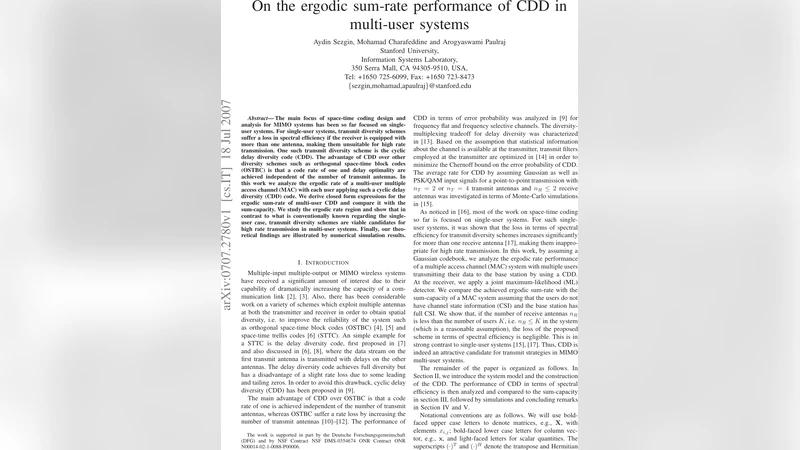
The main focus of space-time coding design and analysis for MIMO systems has been so far focused on single-user systems. For single-user systems, transmit diversity schemes suffer a loss in spectral efficiency if the receiver is equipped with more than one antenna, making them unsuitable for high rate transmission. One such transmit diversity scheme is the cyclic delay diversity code (CDD). The advantage of CDD over other diversity schemes such as orthogonal space-time block codes (OSTBC) is that a code rate of one and delay optimality are achieved independent of the number of transmit antennas. In this work we analyze the ergodic rate of a multi-user multiple access channel (MAC) with each user applying such a cyclic delay diversity (CDD) code. We derive closed form expressions for the ergodic sum-rate of multi-user CDD and compare it with the sum-capacity. We study the ergodic rate region and show that in contrast to what is conventionally known regarding the single-user case, transmit diversity schemes are viable candidates for high rate transmission in multi-user systems. Finally, our theoretical findings are illustrated by numerical simulation results.
💡 Research Summary
The paper investigates the ergodic sum‑rate performance of cyclic delay diversity (CDD) when it is employed by each user in a multi‑user multiple‑access channel (MAC). While CDD and other transmit‑diversity schemes are known to suffer a loss of spectral efficiency in single‑user MIMO systems with more than one receive antenna, the authors argue that this drawback does not necessarily extend to the multi‑user setting. They consider a MAC with K users, each equipped with Nₜ transmit antennas, and a base station with Nᵣ receive antennas. Every user applies a CDD encoder that cyclically shifts the transmitted symbols across its antennas; the corresponding delay matrix Uₖ is unitary, preserving transmit power while creating artificial multipath diversity.
The channel matrices Hₖ (size Nᵣ×Nₜ) are assumed i.i.d. complex Gaussian. After CDD, the equivalent channel seen at the receiver is
Ĥ = Σₖ Uₖ Hₖ .
Because each Uₖ is unitary and independent of Hₖ, Ĥ retains the i.i.d. Gaussian property, and the Gram matrix ĤĤᴴ follows a complex Wishart distribution with degrees of freedom Nₜ·K. Leveraging the known eigenvalue density of Wishart matrices, the authors derive a closed‑form expression for the ergodic sum‑rate
R_CDD = E
Comments & Academic Discussion
Loading comments...
Leave a Comment