Cloud Computing has become another buzzword after Web 2.0. However, there are dozens of different definitions for Cloud Computing and there seems to be no consensus on what a Cloud is. On the other hand, Cloud Computing is not a completely new concept; it has intricate connection to the relatively new but thirteen-year established Grid Computing paradigm, and other relevant technologies such as utility computing, cluster computing, and distributed systems in general. This paper strives to compare and contrast Cloud Computing with Grid Computing from various angles and give insights into the essential characteristics of both.
Deep Dive into Cloud Computing and Grid Computing 360-Degree Compared.
Cloud Computing has become another buzzword after Web 2.0. However, there are dozens of different definitions for Cloud Computing and there seems to be no consensus on what a Cloud is. On the other hand, Cloud Computing is not a completely new concept; it has intricate connection to the relatively new but thirteen-year established Grid Computing paradigm, and other relevant technologies such as utility computing, cluster computing, and distributed systems in general. This paper strives to compare and contrast Cloud Computing with Grid Computing from various angles and give insights into the essential characteristics of both.
So is "Cloud Computing" just a new name for Grid? In information technology, where technology scales by an order of magnitude, and in the process reinvents itself, every five years, there is no straightforward answer to such questions.
Yes: the vision is the same-to reduce the cost of computing, increase reliability, and increase flexibility by transforming computers from something that we buy and operate ourselves to something that is operated by a third party.
But no: things are different now than they were 10 years ago. We have a new need to analyze massive data, thus motivating greatly increased demand for computing. Having realized the benefits of moving from mainframes to commodity clusters, we find that those clusters are quite expensive to operate. We have low-cost virtualization. And, above all, we have multiple billions of dollars being spent by the likes of Amazon, Google, and Microsoft to create real commercial large-scale systems containing hundreds of thousands of computers. The prospect of needing only a credit card to get on-demand access to 100,000+ computers in tens of data centers distributed throughout the world-resources that be applied to problems with massive, potentially distributed data, is exciting! So we are operating at a different scale, and operating at these new, more massive scales can demand fundamentally different approaches to tackling problems. It also enables-indeed is often only applicable to-entirely new problems.
Nevertheless, yes: the problems are mostly the same in Clouds and Grids. There is a common need to be able to manage large facilities; to define methods by which consumers discover, request, and use resources provided by the central facilities; and to implement the often highly parallel computations that execute on those resources. Details differ, but the two communities are struggling with many of the same issues.
There is little consensus on how to define the Cloud [49]. We add yet another definition to the already saturated list of definitions for Cloud Computing:
A large-scale distributed computing paradigm that is driven by economies of scale, in which a pool of abstracted, virtualized, dynamically-scalable, managed computing power, storage, platforms, and services are delivered on demand to external customers over the Internet. There are a few key points in this definition. First, Cloud Computing is a specialized distributed computing paradigm; it differs from traditional ones in that 1) it is massively scalable, 2) can be encapsulated as an abstract entity that delivers different levels of services to customers outside the Cloud, 3) it is driven by economies of scale [44], and 4) the services can be dynamically configured (via virtualization or other approaches) and delivered on demand.
Governments, research institutes, and industry leaders are rushing to adopt Cloud Computing to solve their everincreasing computing and storage problems arising in the Internet Age. There are three main factors contributing to the surge and interests in Cloud Computing: 1) rapid decrease in hardware cost and increase in computing power and storage capacity, and the advent of multi-core architecture and modern supercomputers consisting of hundreds of thousands of cores;
- the exponentially growing data size in scientific instrumentation/simulation and Internet publishing and archiving; and 3) the wide-spread adoption of Services Computing and Web 2.0 applications.
Many discerning readers will immediately notice that our definition of Cloud Computing overlaps with many existing technologies, such as Grid Computing, Utility Computing, Services Computing, and distributed computing in general. We argue that Cloud Computing not only overlaps with Grid Computing, it is indeed evolved out of Grid Computing and relies on Grid Computing as its backbone and infrastructure support. The evolution has been a result of a shift in focus from an infrastructure that delivers storage and compute resources (such is the case in Grids) to one that is economy based aiming to deliver more abstract resources and services (such is the case in Clouds). As for Utility Computing, it is not a new paradigm of computing infrastructure; rather, it is a business model in which computing resources, such as computation and storage, are packaged as metered services similar to a physical public utility, such as electricity and public switched telephone network. Utility computing is typically implemented using other computing infrastructure (e.g. Grids) with additional accounting and monitoring services. A Cloud infrastructure can be utilized internally by a company or exposed to the public as utility computing.
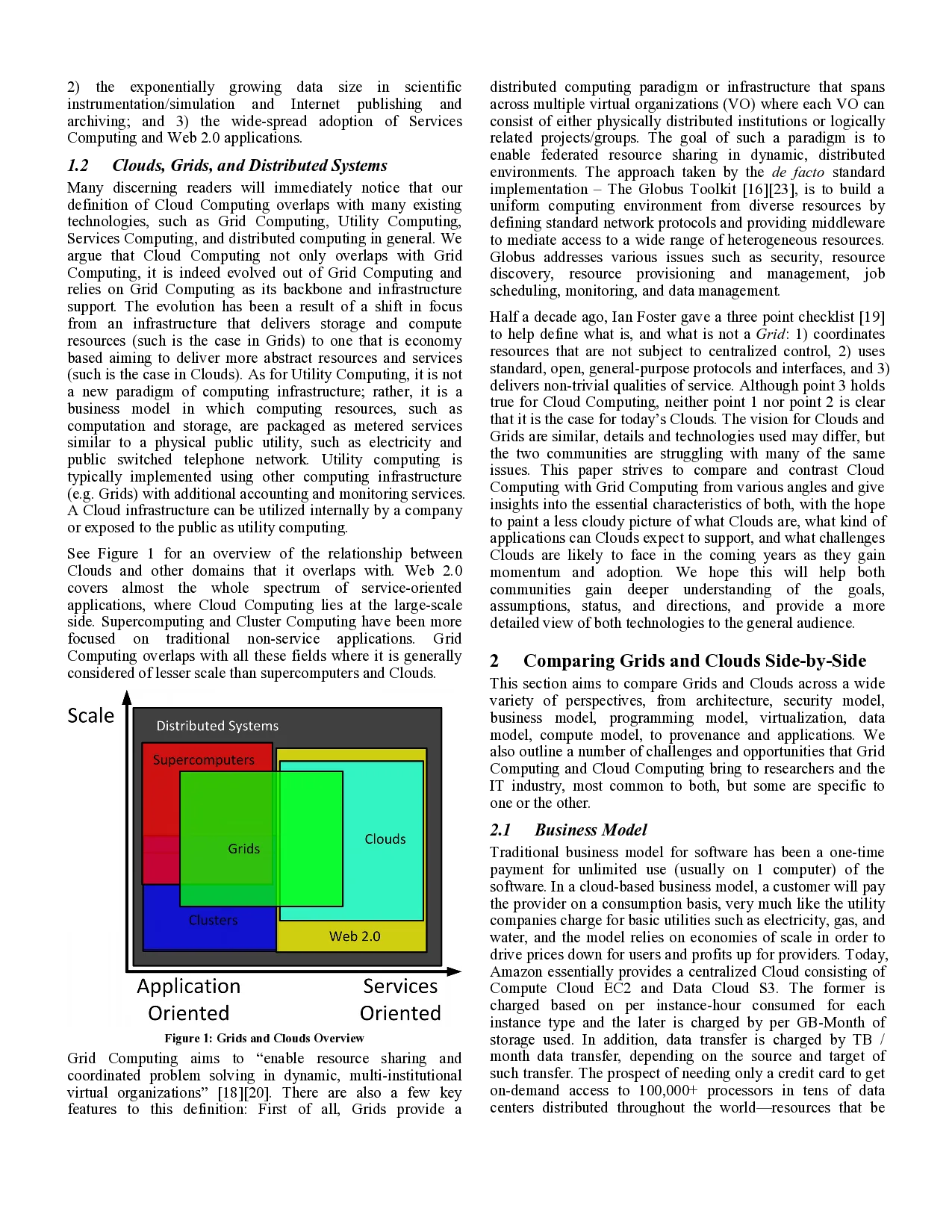
See Figure 1 for an overview of the relationship between Clouds and other domains that it overlaps with. Web 2.0 covers almost the whole spectrum of service-oriented applications, where Cloud Computing lies at the large-scale side. Supercomputing and Cluster Computing have been more focused
…(Full text truncated)…
This content is AI-processed based on ArXiv data.