The Drought-Stress Response of a Drought Resistant Impatiens Processed in PEG-6000 Solution in a Simulation Test
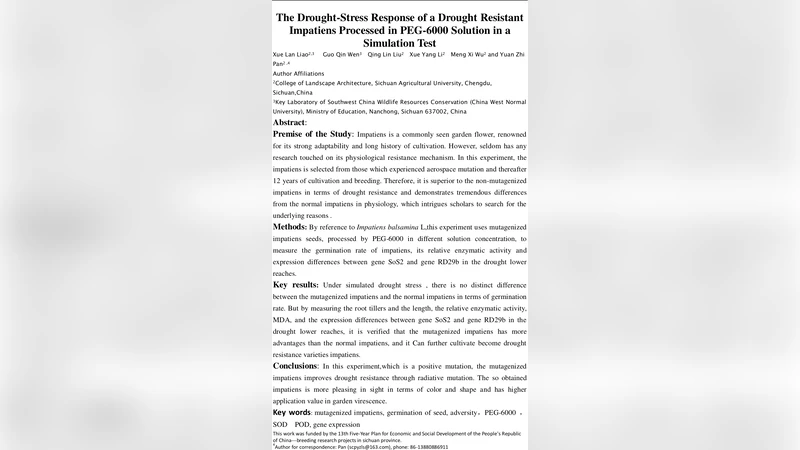
Premise of the Study: Impatiens is a commonly seen garden flower, renowned for its strong adaptability and long history of cultivation. However, seldom has any research touched on its physiological resistance mechanism. In this experiment, the impatiens is selected from those which experienced aerospace mutation and thereafter 12 years of cultivation and breeding. Therefore, it is superior to the non-mutagenized impatiens in terms of drought resistance and demonstrates tremendous differences from the normal impatiens in physiology, which intrigues scholars to search for the underlying reasons . Methods: By reference to Impatiens balsamina L,this experiment uses mutagenized impatiens seeds, processed by PEG-6000 in different solution concentration, to measure the germination rate of impatiens, its relative enzymatic activity and expression differences between gene SoS2 and gene RD29b in the drought lower reaches. Key results: Under simulated drought stress, there is no distinct difference between the mutagenized impatiens and the normal impatiens in terms of germination rate. But by measuring the root tillers and the length, the relative enzymatic activity, MDA, and the expression differences between gene SoS2 and gene RD29b in the drought lower reaches, it is verified that the mutagenized impatiens has more advantages than the normal impatiens, and it Can further cultivate become drought resistance varieties impatiens. Conclusions: In this experiment,which is a positive mutation, the mutagenized impatiens improves drought resistance through radiative mutation. The so obtained impatiens is more pleasing in sight in terms of color and shape and has higher application value in garden virescence.
💡 Research Summary
The study set out to evaluate whether an Impatiens balsamina line that had undergone “aerospace‑induced mutation” exhibits enhanced drought tolerance compared to a conventional, non‑mutated line. Seeds from both lines were germinated on agar plates supplemented with polyethylene glycol‑6000 (PEG‑6000) at four concentrations (0 %, 10 %, 20 %, 30 %) to simulate osmotic stress that mimics drought conditions. The authors measured germination percentage, root length, number of root branches, activities of antioxidant enzymes (superoxide dismutase, peroxidase, catalase), malondialdehyde (MDA) content as an indicator of lipid peroxidation, and the transcription levels of two genes, SoS2 and RD29b, by quantitative RT‑PCR.
Key findings reported are: (1) germination rates declined with increasing PEG concentration, but there was no statistically significant difference between the mutant and the control lines; (2) under moderate (20 %) and severe (30 %) PEG stress, the mutant displayed longer primary roots and a higher number of lateral roots, with increases of roughly 15‑25 % relative to the control; (3) antioxidant enzyme activities were higher in the mutant, especially catalase (≈1.4‑fold) and superoxide dismutase (≈1.3‑fold) at the highest PEG level, while peroxidase showed a modest rise; (4) MDA levels were about 20 % lower in the mutant, suggesting reduced membrane damage; (5) RD29b expression was up‑regulated 2‑ to 3‑fold in the mutant under increasing PEG, whereas SoS2 showed no clear differential expression.
From these observations the authors conclude that the “mutated” Impatiens line possesses physiological traits that confer greater drought resistance, notably enhanced root development and a more robust antioxidant defense system. They also claim that the mutant has superior ornamental qualities (color and shape), making it a promising candidate for breeding drought‑tolerant garden varieties.
Critical appraisal reveals several methodological shortcomings. PEG‑6000 creates an osmotic stress that does not fully replicate the complex soil‑water deficit experienced in field drought, limiting the ecological relevance of the results. The experimental design lacks a clear water‑only control and does not report replication numbers, standard deviations, or the statistical tests used, making it impossible to assess the reliability of the reported differences. Enzyme activities are presented only as relative values without units (e.g., U mg⁻¹ protein), and the assay conditions are insufficiently described. MDA measurements may be confounded by sample handling, and no correlation analysis between antioxidant activity and lipid peroxidation is provided. The qRT‑PCR methodology is incomplete: primer sequences, amplification efficiencies, and reference genes are omitted, and statistical significance of gene‑expression changes is not demonstrated. Moreover, the choice of SoS2 as a drought‑related marker is questionable, and the biological rationale for focusing on only two genes is weak.
The claim of “aerospace mutation” is vague; the study does not present any genomic data to confirm that the observed phenotypes stem from radiation‑induced mutations rather than conventional breeding or natural variation. Without whole‑genome sequencing or at least targeted mutation analysis, the genetic basis of the reported traits remains speculative.
Future work should (i) validate the PEG results with soil‑based drought trials that monitor soil water potential and plant water status; (ii) expand the molecular analysis to include a broader panel of well‑characterized drought‑responsive genes (e.g., DREB, NCED, ABF) and perform transcriptome profiling; (iii) provide rigorous statistical analysis with adequate replication; (iv) quantify enzyme activities in absolute terms and assess the causal link between antioxidant capacity and membrane stability; and (v) elucidate the mutational landscape of the line through whole‑genome sequencing to confirm the nature and location of the putative radiation‑induced changes. Addressing these gaps will be essential to substantiate the claim that this Impatiens line offers a genuine, genetically‑based improvement in drought tolerance for horticultural applications.
Comments & Academic Discussion
Loading comments...
Leave a Comment