Statistics of bedload transport over steep slopes: Separation of time scales and collective motion
Steep slope streams show large fluctuations of sediment discharge across several time scales. These fluctuations may be inherent to the internal dynamics of the sediment transport process. A probabilistic framework thus seems appropriate to analyze such a process. In this letter, we present an experimental study of bedload transport over a steep slope flume for small to moderate Shields numbers. The sampling technique allows the acquisition of high-resolution time series of the solid discharge. The resolved time scales range from $10^{-2}$s up to $10^{5}$s. We show that two distinct time scales can be observed in the probability density function for the waiting time between moving particles. We make the point that the separation of time scales is related to collective dynamics. Proper statistics of a Markov process including collective entrainment are derived. The separation of time scales is recovered theoretically for low entrainment rates.
💡 Research Summary
This paper investigates the highly intermittent nature of bedload transport on steep‑slope streams by combining high‑resolution laboratory experiments with a stochastic theoretical framework. The authors built a 2.5‑m long, 8‑cm wide flume set at a constant steep slope and filled it with uniform natural gravel (mean diameter 8 ± 1.5 mm). Three experiments (labeled a, b, c) were performed at increasing Shields stresses while keeping the slope and water depth (1–3 cm) constant, thereby reproducing fully turbulent, super‑critical flow conditions (Re ≥ 8000, Fr ≈ 1.4).
A novel measurement technique was employed: each particle exiting the flume strikes a metallic plate equipped with a small accelerometer. By applying a peak‑over‑threshold algorithm, the exact time of each impact is recorded with sub‑0.01 s resolution. This method yields continuous time series of particle “emigration” events spanning six orders of magnitude (from 10⁻¹ s up to 10⁵ s). Over 10⁵ waiting‑time intervals (the time T between successive particle exits) were collected, allowing a robust statistical analysis of the waiting‑time probability density function (pdf).
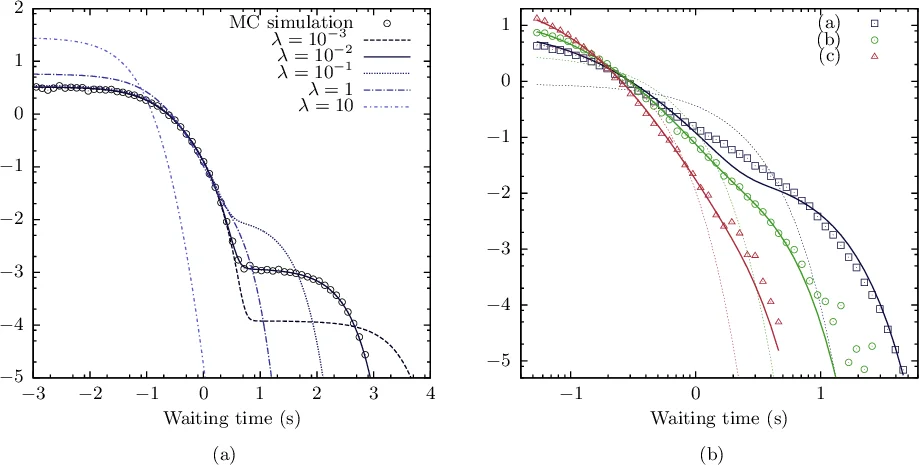
The empirical pdf of T, plotted on log‑log axes, displays a pronounced bimodal shape: a short‑time peak (≈10⁻¹–10⁰ s) and a long‑time peak (≈10²–10⁴ s). The tail is far heavier than an exponential distribution, which underlies classic Poisson‑based bedload models (Einstein 1950; Turowski 2010). The authors interpret the two modes as signatures of two distinct transport processes. The short‑time mode reflects rapid, clustered releases of particles, whereas the long‑time mode corresponds to isolated, independent particle motions.
To explain this behavior, the authors extend the continuous‑time birth‑death Markov model originally proposed by Ancey et al. (2008). The state variable N(t) denotes the number of moving particles within an observation window. Four stochastic events are considered: (i) fluid‑driven entrainment at rate λ, (ii) deposition onto the bed at rate σ, (iii) emigration (exit) at rate γ, and (iv) collective entrainment at rate μ, whereby a moving particle triggers the release of an additional resting particle. The inclusion of μ captures the “collective motion” observed experimentally (e.g., particle‑particle collisions, turbulent eddy clusters, or small avalanches).
The model assumes stationarity (γ + σ > μ) and derives the joint probability Fₙ(t)=Pr(T > t, N(t)=n). By constructing the generating function G(z,t)=∑ₙFₙ(t)zⁿ and solving the resulting partial differential equation via characteristic curves, the authors obtain an explicit expression for the waiting‑time pdf:
f_T(t)=γ · ⟨Fₙ(t)⟩,
where the angular brackets denote averaging over n. When μ = 0 the solution reduces to a single exponential (the classic Poisson case). For μ > 0 the solution becomes a mixture of two exponentials, naturally producing the observed bimodal pdf. Importantly, the separation of time scales becomes more pronounced as μ decreases, i.e., at low entrainment rates (near the threshold of motion).
The theoretical predictions are compared with the experimental data. In the low‑Shields case (experiment a), the model reproduces both the short‑time and long‑time peaks and matches the overall shape of the pdf. Experiments b and c, performed at higher Shields stresses, show a reduced prominence of the short‑time peak, consistent with an increased collective entrainment rate μ that blurs the distinction between the two modes. This agreement validates the hypothesis that collective dynamics are responsible for the heavy‑tailed, multimodal waiting‑time statistics observed in steep‑slope bedload transport.
The paper concludes that (1) high‑frequency, single‑particle impact measurements provide unprecedented insight into bedload intermittency, (2) bedload discharge on steep slopes is governed by two interacting time scales associated with independent and collective particle releases, and (3) a Markov birth‑death process augmented with a collective entrainment term offers a parsimonious yet powerful statistical description. The authors suggest that field applications will require methods to estimate λ and μ directly (e.g., high‑speed imaging or acoustic sensors) and that future work should explore how grain‑size distribution, slope angle, and turbulent flow structures modulate μ. Extending the framework to non‑stationary conditions (e.g., flood pulses) and to natural rivers with complex geometry represents a promising direction for improving sediment‑transport forecasting in mountainous catchments.
Comments & Academic Discussion
Loading comments...
Leave a Comment