#mytweet via Instagram: Exploring User Behaviour across Multiple Social Networks
We study how users of multiple online social networks (OSNs) employ and share information by studying a common user pool that use six OSNs - Flickr, Google+, Instagram, Tumblr, Twitter, and YouTube. We analyze the temporal and topical signature of users’ sharing behaviour, showing how they exhibit distinct behaviorial patterns on different networks. We also examine cross-sharing (i.e., the act of user broadcasting their activity to multiple OSNs near-simultaneously), a previously-unstudied behaviour and demonstrate how certain OSNs play the roles of originating source and destination sinks.
💡 Research Summary
The paper investigates how users who maintain accounts on multiple online social networks (OSNs) behave across platforms, focusing on six services that span a broad range of media types: Flickr, Google+, Instagram, Tumblr, Twitter, and YouTube. Using About.me as a linkage hub, the authors collected more than 180,000 public profiles and identified 15,595 individuals who link to at least four of the six target OSNs. For each of these users, they harvested all publicly available posts via the official APIs on August 15 2013, resulting in over 43 million activity records.
First, the authors quantify overlap between networks using Jaccard similarity. Twitter shows the highest cross‑network presence, followed by Google+, reflecting their popularity among highly connected users. Notably, YouTube shares 84 % of its users with Google+, a consequence of the shared corporate ecosystem, while Instagram and Tumblr also exhibit high mutual overlap (≈79 % and 68 %). Overlap alone, however, does not guarantee active participation; therefore, the authors examine daily activity patterns. By plotting the cumulative distribution of the number of networks a user visits per day, they find that roughly 40 % of users are active on any given day, with an average of 1.5 networks. On “high‑activity” days (more than ten posts), the average number of concurrently used networks rises to about 2.3, indicating that multi‑platform engagement intensifies when users are especially active.
The study then delves into profile text. Among the 190 users who filled out profile descriptions on all six OSNs (after filtering out very short entries), the authors retain only frequent non‑stopword nouns and compute pairwise Jaccard similarity. The resulting distribution shows that 95 % of users have an average similarity below 0.5, and 80 % below 0.15, meaning that most users craft distinct self‑descriptions for each platform. This supports the hypothesis that functional differences among OSNs (photo‑centric vs. micro‑blogging) shape how users present themselves.
Temporal analysis splits each day into eight three‑hour windows and distinguishes weekdays from weekends. Instagram and Flickr activity peaks in the evening (18:00‑24:00), Twitter and Tumblr are most active during typical work hours (09:00‑15:00), while Google+ displays a relatively flat distribution throughout the day. These patterns suggest that users allocate different platforms to different daily routines—visual sharing after work, quick updates during work, and broader social networking at any time.
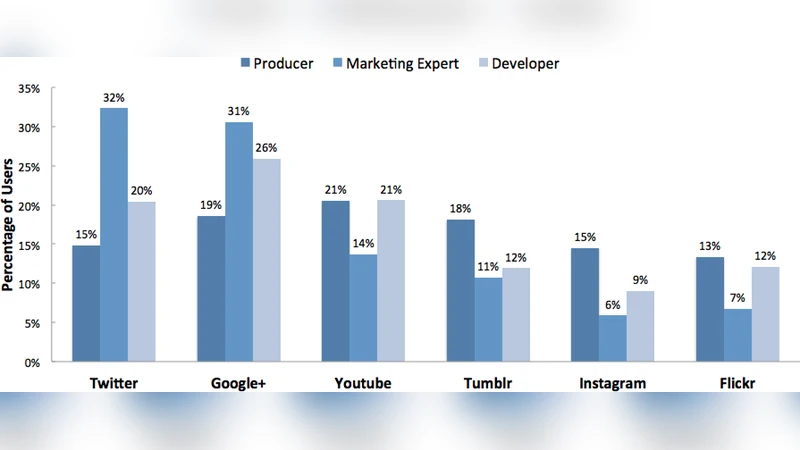
Topic modeling using Latent Dirichlet Allocation (LDA) reveals platform‑specific content themes. Visual platforms (Instagram, Flickr, YouTube) dominate topics such as travel, nature, fashion, and food, whereas text‑oriented platforms (Twitter, Tumblr) focus on news, politics, everyday conversation, and humor. When intersecting topics with self‑reported occupations, the authors find that creative and marketing professionals gravitate toward Instagram and YouTube, while IT and development professionals are more active on Twitter and Google+. This occupational segmentation underscores the role of professional identity in platform choice.
The most novel contribution is the systematic examination of “cross‑sharing” – the practice of broadcasting the same content to multiple OSNs within a short time window. By identifying 1,200+ cross‑sharing events, the authors construct a directed graph where nodes are OSNs and edges represent the flow of shared content. The graph shows a clear hierarchy: Instagram and Flickr act primarily as sources, pushing media to other services; Twitter and Tumblr function as sinks, receiving content from the visual platforms; Google+ and YouTube occupy intermediate positions, both sending and receiving. This topology mirrors the functional affordances of each service (e.g., Instagram’s native sharing to Twitter) and illustrates how information diffuses across a heterogeneous social media ecosystem.
Limitations are acknowledged. About.me users are not a random sample of the global internet population; they tend to be professionals, freelancers, and creatives, which may bias findings. Moreover, the analysis relies exclusively on publicly available data, omitting private posts, direct messages, and other non‑public interactions that could affect cross‑platform dynamics.
In conclusion, the paper demonstrates that single‑network studies provide an incomplete picture of modern social media behavior. By integrating profile semantics, temporal rhythms, topical interests, occupational cues, and cross‑sharing flows, the authors offer a multi‑dimensional portrait of how users allocate their attention and content across diverse OSNs. The findings have practical implications for marketers designing cross‑platform campaigns, for platform designers seeking to improve interoperability, and for researchers building more realistic models of information diffusion in a multi‑network world.
Comments & Academic Discussion
Loading comments...
Leave a Comment