The Emerging Internet of Things Marketplace From an Industrial Perspective: A Survey
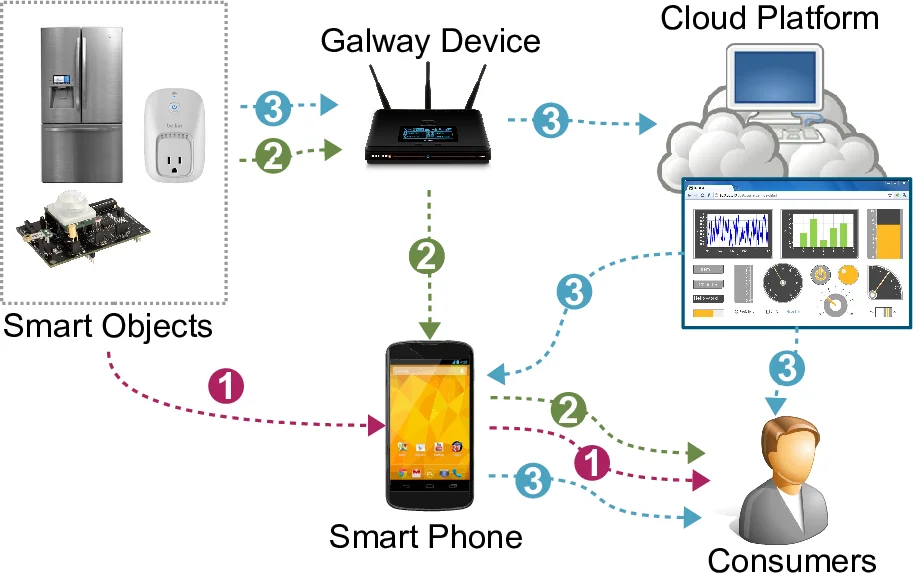
The Internet of Things (IoT) is a dynamic global information network consisting of internet-connected objects, such as Radio-frequency identification (RFIDs), sensors, actuators, as well as other instruments and smart appliances that are becoming an integral component of the future internet. Over the last decade, we have seen a large number of the IoT solutions developed by start-ups, small and medium enterprises, large corporations, academic research institutes (such as universities), and private and public research organisations making their way into the market. In this paper, we survey over one hundred IoT smart solutions in the marketplace and examine them closely in order to identify the technologies used, functionalities, and applications. More importantly, we identify the trends, opportunities and open challenges in the industry-based the IoT solutions. Based on the application domain, we classify and discuss these solutions under five different categories: smart wearable, smart home, smart, city, smart environment, and smart enterprise. This survey is intended to serve as a guideline and conceptual framework for future research in the IoT and to motivate and inspire further developments. It also provides a systematic exploration of existing research and suggests a number of potentially significant research directions.
💡 Research Summary
The paper presents a comprehensive survey of more than one hundred commercially available Internet of Things (IoT) solutions that have been brought to market by start‑ups, SMEs, large corporations, and research organisations. Unlike previous academic‑oriented surveys, the authors collect primary information from product web sites, demo videos, technical specifications, and user reviews, focusing on real‑world industrial offerings. The solutions are classified into five application domains: smart wearable, smart home, smart city, smart environment, and smart enterprise.
For each domain, the authors detail functional capabilities (e.g., health monitoring, energy management, location‑based services), hardware platforms (sensors, microcontrollers, wearables), software stacks (cloud services, mobile apps, open‑source platforms), communication protocols (BLE, ZigBee, Wi‑Fi, LoRaWAN, NB‑IoT), and power sources (battery, energy‑harvesting). In the wearable category, devices are further broken down by body location (wrist, eye, head, etc.), illustrating a wide range of sensors such as accelerometers, ECG, temperature, and pressure sensors, and showing how data are fused and sent to cloud back‑ends for analytics or real‑time alerts. Smart‑home solutions are examined through platforms like SmartThings, HomeOS, and Lab‑of‑Things, highlighting rule‑based automation, voice interfaces, and remote control of appliances. Smart‑city and smart‑environment offerings demonstrate large‑scale sensor deployments, edge computing, GIS integration, and use cases such as traffic optimisation, air‑quality monitoring, and waste‑collection efficiency. The smart‑enterprise section focuses on Industrial IoT (IIoT) integrations with PLCs, SCADA systems, and predictive maintenance pipelines, emphasizing reliability, security, and data‑driven decision making.
The analysis reveals that the market is fragmented across multiple wireless standards, leading to interoperability challenges. Power‑management remains a critical issue, especially for high‑reliability industrial applications, despite growing interest in low‑power and energy‑harvesting techniques. Business models are diverse, ranging from hardware sales to subscription services, data monetisation, and platform fees, with data privacy and regulatory compliance emerging as decisive factors for revenue strategies.
Based on these observations, the authors propose five research directions: (1) development of unified communication standards and interoperability frameworks; (2) deployment of edge AI and lightweight machine‑learning algorithms for real‑time processing; (3) strengthening security and privacy mechanisms across all layers; (4) advancing sustainable power solutions, including energy‑harvesting and ultra‑low‑power design; and (5) establishing legal and ethical guidelines for data‑centric business models. The paper serves as a practical roadmap for academics, industry practitioners, and policymakers aiming to navigate the rapidly evolving IoT marketplace and address its open challenges.
Comments & Academic Discussion
Loading comments...
Leave a Comment