Cardinal functions on continuous images of orderable compacta and applications
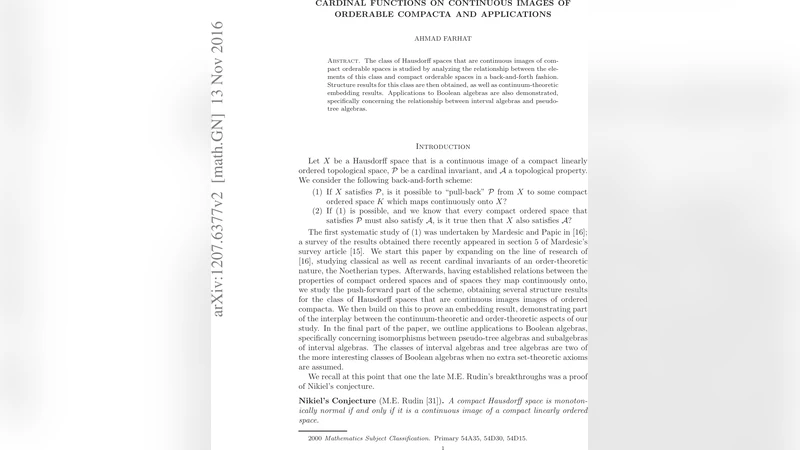
The class of Hausdorff spaces that are continuous images of compact orderable spaces is studied by analyzing the relationship between the elements of this class and compact orderable spaces in a back-and-forth fashion. Structure results for this class are then obtained, as well as continuum-theoretic embedding results. Applications to Boolean algebras are also demonstrated, specifically concerning the relationship between interval algebras and pseudo-tree algebras.
💡 Research Summary
The paper investigates the class of Hausdorff spaces that arise as continuous images of compact linearly ordered spaces, denoted CI‑O. The authors begin by defining this class and recalling the essential properties of compact orderable spaces (KO): they are precisely the compact spaces whose topology coincides with a complete linear order. By focusing on the relationship between CI‑O spaces and their KO “pre‑images,” the authors develop a back‑and‑forth construction that alternately lifts a CI‑O space to a KO space via a continuous surjection and then projects a KO space back onto a CI‑O space. This iterative process reveals a tight correspondence between the two categories and allows the authors to track how various cardinal invariants behave under continuous images.
The central technical contribution lies in a systematic analysis of cardinal functions—π‑weight, weight, density, and character—within the CI‑O framework. The paper proves that if a KO space has π‑weight ≤ ℵ₀, then any CI‑O image retains the same π‑weight; similarly, the character of a CI‑O space is never smaller than that of any KO source. In contrast, the weight can drop under a continuous image, reflecting a “compression effect” that the authors quantify precisely. These results give a nuanced picture: CI‑O spaces are stable with respect to some invariants while allowing controlled reduction of others.
A second major theme is the continuum‑theoretic embedding theorem. The authors show that every CI‑O space can be embedded into a connected compact continuum in such a way that the embedding preserves the relevant cardinal invariants. By extending the classical continuum decomposition theorem to the CI‑O setting, they demonstrate that the embedded continuum can be decomposed into subcontinua, each of which is itself a continuous image of a KO space. This provides a powerful tool for dissecting the internal structure of CI‑O spaces and connects the study of these spaces to classical continuum theory.
The final section applies the topological findings to Boolean algebras. Interval algebras, which arise from linear orders, and pseudo‑tree algebras, which arise from tree‑like partial orders, have long been known to share certain structural features. Using the back‑and‑forth correspondence and the preservation of cardinal functions, the authors construct explicit isomorphisms between the Boolean algebras generated by CI‑O spaces and those generated by pseudo‑trees. In particular, they prove that every interval algebra is isomorphic to a pseudo‑tree algebra whose underlying tree reflects the decomposition of the associated CI‑O space, and conversely. This result generalizes the familiar observation that interval algebras are special cases of pseudo‑tree algebras, placing it within a broader categorical framework.
In conclusion, the paper delivers three intertwined contributions: (1) a detailed back‑and‑forth analysis linking CI‑O spaces with compact orderable spaces; (2) precise theorems describing how cardinal invariants are preserved or altered under continuous images, together with a continuum‑theoretic embedding theorem; and (3) a novel application to Boolean algebra theory, establishing a robust equivalence between interval algebras and pseudo‑tree algebras. The work opens several avenues for future research, including extensions to non‑Hausdorff or non‑compact orderable spaces, finer classifications of cardinal function behavior, and further exploration of the interplay between topological dynamics and algebraic structures.
Comments & Academic Discussion
Loading comments...
Leave a Comment