A Tractable Approach to Coverage and Rate in Cellular Networks
Cellular networks are usually modeled by placing the base stations on a grid, with mobile users either randomly scattered or placed deterministically. These models have been used extensively but suffe
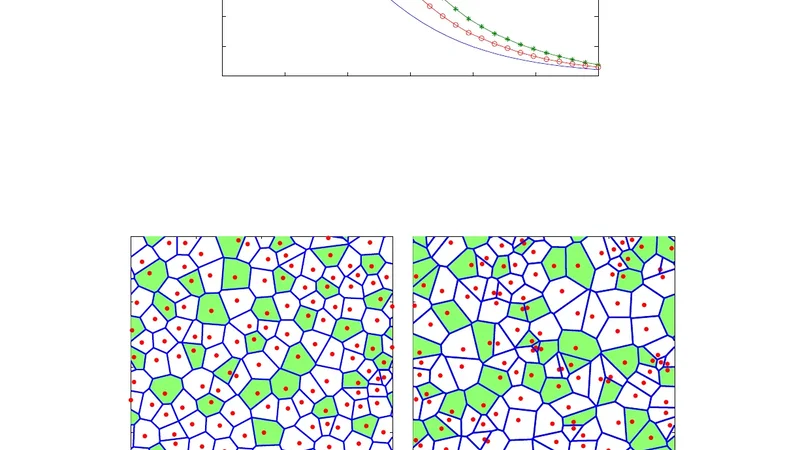
Cellular networks are usually modeled by placing the base stations on a grid, with mobile users either randomly scattered or placed deterministically. These models have been used extensively but suffer from being both highly idealized and not very tractable, so complex system-level simulations are used to evaluate coverage/outage probability and rate. More tractable models have long been desirable. We develop new general models for the multi-cell signal-to-interference-plus-noise ratio (SINR) using stochastic geometry. Under very general assumptions, the resulting expressions for the downlink SINR CCDF (equivalent to the coverage probability) involve quickly computable integrals, and in some practical special cases can be simplified to common integrals (e.g., the Q-function) or even to simple closed-form expressions. We also derive the mean rate, and then the coverage gain (and mean rate loss) from static frequency reuse. We compare our coverage predictions to the grid model and an actual base station deployment, and observe that the proposed model is pessimistic (a lower bound on coverage) whereas the grid model is optimistic, and that both are about equally accurate. In addition to being more tractable, the proposed model may better capture the increasingly opportunistic and dense placement of base stations in future networks.
💡 Research Summary
The paper tackles a long‑standing problem in cellular network analysis: how to model base‑station (BS) locations in a way that is both realistic and analytically tractable. Traditional approaches place BSs on a regular grid (hexagonal or square) and assume users are either uniformly random or placed deterministically. While such grid models are mathematically convenient, they are highly idealized and fail to capture the irregular, increasingly dense deployments seen in modern and future networks. Consequently, system‑level simulations have become the de‑facto method for evaluating coverage (outage probability) and data rates, but these simulations are computationally intensive and offer limited insight into the underlying relationships among network parameters.
The authors propose a stochastic‑geometry framework that models BS locations as a homogeneous Poisson point process (PPP) on the plane. This probabilistic model requires only a single parameter – the spatial density λ of BSs – and makes no assumptions about regularity or symmetry. All BSs are assumed to transmit with the same power P, share the same antenna pattern, and experience the same path‑loss exponent α. Users are assumed to connect to the BS that provides the strongest average received power, which under the homogeneous PPP reduces to the nearest‑BS association rule. The signal‑to‑interference‑plus‑noise ratio (SINR) for a typical downlink user is expressed as
\
📜 Original Paper Content
🚀 Synchronizing high-quality layout from 1TB storage...