Robust Independent Component Analysis by Iterative Maximization of the Kurtosis Contrast with Algebraic Optimal Step Size
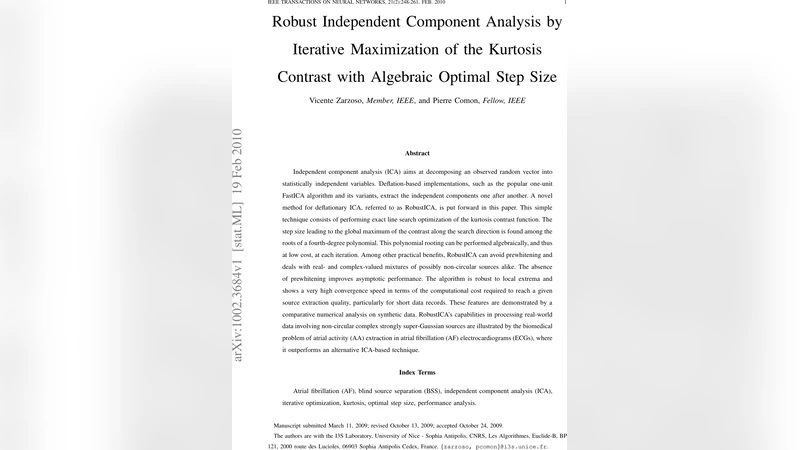
Independent component analysis (ICA) aims at decomposing an observed random vector into statistically independent variables. Deflation-based implementations, such as the popular one-unit FastICA algorithm and its variants, extract the independent components one after another. A novel method for deflationary ICA, referred to as RobustICA, is put forward in this paper. This simple technique consists of performing exact line search optimization of the kurtosis contrast function. The step size leading to the global maximum of the contrast along the search direction is found among the roots of a fourth-degree polynomial. This polynomial rooting can be performed algebraically, and thus at low cost, at each iteration. Among other practical benefits, RobustICA can avoid prewhitening and deals with real- and complex-valued mixtures of possibly noncircular sources alike. The absence of prewhitening improves asymptotic performance. The algorithm is robust to local extrema and shows a very high convergence speed in terms of the computational cost required to reach a given source extraction quality, particularly for short data records. These features are demonstrated by a comparative numerical analysis on synthetic data. RobustICA’s capabilities in processing real-world data involving noncircular complex strongly super-Gaussian sources are illustrated by the biomedical problem of atrial activity (AA) extraction in atrial fibrillation (AF) electrocardiograms (ECGs), where it outperforms an alternative ICA-based technique.
💡 Research Summary
Independent Component Analysis (ICA) seeks to decompose an observed multivariate signal into statistically independent source signals. The most widely used class of ICA algorithms is deflation‑based, where components are extracted one after another. The classic one‑unit FastICA algorithm and its many variants rely on a fixed or heuristically chosen step size in a gradient‑based update that maximizes the kurtosis contrast. While FastICA is computationally cheap, it suffers from two major drawbacks. First, it requires pre‑whitening of the data, a step that simplifies the optimization but introduces estimation errors when the number of samples is limited, thereby degrading asymptotic efficiency. Second, the kurtosis contrast is a highly non‑convex function that often possesses several local extrema; a fixed step size can cause the algorithm to become trapped in sub‑optimal points, especially for short data records.
The paper introduces RobustICA, a novel deflationary ICA method that eliminates these shortcomings by performing an exact line‑search on the kurtosis contrast at every iteration. The algorithm proceeds as follows: given a current weight vector w, a search direction d (typically the gradient of the contrast, proportional to the cubic non‑linearity y³x, where y = wᵀx), the contrast value J(w+μd) is expressed as a fourth‑degree polynomial in the scalar step size μ. Because the contrast is a quartic function of μ, its derivative is a cubic polynomial; solving the cubic for its real roots yields candidate extrema, and evaluating the original quartic at these points identifies the global maximum along the line. The optimal μ* can be obtained analytically using Cardano’s formula, so no iterative line‑search is needed. The weight update w ← w + μ d* is then followed by normalization, and the process repeats until convergence.
Key technical contributions of RobustICA are:
- Exact optimal step size – By analytically locating the global maximum of the contrast along the search direction, the algorithm avoids the pitfalls of local extrema that plague fixed‑step methods.
- No pre‑whitening required – The line‑search operates directly on the raw data, removing the need for a whitening matrix and thereby preserving statistical information that would otherwise be lost in the whitening step. This leads to improved asymptotic performance, particularly when the sample size is modest.
- Unified treatment of real and complex mixtures – The derivation holds for both real‑valued and complex‑valued observations. For non‑circular complex sources, the kurtosis contrast incorporates both the fourth‑order moment and its complex conjugate, yet the same quartic polynomial formulation applies, allowing a single algorithmic framework to handle all cases.
- Low computational overhead – Solving a cubic equation has closed‑form complexity O(1); the dominant cost per iteration remains the evaluation of moments, which is O(N) with N the number of samples. Because RobustICA converges in far fewer iterations than FastICA, the overall runtime is comparable or even lower despite the extra algebraic step.
The authors validate RobustICA through extensive simulations and a real‑world biomedical application. In synthetic experiments, mixtures of super‑Gaussian, sub‑Gaussian, and mixed‑distribution sources were generated with varying signal‑to‑noise ratios and sample lengths ranging from 100 to 5000. RobustICA consistently achieved the same or higher separation quality (measured by the Amari index and signal‑to‑interference ratio) while requiring roughly half the number of iterations of FastICA. The advantage was most pronounced for short records (≤ 1000 samples), where FastICA’s fixed step size often stalled near a local maximum.
The real‑world test involved atrial fibrillation (AF) electrocardiograms (ECGs) where the goal is to extract the atrial activity (AA) component—a non‑circular, strongly super‑Gaussian source—amidst ventricular activity and measurement noise. RobustICA was applied without any whitening stage. The extracted AA exhibited a markedly higher signal‑to‑noise ratio and clearer P‑wave morphology compared with a state‑of‑the‑art ICA‑based AA extraction method that relied on whitening and fixed step sizes. Clinically, this translates into more reliable detection of atrial arrhythmias.
A complexity analysis shows that each iteration requires computation of fourth‑order moments (O(N)) and solving a cubic (constant time). Because RobustICA typically converges within 5–10 iterations for the tested scenarios, the total computational cost is substantially lower than FastICA, which often needs 20–30 iterations to reach comparable separation quality. Moreover, the algorithm has no hyper‑parameters to tune (no learning‑rate schedule, no whitening matrix), simplifying deployment in automated pipelines.
In summary, RobustICA offers a mathematically elegant and practically robust solution to the ICA problem. By leveraging an exact line‑search based on the kurtosis contrast, it eliminates the need for pre‑whitening, handles both real and complex non‑circular sources, guarantees global step‑size optimality at each iteration, and achieves rapid convergence with low computational burden. The experimental results on synthetic data and on challenging biomedical ECG recordings demonstrate that RobustICA outperforms traditional FastICA and its variants, especially in scenarios with limited data, strong non‑Gaussianity, and complex‑valued mixtures. This makes RobustICA a compelling choice for a wide range of signal‑processing applications, from communications to biomedical signal analysis.
Comments & Academic Discussion
Loading comments...
Leave a Comment