Spectrum sensing by cognitive radios at very low SNR
Spectrum sensing is one of the enabling functionalities for cognitive radio (CR) systems to operate in the spectrum white space. To protect the primary incumbent users from interference, the CR is required to detect incumbent signals at very low sign…
Authors: Zhi Quan, Stephen J. Shellhammer, Wenyi Zhang
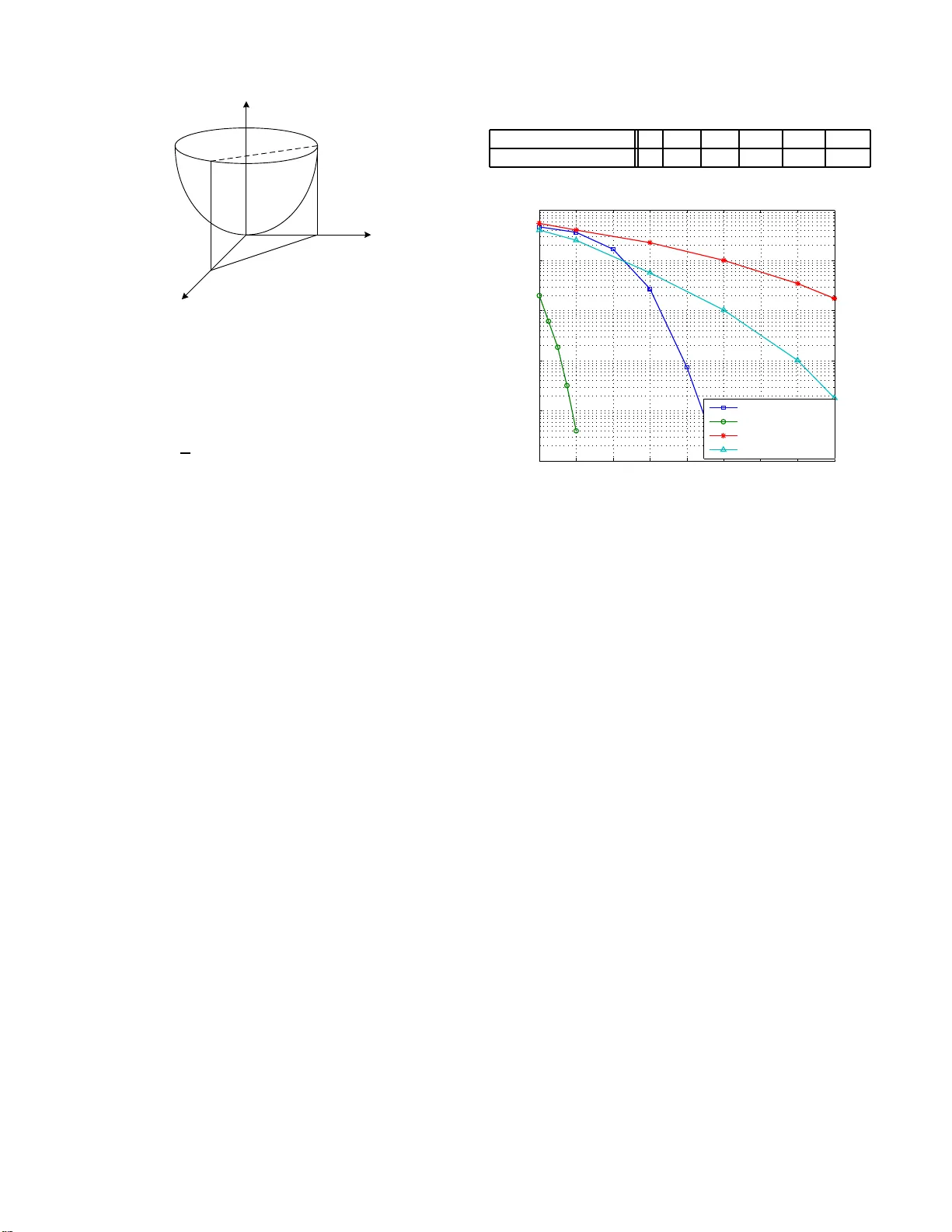
Spectrum Sensing by Cogniti v e Radios at V ery Lo w SNR Zhi Quan 1 , Stephen J . Shellhammer 1 , W enyi Zhang 1 , and Ali H. Say ed 2 1 Qualcomm Incorpora ted, 5665 Morehouse Driv e, San Diego, CA 92 121 E-mails: { zquan, sshe llha, wenyiz } @qualcomm.co m 2 Electrical En gineerin g Dep artment, University of Califor nia, Los Angeles, CA 90095 E-mail: saye d@ee.ucla.ed u Abstract — Spectrum sensing is one of the enablin g func- tionalities fo r cognitive radio (CR) sys tems to operate in the spectrum white space. T o protect t he primary incumbent users from interfer ence, the CR is required to detect incumbent signals at very low signal-to-noise ratio (SNR). In this paper , we present a spectrum sen sing techniq ue based on correlating spectra f or detection of television (TV) broadcasting signals. The basic strategy is to correlate the periodogram of the receiv ed signal with th e a priori known spectral features of t he primary signal. W e show that according to the Neyman-Pe arson criterion, this sp ectra corr elation- based sensing techniqu e is asymptotically optimal at very lo w SNR and with a lar ge sensing time. Fr om the system design perspectiv e, we analyze the effect of the spectral features on the spectru m sensing perform ance. Through the optimization analysis, we obtain usefu l insights on how to choose effectiv e spectral features to achiev e reliable sensing. Simulation results show th at the proposed sensin g techn ique can reliably detect analog and d igital TV signals at SNR as l ow as − 20 dB. I . I N T RO D U C T I O N Due to the incre asing pr oliferation o f wireless devices a nd services, the tradition al static spectrum allo cation policy be- comes inefficient. The Federal Commu nications Commission (FCC) has recently op ened the TV bands for cognitive ra dio devices, wh ich can continu ously sen se the spectral en viron- ment, dyn amically identify unused spectral segmen ts, and then o perate in these white spac es witho ut causin g har mful interferen ce to the incumb ent com munication serv ices [1]. The IEEE 8 02.22 Wireless Regional Area Network (WRAN) working grou p is d ev eloping a CR-b ased air inte rface standard for u nlicensed op eration in the unu sed TV bands [2]. Spectrum sensing to detect the presence of primary signals is on e of the most imp ortant fun ctionalities o f CRs. T o avoid causing harmfu l interf erence to the in cumben t users, FCC re- quires that unlicen sed CR devices o perating in the unused TV bands d etect TV an d wireless micro phon e signa ls at a power lev el of − 1 14 dBm [1]. For a noise floor around − 96 dBm in the receiver cir cuitry (with r espect to 6 M Hz ban dwidth and a 10 dB noise figu re), spectrum sensing algorithm s need to reliably de tect incu mbent TV signals at a very low SNR o f at least − 18 d B. This req uirement poses new challeng es to the design o f CR systems since traditional detectio n techn iques such as energy detection and matched filtering are no longer applicable in the very lo w SNR region [2 ]. In gener al, there are thr ee signal de tection ap proach es for spectrum sensing: energy detectio n, matched filter ing (coher- ent detection) , and featur e detection . If o nly th e local noise power is known, the en ergy detecto r is o ptimal [3] . If a deterministic patter n (e.g. , pilot, prea mble, or tr aining se- quence) of prima ry signals is k nown, then the optimal detecto r usually applies a matched filtering structu re to maximize the probab ility of detection. Depending on the av a ilable a priori informa tion abo ut the p rimary signal, one may ch oose one of the above appr oaches for spectrum sensing in CR networks. Howe ver, energy de tection an d matched filtering appro aches are not ap plicable to detectin g w eak signals at very low SNR. At very low SNR, th e energy detector suffers from n oise uncertainty and the matched filter experience s the p roblem of lost synchro nization. T o improve sensing r eliability , most previous stud ies h av e focu sed on th e d evelopment of coop- erative sen sing schemes u sing multiple CRs [ 4] [5] [6]. An alternative app roach is to use feature d etection provided that some in formatio n is a p riori known. Cyclostationary detection exploiting the period icity in the modulated schemes [7] is such an examp le but requires high computational com plexity . Recently , Ze ng and Lian g d ev eloped an eigenv alu e based algorithm u sing th e ratio o f the max imum an d min imum eigenv alue s of the sample cov arian ce matrix [8] . In this paper, we develop a featur e detection-based spectrum sensing techniq ue fo r a single CR to me et the FCC sensing requirem ent. The basic strategy is to co rrelate the pe riodog ram of the received sign al with the selected spectral featur es of a particu lar TV transmission scheme, either the national television system committee (NTSC) scheme or the advanced television standard committee (A TSC) scheme, and then to examine the co rrelation fo r de cision mak ing. By utilizing the asymptotic pr operties of T oe plitz matric es [9], we sh ow that for certain sign al mode ls the spectra corr elation-based detector is asymp totically equiv alent to the likelihood ratio test (LR T) at very low SNR. In add ition, we ana lyze how the spectral features c an affect the sen sing per forman ce. Specifically , we formu late th e sensing problem into an optimization problem. By solving this p roblem, we obtain usefu l insights on h ow to select or design effecti ve spec tral features to achiev e reliable sensing. Exten si ve simulation results show that the prop osed sensing techniqu e can r eliably detect TV sign als from ad ditiv e white Gaussian noise (A WGN) at SNR as low as − 20 d B. 0 1 2 3 4 5 6 −10 0 10 20 30 40 50 60 70 PSD (dB) f (MHz) NTSC Signal (CH 51) Chrominance Carrier (QAM) Luminance Carrier (AM) Audio Carrier (FM) (a) The measured NTSC channel spectrum in UHF Channel 51 (San Diego, CA, USA). 0 1 2 3 4 5 6 0 10 20 30 40 50 60 PSD (dB) f (MHz) ATSC Signal (CH 19) (b) The m easured A TSC channel spectrum in UHF Channel 19 (San Diego, CA, USA). Fig. 1. The estimate d power spectra in NT SC and A TSC channe ls. I I . S P E C T R A C O R R E L AT I O N B A S E D S P E C T R U M S E N S I N G Before presenting the spectrum sensing techniqu e, we first briefly r evie w the TV tr ansmission sche mes. A. TV Signal Characteristics A typical TV c hannel occupies a total ba ndwidth of 6 M Hz and its power s pectrum density (PSD) describes how the signal power is distributed in th e freq uency domain. Fig. 1 (a) and (b) illustrate the PSD f unction s of both N TSC and A TSC signals. NTSC is the standard ized analog video system used in North Am erica a nd m ost of Sou th Am erica. T he power spectrum of an NTSC sig nal consists of three p eaks across the 6 MHz chann el, which co rrespon d to the vid eo, c olor, and audio carriers, respe ctiv ely . On the oth er hand , A TSC is designed f or th e dig ital television (DTV) transmission, an d it deliv ers a Moving Picture Expe rts Group (MPEG)-2 video stream of up to 19 . 39 Mbps. The A TSC sp ectrum is relatively flat but has a pilot located in 310 k Hz above the lower edge of the channel. W e find tha t bo th NTSC and A TSC signals h ave distinct spectral featur es, wh ich are constant dur ing the transmissions. This obser vation mo ti vates us to design a spec trum sensing technique for TV signals by exploitin g these a priori known spectral fea tures. B. Sensin g Strate g y The spectrum sensing pro blem can be mo deled into a bin ary hypoth esis test at the l -th time instant as follows: H 0 : y ( l ) = v ( l ) , l = 0 , 1 , 2 , . . . ; H 1 : y ( l ) = x ( l ) + v ( l ) , l = 0 , 1 , 2 , . . . , (1) where y ( l ) is the re ceiv ed signal by a second ary user, x ( l ) denotes the transmitted incumbe nt signal, and v ( l ) is as- sumed to b e complex ze ro-mean add iti ve white Gaussian noise (A WGN), i.e ., v ( l ) ∼ C N (0 , σ 2 v ) . W e assume that th e signal and noise are ind ependen t. According ly , the PSD of th e received sig nal S Y ( ω ) for d ifferent hy potheses can be written as H 0 : S Y ( ω ) = σ 2 v H 1 : S Y ( ω ) = S X ( ω ) + σ 2 v , 0 ≤ ω < 2 π , (2) where S X ( ω ) is the PSD func tion of the transmitted primary signal. Our objective is to disting uish between H 0 and H 1 by exploiting the unique spectral sign ature exhib ited in S X ( ω ) . Generally , we can o btain an estimate of the PSD of the observations thro ugh various spectral estimation algorithms, and here we focus on the periodo gram, i.e. , the squ ared magnitud es of the n -po int discrete-time Fourier tr ansform (DFT) of the n - point received sign al, den oted S ( n ) Y ( k ) , k = 0 , 1 , . . . , n − 1 . (3) On the other hand, we suppo se that the n -po int sam pled PSD of the signal u nder detection, S ( n ) X ( k ) = S X (2 π k /n ) , is known a priori at the r eceiver . T o detect the presence of a TV ( NTSC or A TSC) signal, we perfo rm the f ollowing test: T n = 1 n n − 1 X k =0 S ( n ) Y ( k ) S ( n ) X ( k ) H 1 R H 0 γ (4) where γ is the d ecision thresh old. Nam ely , if the spectra correlation between S ( n ) X ( k ) an d S ( n ) Y ( k ) is grea ter than th e threshold then we would decide H 1 , i.e., presence of the signal of interest; o therwise, we would d ecide H 0 , i.e., absence of the pr imary signal. I I I . A S Y M P T O T I C O P T I M A L I T Y In this sectio n, we show that the p roposed spectrum sen sing technique (4) is asymp totically optimal at very low SNR in the Neyman-Pearson sense. The asymptotic optimality is in th e sense that, as shown in Th eorem 1 b elow , th e decision statistic T n asymptotically app roache s the likelihood ratio dec ision statistic f or low SNR and large obser vation length. A. LRT at V ery Low SNR Considering a sensing interval of n samples, w e can rep- resent the received signal and the primary tran smitted signa l in vector fo rm as y = [ y (0) , y (1) , . . . , y ( n − 1 )] T and x = [ x (0) , x (1) , . . . , x ( n − 1)] T . Since TV signals ar e perturb ed by propagation along multiple paths, it may be reasonable to approx imately m odel them as being a seco nd-o rder station ary zero-mea n Gau ssian stoc hastic pro cess, i.e, x ∼ C N ( 0 , Σ n ) (5) where Σ n = E xx T (6) is the c ovariance matrix. Consequen tly , (1) is equivalent to the following hypo thesis testing prob lem in the n -dimension al complex space C n : H 0 : y ∼ C N 0 , σ 2 v I H 1 : y ∼ C N 0 , Σ n + σ 2 v I (7) where I is the id entity ma trix. Th e lo garithm of the likelihood ratio is giv en by [10]: log L ( y ) =2 n log σ v − log det Σ n + σ 2 v I − y T h Σ n + σ 2 v I − 1 − σ − 2 v I i y (8) Incorp orating the co nstant terms into the thr eshold, we obtain the logarithmic LR T detector in the quadr atic form as T LR T = y T h σ − 2 v I − σ 2 v I + Σ n − 1 i y H 1 R H 0 γ ′ (9) which is the optimal detection scheme according to the Neyman-Pearson criterio n. Th is de tector is a lso known as a quadratic detector . From th e T ay lor series expansion, we h av e σ 2 v I + Σ n − 1 = I + σ − 2 v Σ n − 1 σ − 2 v = I − σ − 2 v Σ n + σ − 4 v Σ 2 n − · · · σ − 2 v (10) where the conver gence of the series is obtained if the eigen - values o f σ − 2 v Σ n are less than unity . This con dition always holds in the low SNR regime where σ 2 v grows sufficiently large. For weak sign al detectio n in the very low SNR region, i.e., det 1 /n ( Σ n ) ≪ σ 2 v , ( 10) can be app roximate d as σ 2 v I + Σ n − 1 ≃ σ − 2 v I − σ − 4 v Σ n (11) Plugging ( 11) into (9), we obtain T LR T = y T h σ − 2 v I − σ 2 v I + Σ n − 1 i y ≃ σ − 4 v y T Σ n y Hence, the optimal LR T detector at very low SNR is g iv en by T LR T ,n ≃ 1 n y T Σ n y H 1 R H 0 γ LR T (12) where γ LR T = σ 4 v γ ′ /n . B. Asymptotic Equivalence Now we show that our pr oposed spectra correlatio n-based detector (4) is asympto tically equiv a lent to the LR T d etector at very low SNR (12). Consider a sequ ence of optimal LR T detectors a s de fined in (12) T LR T ,n = 1 n y T Σ n y H 1 R H 0 γ LR T , n = 1 , 2 , . . . . (13) Like wise, we define a sequence of spectra correlation detectors as T n = 1 n n − 1 X k =0 S ( n ) X ( k ) S ( n ) Y ( k ) , n = 1 , 2 , . . . . (14) Note that the LR T detectors are per formed in time domain while the spectra correlation detectors a re in freq uency do - main. The asymptotic equiv alence of these two sequences of detectors is established in the following theore m. Theor em 1: The seq uence of spectra correlation de tectors { T n } defined in (14) are asymptotically equ iv alen t to th e sequence of o ptimal LR T d etectors { T LR T ,n } at very low SNR defined in (13), i.e., lim n →∞ | T LR T ,n − T n | = 0 . (15) Pr oof: The p roof is sketched in Appendix A . I V . S P E C T R A L F E AT U R E S E L E C T I O N In th is section, we study the effect of spectral features on the d etection perform ance. Although the sensing algo rithm cannot co ntrol o r ch ange the spectr al features o f tran smitted signals since these features ar e com pletely determined by the in cumben t transmitter , we can obtain throug h analysis importan t insights to ide ntify the best features fo r the signal detection. These in sights are also useful for system engineers to design ro bust signals that can be reliably detected at very low SNR. W e first con sider the case where there is n o primar y sign al in the band of interest. Und er hypo thesis H 0 , we ha ve E [ T n, 0 ] = 1 n σ 2 v n − 1 X k =0 S ( n ) X ( k ) = σ 2 v P x (16) where P x = 1 n n − 1 X k =0 S ( n ) X ( k ) (17) is th e av erage power transmitted across the whole bandwid th. On the other hand, by exploitin g th e fact th at th e p eriodog ram is an asym ptotically unbiased estimate o f the PSD [11] , we have fo r sufficiently large n , E [ T n, 1 ] = 1 n n − 1 X k =0 E [ S ( n ) Y ( k )] S ( n ) X ( k ) ≈ σ 2 v P x + 1 n n − 1 X k =0 h S ( n ) X ( k ) i 2 (18) under h ypothe sis H 1 . Here we sha ll use the difference between E [ T n, 0 ] an d E [ T n, 1 ] to determ ine th e detectio n pe rforma nce. Suppose that we can co ntrol the spectral mask { S ( n ) X ( k ) } o f the transmitted signal, we would like to m aximize th e d ifference b etween S X (0) S X (0) S X (1) S X (1) S X (0) + S X (1) = 2 P x S X (0) + S X (1) = 2 P x S 2 X (0) + S 2 X (1) S 2 X (0) + S 2 X (1) Fig. 2. A geome tric illustrat ion of the non -con vex optimizati on problem formulate d in (20). E [ T n, 0 ] an d E [ T n, 1 ] , i.e ., maximize E [ T n, 1 ] − E [ T n, 0 ] s . t . 1 n n − 1 X k =0 S ( n ) X ( k ) = P x S ( n ) X ( k ) ≥ 0 , k = 0 , 1 , . . . , n − 1 (19) with the op timization variables { S ( n ) X ( k ) } n − 1 k =0 . For large n , this p roblem is equiv alen t to maximize n − 1 X k =0 h S ( n ) X ( k ) i 2 s . t . n − 1 X k =0 S ( n ) X ( k ) = nP x S ( n ) X ( k ) ≥ 0 , k = 0 , 1 , . . . , n − 1 (20) which maximizes a conve x fu nction over a hyperp lane. I n th e sequel, we will sho w ho w to s olve this nonconve x o ptimization problem . T o solve (2 0), we first lo ok at its geom etrical representatio n, as shown in Fig. 2. It is easy to see that optimal solution s fall into th e intersectio n o f the conv ex sur face of the ob jective function and the hyp erplane d etermined by the con straints. Thus, th e optim al solution s are g iv en b y ( S ( n ) X ( j ) = nP x , j ∈ { 0 , 1 , . . . , n − 1 } S ( n ) X ( k ) = 0 , 0 ≤ k ≤ n − 1 , and k 6 = j (21) for any arbitrar y j , imp lying that all th e transmit power is concentr ated in a single freq uency bin. Accord ingly , the optimal value o f (2 0) is E [ T n, 1 ] − E [ T n, 0 ] = n 2 P 2 x . (22) On the o ther h and, the worst case o ccurs wh en S ( n ) X ( k ) = P x , k = 0 , 1 , . . . , n − 1 (23) which m akes E [ T n, 1 ] − E [ T n, 0 ] = nP 2 x . I n this extreme case, the spe ctral m ask fu nction is flat acr oss the spectrum. A rep re- sentativ e examp le of such a spe ctral fe ature is the white n oise- like signal. T his result is consistent with our intuition since it is T ABLE I I T U P E D E S T R I A N - B M U LT I PAT H C H A N N E L - P O W E R D E L A Y P RO FI L E Dela ys (ns) 0 200 800 1200 2300 3700 Avg . Po werGain (dB) 0 -0.9 -4.9 -8.0 -7.8 -23.9 −21 −20 −19 −18 −17 −16 −15 −14 −13 10 −5 10 −4 10 −3 10 −2 10 −1 10 0 SNR (dB) Prob. Missed Detection AWGN (24 ms) AWGN (48 ms) ITU Ped−B (24 ms) ITU Ped−B (48 ms) Fig. 3. The missed detection rate of the proposed spectrum sensing algorithm for A TSC signal s, with a f alse alarm rate less than 0.001. The d etecti on interv al is 24 ms . generally difficult to distingu ish a white Gaussian signal from additive wh ite Gaussian noise. T he optimal detector for such a ca se is th e e nergy detector (rad iometer) [1 0] [ 3] p rovided that the noise power is perfectly known. V . S I M U L AT I O N R E S U LT S In this section, we numeric ally ev alu ate the proposed spectra feature correlatio n-based spectrum sensing algor ithm for both A TSC a nd NT SC signals. First, we obtain the “clean” b aseband TV signals by c aptur- ing th e TV signals in the RF f ront-en d and then transfor ming the signals from the ultra- high freq uency (UHF) bands to the baseband. Th rough p rocessing, the TV signals in th e ba seband are sampled at a rate 6 × 10 6 samples/sec, with 6 MHz bandwidth . The TV data are divided in to a n umber of blocks, each of which is 6 msecs. The spectral features are obtained by comp uting the (averaged) perio dogr ams of the clean TV signals. W e study the sen sing perfo rmance for two channel mode ls: A WGN and multipath fading. For the multipath fading channel model, we app ly the ITU Pede strian B mod el, who se power delay p rofile is g iv en in T able I. T he root mean square (RMS) delay spread of th e ITU Ped-B mod el is 63 3 ns . W e pass th e clean TV sign als th rough the cha nnel models to simulate the real wireless propagation environment. For both A T SC an d NTSC signals, we cho ose the te st thresholds such that their false alarm rates a re le ss th an 0.0 01. W e use the white Gaussian noise to test the sensing algor ithms to make sure the false alarm rates are less th an 0.001 . Once we −21 −20 −19 −18 −17 −16 −15 −14 −13 10 −4 10 −3 10 −2 10 −1 10 0 SNR (dB) Prob. Missed Detection AWGN (6 ms) AWGN (12 ms) ITU Ped−B (12 ms) ITU Ped−B (24 ms) Fig. 4. The missed detection rate of the proposed spectrum sensing algorithm for NTSC signals, with a false al arm rate less than 0.001. The results for A WGN channels are not sho wn because they are lo wer than 10 − 4 in the abov e SNR regions. T he detec tion interv al is 24 ms . find the test thresholds for A TSC and NTSC signals, we can simulate an d calculate the missed detection ra tes. For each SNR value, we simulate the sensing alg orithms for 2 5,000 realizations. Th e simulation results for A TSC and NTSC ar e plotted in Figs. 3 and 4. For both A T SC and NTSC signals, the spectral f eature detector c an reliably detect the signals at SNR = − 20 dB with a missed detection rate less th an 0 . 01 in the A WGN ch annels. It can be observed that th e NTSC signal is easier to detect than the A TSC signal since th e NTSC signal has three shar p spectral featu res while the A TSC co ntains a large amount of flat spectrum and has on ly on e feature correspon ding to the pilot. This observation is con sistent with ou r op timization analysis in Sectio n IV. V I . C O N C L U S I O N In this pap er, we have prop osed a spectral f eature detector for spectru m sensing in CR ne tworks. Th e b asic strategy is to use the cor relation betwe en the p eriodo gram of the received signal and th e a priori spectr al features. Using the asymp totic proper ties o f T o eplitz an d circu lar matr ices, we have shown that this spectral fea ture d etector is asymptotically op timal at very low SNR and with a large blo ck size. In add ition, we have performed optimization analysis on the effects of spectr al features on the sensing per forman ce. The analytica l results show that the sign als with sharp spectral featur es are easier to detect compar ed with those with relatively flat sp ectra. The simulation resu lts show th at the pro posed spe ctral featur e correlation d etector can reliably d etect ana log an d dig ital TV signals a t SNR as low as − 20 dB. A P P E N D I X A P R O O F O F T H E O R E M 1 From th e definitio n of the two test statistics, we ha ve lim n →∞ | T LR T ,n − T n | = lim n →∞ 1 n | y ∗ Σ n y − y ∗ W ∗ n Λ n W n y | (24) where Λ n = S ( n ) X (0) 0 . . . . . . . . . 0 · · · S ( n ) X ( n − 1) (25) is a diagonal matr ix with the PSD o f the incumbent signal in the diag onal, and W n is the DFT matrix defined as W n = 1 1 1 · · · 1 1 w n w 2 n · · · w n − 1 n 1 w 2 n w 4 n · · · w 2( n − 1) n . . . . . . . . . . . . 1 w n − 1 n w 2( n − 1) n · · · w ( n − 1)( n − 1) n (26) with w n = e − j 2 π /n being a p rimitive n th roo t of un ity . Consequently , lim n →∞ | T LR T ,n − T n | = lim n →∞ 1 n | y ∗ ( Σ n − W ∗ n Λ n W n ) y | = lim n →∞ 1 n | y ∗ ( Σ n − C n ) y | (27) where C n ∆ = W ∗ n Λ n W n is a circular matrix. It ha s been shown in [9] that the T o epliz matrix Σ n is asymptotically equiv alent to the circular matr ix C n since the weak n orm (Hilbert-Schm idt norm) of Σ n − C n goes to zero [9 ], i.e ., lim n →∞ k Σ n − C n k = 0 . (28) Thus, we can establish (15) fro m (27). R E F E R E N C E S [1] “Federal communicat ions commission, ” FCC- 08-260, Nov . 2008. [Onlin e]. A v ailabl e: http:/ /hraunfoss.fcc.go v/edocs public/ attac hmatch/FCC- 08 - 260A1 .pdf. [2] S. Shellha mmer , S. Shankar N, R. T andra, and J. T omcik, “Performanc e of power detec tor sensors of DTV signals in IEEE 802.22 W RANs, ” in Pr oc. ACM T AP AS , Boston, MA, Aug. 2006. [3] S. M. Kay , Fundamentals of Statistic al Signal Pro cessing: Detecti on Theory . Pre ntice Hall, NJ , 1998. [4] Z. Quan, S. Cui, and A. H. Sayed, “Optimal linear coopera tion for spectrum sensing in cogniti ve radio networks, ” IEEE Jou rnal of Selec ted T opics in Signal Proc essing , vol. 2, no. 1, pp. 28–40, Feb. 2008. [5] Z. Quan, S. Cui, H. V . Poor , and A. H. Sayed, “Collabora ti ve wideband sensing for cogniti ve radios, ” IEEE Signal P r ocessing Magazine , no. 6, pp. 60–73, Nov . 2008. [6] Z. Quan, S. Cui, A. H. Sayed, and H. V . Poor , “Optimal m ultiban d joint detecti on for spectrum sensing in cogniti ve radio network s, ” IEE E T rans. Signal Proce ssing , vol. 57, no. 3, pp. 1128–1140, Mar . 2009. [7] W . Gardner , “Exploi tation of spectral redundanc y in cyclostat ionary signals, ” IEE E Signal Proc essing Mag. , vol. 8, no. 2, pp. 14–36, Apr . 1991. [8] Y . Zeng and Y .-C. Lia ng, “Eigen v alue based spectrum sensing a lgorithms for cogniti ve radio, ” IEEE T rans. Commun. , to appear . [9] R. M. Gray , “T oeplit z and circular matrices: A re vie w, ” F oudation s and T rends in Communications and Information Theory , vol. 2, no. 3, pp. 155–239, 2006. [10] H. V . Poor, A n Intr oduction to Signal Dete ction and Estimation . Springer -V erlag, New Y ork, 1994. [11] P . Stoica and R. L . Moses, Intro duction to Spectr al A nalysis . Prentic e Hall, 1997.
Original Paper
Loading high-quality paper...
Comments & Academic Discussion
Loading comments...
Leave a Comment