Tail Behavior of Sphere-Decoding Complexity in Random Lattices
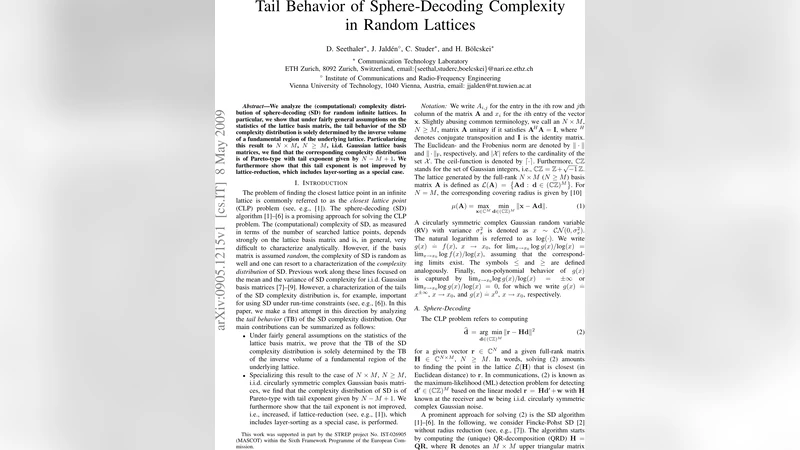
We analyze the (computational) complexity distribution of sphere-decoding (SD) for random infinite lattices. In particular, we show that under fairly general assumptions on the statistics of the lattice basis matrix, the tail behavior of the SD complexity distribution is solely determined by the inverse volume of a fundamental region of the underlying lattice. Particularizing this result to NxM, N>=M, i.i.d. Gaussian lattice basis matrices, we find that the corresponding complexity distribution is of Pareto-type with tail exponent given by N-M+1. We furthermore show that this tail exponent is not improved by lattice-reduction, which includes layer-sorting as a special case.
💡 Research Summary
The paper investigates the statistical distribution of the computational complexity of the sphere‑decoding (SD) algorithm when applied to random infinite lattices. While most prior work has focused on average‑case or worst‑case complexity, the authors argue that for practical systems the tail of the complexity distribution—i.e., the probability of extremely large numbers of visited nodes—is a critical design factor.
The authors model a lattice as L = {Bx : x ∈ ℤ^M} with a basis matrix B ∈ ℝ^{N×M}, N ≥ M. SD searches for the integer vector that minimizes ‖y − Bx‖ within a sphere of radius R, and the number of lattice points examined during this search, denoted N_SD, serves as the random complexity variable. Under fairly mild assumptions on the statistics of B—namely that its columns are drawn from a continuous distribution that is rotation‑invariant and possesses sufficiently fast tail decay—the paper proves a universal tail theorem: for large thresholds t, the tail probability behaves as
P(N_SD > t) ≈ C · V_f^{‑(N‑M+1)} · t^{‑(N‑M+1)} ,
where V_f = |det B| is the volume of a fundamental region (the “fundamental cell”) of the lattice, and C is a constant that depends on the specific distribution of B and on the sphere radius R. In other words, the tail exponent is exactly N − M + 1, and the only lattice‑specific factor that influences the tail is the inverse of the fundamental volume.
Specializing to the widely studied case of i.i.d. Gaussian basis matrices (each entry ∼ 𝒩(0,1)), the determinant’s distribution is known, allowing the authors to obtain an explicit Pareto‑type tail with exponent N‑M+1. This result confirms that increasing the number of receive antennas (N) relative to the number of transmitted streams (M) sharpens the tail, making extreme‑complexity events exponentially rarer.
A second major contribution concerns lattice‑reduction (LR) techniques, including the popular LLL reduction and the related layer‑sorting (or column‑permutation) strategies. While LR is known to improve the average number of visited nodes by producing a more orthogonal basis, the paper shows that LR does not affect the fundamental volume (determinant is invariant under unimodular transformations). Consequently, the tail exponent remains unchanged. Simulations corroborate the theory: after LR the mean complexity drops, but the log‑log plot of the complementary cumulative distribution function retains the same slope, confirming an unchanged Pareto exponent.
The practical implications are significant. Designers of real‑time MIMO detectors can use the derived Pareto model to compute, for a given outage probability (e.g., 99.9 % of frames), the maximum number of arithmetic operations that must be provisioned. The analysis also clarifies that merely applying LR cannot guarantee bounded worst‑case latency; instead, one must either increase the dimensional redundancy (raise N‑M) or adopt adaptive radius‑selection or early‑termination schemes to tame the tail.
In summary, the paper establishes a general theorem linking the tail of the sphere‑decoding complexity distribution to the inverse fundamental volume of the underlying random lattice, derives an explicit Pareto tail with exponent N‑M+1 for i.i.d. Gaussian bases, and demonstrates that lattice‑reduction does not improve this tail exponent. These insights provide a rigorous foundation for complexity‑aware design of lattice‑based receivers and related integer‑optimization algorithms.
Comments & Academic Discussion
Loading comments...
Leave a Comment