Joint universal lossy coding and identification of stationary mixing sources with general alphabets
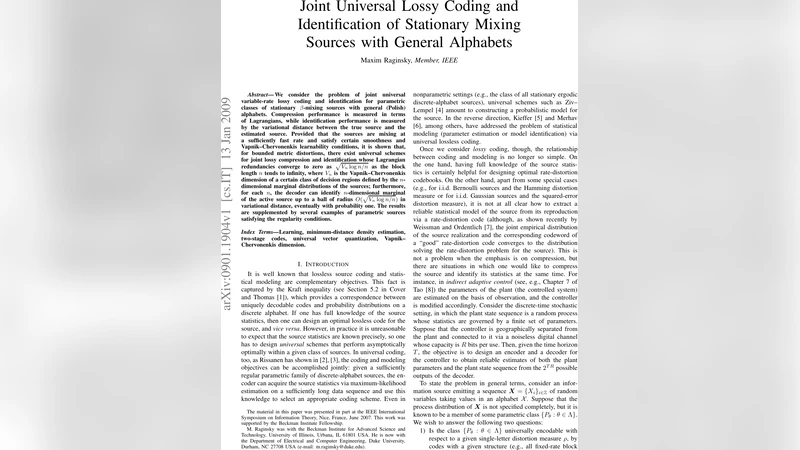
We consider the problem of joint universal variable-rate lossy coding and identification for parametric classes of stationary $\beta$-mixing sources with general (Polish) alphabets. Compression performance is measured in terms of Lagrangians, while identification performance is measured by the variational distance between the true source and the estimated source. Provided that the sources are mixing at a sufficiently fast rate and satisfy certain smoothness and Vapnik-Chervonenkis learnability conditions, it is shown that, for bounded metric distortions, there exist universal schemes for joint lossy compression and identification whose Lagrangian redundancies converge to zero as $\sqrt{V_n \log n /n}$ as the block length $n$ tends to infinity, where $V_n$ is the Vapnik-Chervonenkis dimension of a certain class of decision regions defined by the $n$-dimensional marginal distributions of the sources; furthermore, for each $n$, the decoder can identify $n$-dimensional marginal of the active source up to a ball of radius $O(\sqrt{V_n\log n/n})$ in variational distance, eventually with probability one. The results are supplemented by several examples of parametric sources satisfying the regularity conditions.
💡 Research Summary
The paper tackles the simultaneous problem of universal variable‑rate lossy compression and source identification for parametric families of stationary β‑mixing processes whose alphabets are general Polish spaces. The authors measure compression efficiency by a Lagrangian cost, L = ℓ + λ·E
Comments & Academic Discussion
Loading comments...
Leave a Comment