Joint Adaptive Modulation-Coding and Cooperative ARQ for Wireless Relay Networks
This paper presents a cross-layer approach to jointly design adaptive modulation and coding (AMC) at the physical layer and cooperative truncated automatic repeat request (ARQ) protocol at the data link layer. We first derive an exact closed form exp…
Authors: Morteza Mardani, Jalil S. Harsini, Farshad Lahouti
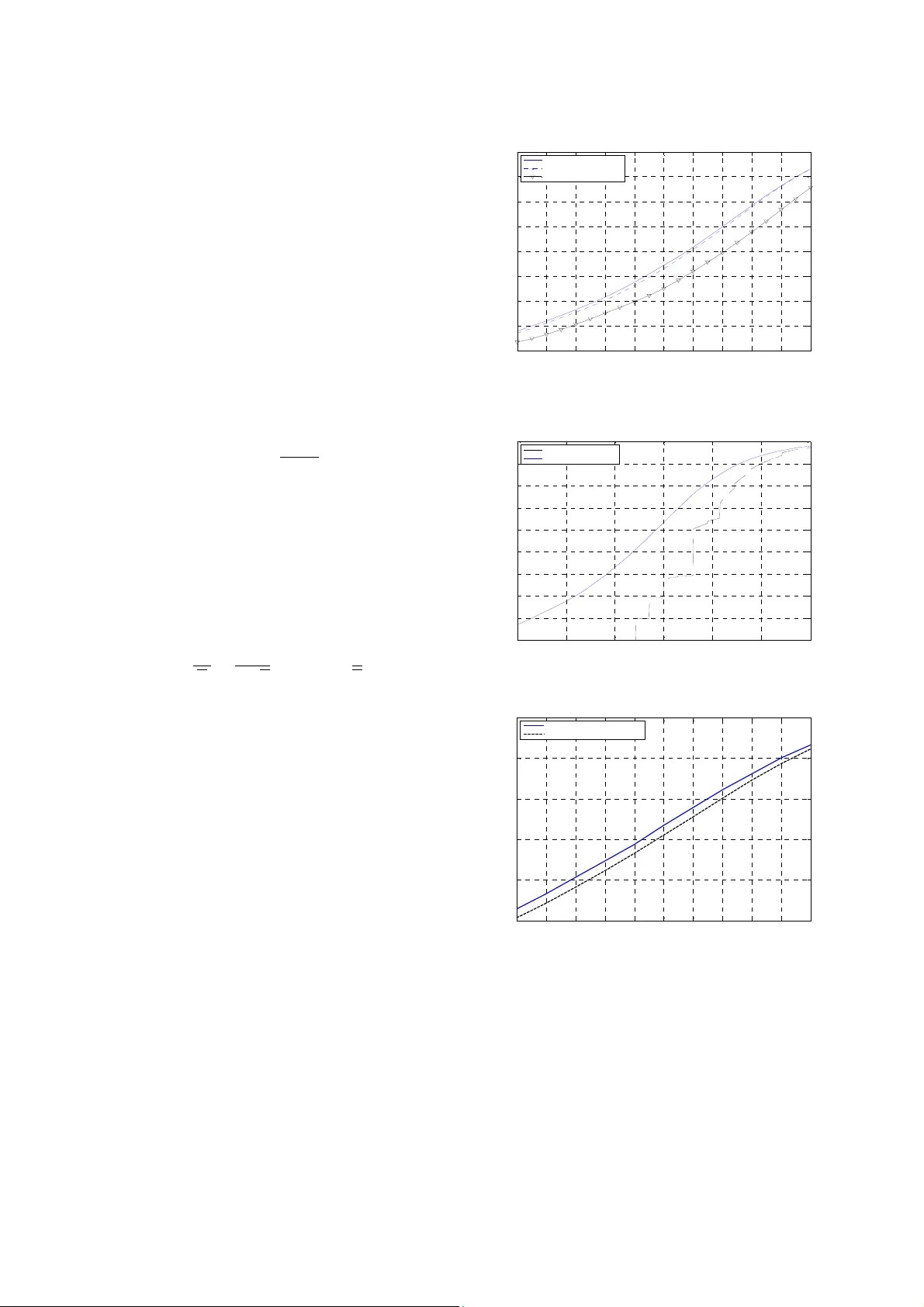
Abstract — This paper presen ts a cross-laye r approach to jointly design adaptive modula tion and coding (AMC) at the physical layer an d cooperative truncated automatic repeat request (ARQ) protocol at the data link layer. We first derive an exact closed form exp ression for the spectral effi ciency of the proposed joint AMC-cooperati ve ARQ scheme. Aiming at maximizing this syst em performance measure, we then optimize an AMC sch eme which directly satisfies a prescribed packet loss rate con straint at the data-link layer. The results indicate that utilizing cooperative ARQ as a retransmission strategy, notice ably enhances the sp ectral efficiency compared with the system that emp loys AMC alone at the physical layer. Moreover, the prop osed adaptive rate cooperative ARQ sch eme outperforms the fixed rat e counterpart when the trans mission modes at the sou rce and relay are chosen based on th e channel statistics. This in turn quantifies the possible gain achieve d by joint design of AMC and ARQ in wireless re lay networks. Index Terms — Adaptive modulation and coding, cooperative ARQ, quality of service, cross-l ayer design. I. I NTRODUCTION Providing quality of service (Qo S) guarantees to various communicat ions applications i s an important ob jective of next generati on wireless netwo rks. However, wirel ess links are subject to time varying fading which li mits their performa nce. Adaptive Modulat ion and Codi ng (AMC) is a powerful technique to combat the effect of fa ding at the physical laye r, which can enha nce the spectral efficiency, dramatically with respect to non-adaptiv e systems [1 ], [2 ] . Still, joint design of AMC and an Automatic Repeat Request (ARQ) prot ocol further e nhances the perfor mance [3]. Cooperative relaying has recently emerged as a powerful spatial dive rsity technique for improve d perform ance [4], [5]. An information theoretic study of the relay channel is presented in the or iginal work of Cover and El Gamal in [6]. Since then, it has been extensively studied and the associated practical protocols have been devised. Specifical ly, the incremental decode and forward rel aying protoc ol, enjoys a high spectral efficiency, owing to limitin g the relay to destination retransmission only to th e instances when the data received at the destination is in error [4]. The selection decode and forward protocol, still checks whether the data received at the relay is correct, prior to a possible relay to destination retransmission [4]. In this direction, a cooperative ARQ protoco l is presented in [7], whic h benefiting fr om the spatial diversity of the relay channel, outperform s a traditional A RQ scheme, particul arly when the source-destinatio n channel is subj ect to a high temporal correlation . The authors in [8] investigate a cross-layer design for combining cooperative div ersity with truncated ARQ in wireless Ad-hoc netwo rks. Using through put performance measure they found optimal packet length and modulati on level which m aximize the syst em throughput . Their results show that the combination o f cooperative diversity with truncated ARQ considerab ly improves the system throughput p erformance, when compared to the traditional truncated ARQ. To apply the idea of AMC to the relay channel a few works are reported in the literature, e.g. [9], [10], [11]. Assuming capacity achievi ng codes, the work in [9] proposes a dis crete power and rate ada ptation algo rithm for fixed deco de and forward relay protoc ol. In [11], a rat e adaptation schem e for coded-coope ration protoc ols based on the channel statistics is presen ted, when an ARQ protocol with possibly infinite number of retransmission s is used. However, desi gning practica l AMC schemes suita ble for QoS constrained applications in wireless relay networks is still an open problem. The main contribution of this paper is to quan tify the potential spectral efficiency gain ach ieved by joint design of discrete-rate AMC with cooperative-ARQ, while satisfying the QoS constr aints of higher layers. To this end, we take a cross-layer des ign approach. We first derive an exact closed form expression for the spectral efficiency of joint AM C- cooperative tr uncated-ARQ schem e over bloc k fading channels. Then based on this performance measure, we propose a cross-lay er design ma ximizing the system performance subject to a packet loss rate (PLR) constraint. Numerical result s show that the prop osed cross-layer design achieves considerable spectra l efficiency gain with respect to AMC alone at the physical la yer. M oreover, it outperf orms the constant rate cooperativ e ARQ, when the transmission modes at the source and relay are chosen base d on the channel statistics . The rest of thi s paper is orga nized as follows. Sect ion II describes the syst em model, includi ng a proposed cooperative AR Q protocol descri ption at the data li nk layer and AMC at th e physical layer. In Secti on III, we first derive the spectral efficiency of th e assumed system model, and subsequently use it to propos e a cross-layer desi gn scheme. Section IV describes t he cooperative AR Q in a fixed rate scenario. Numerical results are provided in section V, while the concluding remarks are presented in sections VI. Joint Adaptive Modulation-Coding and Cooperative ARQ for Wireless Relay Networks Morteza Mardani*, Jalil S. Harsini *, Farshad Lahouti*, Behrouz Eliasi** *Wireless Multimedia Communication Lab., School of E&CE, University of Tehran **Iran Teleco mmunication R esearch Center, PO B ox 14155-39 61, Tehran 14399, I ran Emails: m.mardani@ece.ut.ac.ir, j.harsini@ece.ut .ac.ir, la houti@ut.ac. ir, eliasi@itrc.ac.ir Fig. 1. System model II. S YSTEM M ODEL A. System Description As illustrated in Fig.1 we cons ider a wireless network composed of a sou rce node (S), a relay node (R) and a destination node (D), where each node is equipped with a single antenna. A t the source node, input packets fr om higher laye rs of protoc ol stack are fi rst stored in a transmit buffer, grouped into frames, and then transmitted o ver the wireless channel on a frame by frame basis. We adopt the packet and frame structure as in [3], where the CRC bits of each packet facilitate perfect er ror detection. The considered cooperative-ARQ protocol acts as follows. First th e S node transmits a data frame to both R and D nodes . Upon reception of a packet at node D, it checks the CRC for each packet and transmits either a positive or negative acknowledgement (ACK or NACK). In case, the relay receives a NACK message from the destination, and it has been able to successfully dec ode the correspondi ng packet, it retransmits the packet until it is successfully received at the destination or a maximum allowable number of retransmissions is reached. Othe rwise, the S transmits a fresh packet and the above process is repeated. B. Channel Models and AMC Mod es For S-D, R-D and S-R channels We consider a discrete time channel model and AWGN wi th one-sided p ower spectral density . Both S-D and R-D chann els encoun ter Rayleigh fa ding with stati onary and ergo dic channel gains and , respectively. We adopt a blo ck fading model so that the channel ga ins are consta nt per frame and vary random ly from one fra me to anothe r [13]. Due to the suitable selection of the relay position , we assume that the S- R link is an AWGN chann el with SNR . Both S and R nodes have the sam e constant tra nsmit power level of and a bandwi dth . The in stantaneous received SNR for the S-D and R-D ch annels are ⁄ and ⁄ , respectively. At the physical layer, AMC is empl oyed for both S-D and R-D links based on t heir corresponding cha nnel state inform ation (CSI). We assum e that perf ect CSI is available at the destination and that the selected AMC m odes are fed back to the S and R nodes rel iably and with out delay. The AMC can be employed f or each link by divi ding the entire SNR range into 1 non-o verlapping consecut ive intervals, denote d by , , , , 1,2 , 0 ,…, , where , 0 and , ∞ . When the instantan eous SNR falls in the interval , , , , the m ode of AMC is chosen and the S transmits at the rate of (bits/symbol). Also, when the SNR falls in the interval , , , , the R will transmit at the rate . No signal is transmitted when , , , , 1,2 , correspondi ng to the outa ge modes of S-D and R -D links, respec tively. As the channel gains are assumed constant over a fram e, the corresponding atten uation ma y be compensated at the receiver, and therefore, the c hannel may be considered as AWGN in each frame. In order to simplify the analysis, we approximate the pac ket error rate (PER) for the AMC mode n using the f ollowing expressi on [3] 1, Γ exp , Γ (1) where the parameters { , , } are determined by the curve fitting to the exact PER of mode . III. J OINT D ESIGN OF AMC AND C OOPERATIVE ARQ In this section, we develop a cross -layer approach to jointly design AMC at the ph ysical layer and cooperative ARQ at the data link layer. To guarantee a low delay and a small buf fer size, we assum e that the ma ximum num ber of retransmission attempts per packet at the R node is limited to . Using a limited num ber of ret ransmissions, er ror free delivery of pa ckets is not guarant eed. Therefore, if a packet is not received correctly after the relay retransmissions, it is considered as lost. In additio n to the delay con straint, we also assume that the packet service to be provisi oned imposes a PLR QoS constraint at the data link layer. A. Spectral Efficienc y Here, we derive an exact clos ed-form expression for the spectral efficiency of the pro posed adap tive ra te cooper ative ARQ scheme. In [2] the spectr al efficiency for an adaptive- rate scheme is defined as the average number of i nformation bits transmitted per symbol. In this section, we develop a similar definition for the spectral efficiency of the proposed combining scheme. To this en d, the following Proposition is presented. Proposition 1 : For the considered adaptive rate cooperative ARQ protocol, the a verage spectral efficiency is given by (2), whe re is the PER of AWGN S-R channel i n mode , , 1 ⁄ ∑ 1 ⁄ , , ,…, , , , and , , (3) The probability and PER are obtained by substituting the R-D chann el parameters in and . Proof : consider a packet based system where each pac ket contains a fixed num ber of bits, and is transmitted using L symbols. Each pac ket encounters a vect or of SNR chann el realizations , ,…, until it is received correctly 1 1 , 0 1 , 1 1 , 2 or the maxim um allowable num ber of retransmi ssions is reached. Here the random variable 1 , 2 ,.., depend s on the channel noise. The s pectral efficiency is defined as the average number of transmitted bits per symbol, i.e. , (4) After following some mathematical calculations the equation (4) i s reduced to (2). The det ailed derivation of (2) is omitted here due to lack of space and is available in [14]. Corollary 1 : For an adaptiv e rate traditional ARQ scheme with a maxim um number of retransmissions per packet , when the channe l gain for original transmission and retransmissions of a packet are inde pendent, the average spectral efficiency is obtained from (2) by substituting 0 and . Proof : The proof is straightforward from Proposition 1 by substituting 0 and . B. Optimizing th e Spectral Efficiency Based on the performance m etric derived in t he previous subsection, we now propose a cross-layer design for adaptive-rate cooperat ive-ARQ system with 1 . Extension of the proposed analysis to the case of 1 is straightforward. T he objective is to maximize the average system spectral efficiency subject to a prescribed error requirement as follows max , , , , subject to C: (5) wher e is the target PLR, and is the aver age syste m PLR. The con straint C states that the system packet loss rate is not greater than the target PLR. Proposition 2 : The average system PLR of the considered adaptive rate cooperativ e ARQ protocol is ∑ ∑ ∑ ∑ ∑ ∑ 1 ∑ ∑ (6 ) Proof : The proof is prov ided in appendix A. Having descri bed the perform ance measure and QoS constraints, we now consider the cross-layer desig n problem of interest in (5). Sp ecifically , we propose an ap proach that formulates this problem into two separate designs of AMC for S-D and R-D li nks. In this form ulation, we consider t he following average PERs per m ode , , 1 , 2 ,…, (7) and , , 1 , 2 ,…, (8) where , and , are target PERs. Using equations (6), (7) and (8), satisfy ing the PLR constraint C in (6) wit h equality, we have , , , 1 , (9) where, ∑ ∑ (10) is the average PER over th e S-R channel. The design problem is to find the optimal target PERs, , and , , such that the system spectral efficiency is maximized, while satisfying the equ ation (9). The following algo rithm describes a sea rch method for this purpose. Step 1) Choose , , where the set is , : , 1 (10) Step 2) D esign AMC for the S-D lin k based on the given , , and equatio n (7), followi ng the approach suggested in [12]. Step 3) Compute the averag e PER of S-R channel us ing equation (10). Step 4) Given , , , , using (9), we obtain , , , (11) If , 0 go to step 7. Step 5) Design AMC for the R-D link based on the given , , and equati on (8), follo wing the appr oach suggested in [12]. Step 6) Compute , from (2). Step 7) Repeating steps 1 to 6, determine the op timal , as follows , a r g m a x , , 12 Once, , and subse quently , are obtained, the design process is completed. A special case of interest is to consider a S-R channel with high SNR 0 . In this case, we have , , . Naturally, one in general may devise more efficient design or search solutions for the last step of the algorithm. IV. C OOPERATIVE ARQ IN F IXED R ATE S CENARI O In order to provide a benc hmark for com parison, here we consider a s cenario in wh ich only the average SNR of the corresponding channels are kn own at the source and relay nodes and no i nstantaneous CSI i s available. In this case th e optimized transmission modes at the sour ce and relay nodes can be selected base d on the channel statistics. Consi der the problem of selecting the fi xed optim ized rates and for the S and R node s, respectively , aiming at maxim izing the spectral efficiency subject to the average PLR constraint, i.e., max , , subject to 13 C: , In a manner similar to that proposed in proposition 1, the average spectral efficiency for this scenario i s given by , 1 1 (14) Using the same approach as in Appendi x A, the average PLR is given by , 1 (15) wher e 1 ∞ 0 exp 1 Γ Γ We can obtain by substitu ting n and by m and in . In the absence of ra te adaptation, average system PLR does not satisfy the constraint C over the range of the and . In fact, for each pair , there is a threshold for the transmit power of source and the relay nodes so that t he constraint C is satisfied only for . As in the ca se of adap tive ra te coop erative ARQ (Section III-B), the probl em in (13) can be reduc ed to a simpler single-variable optimization prob lem similar to (12). V. N UMERICAL R ESULTS In this section, we evalua te the performance of the proposed sche mes. For bot h relay and sou rce nodes we use the AMC modes of HYPERLAN/2 standard with packet length 1080 bits as presen ted in table II of [12 ]. We consider the scenari o where the S, R and D lie along a straight line, the S-D distan ce is normalized to unity and the S-R distanc e is denoted by d [9 ] . In this case, the channe l SNRs , are exponential random variables with mean , , 1 . Also, the SNR of AWGN S-R channel is . In our analysis we assume a path loss exponent of 4 and 0.001 . Fig. 2 depicts the average sp ectral efficiency versus the average SNR of S-D link ( ) for adaptive-rate co operative ARQ and AMC-only schem es. We observe that the spectral efficiency of the proposed joint AMC-cooperative AR Q scheme exceeds that of AMC -only scheme by about 0.5 bi ts per symbol. T his considerab le performance gain si gnifies the role of retran smission by the relay. Fig. 2. Spectral efficiency vs. the S-D link SNR for both joint AMC-cooperative ARQ sche me and AMC-only scheme. Fig. 3. Spectral effici ency vs. S-D link SNR for both adaptive rate and fixed rate cooperative ARQ schemes, d= 0.2 . Fig. 4. Comparison between the spectral efficiency of proposed joint AMC-traditional ARQ and t hat in [3] for P loss = 0.001. In Fig. 3 we plot the spectra l efficiency of the adaptive rate and fixed rate cooperative ARQ. As evi dent the proposed joi nt AMC-cooperati ve ARQ scheme provi des much higher spectral effici en cy gain when compared to fixed rate cooperative AR Q thanks to the use of CSI at t he source and relay. As specified in Corollary 1, for 0 , the proposed scheme reduces to a special cas e of AMC com bined with the traditional ARQ scheme. In [3], a similar approach for jointly desi gning of AMC wi th traditional ARQ is propos ed. As depicted in Fig. 4, the spec tral efficiency of the proposed AMC design with traditional ARQ outperforms that o f [3], 0 2 4 6 8 10 12 14 16 18 20 0 0.5 1 1.5 2 2.5 3 3.5 4 S-D lin k av erage SN R ( dB) Average Spect ral Eff iciency(bps/Hz) AM C+ Cooperat i v e ARQ , d= 0. 6 AM C+ Cooperat i v e ARQ , d= 0. 2 AMC -On ly 0 5 10 15 20 25 30 0 0.5 1 1.5 2 2.5 3 3.5 4 4.5 S-D lin k av erage SN R ( dB) Average Spect ral Effec iecny (bps/ Hz) Fix ed rate +Coo perat ive ARQ AM C+ Cooperat i v e ARQ 10 11 12 13 14 15 16 17 18 19 20 1.5 2 2.5 3 3.5 4 S-D lin k av erage SNR ( dB) Avrage Spctral Effeci ecny (bps/Hz) AMC+ t radit ional A RQ, (Propos ed) AMC+ t radit ional A RQ, ([9] ) especially for smaller SNRs. This is because the proposed scheme uses differe nt target PERs for t ransmission and retransmissions of a packet in an optimized manner. VI. C ONCLUSIONS In this pa per we developed a cross-layer approach to jointly design AMC at the physical an d cooperative ARQ at the data link layer to enh ance the system performance for transmissi ons of data packet over bl ock fading rel ay channels. The pro posed scheme maximizes t he system spectral efficiency subject to a prescribed PLR constraint for delay constrained packet servi ces. Numerical results indicate a considerable spectral efficiency gain c an be achieved in compare with AMC-only at th e physical layer. M oreover, the proposed adaptive rate cooperative ARQ scheme outperforms the fixe d rate cooperative ARQ when the transmission modes at the source and relay nodes are selected based on the chan nel statistics. This in turn validates the efficiency of the pr oposed cross -layer approach for designing AMC schemes in wireless relay networks. As a future work we are investig ating the benefits of joint AMC-cooperative AR Q desi gn over correlated fading channels such as land mobile satellite chan nels where due to burst errors the traditional ARQ schemes degrade, sev erely. A CKNOWLEDGEMENT This work has been su pported in part by the Iran Telecommuni cations Research Ce nter. R EFERENCES [1] A. J. Goldsmith and S. Chua, “Var iable-rate variable-power M-QAM for fading channels,” I EEE Trans. Commun. , vol. 45, no. 10, pp. 1218 –1230, Oct. 1997. [2] S. T. Chung and A. J. Goldsmith, “Degrees of freedom in adaptive modulation: a unified view,” IEEE Trans. Commun. , vol. 49, n o. 9, pp. 1561-1570, Sep. 2001. [3] Q. Liu, S. Zhou, and G. Giannakis, “Cross-layer combining of adaptive modulation and coding with truncated ARQ over wireless links,” IEEE Trans. Wireless Commun. , vol. 3, pp. 1746–1755, Sep. 2004. [4] N. Lane man, D. Tse, and G. Wornell, “Cooperative diversity in wireless networks: Efficient pr otocols and outage behaviour,” IEEE Trans. Info. Theory, vol. 50, no. 12, pp. 3062–30 80, Dec. 2004. [5] A. Sendonaris, E. Erkip, and B. Aazhang, “User cooperation diversity-part I and II,” IEEE Trans. Commun ., vol. 5 1, pp. 1927- 1948, Nov. 2003. [6] T. M. Cover and A. E. Gamal, “C apacity theorems for the relay channel,” IEEE Trans. Info . Theory , vol. 25, no. 5, pp. 572–84, Sep. 1979. [7] G. Yu, Z. Zhang, and P. Qiu, “E fficient ARQ protocols for exploiting cooperative relaying in wire less sensor networks,” Elsevier Journal of Computer Communications, vol. 30, pp. 2765–2773, June. 2007. [8] L. Dai and K. B. Letaief, “ C ross-layer design for co mbining cooperative diversity with truncated ARQ in Ad-hoc wireless networks ,” In Proc. IEEE Globeco m , Missouri, USA, Nov. 2005. [9] N. Ahmed, B. Aazhang, “Thr oughput gains using rate and power control in cooperative relay networks,” IEEE Trans. Commun , vol. 55, no. 4, pp. 645–656, April. 2007. [10] B. Can, H. Yo mo, and E. D. Carv alho, “Link adaptation and selection method for OFDM based wire less relay networks,” Journal of Communications and Networks, vol. 9, pp. 118–1 27, Jun. 2007. [11] Z. Lin and E. Erkip, “ Rate adaptation for cooperative systems,” In Proc. IEEE Globecom , San Francisco, CA, USA Nov. 2006. [12] Q. Liu, S. Zhou, and G. Giannakis, “Queuing with adaptive modulation and coding over wire less links: cross-layer analysis and design,” IEEE Trans . Wireless Commun ., vol. 4, pp. 1142–1152, May 2005. [13] Ozarow, L. H., Shamai, S. and, A. D. Wy ner, “Information theoretic considerations for cellular mobile radio, ” IEEE Trans. Veh. Technol ., vol. 43, pp. 359-378, M ay 1994 [14] M. Mardani, J. S. Harsini, F. La houti, B. Eliasi, “Joint adaptive modulation coding and cooper ativ e ARQ over relay channels– Applications to land mobile satellite comm unications”, Submitted to Wiley J. on Wireless Commun. and Mobile Computing, July 2008 . A PPENDIX A Given the instantaneous SNRs , , and a fix ed SNR for the S-D , R-D, and S- R chann els respec tively, u sing the total probability th eorem, the average PLR of the proposed s cheme is given by Pr Loss of packe t | , , , (16) wher e Pr Loss of pack et | , P r : , : | , Pr : , : , : | , (17) Since the channel SNRs and are indepe ndent, we have Pr : , : | , (18) Pr : , : , : | , 1 where , , denote the transm ission over S- D, S-R and R-D links, respectively. f and s also denote the success and failure of the transmission, respectively. In the scen ario under consi deration, in the outage modes of S-D ( . . , ) and R-D links ( . . , ), no data is transmitted by the S a nd R nodes. T herefore, usi ng (16) and (17) the average system PLR can be calculated as , Pr : , : | , , , , Pr : , : , : | , , , (19) Substituting the equatio n (18) in (19) we can obtain ∑ , , ∑ , , (20) ∑ , , ∑ , , ∑ , , ∑ , , after following a few steps, the PLR in equation (20) is expressed as ∑ ∑ ∑ ∑ ∑ ∑ 1 ∑ ∑ (21)
Original Paper
Loading high-quality paper...
Comments & Academic Discussion
Loading comments...
Leave a Comment