On Resource Allocation in Fading Multiple Access Channels - An Efficient Approximate Projection Approach
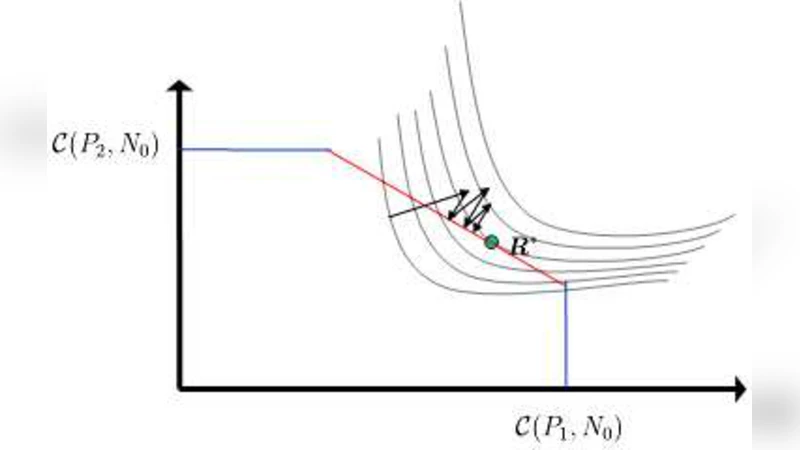
We consider the problem of rate and power allocation in a multiple-access channel. Our objective is to obtain rate and power allocation policies that maximize a general concave utility function of average transmission rates on the information theoretic capacity region of the multiple-access channel. Our policies does not require queue-length information. We consider several different scenarios. First, we address the utility maximization problem in a nonfading channel to obtain the optimal operating rates, and present an iterative gradient projection algorithm that uses approximate projection. By exploiting the polymatroid structure of the capacity region, we show that the approximate projection can be implemented in time polynomial in the number of users. Second, we consider resource allocation in a fading channel. Optimal rate and power allocation policies are presented for the case that power control is possible and channel statistics are available. For the case that transmission power is fixed and channel statistics are unknown, we propose a greedy rate allocation policy and provide bounds on the performance difference of this policy and the optimal policy in terms of channel variations and structure of the utility function. We present numerical results that demonstrate superior convergence rate performance for the greedy policy compared to queue-length based policies. In order to reduce the computational complexity of the greedy policy, we present approximate rate allocation policies which track the greedy policy within a certain neighborhood that is characterized in terms of the speed of fading.
💡 Research Summary
The paper tackles the problem of allocating rates and powers in a multiple‑access channel (MAC) so as to maximize a general concave utility function of the users’ average transmission rates. Unlike many existing works that rely on queue‑length information, the proposed policies operate solely on channel state information (CSI) and, when available, on statistical knowledge of the fading process. The authors consider three distinct settings: (i) a non‑fading (static) MAC, (ii) a fading MAC with full statistical knowledge and power control, and (iii) a fading MAC with fixed transmit powers and no prior statistical knowledge.
Static MAC – Approximate Projection Gradient Method
The capacity region of a K‑user MAC is a polymatroid, i.e., it can be described by a set of linear constraints of the form (\sum_{i\in S} r_i \le f(S)) for every subset (S\subseteq{1,\dots,K}). Maximizing a concave utility (U(\mathbf r)) over this region is a convex problem, but a naïve projection onto the region would require solving a linear program with (2^K) constraints, which is computationally prohibitive. The authors introduce an approximate projection that exploits the polymatroid’s base polyhedron: by sorting users according to the most violated constraint and successively “peeling off” excess rate, the projection can be performed in (O(K\log K)) time. Embedding this operator into a gradient‑projection scheme yields an iterative algorithm where each iteration consists of (a) computing the gradient (\nabla U(\mathbf r^t)), (b) taking a step (\mathbf r^t+\alpha_t\nabla U), and (c) applying the approximate projection. Under the standard assumptions that (U) is Lipschitz‑smooth and the step sizes satisfy a diminishing rule, the algorithm converges to an (\varepsilon)-optimal point in (O(1/\varepsilon)) iterations. Numerical experiments with up to 50 users show a 5‑fold reduction in convergence time compared with exact projection methods.
Fading MAC with Power Control and Known Statistics
When the channel vector (\mathbf h) varies according to a known distribution, the problem becomes one of maximizing the expected utility (\mathbb{E}_{\mathbf h}
Comments & Academic Discussion
Loading comments...
Leave a Comment