Opportunistic Collaborative Beamforming with One-Bit Feedback
An energy-efficient opportunistic collaborative beamformer with one-bit feedback is proposed for ad hoc sensor networks over Rayleigh fading channels. In contrast to conventional collaborative beamforming schemes in which each source node uses channe…
Authors: Man-On Pun, D. Richard Brown III, H. Vincent Poor
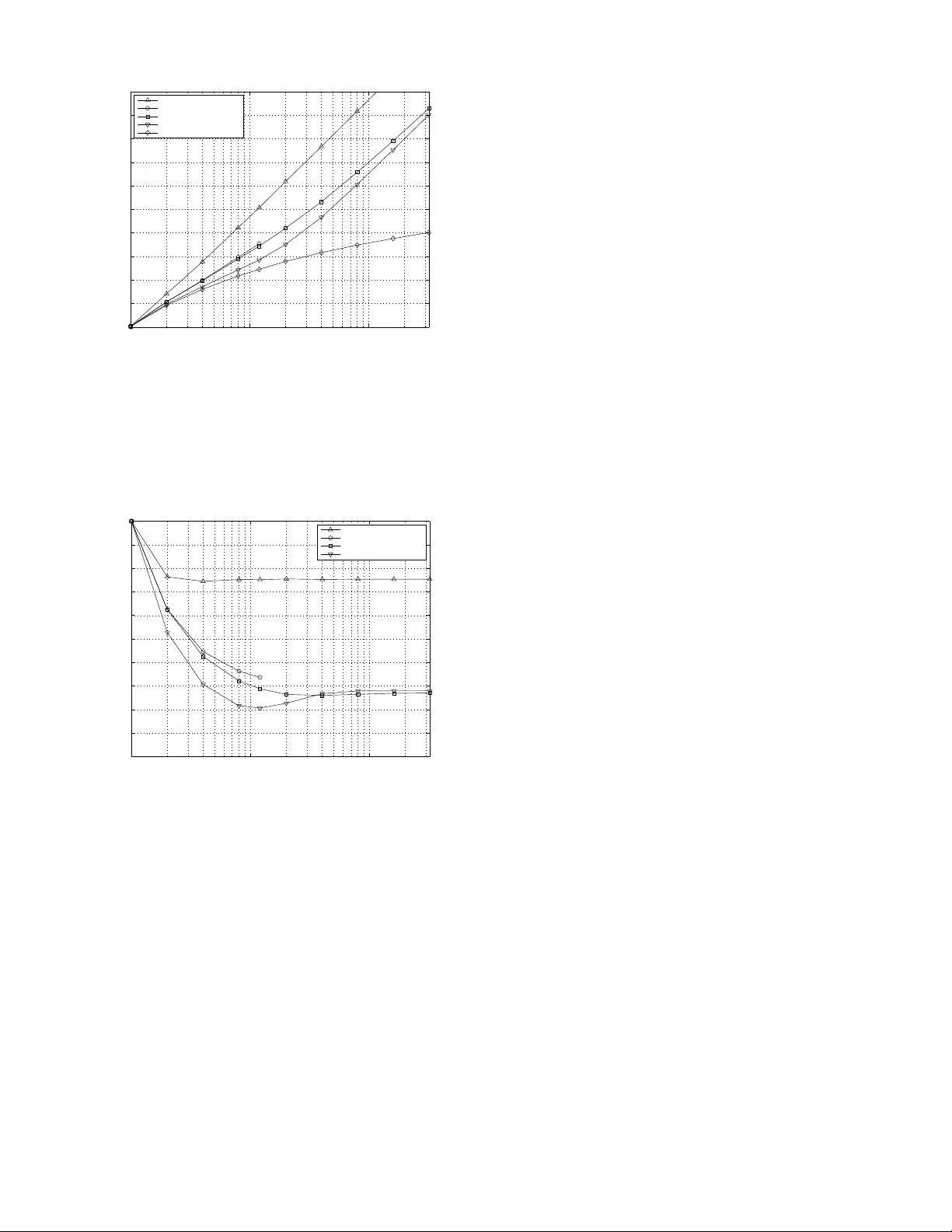
Opportunistic Collaborati v e Beamforming with One-Bit Feedback Man-On Pun, D. Richard Brown III and H. V i ncent Poor Abstract — An energy-efficient opportunistic collabora tive beamf ormer with one-bit feedback is proposed f or a d hoc sensor networks ov er Rayleigh fading chann els. In contrast to con ventional co llaborative beamf orming schemes in which each source node uses channel state infor mation to corr ect its local carrier offset and channel phase, the proposed beamf orming scheme opportunistically selects a subset of source nodes whose recei ved si gnals combine in a quasi-coherent manner at the intended receiv er . No local ph ase-preco mpensation is performed by the n odes in the opportunistic co llaborative b eamf ormer . As a result, each node requires only one-bit of feedback from the d estination in order to d etermine if it sh ould or shouldn ’t participate in the collaborative beamforme r . Theoretical analysis shows that the receiv ed signal power obtained with the proposed beamf orming scheme scales linearly with the number of av ailable source nodes. Since the the optimal node s election rule requires an exhaustive search ov er all possible sub sets of source nodes, two low-complexity selection algorithms are developed. Simu lation results confirm t he effectiveness of opportunistic collaborative beamf orming wi th the low-complexity selection algorithms. I . I N T RO D U C T I O N Collaborative beam forming h as recently attracted con sid- erable research attentio n as an en ergy-efficient tech nique to exploit distributed spatial diversity in ad ho c sensor n etworks [1]–[3 ]. In collaborative b eamformin g, a cluster of low-cost and power-constrained so urce no des collabor ativ ely tr ansmit a common message to a distan t destination node, e.g. a base station (BS) or an un manned aer ial vehicle. It has been demonstrated that collaborative beam forming can provide substantially improved data rate and transmission ran ge by forming a virtual anten na array to direct transmitted signa ls tow ards th e destination node [1], [2]. Howe ver , similar to the conventional bea mformin g tech niques, collaborative beam- forming requires perfect ch annel state in formation (CSI) at each source n ode in or der to achieve coherent combining at the inten ded destination . More sp ecifically , e ach sour ce nod e must pre -compen sate its any local carrier o ffset as well as any phase d istortion caused b y its c hannel such that the b andpass signals from all the no des arri ve at the receiver with identical phase. W ithout prop erly adjusting the pha ses of transmitted signals, collab orativ e beamfo rming ma y perfo rm poorly due to pointing err ors and main beam degradatio n [1]. Man-On Pun and H. V ince nt Poor are with the Department of Elec- trical Engineerin g, Princeton Univ ersity , Princeton, NJ 08544 (e-mail : mopun@princ eton.edu; poor@pr inceton .edu). D. Richa rd Bro wn III is visitin g Princet on Uni v ersity from the Electri- cal and Comput er Enginee ring Department, W orcester Polytechni c Institute , W orcester , MA 01609. (e-mail: drb@wpi.edu). This rese arch was supported in part by the Croucher Fou ndation under a post-doct oral fello wship, and in part by the U.S. Nationa l Science Fou ndation under Grants ANI-03-3 8807, CNS-06-25637, and CCF-0447743. T o o btain CSI, the so urce no des can explo it pilot signals transmitted from the BS by assuming channel reciprocity . Howe ver , sin ce this ap proach in volv es ch annel estimation at each sour ce no de, it imposes h ardware penalties on the sys- tems, which is u ndesirable for developing lo w-cost n etworks. Alternatively , CSI can be estimated by the BS an d returned to the source nodes. While this app roach allows for lo w- complexity source n ode har dware, it may incur excessive feedback overhead , particu larly for networks comp rised of a large nu mber of sou rce n odes. T o circumvent this prob lem, two n ovel appro aches have be en d e veloped in th e literature. In [4], only a subset of the available sou rce nodes with the largest channel gains ar e selected for c ollaborative beam - forming . As a re sult, the total amount of CSI fee dback is reduced propor tionally to the numb er of selected source nodes. Accurate p hase feedba ck, howe ver , may still r equire many bits of inf ormation per selected node. By con trast, feedb ack is completely eliminated in [5] where a distributed scheme was propo sed to select the single source node with the stron gest channel gain . This ap proach , h owe ver , eliminates f eedback by sacrificing th e pote ntial beam forming gains. In this work, we propose opportunistic collaborative bea m- forming with one-b it feed back. Inspired by the observation that bandp ass signals with even moderate phase offsets can still combine to provide beamfo rming gain, the prop osed scheme oppor tunistically selects a subset of av ailable source no des whose transmitted signals com bine in a quasi-constru cti ve manner at the inte nded receiver . Unlike conv entional col- laborative b eamform ing, n o lo cal phase-p recompen sation is perfor med by the source node s. As a result, each node requ ires only one-bit of feedback fr om th e d estination in orde r to determine if it sho uld or shou ldn’t participate in the collabor a- ti ve beamfor mer . T heoretical analysis shows that the received signal power obtained with the pro posed beamformin g scheme scales linearly with the numb er of av ailable sour ce node s. Since the the o ptimal n ode selection rule is e xpon entially complex in t he number of a vailable nodes, two low-complexity selection algorith ms are developed. Simulation results co nfirm the effecti veness of oppo rtunistic c ollaborative beamfo rming with the low-complexity selection algorith ms. Notation : V ectors and matrices ar e deno ted by boldface le t- ters. Further more, we use E {·} , ( · ) T and ( · ) H for expectation, transposition a nd Herm itian transposition . I I . S I G N A L M O D E L W e consider a single-anten na network comprised of K source no des and o ne destination node (th e BS) as illustrated 1 Fig. 1. System under consideratio n for collabo rati ve bea mforming. in Fig. 1. The chan nel gain between the k -th source node and the BS, d enoted b y h k , is mo deled as C N (0 , 1 ) with h k = a k e j φ k , k = 1 , 2 , · · · , K . (1) where a k ≥ 0 an d φ k ∈ ( − π , π ] ar e the Rayleigh-distributed channel amplitude and uniformly -distributed channe l phase, respectively . Furtherm ore, a k and φ k are assumed statis tically indepen dent of each othe r over all source nodes. Denote by s the selection vector of length K . The k - th entry of s is one, i.e. s k = 1 , if and o nly if the k -th source node is selected for transm ission; oth erwise s k = 0 . Thus, the received signal can be written as r = 1 √ s T s h T s d + v , (2) where d is the unit-power data symbol, h = [ h 1 , h 2 , · · · , h K ] T and v is complex Gaussian noise m odeled as C N 0 , σ 2 . It should be em phasized that the to tal transmitted signal p ower is normalized to u nity , regardle ss th e numb er of selected source nodes. As a result, a collabo rativ e beamfo rming schem e is more energy efficient if it pr ovides a higher received sig nal power than single -source tran smission. I I I . T W O - N O D E B E A M F O R M I N G T o shed light on th e beamfo rming ga in of the pro posed scheme, we first consider the case when two sou rce nodes are av ailable for co operative transmission. W e assume without loss of g enerality that a 1 ≥ a 2 . Then we can say P { 1 } = a 2 1 ≥ a 2 2 = P { 2 } . (3) When bo th sources transmit, the received power can be ex- pressed a s P { 1 , 2 } = 1 2 a 1 e j φ 1 + a 2 e j φ 2 2 , (4) = a 2 1 2 1 + ρe j ∆ 2 , (5) where ρ def = a 2 /a 1 and ∆ def = φ 2 − φ 1 . Simu ltaneous trans- mission is optimal if P { 1 , 2 } ≥ P { 1 } , wh ich cor responds to the equiv alent cond ition cos(∆) ≥ 1 − ρ 2 2 ρ . (6) The f ollowing special cases of (6) are of intere st. • When ρ = 1 , bo th sources have identical channel am- plitudes and th e simultan eous transmission co ndition in (6) red uces to | ∆ | ≤ π 2 . The gain with r espect to single- source transmission, the case considered in [5] , can be expressed as Γ = P { 1 , 2 } P { 1 } = 1 2 1 + e j ∆ 2 , (7) which attains a maximum value of 2 when ∆ = 0 and a m inimum value of 1 wh en ∆ = ± π 2 . E ven relativ ely large phase o ffsets between the sources can lead to significant gains with respect to sing le-source transmission. For example, when ∆ = π 3 , the resu lting gain can be comp uted to be Γ = 1 . 76 dB. • When ∆ = 0 , the transmissions fr om b oth sou rces arrive in per fect phase alignme nt at the destination . Interestingly , (6) implies that simultaneou s tran smission is optimal only if ρ ≥ √ 2 − 1 ≈ 0 . 4142 . In other words, ev en thou gh both nodes have perfect phase alignme nt, simultaneou s transmission is optima l only if th e r atio o f the second node’ s ch annel amplitud e to that of the first node is a t least 0 . 4 1 42 . I V . K - N O D E B E A M F O R M I N G The received power of a K - node oppo rtunistic collabora ti ve beamfor mer with the op timal selection rule can be written as P ( K ) opt = max s ∈{ 0 , 1 } K 1 s T s | h T s | 2 . (8) Optimal selection of nodes that participate in the b eamform er entails an exhaustive search over all possible 2 K − 1 possible selection vectors. As a result, th e com putational com plexity required to obtain the op timal selection is f ormidab le, e ven for a modera te value of K . T o better under stand the perfo rmance of the o ptimal op portunistic collab orative beam former, this section d e velops lower and upper bo unds on its p erforman ce for the large-n etwork case, i. e. K → ∞ . For finite K , we also propo se an iterative gr eedy alg orithm for source selection that adds one new source nod e in each iteration such th at the resulting rece i ved power increases in each iteration. A. Larg e-Network Receive d P ower Boun ds Exploiting the in equality | h T s | 2 ≤ | a T s | 2 in (8), wh ere a = [ a 1 , a 2 , · · · , a K ] T , an u pper b ound for P ( K ) opt can be derived by consider ing the case when all of the transmissions are received co herently at zer o p hase, i.e. h k = a k ≥ 0 for all k ∈ { 1 , . . . , K } . As discu ssed in Section III, ev en th ough the no des all combine co nstructively at the destinatio n, the optimal b eamformin g selectio n rule sho uld no t select all K nodes for simultaneous transmission. In stead, only nodes with sufficiently large amplitude should be selected such that the resulting normalized r eceiv ed p ower is m aximized. Denoting the selection thresh old as r , we can write s k = ( 1 if a k ≥ r 0 otherwise . (9) 2 Recall that a k are i.i.d. Rayleigh distributed ch annel am pli- tudes with mean E [ a k ] = √ π 2 . For sufficiently large K , we can say th at lim K →∞ s T s K = Pr ( a k ≥ r ) = e − r 2 . (10) Thus, we can express the received power up per bo und nor- malized by K as lim K →∞ P ( K ) ub ( r ) K = lim K →∞ K s T s Z ∞ r 2 x 2 e − x 2 dx 2 (11) = π 4 f ( r ) , (12) where f ( r ) def = e r 2 erfc ( r ) + 2 r √ π e − r 2 2 , (13) with erfc ( x ) b eing the co mplementar y error function defined as er fc ( x ) = 2 √ π R ∞ x e − t 2 dt . Note that r eceiv ed power upper bound grows linearly with K , as would be expected of an ideal coh erent be amformer . Numerical maximization of f ( r ) can be perf ormed to sh ow that max f ( r ) ≈ 1 . 084 9 and r ∗ = arg max f ( r ) ≈ 0 . 53 1 6 . Hence, we can write lim K →∞ P ( K ) opt K ≤ lim K →∞ P ( K ) ub ( r ∗ ) K = 0 . 852 1 . (14) selection region rejection region P S f r a g r e p l a c e m e n t s r α α Re ( h k ) Im ( h k ) Fig. 2. Sector-ba sed selec tion re gion used to deriv e the recei v ed po wer lowe r bound (19 ). T o develop a lower bound on P ( K ) opt , we pr opose a sub- optimal selection rule using the secto r-based selection region shown in Fig. 2. Th e selection region is char acterized by two parameters: r corr espondin g to a minimum am plitude and α correspo nding to a maximu m angle. Nod es mu st satisfy bo th the min imum amplitu de and max imum ang le requireme nts to be selected f or tran smission, i.e., s k = ( 1 if a k ≥ r and | φ k | ≤ α 0 other wise . (15) Giv en i.i.d. chan nel coefficients h k = a k e j φ k with a k Rayleigh-distributed and φ k unifor mly distributed on ( − π , π ] , the probab ility that h k falls in the selection region Φ c an be expressed as Pr( h k ∈ Φ) = Pr ( | φ i | ≤ α ) Pr ( a i ≥ r ) (16) = α π exp − r 2 . (17) When K is large, th e lower b ound can be expressed as lim K →∞ P ( K ) lb ( r , α ) K = lim K →∞ K s T s Z α − α Z ∞ r cos θ π x 2 e − x 2 dx dθ 2 = sin 2 α 4 α f ( r ) , (18) where we ha ve used the fact that s T s K → P r ( h k ∈ Φ) and f ( r ) is as defined in (13). The term sin 2 α 4 α is not a functio n of r and attains its maximu m when cos α = sin α 2 α . The optimu m value α ∗ ≈ 1 . 1656 rad ians can be f ound nu merically . Since f ( r ) achieves its maximum at r ∗ ≈ 0 . 53 16 , the recei ved power lower bound can b e written as lim K →∞ P ( K ) lb ( r ∗ , α ∗ ) K = 0 . 196 5 ≤ lim K →∞ P ( K ) opt K (19) when K is large. In the sequel, th e selection algorithm em- ploying { r ∗ , α ∗ } is referred to as the “sector-based selection algorithm ”. Summarizin g (1 4) and ( 19), the upper and lower bo unds on the nor malized r eceiv ed power of opportu nistic collabo rativ e beamfor ming with the optimum selection rule can be wr itten as 0 . 1965 ≤ lim K →∞ P ( K ) opt K ≤ 0 . 8 521 . (20) T wo imp lications of th is resu lt me rit furth er discussion: 1) When K is large, the ratio of the upper an d lower bound s im plies tha t P ( K ) opt will be no worse than 6 .37dB below the power of th e ideal coher ent phase- aligned beamfor mer . 2) When K is large, even simple sub-o ptimal selection algorithm s fo r o pportu nistic collabo rativ e bea mforming can re sult in a norm alized r eceiv ed power th at scales linearly with K . Since both the upp er and lower power bound s are linear in K , th e n ormalized received power of th e o ptimum op portunistic collabo rativ e beamforme r must also scale linearly with K . This repre sents a sig- nificant improvement over the single-best-relay selection rule in [5] whose r eceiv ed power scales as log ( K ) [6]. B. Iterative Greedy Selection Algorithm Despite its simplicity and insigh tful a nalytical results, the sector-based selection alg orithm do es not fully exploit the CSI av ailable to the BS. In this section , an iterative greedy algorithm is prop osed to select a sub-optimal subset of sourc e nodes fo r collabora ti ve beam forming with afforda ble com- putational comp lexity . Clear ly , th e success of the alg orithm hinges on effectively determining th e numb er of selected source nodes and identify ing the suitable no des. T he propo sed iterativ e algorith m successfully add resses these two issues by 3 capitalizing on our previous analy sis on the two-nod e case. In each iteration, the prop osed algo rithm adds one new node to the selection su bset b ased on a well-define d c ost fu nction until no furth er b eamform ing gain can b e achieved by adding more nodes. W e denote b y p ( N ) ∈ { 1 , 2 , · · · , K } the nod e ind ex cho sen in the N -th iteration, 1 ≤ N ≤ K . T o facilitate our subsequent deriv ation, we first d efine the f ollowing two quantities: z ( N ) = 1 √ N N X n =1 a p ( n ) e j φ p ( n ) , (21) P ( N ) = z ( N ) 2 , (22) where z ( N ) is the comp osite chann el gain between the N selected source nod es and the BS while P ( N ) is th e corre- sponding rec ei ved signal power . Now , we consider P ( N +1) by addin g one new sou rce node into th e sub set of selected source nod es. P ( N +1) = 1 N + 1 N +1 X n =1 a p ( n ) e j φ p ( n ) 2 , (23) = 1 N + 1 p N P ( N ) + a p ( N +1) e j ∆ N +1 2 , (24) where ∆ N +1 is the r elative phase offset between the newly added ch annel g ain and z ( N ) . Next, we can rewrite (24) as P ( N +1) = 1 N + 1 h N P ( N ) + a 2 p ( N +1) + 2 a p ( N +1) p N P ( N ) cos (∆ N +1 ) i , (25) Clearly , the co ndition P ( N +1) > P ( N ) has to hold in order to inc orporate the p ( N +1) -th sourc e node into the collab orative transmission. After straightfo rward mathematical m anipula- tion, th e con dition can be equivalently r ewritten as cos (∆ N +1 ) > P ( N ) − a 2 p ( N +1) 2 a p ( N +1) √ N P ( N ) . (26) Finally , we are read y to p ropose the following iterative greedy selection algor ithm. De note by I the nod e index set containing sou rce nodes selected for c ollaborative beamf orm- ing. Furthermor e, le t ¯ I be the com plementary set of I over { 1 , 2 , · · · , N } . The proposed gre edy algorith m is summa rized in Algorithm 1. V . N U M E R I C A L R E S U LT S This section presents numerical examples o f the achie vable perfor mance of the proposed opportun istic collabo rativ e beam- forming with respec t to the bo unds dev eloped in Section IV -A and the sing le-best-relay selection sch eme p roposed in [5]. All of the results in this section assume i.i. d. channe l coef ficients h k = a k e j φ k , k ∈ { 1 , . . . , K } , with amplitu des a k Rayleigh distributed with mean E [ a k ] = √ π 2 and phases φ k unifor mly distributed on ( − π , π ] . Algorithm 1 Iterative greed y selection alg orithm States: Initialize N = 1 , I = { 1 } , ¯ I = { 2 , 3 , · · · , K } , z (1) = a 1 e j φ 1 and P (1) = a 2 1 ; Procedure: for N = 1 to K do Find i ∗ = arg m ax i ∈ ¯ I cos (∆ i ) − P ( N ) − a 2 i 2 a i √ N P ( N ) , wh ere ∆ i is the r elati ve phase b etween h i and z ( N ) ; if cos (∆ i ∗ ) > P ( N ) − a 2 i ∗ 2 a i ∗ √ N P ( N ) then 1. Update z ( N +1) = 1 √ N +1 √ N z ( N ) + a i ∗ e j φ i ∗ and P ( N +1) = z ( N +1) 2 ; 2. Set I = I ∪ i ∗ while exclud ing i ∗ from ¯ I ; else T ermin ate the algorithm ; end if end for T o o btain numerica l r esults for finite values of K , mino r modification s wer e made to the ideal co herent upp er bound and sector-based lo wer boun d selection rules. These selection rules were de veloped for the case when K → ∞ and are based on th e statistics of th e channel coefficients, not the current channel realization . Hence, wh en K is finite, it is possible that no node s meet th e selection criteria. It is also possible th at one or mor e nodes meet the selection criteria but the resulting power is less than that of the sing le b est node. The m odified ideal coher ent upp er bou nd and sector- based lower bou nd selection rules check for these c ases and select th e single best no de if either case occurs. Figure 3 shows th e average receiv ed power as a fu nction of the total number of n odes K . The optimum o pportun istic collaborative beam former performance is plotted only for K ≤ 12 due to the com putational complexity of th e exhaustiv e search over 2 K − 1 possible selectio n v ectors. Th e u pper and lower b ounds con firm that the r eceiv ed p ower scaling of oppor tunistic co llaborative beamfo rming is linear in K and , as pr edicted in ( 20), their performan ce g ap is approximate ly 6.37d B fo r large K . These r esults also dem onstrate that the iterative greedy algo rithm outper forms the sector-based selection alg orithm and exhibits an average received p ower perfor mance very close to the op timum exhaustive search, at least for K ≤ 1 2 , with mu ch lower com putational co mplexity . Figure 4 shows the average f raction o f no des selected for participation in the opportunistic collaborative beamf ormer versus the to tal n umber of nod es K . In the case o f the ideal coheren t upp er bound, the fraction of nodes selected con verges to abo ut 75% , which agrees well with our an alytical result Pr ( a k ≥ r ∗ ) = e − 0 . 5316 2 ≈ 0 . 753 8 . This can be further explained b y th e fact that the no des all h av e identical p hase and only nodes with in sufficient amp litude ar e rejected. For K ≤ 12 , the optimum exhau sti ve s earch selectio n rule tends to be mo re inclusive th an either the iterative greedy alg orithm or the sector-based selection algorith m. For large K , th e iter ati ve 4 10 0 10 1 10 2 0 2 4 6 8 10 12 14 16 18 20 number of nodes (K) average received power (dB) ideal coherent upper bound optimal exhaustive search iterative greedy algorithm sector−based lower bound single best relay Fig. 3. A ve rage recei ve d po wer versus the total number of nodes K . greedy algorith m and the sector-based selection ru le tend to select similar fractions of nod es f or beamf orming, with the sector-based selection being slightly more in clusi ve in this scenario. 10 0 10 1 10 2 0 0.1 0.2 0.3 0.4 0.5 0.6 0.7 0.8 0.9 1 number of nodes (K) average fraction of nodes selected ideal coherent upper bound optimal exhaustive search iterative greedy algorithm sector−based lower bound Fig. 4. A vera ge fract ion of nodes sel ected for partici pation in th e colla bo- rati v e bea mformer versus the total number of nod es K . V I . D I S C U S S I O N A N D C O N C L U S I O N S One of the appeals o f oppo rtunistic collabo rativ e beam - forming is that each nod e in the system requires only one bit of feed back in or der to commen ce or halt tran smission. This is in c ontrast to fully-c oherent collaborati ve beamforming schemes that typically re quire sev eral bits o f feedb ack per node in ord er to perf orm local ph ase pre -compen sation (and perhap s additiona l bits to exclude no des with weak ch annels from transmitting ). T he rate at wh ich the sour ce selection vectors must be sent depen ds on the channel coherence time as well as the relative frequ encies of the nodes’ lo cal oscillato rs. In systems with channels that exhib it lo ng coheren ce times, feedback will be required at a rate inv ersely pr oportion al to the maxim um carrier f requency difference among th e no des. Outlier nod es with large car rier offsets could be p ermanently excluded f rom the pool of av ailable nodes to reduce the fe ed- back rate req uirement. Mor e detailed stud ies o n the feedba ck rate req uirement for oppo rtunistic collab orative beamform ing under g eneral chan nel con ditions are of im portance. Throu ghout o ur previous discussions, we ha ve concen trated on the centralized selection in which the BS f eedbacks the selection decision to the source nodes. Howe ver , it is worth emphasizing that th e thresho ld-based selection algor ithm can be also easily implemented in a distributed manner . W e assume that each node only ha s perfect k nowledge abou t its own channel by exploitin g a pilot sign al tra nsmitted from the BS. Similar to [5], we can c onsider a system where each no de sets a timer inv ersely propo rtional to its chan nel g ain. Upon its timeout, the node with th e strong est channel gain first broadc asts its own ch annel info rmation (amplitud e a nd ph ase) to its p eer nod es. This is in co ntrast to [ 5] in w hich the best node simply starts sendin g d ata to th e BS. Exp loiting the rec ei ved infor mation about the strongest ch annel gain, each n ode can compa re its own chann el amplitude an d ph ase against some pre-design ed thresholds. In the n ext time slot, the nodes with channel conditio ns exceeding the thresholds start tr ansmitting data simu ltaneously with the best n ode. The main contributions of this work are th e development of an energy -efficient opp ortunistic collabo rativ e beamfo rmer with o ne-bit f eedback an d a unification of the ideas of collab- orative beam forming and relay selection. Unlike conventional collaborative beamforming , opportunistic co llaborative beam - forming is applicable in n etworks with n odes that m ay not be able to con trol their carrier f requency o r phase. While optimal node selection fo r oppor tunistic c ollaborative beamf orming is exponentially co mplex in the num ber o f av ailable nodes, we showed that low-complexity selection rules can p rovide near- optimum beam forming gain with perfo rmance within 6.37dB of an id eal fully- coherent collabo rativ e beam former . W e also showed, in contrast to single-best-r elay selection, that the received power of opportunistic collabo rativ e b eamform ing scales line arly with the num ber of av ailable no des. R E F E R E N C E S [1] H. Ochiai, P . Mitran, H. V . Poor , and V . T a rokh, “Colla borati v e beam- forming for distrib uted wireless ad hoc s ensor networks, ” IEE E T rans. Signal Pr oc. , vol. 53, no. 11, pp. 4110–4124, Novembe r 2005. [2] R. Mudumbai, G. Barriac, and U. Madhow , “On the feasibilit y of distrib uted beamforming in wirele ss network s, ” IEEE T rans. W ireless Comm. , vol. 6, no. 5, pp. 1754–1763, May 2007. [3] D. R. Bro wn, G. B. Prince, and J. A. McNeill, “ A method for carrier frequenc y and phase synchroniz ation of two autonomous coopera ti ve transmitt ers, ” in Pro c. IEEE W orkshop Signal Pro cess. A dvance s in W i rel ess Commun. , New Y ork, NY , June 2005. [4] R. Madan, N. Mehta, A. Molisch, and J . Zhang, “Energy- ef ficient coopera ti ve relaying over fading chann els with simple relay selection , ” in Pr oc. IEEE Global T elecommunic ations Conf er ence , San Francisco, CA, Nov ember 2006. [5] A. Bletasa, A. Khisti, D. P . Reed, and A. Lippman, “ A simple cooperati ve di versi ty method based on network path selecti on, ” IEEE J ournal Select. Area s Commun. , v ol. 24, no. 3, pp. 659–672, March 2006. [6] P . V isw anath, D. N. C. Tse, and R. Laroia, “Opportunisti c beamforming using dumb ante nnas, ” IEEE T r ans. Info. Theory , vol. 48, no. 6, pp. 1277– 1294, June 2002. 5
Original Paper
Loading high-quality paper...
Comments & Academic Discussion
Loading comments...
Leave a Comment