On the Throughput Allocation for Proportional Fairness in Multirate IEEE 802.11 DCF
This paper presents a modified proportional fairness (PF) criterion suitable for mitigating the \textit{rate anomaly} problem of multirate IEEE 802.11 Wireless LANs employing the mandatory Distributed Coordination Function (DCF) option. Compared to t…
Authors: F. Daneshgaran, M. Laddomada, F. Mesiti
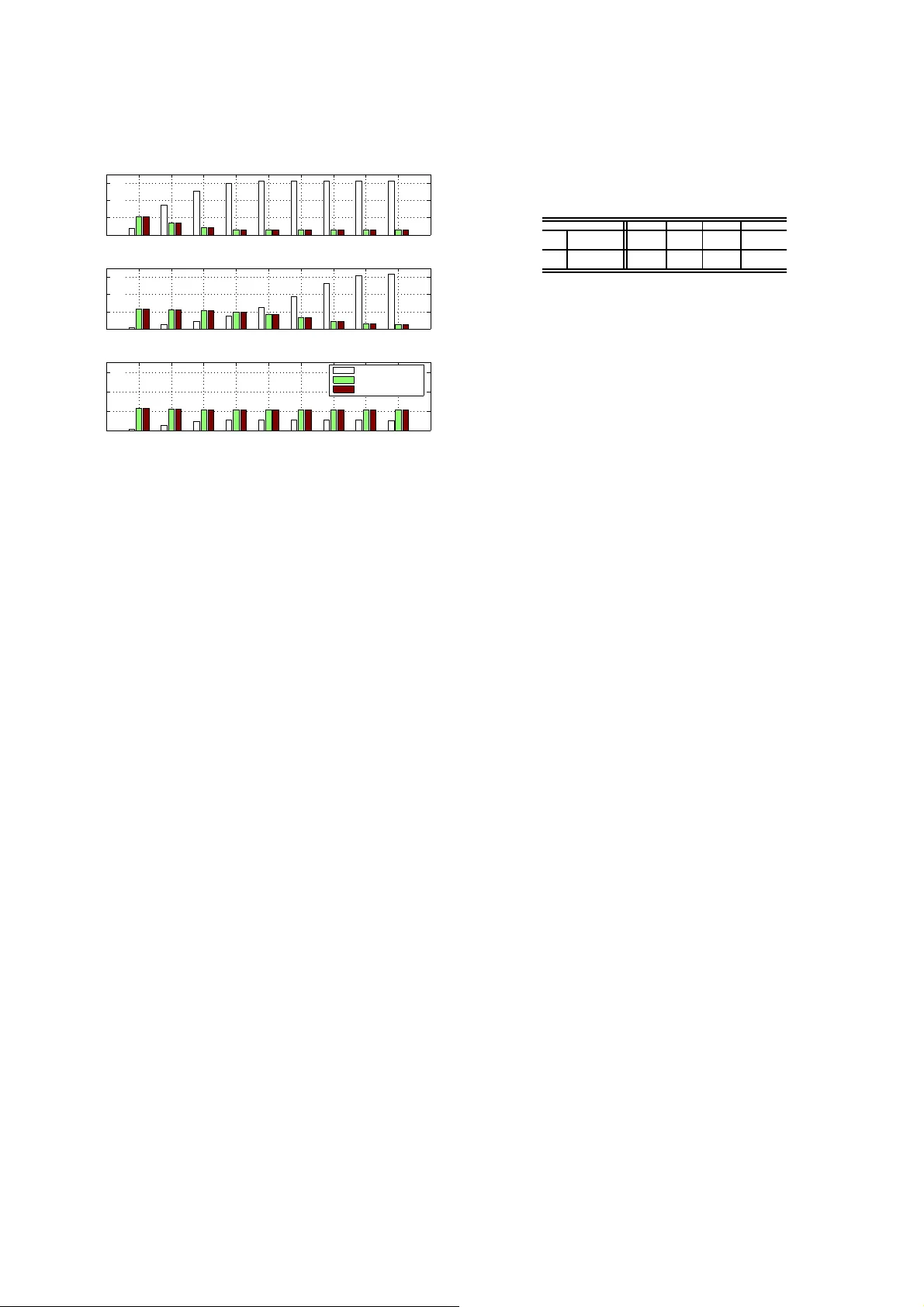
1 On the Throug hput All ocation for Proportional F airness in Multirate IEEE 802 .11 DCF F . Danesh garan, M. Ladd omada, F . Mes iti, and M. Mond in Abstract — This paper presents a modified proportional fair- ness (PF) criterion suitable f or mitigating the rate anomaly problem of multirate IEEE 802.11 Wireless LANs employing the mandatory Distributed Coordin ation Function (DCF) opti on. Compared to th e widely adopted assumption of saturated net- work, the p roposed criterion can be applied to general networks whereby the contending stations are characterized by sp ecific packet arrival rates, λ s , and transmission rates R s d . The throughput allocation resulting from th e proposed algo- rithm is able to greatly increase th e aggr egate t hroughput of the DC F while en suring fairness levels among the stations of th e same order of th e ones a vailable with the classical PF criterion. Put simply , each station is allocated a throughput that depend s on a suitable normalization of its p acket rate, whi ch, to some extent, measures the frequency by wh ich the station tries to gain access to the ch annel. Simulation results are presented for some sample scenarios, confirming the eff ectiv eness of th e proposed criterion. I . I N T R O D U C T I O N Consider the IEEE80 2.11 Medium Access Contro l (MAC) layer [1] employing th e DCF b ased on the Carrier Sense Mu l- tiple Access Collision A voidance CSMA/CA access method . The scen ario envisaged in this work con siders N co ntending stations; each station generates data pa ckets with constant rate λ s by employing a bit rate, R s d , which de pends on th e channel quality experien ced. In this scen ario, it is known that the DCF is affected b y the so-called performance a nomaly prob lem [2]: in mu ltirate networks the aggregate throughp ut is stro ngly influenced by that of the slowest co ntending station. After th e landmark work b y Bianchi [ 3], who provided an a nalysis of the saturation throug hput of the basic 802 .11 protoco l assuming a two dimensional Markov model at the MA C layer, m any p apers have addressed almost any facet of the behaviour of DCF in a variety of traffic lo ads an d chan nel transmission con ditions (see [4 ]-[6] an d referen ces therein). A curr ent top ic o f interest in co nnection to DCF regards th e allocation of throug hput in o rder to mitigate the perfor mance anomaly , while ensuring fairness among multirate stations. W ith this backgr ound, let us pr ovide a q uick survey of the recent literatur e related to the p roblem addre ssed here. Paper [7] propo ses a p ropor tional fairness thro ughpu t allo cation criterion for multirate an d saturated IEEE 8 02.11 D CF b y focusing on th e 8 02.11e stan dard. In pap ers [ 8]-[11] the authors propo se novel fairness cr iteria, which fall within the F . Daneshgar an is with E CE Dept., California State Univ ersity , Los Ange- les, USA. Massimilia no Laddomada is with th e Elec trical Engine ering Dept. of T exas A&M Uni ver sity-T exarkana , email: mladdomada@ tamut.edu. F . Mesiti and M. Mondin are with DELEN, Politec nico di T orino, Italy . class o f the time-based fairness criterion. Time-based fairness guaran tees eq ual time- share o f the cha nnel occup ancy irr e- spectiv e o f the station bit r ate. Fina lly , paper [1 2] in vestigates the fairness pro blem in 802 .11 multir ate networks from a theoretical point of view . A commo n hypoth esis employed in the literature regards the saturation assump tion. Howe ver , real ne tworks a re different in many respects. T raffic is mo stly non -saturated, different stations usually op erate with d ifferent load s, i.e., they have different pac ket rates, while the transmitting bit rate can also differ a mong the contend ing stations. I n all these situations the commo n hy pothesis, widely em ployed in th e literature, that all the co ntending statio ns h av e the same prob ability of transmitting in a rand omly ch osen tim e slo t, does not ho ld anymore. The aim of this paper is to p resent a p roportio nal fairness criterion un der mu ch more realistic scenarios, espe- cially when th e packet rates among th e station are different. As a starting po int for the der i vations that follow , we co nsider the bi-dim ensional Markov model pro posed in the c ompanio n paper [ 4], a nd presen t the necessary mod ifications in order to deal with the prob lem at hand . The rest of the pap er is organiz ed as fo llows. Section II provides the necessary modifications to the Marko v model pro- posed in [4]. For conciseness, we invite the interested read er to refer to [4] for further details ab out the bi-dimension al Markov mod el. The n ovel pro portion al fairness criterion is presented in Section III. Simulatio n results of samp le network scenarios are discussed in Section IV, while Section V draws the conclu sions. I I . E X T E N S I O N S T O T H E M A R K O V I A N M O D E L In a comp anion p aper [4], we de riv ed a bi-dim ensional Markov m odel for characterizin g the behavior of the DCF under a variety of re al traffic con ditions, b oth no n-saturated and saturated , with packet queu es of small sizes, multirate setting, and considered the IEE E 802. 11b proto col with the basic 2-way h andshakin g mechanism. As a startin g po int for the de riv ations which follow , we ado pt the bi-dimension al model pr oposed in [4], app ropriately modified in ord er to account for the following scenario. In the in vestigated network, each statio n employs a specific bit rate, R ( s ) d , a different trans- mission packet rate, λ s , transmits packets with size P L ( s ) , and it em ploys a minim um c ontention window with size W ( s ) 0 , which can differ fro m th e o ne specified in the IEEE 80 2.11 standard [1] (this is req uired for op timizing the ag gregate throug hput while gu aranteeing fairness among th e contend ing stations). For the sake of greatly simplifyin g the ev alu ation of 2 the expec ted time slo ts re quired by the theo retical derivations that follow , we consider N c ≤ N classes of channel occupancy duration s. This assumption relies on the observation that in actual networks some stations mig ht transmit data frames presenting the same channel occup ancy . The scenario at hand r equires a nu mber of modificatio ns to th e p revious theo retical results derived in [4]. First of all, given the pay load length s an d the d ata rates of the N stations, the N c duration -classes are arranged in ord er of decreasing du rations iden tified b y the index d ∈ { 1 , · · · , N c } , whereby d = 1 identifies the slo west class. Notice that in our setup a station is labelled as fast if it has a short ch annel occupan cy . Fu rthermor e, each station is ide ntified by an ind ex s ∈ { 1 , · · · , N } , an d it belon gs to a unique d uration-c lass. In order to id entify the class of a station s , we d efine N c subsets n ( d ) , e ach of th em contain ing the indexes of the L d = | n ( d ) | stations within n ( d ) , with L d ≤ N , ∀ d an d P N c d =1 L d = N . As a n instanc e, n (3) = { 1 , 5 , 8 } mean s that stations 1, 5, and 8 belo ng to the th ird duratio n-class iden tified by d = 3 , an d L d = 3 . W ith this setup , the probability that the s -th station starts a transmission in a rando mly chosen time slot is identified by τ s , and it can be obtained by so lving th e b idimension al Markov chain for the conten tion mod el of th e s -th station [4]: τ s = 2(1 − b ( s ) I )(1 − 2 P ( s ) eq ) ( W ( s ) 0 + 1)(1 − 2 P ( s ) eq ) + W ( s ) 0 P ( s ) eq [1 − (2 P ( s ) eq ) m ] (1) whereby b ( s ) I is the station ary pro bability to be in an id le state mod elling u nloaded conditio ns 1 , W ( s ) 0 is the minimu m contention win dow size of th e s -th station, and P ( s ) eq is th e probab ility of equivalent f ailed transm ission defined as P ( s ) eq = 1 − (1 − P ( s ) e )(1 − P ( s ) col ) = P ( s ) col + P ( s ) e − P ( s ) e · P ( s ) col , wh ereby P ( s ) col and P ( s ) e are, respec ti vely , th e collision and the packet error prob abilities related to the s -th station . Giv en τ s in (1), we can ev aluate the aggregate through put S as follows: S = N X s =1 S s = N X s =1 1 T av P ( s ) s · (1 − P ( s ) e ) · P L ( s ) (2) whereby T av is th e expected time per slot, P L ( s ) is the packet size of the s -th station, and P ( s ) s is the probab ility of s uccessful packet transmission of the s -th station: P ( s ) s = τ s · N Y j =1 j 6 = s (1 − τ j ) (3) The expected time per slot, T av , can be ev alu ated by weighting the times spent by a station in a particula r state with the probab ility of being in that state as alread y m entioned in [4]. Upon observin g the basic fact that there a re four kinds of time slots, nam ely id le time slot, successfu l transmission time slot, collision time slot, a nd chan nel error time slot, T av can be ev aluated by adding the fou r expected slot duration s: T av = T I + T C + T S + T E . (4) 1 Briefly , this state models the situations when, immediatel y after a success- ful transmission, the queue of the transmitt ing station is empty , or the statio n is in an idle state with an empty queue until a new packet arriv es in the queue. Let us evaluate T I , T C , T S , and T E . Upon iden tifying with σ an idle slot duration , and defining with P T R the pro bability that the ch annel is busy in a slot beca use at least o ne station is transmitting: P T R = 1 − N Y s =1 (1 − τ s ) (5) the average idle slot duration can be ev alu ated as fo llows: T I = (1 − P T R ) · σ (6) The av erage slot duration of a successful transmission, T S , can be fou nd upon av eraging the prob ability P ( s ) s that only the s -th tagg ed station is suc cessfully tr ansmitting over the channel, times th e du ration T ( s ) s of a suc cessful transmission from the s -th station: T S = N X s =1 P ( s ) s “ 1 − P ( s ) e ” · T ( s ) S (7) Notice that the term (1 − P ( s ) e ) accounts for the proba bility o f packet transmission without channel induced errors. Analogou sly , the average d uration of th e slot du e to erro- neous transmissions can be ev alu ated as fo llows: T E = N X s =1 P ( s ) s · P ( s ) e · T ( s ) E (8) Let us focus on the evaluation of the expec ted collision slot, T C . There are N c different values of the collision probab ility P ( d ) C , d ependin g on the class o f the tagg ed station identified by d . W e assume th at in a collision of du ration T ( d ) C (class- d collisions), only the stations belongin g to the same class, or to h igher classes (i. e., stations whose c hannel o ccupancy is lower than the one of stations belonging to the tagged station indexed by d ) might be inv o lved. In order to identify the collision prob ability P ( d ) C , le t us first defin e the following th ree tr ansmission pro babilities ( P C ( d ) T R , P H ( d ) T R , P L ( d ) T R ) un der the hypo thesis that th e tagged station belong s to the class d . Pr obability P L ( d ) T R represents the probab ility that at least an other station belo nging to a lower class transmits, and it can be ev alu ated as P L ( d ) T R = 1 − d − 1 Y i =1 Y s ∈ n ( i ) (1 − τ s ) (9) Probability P H ( d ) T R is the p robability that at least o ne station belongin g to a higher class tra nsmits, and it can be ev alu ated as P H ( d ) T R = 1 − N c Y i = d +1 Y s ∈ n ( i ) (1 − τ s ) (10) Probability P C ( d ) T R represents the p robability th at at least a station in the same class d transmits: P C ( d ) T R = 1 − Y s ∈ n ( d ) (1 − τ s ) (11) Therefo re, the co llision prob ability fo r a generic class d takes into a ccount o nly collisions between at le ast o ne station of class d and at least on e station within th e same c lass (intern al 3 collisions) or belo nging to h igher class (external collisions). Hence, the total collision probab ility can be evaluated as: P ( d ) C = P I ( d ) C + P E ( d ) C (12) whereby P I ( d ) C = (1 − P H ( d ) T R ) · (1 − P L ( d ) T R ) · (13) · P C ( d ) T R − X s ∈ n ( d ) τ s Y j ∈ n ( d ) ,j 6 = s (1 − τ j ) represents the internal collisions be tween at lea st two stations within the same class d , while the remaining are silent, and P E ( d ) C = P C ( d ) T R · P H ( d ) T R · (1 − P L ( d ) T R ) (14) concern s to the external collisions with at least o ne station of class higher t han d . Finally , the expected duration of a collision slot is: T C = N c X d =1 P ( d ) C · T ( d ) C (15) Constant time dur ations T ( s ) S , T ( s ) E and T ( d ) C are de fined in a manner similar to [4] with the slight difference tha t the first two duratio ns are associated to a generic statio n s , while th e latter is associated to each du ration class, wh ich depend s on the combinatio n of both payload length an d data rate of the station of class d . A. T raffic Mod el The employed traffic m odel assumes a Poisson distributed packet arriv al proc ess, where inter arriv al times between two packets are expon entially distributed with m ean 1 /λ . In o rder to g reatly simplify the analysis, we consider small queu e (i.e., K Q → 1 , where K Q is the q ueue size expr essed in number of packets). In order to a ccount for th e station traffic, the Mar kov model employs two prob abilities, q an d P I , 0 , defined as in [4]. Briefly , non -saturated tr affic is accou nted for by a new state labelled I , which con siders the fo llowing two situation s: 1) After a succ essful transmission , the queue of the transmitting station is empty . Th is event occurs with probab ility (1 − q ( t ) )(1 − P ( t ) eq ) , whereby q ( t ) is th e probability that th ere is at least one packet in the queue after a successful transmission. 2) The station is in an idle state with an e mpty queue un til a new pac ket arrives in the que ue. Pro bability P ( t ) I , 0 represents th e pr obability that wh ile the statio n resid es in the idle state I there is at least one pac ket arriv a l, and a new b ackoff p rocedu re is schedu led. I n o ur analysis, each station has its own traffic; theref ore, fo r the t -th tagged station we h av e q ( t ) and P ( t ) I , 0 , w hich can be ev aluated as q ( t ) = 1 − e − λ ( t ) · T av and P ( t ) I , 0 = 1 − e − λ ( t ) · T − t av , resp ecti vely . Notice that q ( t ) and P ( t ) I , 0 stem from the fact that, for expo nentially distributed in terarriv al times with mean 1 /λ ( t ) , the pro bability of having at least one packet arriv a l du ring time T is equal to 1 − e − λ ( t ) · T . Co ncerning P ( t ) I , 0 , th e average time spent b y the system in the id le state, i.e., T − t av , is evaluated as T av in (4) except for the fact that the tagged station is not c onsidered in the evaluation of the expected times definin g T av . On the other ha nd, q ( t ) is calculated over the entire average time slot duration , which also co nsiders th e tagged station. I I I . T H E P RO P O RT I O NA L F A I R N E S S T H RO U G H P U T A L L O C AT I O N A L G O R I T H M This section presents the novel thro ughpu t alloc ation crite- rion alo ng with a variation that proved to b e usef ul in relatio n to the packet rate of the slo west station in the network. In order to face the fairness prob lem in the most g eneral scen ario, i.e., multirate DCF an d general station lo ading cond itions, we pro- pose a novel proportio nal fairness criterion (PFC) by startin g from the PCF define d by Kelly in [13], and emp loyed in [ 7] in c onnection to p ropor tional fairn ess throug hput alloca tion in multirate and saturated DCF operation s. In the p roposed model, the tr affic of each station is charac- terized by the pac ket arriv al r ate λ s , wh ich depen ds mainly on the application layer . Upon setting λ max equal to the maximum value amo ng th e p acket rates λ 1 , . . . , λ N of the N contend ing stations, consider the following m odified PFC: max U = U ( S 1 , · · · , S N ) = P N s =1 λ s λ max · log( S s ) subject to S s ∈ [0 , S s,m ] , s = 1 , . . . , N (16) whereby S s is th e throug hput of the s -th station, and S s,m is its maximum value, which eq ual the station bit rate R ( s ) d . In o ur scenario, th e individual thr oughp uts, S s , are in terlaced because of the inter depend ence of th e pro babilities in volved in the transmission pro babilities τ s , ∀ s = 1 , . . . , N . For this reason, we reformu late the maximiza tion pro blem in order to find the N optimal values of τ s for which the cost f unction in (1 6) gets maximized . Put simply , upo n starting fr om the optimum τ ∗ s , we obtain the set of para meters of each station such that optimal point is attained. Due to the compactn ess of the feasible region S s ∈ [0 , S s,m ] , ∀ s , the maximu m of U ( S 1 , · · · , S N ) can be found among the solution s o f ∇ U = ∂ U ∂ τ 1 , · · · , ∂ U ∂ τ N = 0 . After some algebra, the solutions can be written as: λ j λ max 1 τ j − 1 1 − τ j N X k =1 ,k 6 = j λ k λ max = C T av ∂ T av ∂ τ j , ∀ j = 1 , . . . , N (17) whereby C = P N i =0 λ i λ max , and T av is a function of τ 1 , · · · , τ N as noted in (4). Due to th e presence of T av , a closed form o f the m aximum of U ( S 1 , · · · , S N ) cannot b e f ound. Notice that it is quite difficult to derive th e c ontribution of the p artial der i vati ve of T av on τ j , e specially when N ≫ 1 , because of th e hug e number o f n etwork par ameters belo nging to different stations. The definition of T av in (4) is co mposed b y fo ur d ifferent terms, anyone of which includes th e wh ole set of τ s , ∀ s . In order to overcom e th is pro blem, we first obtain the optimal values τ ∗ s , ∀ s from (17) by mean s of Mathematica. Then , we choose the value of the minimu m con tention wind ow size, W ( s ) 0 , by equating the optimizin g τ ∗ s to (1) for any s . The results of the optimizatio n problem (16) will be denoted by the acronym LPF in the following. Let us d erive some observations on the proposed throu ghput allocation algorithm by contrasting it to the classical PF alg o- rithm. Upon employing th e classical PF meth od, a th rough put allocation is prop ortionally fair if a red uction o f x % of the throug hput allocated to o ne station is coun terbalanced by an 4 increase of more than x % o f the through puts allocated to the other co ntending stations. The key ob servation in o ur setu p can be summarized as follows. Consider the tw o stations above with packet rates λ 1 = 5 0 pk t/s and λ 2 = 1 00 p kt/s, r espec- ti vely . The ratio λ 1 /λ 2 can be interp reted as the freq uency b y which the first station tries to g et access to the chann el relative to the other station. By doin g so , in ou r setup a th rough put allocation is pr oportio nally fair if, for instan ce, a redu ction of 20% of the thro ughpu t allocated to the first station, wh ich h as a relative fr equency of 1 / 2 , is coun terbalanced by an increase of mo re than 40% of the thro ughpu t allocated to the second station. I n a scen ario with multiple c ontendin g stations, the relativ e freq uency is evaluated with respect to the station with the highest pa cket rate in th e n etwork, which gets u nitary relativ e frequency . Based on extensive analysis, we foun d that the o ptimization problem (16) sometim es y ields th rough put allocations that cannot b e actually m anaged by th e stations. As a reference example, assum e that, du e to the specific cha nnel co nditions experienced, the first station has a bit r ate equal to 1 Mbps and need s to transmits 2 00 pkt/s. Given a packet size o f 1 024 bytes, that is 8192 bits, the first station would n eed to tr ansmit 8192 × 200 bps ≈ 1 . 6 4 Mbps far above the maximu m b it r ate decided at the p hysical lay er . In this scenario, su ch a station could no t sen d over the ch annel a throug hput gr eater than 1Mbps. The same applies to the o ther co ntending stations in the network experien cing similar con ditions. In ord er to face this issue, we considere d the following optimization problem max P N s =1 λ ∗ s λ ∗ max · log( S s ) over S s ∈ [0 , S s,m ] , s = 1 , . . . , N (18) whereby , ∀ s = 1 , . . . , N , it is λ ∗ s = ( λ s if λ s · P L ( s ) · 8 ≤ R ( s ) d R ( s ) d 8 · P L ( s ) if λ s · P L ( s ) · 8 > R ( s ) d and λ ∗ max = max s λ ∗ s . Th e allocatio n prob lem in (18), solved as fo r the LPF in ( 16), gu arantees a thr oughp ut allocation which is pr oportion al to the freque ncy of c hannel acc ess of each station relative to their actual ability in managin g such traffic. T he re sults of th e optimizatio n problem (1 8) will be denoted by the acronym MLPF in the following section. I V . S I M U L A T I O N R E S U LT S This section pr esents some p reliminary simulatio n results obtained for two network scen arios optimiz ed with the fair - ness criteria prop osed in the pr e vious section. T ypical MA C layer p arameters fo r IEE E802.1 1b [1] have been u sed fo r perfor mance validation. Due to space limitations, we invite the interested reader to c onsult [4] for a list of the network parameters e mployed here as well as fo r the details abo ut the employed simulato r . The first inv estigated scen ario, nam ely A, con siders a n etwork with 3 contendin g stations. T wo stations transmit pac kets with rate λ = 500 pkt/s at 11 Mbps. Th e pay load size, assumed to b e commo n to all the stations, is P L = 1028 bytes. The thir d station has a bit rate equ al to 1Mbps and a p acket r ate λ = 100 0 pkt/s. The simulated n ormalized throug hput achieved by each station in 1 2 3 4 0 0.1 0.2 0.3 0.4 0.5 0.6 0.7 Norm. Throughput 1−DCF 2−PF 3−LPF 4−MLPF 1−DCF 2−PF 3−LPF 4−MLPF 1 Mbps, λ =1000 11 Mbps, λ =500 11 Mbps, λ =500 1 2 3 4 0 0.1 0.2 0.3 0.4 0.5 0.6 0.7 Norm. Throughput 1−DCF 2−PF 3−LPF 4−MLPF 1 Mbps, λ =250 11 Mbps, λ =500 11 Mbps, λ =500 Fig. 1. Simulate d normalized throughput achie ved by three contending station s upon employi ng 1) a classical DCF; 2) DCF with PF alloca tion; 3) DCF optimize d as noted in (16); and 4) DCF optimize d with the criterion MLPF . Left and right plots refer to scenarios A and B, respecti vely . this scen ario is depicted in th e lef t sub plot of Fig. 1 f or the following four setups. The thr ee bars labelled 1-DCF represen t the normalized throughp ut achieved b y the three stations with a classical DCF . The second set of bars, labelled 2-PF , identifies the simulated norm alized thr oughp ut achieved by the DCF optimized with the PF c riterion [7], [13], whe reby the actual packet rates of the stations are not co nsidered. The third set of bars, lab elled 3 -LPF , represents th e normalized thr oughp ut achieved by the three stations when the allocation problem (16) is em ployed. Finally , the last set of bars, lab elled 4-ML PF , represents the simulated n ormalized throug hput achieved by the co ntending stations when the CW sizes are optimized with the modified fairne ss criterion. Notice that the through put allocations g uaranteed by LPF and MLPF improve over the classical DCF . When th e station packet rate is con sidered in the optimization framework, a higher throughp ut is allocated to the first statio n presenting the maximum value of λ among the considered stations. However , the highest a ggregate th rough put is achieved whe n the allocation is accomplished with th e opti- mization fram ew o rk 4-ML PF . Th e reason for this behaviour is related to the fact that th e first station requir es a traffic eq ual to 8 . 22 Mbps = 1 0 3 pkt/s · 1028 byte s/pkt · 8 bits/pkt, wh ich is far above the m aximum traffic ( 1 Mbps) that the station would be able to deal with in th e b est scena rio. I n this respect, th e criterion M LPF r esults in better throu ghput allocations since it accounts for the real traffic that the contending station would be able to deal with in the specific scenario at hand. Similar consideratio ns can b e d rawn fr om the results shown in the right subplot of Fig. 1 (related to scenario B), whereby in the simulated scenario the two fastest stations are also characterized by a pac ket rate greater th an the one of the slowest station . No tice that th e optimization framework 3- LPF is able to guarante e imp roved aggregate thro ughpu t with respect to both the non-op timized DCF an d the classical PF algorithm s. The agg regate th rough put achieved in th e two in vestigated scenarios are noted in T ab le I, whereby we also show the f airness Jain’ s index [14] e valuated on the normalized 5 10 50 100 200 500 1000 2000 3000 3300 0 0.2 0.4 0.6 Norm. Thr. λ [pkt/s] 10 50 100 200 500 1000 2000 3000 3300 0 0.2 0.4 0.6 Norm. Thr. λ [pkt/s] 10 50 100 200 500 1000 2000 3000 3300 0 0.2 0.4 0.6 Norm. Thr. λ [pkt/s] 1 Mbps 11 Mbps, λ =500 pkt/s 11 Mbps, λ =500 pkt/s DCF MLPF LPF Fig. 2. Simulate d normaliz ed throughput achie ved by three contending station s as a function of the pack et rate of the slo west station in DCF , LPF and MLPF modes. throug hputs noted in the subplots of Fig. 1. It is worth noticing that the propo sed thro ughpu t allocatio n criteria are able to guaran tee either improved aggregate throug hput, and improved fairness among the con tending stations over b oth the classical DCF an d the PF algorithm . Mo reover , notice that th e fairness index and the agg regate thro ughpu t of both DCF and PF do not change in the two scen arios, since they do n ot accoun t for th e actu al pa cket rates th at the con tending stations need to transmit over the chan nel. For the sake of inves tigating the behaviour o f the proposed allocation criteria as a f unction of the packet rate of the slo west station, we simulate d the thro ughpu t allo cated to a network composed by three station s, whereby th e slowest station, transmitting at 1Mbps, presents an increasing packet rate in the range 10 − 3300 pkt/s. The other two stations transmit packets at the co nstant rate λ = 500 pk t/s at 11 Mbps. The simulated throug hput of the three contend ing stations is shown in the three subp lot o f Fig. 2 for the u noptimized DCF , as well as for the two cr iteria LPF and M LPF . Some considera tions are in orde r . L et us focu s on the through put o f the DCF (upper most subplo t in Fig. 2). As far as the packet r ate of the slowes t station in creases, the thro ughp ut allocated to th e fastest stations decreases quite fast bec ause of the per forman ce anomaly of the DCF [ 2]. Th e thre e stations r each th e same throug hput when the slowest station p resents a packet rate equal to 50 0 pkt/s, corr espondin g to the one of the oth er two stations. From λ = 500 pk t/s all th e way up to 3300 pkt/s, the throug hput o f the three station s do n ot c hange anymo re, since all th e stations have a through put imposed by the slowest station in the n etwork. Let us focu s on the results shown in the other two subp lots of Fig. 2 , lab elled LPF an d MLPF , respectively . A quick com parison among these three sub plots in Fig. 2 rev eals that the allocation criterio n MLPF guarantees improved aggr egate th rough put f or a wide range of packet rates of the slo west station, gr eatly mitigating the rate anomaly problem of the classical DCF op erating in a m ultirate setting. In terms of agg regate throug hput, the best solution is achieved with the criterion MLPF . T ABLE I J A I N ’ S F A I R N E S S I N D E X A N D A G G R E G ATE T H RO U G H P U T S Scenarios in Fig. 1 1-DCF 2-PF 3-LPF 4-MLPF A Jain’s In dex 0.460 0.909 0.766 0.9317 S [Mbps] 1.89 3.74 3.25 4.69 B Jain’s In dex 0.467 0.902 0.995 0.9290 S [Mbps] 1.93 3.73 4.43 4.72 V . C O N C L U S I O N S This paper proposed a modified propor tional fairness crite- rion suitable fo r mitigating the rate an omaly p roblem of mul- tirate IEE E 802.1 1 W ireless LANs emp loying th e mand atory Distributed Coordin ation Func tion (DCF) optio n. Compar ed to the widely ado pted assumption of saturated network, the propo sed criterion can be applied to gener al networks whereby the conten ding stations are char acterized by specific packet arriv al rates, λ s , and tr ansmission rates R s d . Th e thr oughp ut allocation proved to be able to greatly incr ease th e aggregate throug hput of th e D CF while ensuring fairness levels amo ng the stations of the same order of the ones av ailab le with the classical PF criterion . Simu lation r esults were p resented for some sample scenarios, co nfirming the effectiv e ness o f the propo sed criterion . R E F E R E N C E S [1] IEE E Standard for W ireless LA N Medium Access Contr ol (MAC) and Physical Layer (P HY) Specification s , No vember 1997, P802.11 [2] M. Heusse, et.al. “ Performance anomaly of 802.11b” In Proc. of IEEE INFOCOM 2003 , pp. 836-843. [3] G. Bianchi, “Performa nce analysis of the IE EE 802.11 distributed coordina tion functio n”, IEEE JSA C , V ol.18, No.3, March 2000. [4] F . Daneshgaran , M. Laddomada, F . Mesiti, and M. Mondin, “Modelli ng and analysis of the distrib uted coordina tion function of IEE E 802.11 with multi rate capa bility ”, In P r oc. of IEEE WCNC 2008, L as V egas, March 31 2008-April 3, 2008, pp. 1344-1349. [5] F . Daneshgaran, M. Laddomada, F . Mesiti, and M. Mondin, “On the linea r behaviour of the throughput of IEEE 802.11 DCF in non-saturate d conditi ons”, IEEE Communic ations Letter s , V ol. 11, No. 11, pp. 856- 858, Nov . 2007. [6] F . Daneshgaran, M. Laddomada, F . Mesiti, and M. Mondin, “Unsat- urated throughput analysis of IEEE 802.11 in presence of non ideal transmission channel and capture ef fects, ” IEEE Trans. on Wi reless Communicat ions, V ol. 7, No. 4, pp. 1276-1286 , April 2008. [7] A. Banchs, P . Serrano, and H. Oli ver , “Proportiona l fair throughput al- locat ion in multirate IEEE 802.11e wireless LANs ”, W irele ss Networks, V ol 13, No. 5, pages 649-662, May 2007. [8] I. Tinnire llo and S. Choi, “T emporal fairn ess provisioning in m ulti-ra te content ion-base d 802.11e WLANs”, In Proc. of Sixth IEEE Int. Symp. on W oWMoM 2005, pp.220 - 230, June 2005. [9] G. T an and J. Guttag, “Time-ba sed fairness improve s performance in multi-rat e WLANs”, USENIX Annual T echn ical Confere nce , June 27- July 2, 2004, Boston, MA, USA. [10] A.V . Bab u, L. Jacob, and V . Brijith, “ A nov el scheme for achie ving time based fairne ss in IEEE 802.11 multirat e wireless LANs”, In Pr oc. of 13th IE EE ICN 2005, V ol.1, pp.16-18, Nov . 2005. [11] T . J oshi, A. Mukherje e, Y . Y oo, and D. P . Agrawa l, “ Air time fairness for IEEE 802.11 multi rate networks”, IEEE T rans. on Mobile Computing, to appear 2008. [12] A.V . Babu and L. Jacob, “Fa irness ana lysis of IEEE 802.11 multirate wireless LANs”, IE EE T rans. on V ehicular T ech nolog y , V ol.56, No.5, pp.3073-3088, Sept. 2007. [13] F . Kelly , “Charging and rate control for elastic traf fic”, Europe an T rans. on T elecommunic ations, V ol.8, No.1, pp.33-37, January 1997. [14] R. Jain, D. Chiu, and W . Hawe, “ A quantita ti ve measure of fairness and discrimina tion for resource allocati on in shared computer systems”, Dig- ital Equip. Corp., Little ton, MA, DE C Rep., DEC-TR -301, Sept. 1984. [15] G. Bolch, S. Greiner , H. de Meer , and K. S. Tri vedi, Q ueuei ng Networks and Marko v Chains , Wi ley-I nterscie nce, 2nd edition, 2006.
Original Paper
Loading high-quality paper...
Comments & Academic Discussion
Loading comments...
Leave a Comment