Asymptotically Good LDPC Convolutional Codes Based on Protographs
LDPC convolutional codes have been shown to be capable of achieving the same capacity-approaching performance as LDPC block codes with iterative message-passing decoding. In this paper, asymptotic methods are used to calculate a lower bound on the fr…
Authors: David G. M. Mitchell, Ali E. Pusane, Kamil Sh. Zigangirov
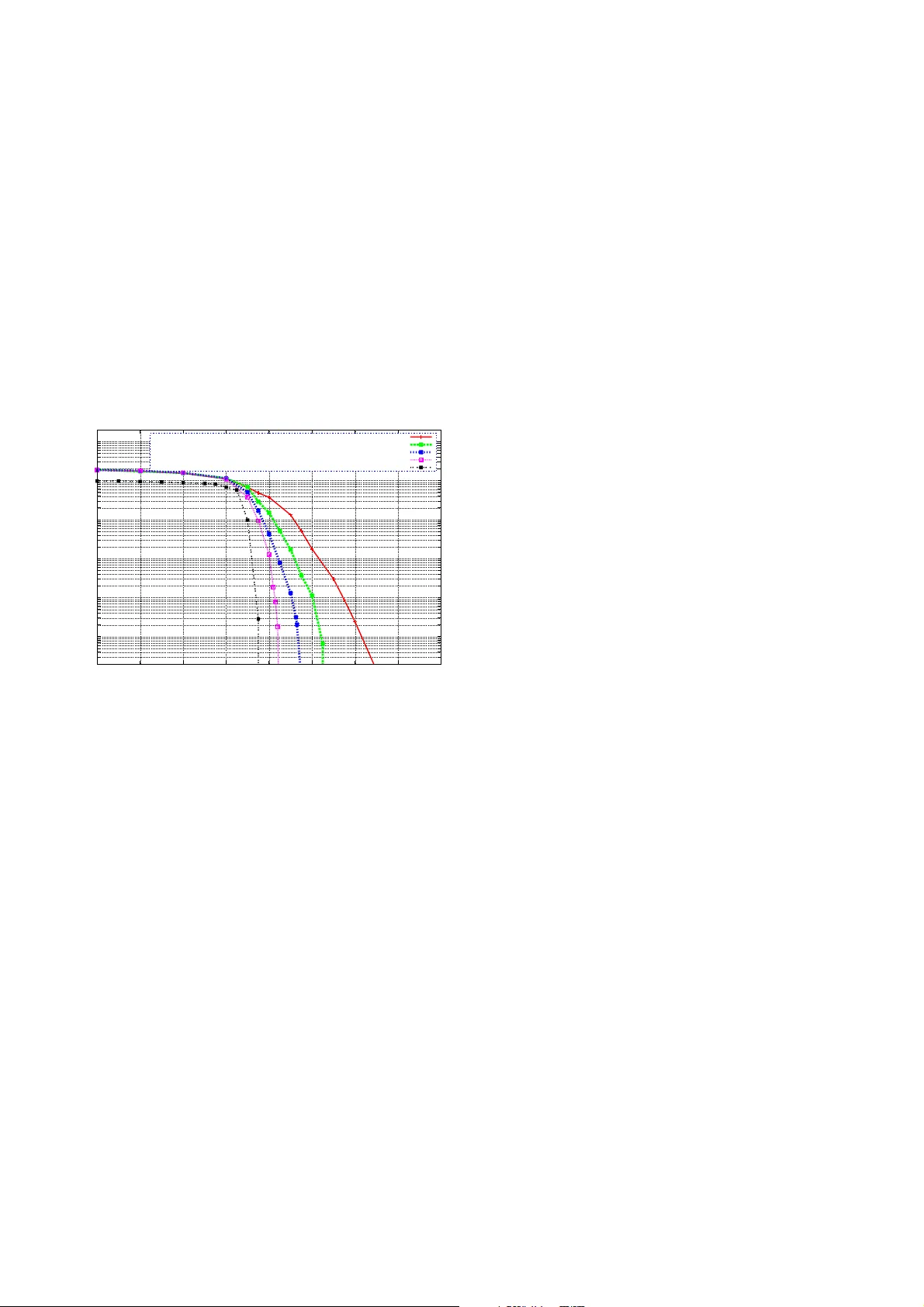
Asymptotically Good LDPC Con v olutional Codes Based on Protographs David G. M. Mitchell ∗ , Ali E. Pusan e † , Kamil Sh. Zigangirov † , an d Daniel J. Costello, Jr . † ∗ Institute for Digital Communications, Joint Research Institute f or Sign al & Image Processing, The Un i versity of Edinburgh, Scotland, David.Mitchell@ed.ac.uk † Dept. o f E lectrical Eng ineering, Univ ersity of Notre Dame, Notre Dame, Indian a, USA, { apusane, k zigangi, dcostel 1 } @nd.edu Abstract — LDPC con volutional codes hav e been shown to b e capable of achieving the same capacity-appr oaching perf ormance as LDPC b lock codes with iterative message-passing d ecoding. In this p aper , asy mptotic methods are used to calculate a lower bound on the free distance fo r sev eral ensembles of asymptotically good protograph-based LDPC conv olutional codes. Furth er , we show that the free d istance to constraint len gth ratio of the L DPC con volutional codes ex ceeds the minimum distance to block length ratio of corresponding LDP C block codes. I . I N T R O D U C T I O N Along with tur bo code s, low-density parity-ch eck (LDPC) block codes form a class of codes wh ich approac h the (the- oretical) Shannon limit. LDPC co des were first introduced in the 1960 s by Gallager [ 1 ] . Howe ver , they were co nsidered impractical at th at time a nd very little related work w as done until T anner provided a gra phical interpr etation of the parity- check matrix in 1981 [ 2 ] . More r ecently , in his Ph.D. Th esis, W iberg re vived interest in LDPC codes an d further de veloped the relation b etween T an ner graph s an d iterati ve d ecoding [3]. The con volutional cou nterpart of LDPC b lock codes was introdu ced in [4], and LDPC co n volutional co des hav e been shown to have cer tain advantages compared to LDPC block codes of the same comp lexity [5], [6]. In this p aper, we use ensembles of tail-b iting LDPC conv olutional cod es derived from a protog raph-b ased ensemble of LDPC blo ck cod es to obtain a lower bound o n the free distan ce of unterminated, asymptotically good , p eriodically time-varying L DPC con vo- lutional cod e ensem bles, i.e., ensembles that h a ve the property of fr ee d istance gr owing linearly with constra int length. In th e process, we show that th e min imum distances of ensembles of tail-biting LDPC co n volutional codes (intro- duced in [7]) a pproach the free distanc e of an associated untermin ated, perio dically time- varying LDPC conv olution al code ensemb le as the bloc k leng th of th e tail-biting ensemble increases. W e also sh ow that, for pr otograp hs with regular degree distributions, the f ree distan ce boun ds are con sistent with tho se recen tly derived for re gu lar LDPC con volutional code ensem bles in [8] and [9]. Further, for p rotograp hs with irregular degree d istributions, we ob tain new free distance bound s that grow linear ly with constraint leng th an d wh ose free distance to constraint length ratio exceeds the minimum distance to bloc k length ratio of the correspo nding block codes. The p aper is stru ctured as follows. In Section II, we br iefly introdu ce LDPC con volutional co des. Section III summarizes the techniqu e propo sed by Divsalar to analyze th e asymptotic distance g rowth behavior of protogra ph-based LDPC bloc k codes [10]. In Section IV , we describe the con struction of tail- biting LDPC conv olutional cod es a s well as the correspo nding untermin ated, periodica lly time- varying LDPC conv olution al codes. W e then show that the free distance o f a perio dically time-varying LDPC conv olution al code is lower b ounded b y the minimum distance of the block code formed by ter minating it as a tail-biting LDPC co n volutional code. Finally , in Sectio n V we presen t n ew resu lts on the free distance of en sembles of LDPC conv olution al codes b ased on protogr aphs. I I . L D P C C O N V O L U T I O NA L C O D E S W e start with a b rief definition of a ra te R = b/c b inary LDPC conv olutional code C . (A m ore d etailed de scription c an be f ound in [4].) A code seque nce v [0 , ∞ ] satisfies the equ ation v [0 , ∞ ] H T [0 , ∞ ] = 0 , (1) where H T [0 , ∞ ] is the syndro me former m atrix an d H [0 , ∞ ] = 2 6 6 6 6 6 6 6 6 6 4 H 0 (0) H 1 (1) H 0 (1) . . . . . . . . . H m s ( m s ) H m s − 1 ( m s ) . . . H 0 ( m s ) H m s ( m s + 1) H m s − 1 ( m s + 1) . . . H 0 ( m s + 1) . . . . . . . . . 3 7 7 7 7 7 7 7 7 7 5 is the parity- check matr ix o f the con volutional code C . The submatrices H i ( t ) , i = 0 , 1 , · · · , m s , t ≥ 0 , are bin ary ( c − b ) × c submatrices, gi ven by H i ( t ) = h (1 , 1) i ( t ) · · · h (1 ,c ) i ( t ) . . . . . . h ( c − b, 1) i ( t ) · · · h ( c − b,c ) i ( t ) , (2) that satisfy th e f ollowing p roperties: 1) H i ( t ) = 0 , i < 0 and i > m s , ∀ t. 2) Th ere is a t such that H m s ( t ) 6 = 0 . 3) H 0 ( t ) 6 = 0 and has full rank ∀ t . W e call m s the syn drome former mem ory and ν s = ( m s + 1) · c the decoding constraint length. T hese parameters determine the width of the no nzero d iagonal region of H [0 , ∞ ] . The sparsity of the p arity-chec k matrix is en sured by deman ding that its rows have very lo w Hamming weight, i.e., w H ( h i ) << ( m s + 1) · c, i > 0 , where h i denotes the i -th row of H [0 , ∞ ] . The cod e is said to be r egular if its p arity-check matrix H [0 , ∞ ] has exactly J ones in every column an d, startin g f rom row ( c − b ) m s + 1 , K one s in e very row . The other entr ies are zeros. W e refer to a code with the se p roperties as an ( m s , J, K ) - regular LDPC con volutional co de, and we note that, in general, the co de is time- varying and has rate R = 1 − J /K . An ( m s , J, K ) -r egular time-varying LDPC conv olu tional code is periodic w ith per iod T if H i ( t ) is p eriodic, i.e. , H i ( t ) = H i ( t + T ) , ∀ i, t , and if H i ( t ) = H i , ∀ i, t , the code is time- in variant. An LDPC conv olutio nal code is c alled irr egular if its row and colu mn weigh ts ar e not con stant. Th e notion of degree distribution is used to charac terize the variations of ch eck and variable nod e degrees in the T anner graph cor respond ing to an LDPC co n volutional code. Optimized degree distrib utio ns have b een used to design LDPC con volutional codes with good iterativ e dec oding p erforman ce in th e literature (see, e.g ., [7], [11], [12], [1 3]), but no distance b ound s for irregular LDPC conv olutiona l code en sembles have been p reviously published. I I I . P ROT O G R A P H W E I G H T E N U M E R A T O R S Suppose a given protograp h has n v variable no des and n c check no des. An ensemble of protogra ph-based L DPC block codes can b e created by th e copy-and -permute op eration [14]. The T anner g raph obtained for o ne member of an ensemble created u sing this method is illustrated in Fig. 1. 0 1 2 3 0 1 2 3 0 1 2 3 0 1 2 3 0 1 2 3 0 1 2 3 0 1 2 3 A B C A B C A B C A B C A B C A B C A B C Fig. 1. The copy-and-p ermute operation for a protograph. The parity -check matrix H corresp onding to the ensemble of pro tograph -based LDPC block cod es can be o btained b y replacing on es with N × N p ermutation matrices an d zeros with N × N all zero matrices in the u nderlyin g pr otograp h parity-ch eck matrix P , where the permutation matrices are chosen ra ndomly and ind ependen tly . The protograp h parity- check matrix P corresponding to the proto graph given in Figure 1 can be written as P = 1 1 0 0 0 1 1 1 1 1 1 0 , where we note th at, since the row and column weights of P are not con stant, P rep resents the par ity-check matrix of an irregular LDPC cod e. If a v ariable node and a check node in the p rotogr aph ar e co nnected b y r parallel edges, then the associated entry in P equals r and the corr esponding blo ck of H con sists o f a summation of r N × N permutation m atrices. The sparsity con dition of an LDPC p arity-chec k matrix is thus satisfied for large N . The code created by applying the copy- and-pe rmute op eration to an n c × n v protog raph parity-c heck matrix P has bloc k length n = N n v . In ad dition, th e code h as the same rate a nd degree distrib utio n for each of its variable and ch eck n odes as the und erlying protog raph co de. Combinator ial metho ds of calculating ensemble average weight en umerator s have been presented in [10] and [ 15]. The remainder of this Sectio n summarizes the metho ds presented in [10]. A. En semble weight enumerators Suppose a p rotograp h con tains m variable nodes to be transmitted over the channel and n v − m pun ctured variable nodes. Also, suppose that each of the m transmitted variable nodes has an associated weig ht d i , where 0 ≤ d i ≤ N for all i . 1 Let S d = { ( d 1 , d 2 , . . . , d m ) } be the set of all possible weight distributions su ch that d 1 + . . . + d m = d , and let S p be the set o f all p ossible weight d istributions for the remaining punctur ed nod es. The ensem ble weight enumer ator for the protog raph is then g iv en by A d = X { d k }∈ S d X { d j }∈ S p A d , (3) where A d is the average numb er of codew ord s in the ensemb le with a particular weight distribution d = ( d 1 , d 2 , . . . , d n v ) . B. Asymp totic weight enumerators The normalized logarithmic asymptotic weight distribu- tion of a code ensemble can be written as r ( δ ) = lim n →∞ sup r n ( δ ) , where r n ( δ ) = ln ( A d ) n , δ = d/n , d is the Hamming distance, n is th e block length, and A d is the ensemble a verage weight distrib utio n. Suppose the first zero cr ossing o f r ( δ ) occu rs at δ = δ min . If r ( δ ) is negati ve in the ran ge 0 < δ < δ min , then δ min is called the minimum distance gr owth rate of the code ensemble. By co nsidering the probability P ( d < δ min n ) = δ min n − 1 X d =1 A d , it is clear th at, as the blo ck length n grows, if P ( d < δ min n ) << 1 , then we can say with high pr obability that the majority of co des in the ensemble h av e a m inimum distance that grows linearly with n and th at the d istance growth rate is δ min . I V . F R E E D I S TA N C E B O U N D S In th is sectio n we present a m ethod fo r obtain ing a lo wer bound on the free distance of an ensem ble of untermin ated, asymptotically good , p eriodically time-varying LDPC co n vo- lutional co des derived f rom proto graph- based LDPC block codes. T o proce ed, we will make use of a family of tail-b iting LDPC conv olutiona l c odes with incremental increases in block length. The tail- biting cod es will be u sed as a tool to obtain the desired b ound on the free distance of the untermina ted codes. A. T a il-biting con volution al codes Suppose that we have an n c × n v protog raph parity -check matrix P , where gcd ( n c , n v ) = y . W e then partition P as a y × y block m atrix as follows: P = P 1 , 1 . . . P 1 ,y . . . . . . P y , 1 . . . P y ,y , 1 Since we use N copies of the protograph, the weight associate d with a partic ular v ariable node in the protograph can be as lar ge as N . where each block P i,j is of size n c /y × n v /y . P can thus be separated into a lower triangu lar p art, P l , and an upper triangular p art minu s the leading diago nal, P u . E xplicitly , P l = 2 6 6 6 4 P 1 , 1 P 2 , 1 P 2 , 2 . . . . . . . . . P y, 1 P y, 2 . . . P y,y 3 7 7 7 5 and P u = 2 6 6 6 4 P 1 , 2 . . . P 1 ,y . . . . . . P y − 1 ,y 3 7 7 7 5 , where blank spaces cor respond to z eros. T his operatio n is called ‘cutting’ a p rotograp h p arity-check matrix . Rearrangin g the positions o f these two trian gular matrices and repeating them in definitely results in a parity -check matrix H cc of an unterminate d, p eriodically time-varying conv olu - tional code w ith constraint length ν s = n v and period T = y giv en b y 2 H cc = P l P u P l P u P l . . . . . . . (4) Note that if gcd ( n c , n v ) = 1 , we can not fo rm a square block matrix larger tha n 1 × 1 with e qual size blocks. In this case, P l = P and P u is th e all zero matrix of size n c × n v . This trivial cut results in a conv olution al co de with syn drome former mem ory zero, with repeating blocks o f the original protog raph on the lead ing d iagonal. I t is necessary in this case to create a larger protog raph parity-chec k m atrix by using the copy and pe rmute operatio n o n P . This results in an M n c × M n v = n ′ c × n ′ v parity-ch eck m atrix for some small integer M . The n ′ c × n ′ v protog raph par ity-check matrix can then be cut following the procedur e ou tlined above. In effect, the cho ice of M × M p ermutation matrix creates a mini ensemble o f blo ck co des suitab le to be unwrap ped to an ensemble of conv olution al code s. W e now introduce the notion of tail- biting conv olution al codes by defining an ‘un wrapping f actor ’ λ as the number of tim es th e sliding con volutional struc ture is repeated. For λ > 1 , the parity-check matrix H ( λ ) tb of the desired tail-biting conv olutiona l code can be w ritten as H ( λ ) tb = P l P u P u P l P u P l . . . . . . P u P l λn c × λn v . Note that the tail-b iting con volutional code for λ = 1 is simply the original block code. B. A tail-biting LDPC convolutional cod e ensemble Giv en a pr otograp h par ity-check matr ix P , we genera te a family of ta il-biting con volutional codes with increasing block length s λn v , λ = 1 , 2 , . . . , using the pro cess described above. Since tail-biting conv olutiona l codes are themselves block cod es, we can treat th e T anner graph of H ( λ ) tb as a protog raph f or each value of λ . Replacing the en tries of this matrix with eithe r N × N p ermutation matrice s or N × N a ll zero matrices, a s discussed in Section III, creates an ensemble 2 Cuttin g certain protograp h parity-check matrice s may result in a smaller period T = y ′ of H cc , where y ′ ∈ Z + di vides y wit hout remainder . If y ′ = 1 then the result ing con volutiona l code is time-in v ariant. of LDPC co des that can b e ana lyzed asymptotically as N go es to infin ity , where the sparsity co ndition of an LDPC code is satisfied f or la rge N . Each tail-biting LDPC code en semble, in turn, can be unwra pped an d repeated indefinitely to form an en semble of u nterminated , periodically time-varying LDPC conv olutiona l codes with constraint len gth ν s = N n v and, in general, p eriod T = λy . Intuitively , as λ increases, th e tail-b iting co de beco mes a better rep resentation of th e associated u nterminated conv olu- tional cod e, with λ → ∞ correspo nding to the unterminated conv olutiona l code itself. T his is r eflected in the weight enumera tors, and it is shown in Section V that increasing λ provides us with distance growth rates that converge to a lower bound o n the free distance gr owth rate o f the un terminated conv olutiona l code. C. A fr ee distance boun d T ail- biting con volutional codes can be used to establish a lower bou nd on th e free d istance of an associated un- terminated, period ically time-v ary ing co n volutional code by showing that the free distance of th e unterm inated code is lower bo unded by the minimum distance of an y of its tail- biting version s. A p roof can be fo und in [9]. Theor em 1: Consider a rate R = ( n v − n c ) /n v unter- minated, periodically time- varying convolutional co de with decodin g constraint length ν s = N n v and period T = λy . Let d min be the min imum distance of the associated tail-biting conv olutiona l code with length n = λN n v and unwrap ping factor λ > 0 . Then th e fre e distance d f r ee of th e unterm i- nated conv olution al code is lower b ound ed by d min for any unwrapp ing factor λ , i.e., d f r ee ≥ d min , ∀ λ > 0 . (5) A trivial corollary of the above theorem is that the minimu m distance of a p rotogra ph-based LDPC block code is a lower bound on the free d istance of the associated un terminated, periodically time-varying LDPC conv olutio nal code. This can be ob served by setting λ = 1 . D. The fr ee distance gr owth rate One must be carefu l in comp aring the distance growth rates of codes with different under lying structures. A fair basis for c omparison gene rally requir es eq uating the complexity of encodin g and/or decodin g of the two codes. T rad itionally , the minimum distance growth rate of block cod es is measured relativ e to block leng th, wherea s constraint leng th is used to measure the fr ee distance gr owth rate of co n volutional codes. These measures are b ased on th e complexity of decod ing both ty pes of codes on a trellis. Indeed , the typ ical n umber of states required to decod e a block co de on a trellis is exponential in the block length , and similarly th e numbe r of states required to decode a con volutional cod e is expo nential in th e constraint length. This has been an accepted basis of comparin g b lock a nd conv olu tional code s fo r decad es, since maximum -likelihood decod ing can be implem ented on a trellis for b oth ty pes of codes. The definition of deco ding complexity is d ifferent, ho wever , for LDPC codes. The sparsity of their parity -check matrices, along with the iterative me ssage-passing decoding algorithm typically emp loyed, imp lies tha t the d ecoding comp lexity per symbol d epends on the d egree distribution of the variable and check nodes and is ind ependen t of both th e b lock len gth an d the constra int leng th. The cutting techniq ue we described in Section IV -A preserves the degree distribution o f the und er- lying LDPC block cod e, and thus the decoding co mplexity per symbol is th e sam e for th e blo ck an d convolutional c odes considered in this paper . Also, for rand omly constructed LDPC block codes, state-of- the-art encoding alg orithms require on ly O ( g ) op erations per symbol, wh ere g << n [16], wh ereas fo r LDPC conv olution al codes, if the parity -check matrix satisfies the co nditions listed in Section II, the numb er of enc oding operations per symbol is only O (1) [1 7]. Here again , the encod ing co mplexity per symbol is essentially independe nt of bo th the block leng th an d the constraint length. Hence, to com pare the distance gr owth rates of LDPC block and conv olution al codes, we c onsider the ha rdware complexity of impleme nting the encodin g an d d ecoding op - erations in hardware. T y pical hard ware stor age requirem ents for b oth LDPC block encoder s an d decoder s ar e pro portional to the block len gth n . The corresponding har dware storag e requirem ents f or LDPC conv olutio nal enco ders and decoders are proportion al to the decodin g constraint leng th [17]. 3 V . R E S U LT S A N D D I S C U S S I O N A. Distan ce gr owth rate r esults W e now pr esent distance growth rate results for se veral en- sembles of rate 1 / 2 asympto tically good LDPC con volutional codes b ased on protog raphs. Example 1 Consider a (3 , 6) r egular LDPC co de with the folowing protog raph: . For this example, the minimu m distance growth rate is δ min = 0 . 023 , as o riginally calculated by Gallager [1]. A family of tail-b iting L DPC conv olu tional code ensemb les can be generated a ccording to the f ollowing cut: P = 1 1 1 1 1 1 1 1 1 1 1 1 1 1 1 1 1 1 . For each λ , the minimum distance growth rate δ min was calculated for the tail-biting LDPC co n volutional codes using the ap proach ou tlined in Section IV -B. Th e distan ce growth rates f or each λ a re given as δ min = d min n = d min λN n v = d min λν s . (6) The fr ee distance growth rate of the associated ra te 1 / 2 ensemble of un terminated, p eriodically time-varying LDPC conv olutiona l codes is δ f r ee = d f r ee /ν s , as discussed above. Then (5) gives us the lower bou nd δ f r ee = d f r ee ν s ≥ d min ν s = λδ min (7) for λ ≥ 1 . These gr owth rates are plotted in Fig. 2. 3 For rat es other than 1 / 2 , encodi ng constrain t lengths may be pre ferred to decodin g constria nt lengths. For further details, see [18]. 1 2 3 4 5 6 7 8 0 0.01 0.02 0.03 0.04 0.05 0.06 0.07 0.08 0.09 Lower bound on the convolutional growth rate δ free Tail−biting growth rates δ min Distance growth rates for δ min and δ free Protograph unwrapping factor λ Fig. 2. Distance growth rates for Example 1 . W e observe that, onc e the unwrap ping factor λ of the tail- biting con volutional co des e xc eeds 3 , the lo wer bound on δ f r ee lev els off at δ f r ee ≥ 0 . 086 , which a grees with the r esults presented in [8] a nd [9] and represents a sign ificant increase over the value of δ min . In this case, the minimum weigh t codeword in the unter minated conv olu tional code also ap pears as a codeword in the tail-b iting code. Example 2 The following irregular protogra ph is from the Repeat Jagg ed Ac cumulate [19] (RJ A) family . It was shown to have a good iterative decoding threshold ( γ iter = 1 . 0 dB) wh ile maintaining linear minimu m distance gr owth ( δ min = 0 . 0 13 ). W e display belo w the associated P m atrix an d cu t used to generate the family o f tail-biting LDPC c on volutional co de ensembles. ! P = ! 2 2 1 1 1 1 3 1 " . W e observe that, as in Example 1 , th e minimu m distance growth rates calculated for increasing λ p rovide us with a lower b ound on th e free distance growth rate o f the co n- volutional code ensemble using (7). T he lower b ound was calculated as δ f r ee ≥ 0 . 05 7 (f or λ ≥ 5 ), significantly larger than the m inimum distance gr owth rate δ min of the un derlying block code e nsemble. Example 3 The following irregular protogra ph is from the Accumulate Repeat Jagged Accum ulate family (ARJ A) [19]: , where the un darkened cir cle rep resents a punctur ed variable node. This pr otograp h is of significant practical interest, sinc e it was sh own to h av e δ min = 0 . 015 an d iterative deco ding threshold γ iter = 0 . 628 , i.e., pre- coding the protograp h of Example 2 provides an improvement in both values. In this ARJ A example, the pr otograp h matrix P is of size n c × n v = 3 × 5 . W e o bserve that gcd ( n c , n v ) = 1 , and thus we have th e trivial cut mentioned in Section IV -A. W e must then copy an d p ermute P to g enerate a mini en semble of block codes. Results are sho wn for one particular member of the min i en semble with M = 2 , b ut a change in per formanc e can be o btained by varying the particula r p ermutation chosen. Increasing λ for the c hosen permuta tion re sults in a lower bound , found using (7), o f δ f r ee ≥ 0 . 053 for λ ≥ 4 . Again, we observe a significant increa se in δ f r ee compare d to δ min . B. S imulation r esults Simulation results for LDPC block and conv olutiona l codes based on the protog raph of Examp le 3 wer e obtained assuming BPSK modulation a nd an add iti ve wh ite Ga ussian noise chan - nel (A WGNC). All decoders wer e a llowed a max imum of 100 iterations, and th e bloc k cod e de coders emp loyed a syn drome- check based stopping ru le. As a result of their block structure, tail-biting LDPC co n volutional cod es we re decoded using standard LDPC block decoders em ploying a belief-propag ation decodin g algorithm. The L DPC convolutional co de, on the other hand , was decod ed by a sliding -window b ased belief- propag ation decoder [4]. The resulting b it erro r rate (BER) perfor mance is shown in Fig.3. 10 -5 10 -4 10 -3 10 -2 10 -1 10 0 0 0.2 0.4 0.6 0.8 1 1.2 1.4 1.6 BER E b /N 0 (dB) Protograph-Based LDPC-BC with n=10000 Protograph-Based Tailbiting LDPC-BC with ν s =10000 and λ =2 Protograph-Based Tailbiting LDPC-BC with ν s =10000 and λ =4 Protograph-Based Tailbiting LDPC-BC with ν s =10000 and λ =8 Protograph-Based LDPC-CC with ν s =10000 Fig. 3. Simulation results for Example 3 . W e note tha t the protograph -based tail-biting LDPC con- volutional c odes outperform th e underlyin g protog raph-b ased LDPC b lock code ( which can also be seen as a tail- biting cod e with unwrapping factor λ = 1 ). Larger un wrapping factors yield impr oved er ror perfor mance, eventually app roaching the perfor mance of the u nterminated con volutional co de, which can b e seen as a tail-biting co de with an infinitely large unwrapp ing factor . W e also n ote that no error floo r is ob served for th e co n volutional code, which is e xp ected, since the co de ensemble is asymptotically good and has a relatively large ( δ f r ee ≥ 0 . 053 ) distance g rowth rate. W e also note that the per forman ce of the untermina ted LDPC co n volutional code is consistent with th e iterative decodin g thr eshold compu ted f or the u nderlyin g proto graph. At a mo derate co nstraint len gth of 10 000 , the un terminated code achieves 1 0 − 5 BER at roug hly 0 . 12 dB away from the thresho ld, an d with larger b lock (constrain t) lengths, the perfor mance will improve even further . Th is is expected, since both the unterminated and th e tail-biting con volutional codes preserve the sam e d egree distribution as the un derlying protog raph. V I . C O N C L U S I O N S In this pa per , asymptotic metho ds we re used to ca lcu- late a lower b ound on the free d istance th at grows linear ly with constraint length for se veral ensemb les o f u nterminated , protog raph-b ased periodically time varying LDPC convolu- tional codes. It w as shown that the free distance growth rates of the LDPC conv olu tional cod e en sembles exceed th e m inimum distance g rowth rates of the correspond ing LDPC block code ensembles. Further, we observed th at the perf ormance of the LDPC co n volutional codes is consistent with th e iterative decodin g thr esholds of the u nderlyin g proto graphs. A C K N O W L E D G E M E N T This work was partially su pported by NSF Grants CCR02- 05310 and CCF05-15 012 an d NASA Gran ts NNG0 5GH736 and NNX07A K536. In additio n, the au thors ac knowledge the support of th e Scottish Fun ding Council f or the Joint Research Institute with the Heriot-W att University , which is a par t of the Edinburgh Research Partnership. Mr . Mitchell acknowledges the Royal Society of Edinburgh for the award of the John Moyes Lessells T ravel Scho larship. R E F E R E N C E S [1] R. G. Gallager , “Lo w-density parity-che ck codes”, IRE T rans. Inform. Theory , IT -8: 21-28, Jan. 1962. [2] R. Michae l T anner , “ A Recur sive Approach to Low Comple xity Codes”, IEEE T rans. Inform. Theory , IT -27, pp.533-547, Sept. 1981. [3] N. W iber g, “ Codes and decoding o n gene ral graph s”, Ph.D. Thesis, Dep t. of E. E., Link ¨ oping Univ ersity , Link ¨ oping, Sweden. [4] A. Jim ´ enez-Fe lstr ¨ om and K. Sh. Zigangiro v , “Time-v arying periodi c con vol utional codes with low-de nsity parity-che ck matric es”, IE EE T rans. Inform. Theory , IT -45, pp.2181-2191, Sept. 1999. [5] D. J. Costello, Jr ., A. Pusa ne, S. Bates, and K. Sh. Zigangirov , “ A comparison betwe en L DPC bloc k and con volut ional codes”, Proc. In form. Theory and A pp. W orkshop , San Diego, CA, Feb . 2006. [6] D. J. Costello, Jr ., A. E. Pusane, C. R. Jones, and D. Divsal ar , “ A com- parison of ARA- an d protogr aph-based LDPC block and con vol utional codes”, Pr oc. Inform. Theory and A pp. W orkshop , San Diego, CA, Feb. 2007. [7] M. T av ares, K. Sh. Zigangiro v , and G. Fettweis, “T ail-Bi ting LDPC Con volu tional Codes”, Proc. IEEE Int. Symp. on Inform. Theory , Nice, France, June 2007. [8] A. Sridharan , D. Truh ache v , M. Lentmai er , D. J. Cost ello, Jr ., a nd K. Sh. Zigangiro v , “Distance bounds for an ensemble of LDPC conv olutiona l codes”, IEE E T rans. Inform. Theory , IT -53, pp. 4537-4555, Dec. 2007. [9] D. T ruhache v , K. Sh. Zigangiro v , and D. J. Costello, Jr ., “Distanc e bounds for periodic LDPC conv olutiona l codes and tail-biti ng con volution al codes”, IEEE T rans. Inform. Theory (submitted), J an. 2008. A v ailable online a t http://luur.l ub.lu.se/luur? func=downloadFile &fileOId=1054 996 . [10] D. Divsal ar , “Ensemble W eight Enumerators for Protogr aph L DPC Codes”, Proc. IEEE Int. Symp. on Inform. Theory , Seattle, W A, Jul. 2006. [11] G. Richter , M. Kaupper , and K. Sh. Zigangirov “Irreg ular low-densit y parity-c heck con vol utional codes based o n protographs”, Proc . IEEE Int. Symp. on Inform. Theory , Seattle, W A, Jul. 2006. [12] A. Sridharan, D. Sridhara, D. J. Costello, Jr ., and T . E. Fuja “ A construct ion for irre gular lo w de nsity parity check co des”, Pr oc. IEE E Int. Symp. on Inform. Theory , Y okohama, Japan, June 2003. [13] A. E. Pusane, K. Sh. Zigangiro v , and D. J . Costello, Jr ., “Construct ion of irre gular L DPC con volution al codes with fast decoding”, Proc . IEEE Int. Conf. on Communications , Istanbu l, Turk ey , June 2006. [14] J. Thorpe, “Low-De nsity Parit y-Check (LDPC) codes construct ed from protograp hs”, JPL INP P r ogr ess Report , V ol. 42-154, Aug. 2003. [15] S. L. Fogal, R. McEliec e, and J. Thorpe, “Enumerat ors for protograph ensembles of L DPC codes”, Pr oc. IEEE Int. Symp. on Inform. Theory , Adelaid e, Australia , Sept. 2005. [16] T . J. Ric hardson and R. L. Urbank e, “Efficie nt encodi ng of lo w-density parity-c heck co des, ” IE EE T rans. Inform. Theory , IT -47, pp.638-656, Feb. 2001. [17] A. E. Pusane, A. Jim ´ ene z-Feltstr ¨ om, A. Sridharan, M. Lentmaier , K. Sh. Zigangirov, and D. J. C ostello, Jr ., “Impl ementation aspec ts of L DPC con vol utional codes, ” IEEE T rans. Commun. , to appea r . [18] D. G. M. Mitchell, A. E. Pusane, N. Goertz, and D. J. Costello, Jr ., “Free Distance Bounds for Protograph-Based Re gular LDPC Con voluti onal Codes”, 2008 Int. Sy mp. on T urbo Cod es and Related T opics (submitted). A vail able online at http://ar xiv.org/abs/0804 .4466 . [19] D. Divsal ar , S. Dolinar , and C. Jones, “C onstruction of protogra ph LDPC codes with linear m inimum distance”, Proc. IEEE Int. Symp. on Inform. Theory , Seattle, W A, Jul. 2006.
Original Paper
Loading high-quality paper...
Comments & Academic Discussion
Loading comments...
Leave a Comment