Sum-Capacity of Ergodic Fading Interference and Compound Multiaccess Channels
The problem of resource allocation is studied for two-sender two-receiver fading Gaussian interference channels (IFCs) and compound multiaccess channels (C-MACs). The senders in an IFC communicate with their own receiver (unicast) while those in a C-…
Authors: Lalitha Sankar, Elza Erkip, H. Vincent Poor
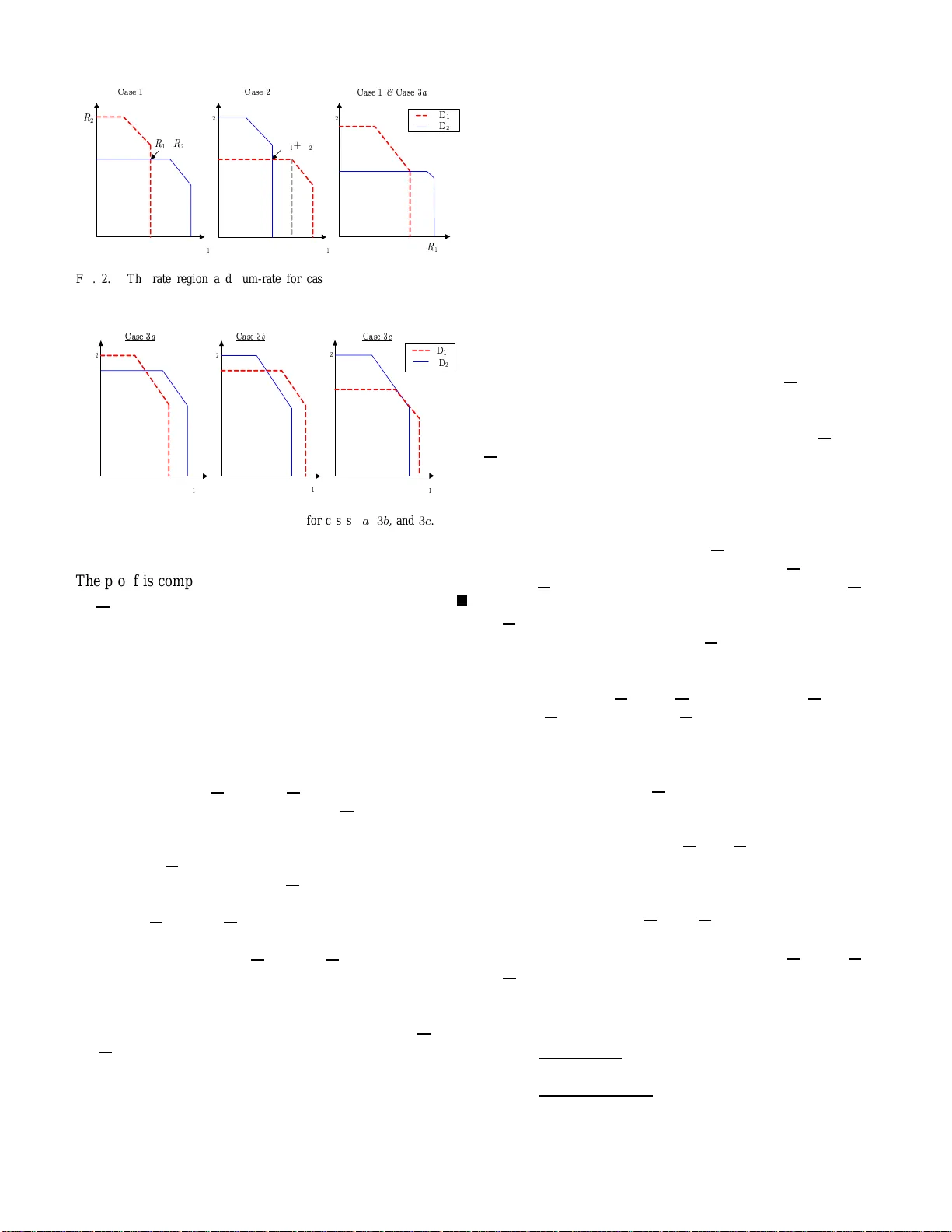
Sum-Capacity of Er godic Fading Inter ference and Compound Multiacce ss Channels Lalitha Sankar ∗ , Elza Erkip ∗ † , H. V incent Poor ∗ ∗ Dept. of Electrical Eng ineering, Princeton University , Princeto n, NJ 08 544. lalitha,eer kip,poor@prin ceton.edu † Dept. of Electrical and Computer En gineering, Polytechn ic Univ ersity , Brook lyn, NY 1120 1. elza@poly .edu Abstract — The problem of resour ce allocation is studied for two-sender two-recei ver fading Gaussian in terfer ence channels (IFCs) and compound multiaccess channels (C-MA Cs). The senders in an IFC communicate with their own recei ver (unicast) while those in a C-MA C communicate with both receiv ers (mul- ticast). The instantaneous fading state between every transmit- recei ve pair in this network is assumed to b e known at all transmitters and recei vers. Under an a v erage power constraint at each source , the sum-capacity of the C-MAC and the power policy that achieves this capacity is developed. The conditions defining the classes of strong and very strong ergodic IFCs are presented and th e multicast sum-capacity is shown to be tight fo r both classes. I . I N T RO D U C T I O N The two-user interferenc e ch annel (IFC) and the two-user compou nd multiaccess channel (C-MAC) mo del network s with two sources (senders or transmitters) and two destinations (receivers). The unicast c ase in which the messag e f rom each source is intended for o nly one destination is modeled as an IFC while the multicast case in w hich b oth message s are intended for both de stinations is mod eled as a C-MA C (see Fig. 1). Th e c apacity r e gion of a discrete me moryless C-MAC is obtained in [1]. The capacity region of both th e discrete memory less and th e Gaussian IFC remain open pro blems; howe ver , for certain classes o f time-inv ariant I FC s satisfying specific well-defined co nstraints th e capacity region is known (see for e.g., [2]–[ 5] a nd th e r eferences ther ein). The ergodic sum -capacity and th e capacity r e gion o f a multiaccess channel (MA C) ar e studied in [6] and [7], re- spectiv ely , under the assum ption tha t the chan nel states and statistics are k no wn at all nod es. These papers also dev elop the rate-optimal power policies. The ergodic cap acity of a C- MA C, however , is no t a straigh tforward extension of these results. For a p arallel Gaussian IFC, in [8], the a uthors propo se a sub-o ptimal iterative water-filling so lution wh en ev ery receiv er views signals from the unintended transmitters as inter ference. In [9 ], th e capacity o f a par allel Gau ssian IFC where e very parallel subchannel is strong, i. e., its sign al-to- noise and interfere nce-to-noise ratios at each r ecei ver satisfy specific conditions [2], is dev eloped . I n this paper , we study the problem of resou rce allocation for the two-user ergod ic fading This research is supported in part by the National Science Foundation under Grants ANI-03-38807 and CNS-06-25 637 and in part by a fellowshi p from the Princeton Univ ersity Council on Science and T echnology . IFC and C-MA C un der th e assump tion that the instantaneou s fading state b etween each transmit-r ecei ve pair in this network is k no wn at all transm itters and receivers. W e develop the ergodic sum-capa city fo r th e C-MA C which in turn lower bound s the sum- capacity of the IFC. W e fur ther develop the conditio ns defining the classes of str o ng and very str ong er godic IFCs with resour ce allocation and show th at the C- MA C lower bounds are tight fo r both classes. Our work differs from [9] in that we d e velop capacity results f or an ergodic IFC that is strong or very strong on average, i.e., the co nstraints for these cla ss es r equire averaging over all channel instantiatio ns, and thus, our result subsumes that in [9]. The sum -capacity optimal p olicy for the C-MA C is moti- vated by the work in [10] on maximizing the sum-rate of an ergodic fading two-user orthogon al multiacc ess relay chann el (MARC) [10] when the relay employs a decod e-and-forward (DF) strategy . For the MARC, a DF r elay acts as a d ecoding receiver; this enables us to generalize from [10] that when both receivers in a two-send er two-rece i ver network de code messages from both sources (users), the resulting su m-rate belongs to one of fi ve disjoin t cases or lies on the boundar y of any two of them ( boundary cases). Further, the sum- rate optimal policy either : 1) exploits the multiuser fading d i versity to opportu nistically sch edule users analog ous to the fading MA C [6], [7] or 2) inv olves simultaneous water -filling over two indepe ndent po int-to-point link s. W e first develop the capacity region o f the ergod ic C-M A C; the resulting region is shown to lie within th e capacity region of an ergodic I FC . The sum-rate optim al p olicy describe d above achieves th e C-MAC sum-capacity and a lower bou nd on the IFC sum-cap acity . W e develop the con ditions for the very stro ng IFC and show that the C-MAC lower bou nd f or one o f the fi ve disjoint cases is tight for this I FC class. W e define the cond itions for the stron g ergodic IFC an d prove th at when the se co nditions are met, the IFC sum-c apacity is the C-MAC sum-capacity for one o f three other d isjoint cases o r three boundary cases. W e also show that, in contrast to the non- f ading case [ 2], the constra ints for both classes of IFC depend o n both th e chan nel statistics and av erage power constrain ts. The paper is organized as follows. In Section II, we m odel the ergodic f ading Gaussian C-MA C and IFC. In Section III we present the C-MAC capa city region and de termine th e power 1, 1 h 1,2 h 2 ,2 h 1 : S 2 : S 1 D 2 D 2 , 1 h 1 1 N W X → 1 1 2 ˆ IC : ˆ ˆ C-MA C : ( , ) W W W 2 1 2 ˆ IC : ˆ ˆ C-MA C : ( , ) W W W 2 2 N W X → Fig. 1. The two-user Gaussian IFC or C-MAC . policies that max imize the sum-cap acity . In Section IV, we define the strong an d very strong ergod ic IFC conditions and show that the sum- capacity in Section III is tight when the condition s for either the strong or the very stron g ergod ic IFC hold. I I . C H A N N E L M O D E L A N D P R E L I M I N A R I E S A two-sender two-receiver Gaussian I FC co nsists of two source nod es S 1 and S 2 , a nd two destination n odes D 1 and D 2 as sho wn in Fig. 1. Source S k , k = 1 , 2 , uses th e channel N times to transmit its m essages W k , distributed u niformly in the set { 1 , 2 , . . . , 2 B k } , to its inten ded receiver , D k , at a r ate R k = B k / N bits per channel use. I n each u se of the ch annel, S k transmits th e signal X k while the destinations D 1 and D 2 receive Y 1 and Y 2 , respectively , such th at Y 1 = H 1 , 1 X 1 + H 1 , 2 X 2 + Z 1 (1) Y 2 = H 2 , 1 X 1 + H 2 , 2 X 2 + Z 2 (2) where Z 1 and Z 2 are indep endent circularly sym metric co m- plex Gaussian n oise rando m variables with zero mean s an d unit variances. For the special c ase when the me ss ages at S 1 and S 2 are in tended for both d estinations, the model defined by (1) a nd (2) results in a two-user Gaussian C-MA C (see Fig. 1). W e write H to den ote the random matrix of fading states, H k,m , for all k , m = 1 , 2 , such that H is a realization for a given cha nnel use of a jo intly stationary and ergodic (n ot necessarily Gaussian) fading pro cess H . Note that H k,m for all k, m , are not assumed to be indep endent. W e also assume that over N uses of the channel, the source transmissions are constrained in power acc ording to N X i =1 | X k,i | 2 ≤ N P k for all k = 1 , 2 (3) where X k,i denotes th e transmitted signa l from sour ce k in the i th channel use. Since the sources k no w the fading states of the lin ks on which they transmit, they can alloca te their transmitted signal power acc ording to th e chan nel state informa tion. W e write P k ( H ) to deno te the power allocated at the k th transmitter as a function of th e ch annel states H . For a n ergod ic fadin g chann el, (3) then simplifies to E [ P k ( H )] ≤ P k , k = 1 , 2 , (4) where the expectation in (4) is over the jo int distribution of H . W e write P ( H ) to denote a vector of power allocations with entries P k ( H ) , for all k , and define P to be the set of all P ( H ) whose en tries satisfy (4). Th e capacity region C IFC ( C C-MAC ) of a two-user IFC (C-MAC) is defined as the closure o f the set of rate tuples ( R 1 , R 2 ) su ch that the destinations can decode their in tended messages with an arbitrarily small positive error probab ility ǫ . For ease of no tation, we h enceforth omit the function al depend ence of P on H . W e write ran dom variables (e.g. H k,j ) with upperc ase letters and th eir realizations (e.g. h k,j ) with the cor responding lowercase letters. W e write K = { 1 , 2 } to denote the set of tran smitters, the nota tion C ( x ) = lo g(1 + x ) where the log arithm is to th e base 2, ( x ) + = max( x, 0) , and wr ite R S = P k ∈S R k for any S ⊆ K . I I I . C - M A C : S U M - C A PAC I T Y A N D O P T I M A L P O L I C Y The capac ity region of a two-transmitter (sender) two- receiver discrete memor yless ( d.m.) channel, now of ten re- ferred to as a d. m. compo und MA C, is developed in [1] . For each choice of inp ut distrib ution at the two in dependent sources, th is capacity region is a n intersection of the MA C capacity regions achieved at the two r ecei vers. The techniqu es in [1] c an be easily extended to develop the capacity region for a Gau ss ian C-MAC with fixed c hannel gain s. For th e Gaussian C-MAC, on e can show that Gaussian signaling achieves the capacity r e gion using th e fact tha t Gaussian signaling maximizes th e MA C region at each r ecei ver . Th us, the Gaussian C-MAC capac ity region is an intersection of the Gaussian MA C capacity region s ach ie ved at D 1 and D 2 . For a station ary and ergod ic pro cess H , th e ch annel in (1) an d ( 2) can be mo deled as a set of parallel Gaussian C-MACs, one for each fadin g instantiatio n H . For the ergo dic fading case, the c apacity region R C-MAC , achieved over all P ∈ P is given by the following theo rem. Theor em 1: The cap acity region , C C-MAC , o f a n e r god ic fading Gaussian C-MA C is C C-MAC = [ P ∈P {C 1 ( P ) ∩ C 2 ( P ) } (5) where for all S ⊆ K an d j = 1 , 2 , we have C j ( P ) = ( ( R 1 , R 2 ) : R S ≤ E " C X k ∈S | H j,k | 2 P k !#) . (6) Pr o of: T he achievability follows from using Gaussian signaling and decodin g at both receivers. For the converse, we apply the proo f techniqu es developed for the cap acity of an ergodic fading MA C in [7]. For any P ∈ P , one can use limiting argum ents (see f or e.g., [7 , Appendix B]) to show that for asym ptotically error-free perf ormance at receiver j , for all j , the achievable region has to be boun ded as R S ≤ E h log 1 + P k ∈S | H j,k | 2 P k i , j = 1 , 2 . (7) R R R R + R R + R R R R ! " # Fig. 2. The rate regi on and sum-rate for cases 1 , 2 , and boundary case (1 , 3 a ) . $ % & ' R ( R ) R * R + , - . / 0 1 2 3 4 5 6 7 R 8 R 9 : ; < = > ? Fig. 3. The rate region and sum-rate for cases 3 a , 3 b , and 3 c . The pr oof is comple ted by taking the un ion o f th e r e gion over all P ∈ P . Cor o llary 2: The interference c hannel ergodic capacity re- gion C IFC is bound ed as C C-MAC ⊆ C IFC . Corollary 2 fo llo ws fr om the argument that a rate pair in C C-MAC is achiev able for the IFC since C C-MAC is the capacity region when both m essages a re decoded at b oth r ecei vers. Remark 3: The capa city region C C-MAC is co n ve x. This follows fr om th e convexity of the set P and the concavity of the log f unction. The capacity region C C-MAC is a u nion o f the intersection of th e penta gons C 1 ( P ) an d C 2 ( P ) ach ie ved a t D 1 and D 2 , respectively , wher e th e u nion is over all P ∈ P . The region C C-MAC is con vex, and thus, each po int on the b oundary of C C-MAC is obtained by ma ximizing the weighted sum µ 1 R 1 + µ 2 R 2 over all P ∈ P , an d for all µ 1 > 0 , µ 2 > 0 . Specifically , we de termine the o ptimal p olicy P ∗ that m aximizes th e sum- rate R 1 + R 2 when µ 1 = µ 2 = 1 . Using the fact th at th e rate regions C 1 ( P ) and C 2 ( P ) ar e pen tagons, in Figs. 2 and 3 we illustrate the fi ve po ss ible choices fo r the sum-rate resulting from an intersection of C 1 ( P ) and C 2 ( P ) (see also [10]). W e broad ly categorize the five possible ch oices for the sum - rate resulting fro m the intersection of two pen tagons into th e sets of active and in active cases. The ina ctive set , c onsisting of cases 1 a nd 2 , in cludes all intersection s o f C 1 ( P ) and C 2 ( P ) for which th e constraints on th e two su m-rates a re no t activ e, i.e., no rate tuple on th e sum-rate plane achieved at one of the rece i vers lies within or on th e bo undary o f the rate region a chie ved at the other receiver . On the oth er han d, the intersections for wh ich the re exists at least one su ch rate tuple such that the two sum-rates constraints are activ e belon g to the active set . T his includes cases 3 a , 3 b , a nd 3 c shown in Fig. 2 whe re the sum-rate at D 1 is smaller, larger, or equal, respectively , to th at achieved a t D 2 . By definition, the active set also includ e the bo undary cases where there is exactly o ne such rate pair . Howe ver , to simp lify th e optimiza tion prob lem, we co nsider the six b oundary cases sep arately and denote them as cases ( l, n ) , l = 1 , 2 , and n = 3 a, 3 b, 3 c . W e write B i ⊆ P and B l,n ⊆ P to deno te the set of power policies that achieve case i , i = 1 , 2 , 3 a, 3 b , 3 c and case ( l , n ) , l = 1 , 2 , n = 3 a, 3 b, 3 c , r especti vely . Obser v e that cases 1 an d 2 do not share a boun dary since such a transition (see Fig . 2) r equires passing throug h case 3 a or 3 b or 3 c . Finally , note that Fig . 3 illustrates two sp ecific C 1 and C 2 regions f or 3 a , 3 b , and 3 c . The occurrence o f any one of the disjoint ca ses depen ds on both the channel statistics an d the policy P . Sinc e it is not straightforward to know a priori the power allocations that ach ie ve a certain case, we maximize the sum-capacity for each case over all alloc ations in P and write P ( i ) and P ( l,n ) to d enote the o ptimal solution f or case i an d case ( l , n ) , respectively . Explicitly includ ing bou ndary cases ensur es that the sets B i and B l,n are d isjoint fo r all i and ( l, n ) , i. e., the se sets ar e either open or half -open sets such th at no two o f them share a bounda ry (see [10]). T his in turn simplifies the conv ex optimization as fo llo ws. Let P ( i ) be the o ptimal policy maximizing the sum-rate fo r case i over a ll P ∈ P . T he optimal P ( i ) must satisfy the cond itions for case i , i.e., P ( i ) ∈ B i . If th e condition s are satisfied, we prove the optimality of P ( i ) using the fact that th e rate fun ctions for each case are concave. On the oth er h and, when P ( i ) 6∈ B i , it can be shown that R 1 + R 2 achieves its m aximum outside B i . The p roof again follows fr om the fact that R 1 + R 2 for all cases is a concave functio n of P for all P ∈ P . T hus, w hen P ( i ) 6∈ B i , for every P ∈ B i there exists a P ′ ∈ B i with a larger sum-rate. Combining this with the fact that th e su m-rate exp ressions are continuo us while transitioning from one case to another at the bound ary of the open set B i , en sures that the m aximum sum - rate is achiev ed by some P 6∈ B i . Similar arguments justify maximizing the optimal policy for each case over all P . The following th eorem summarizes the op timal power pol- icy for each case. T he op timal P ( i ) or P ( l,n ) maximizing the sum-rate for case i or ( l , n ) satisfies the conditions for on ly that case and is determ ined using Lagrang e multipliers and the Karush-K uhn- T u c ker ( KKT) con ditions. Theor em 4: A policy P ( i ) or P ( l,n ) maximizes the sum- rate for case i , i = 1 , 2 , 3 a, 3 b, 3 c, or the boun dary case ( l , n ) , l = 1 , 2 , and n = 3 a, 3 b, 3 c, when the entr ies P ( · ) 1 and P ( · ) 2 of P ( · ) satisfy f ( · ) k ≤ ν k ln 2 k = 1 , 2 (8) where ν k is chosen to satisfy (4) such that f ( i ) k = | h m,k | 2 ( 1+ | h m,k | 2 P k ) i = 1 : ( m, k ) = (1 , 1) , (2 , 2 ) i = 2 : ( m, k ) = (1 , 2) , (2 , 1 ) f ( i ) k = | h m,k | 2 ( 1+ P 2 j =1 | h m,j | 2 P j ) i = 3 a : m = 1 i = 3 b : m = 2 (9) f ( i ) k = (1 − α ) f (3 a ) k + αf (3 b ) k i = 3 c f ( l,n ) k = (1 − α ) f ( n ) k + αf ( l ) k ( l, n ) = (1 , 3 a ) , (2 , 3 b ) f ( l, 3 c ) k = α 3 f (3 a ) k + α 2 f (3 b ) k + α 1 f ( l ) k l = 1 , 2 (10) with α , α 1 , α 2 , and α 3 = 1 − α 1 − α 2 chosen to satisfy the approp riate bou ndary conditions. The optimal P ( i ) ∈ B i or P ( l,n ) ∈ B l,n satisfies the co ndition for case i or case ( l, n ) , respectively . The cond itions for each case are given as Case 1 : I ( X 1 ; Y 1 | X 2 H ) < I ( X 1 ; Y 2 | H ) I ( X 2 ; Y 2 | X 1 H ) < I ( X 2 ; Y 1 | H ) (11) Case 2 : I ( X 1 ; Y 1 | X 2 H ) < I ( X 1 ; Y 2 | H ) I ( X 2 ; Y 2 | X 1 H ) < I ( X 2 ; Y 1 | H ) (12) Case 3 a : I ( X 1 X 2 ; Y 1 | H ) < I ( X 1 X 2 ; Y 2 | H ) (13) Case 3 b : I ( X 1 X 2 ; Y 1 | H ) > I ( X 1 X 2 ; Y 2 | H ) (14) Case 3 c : I ( X 1 X 2 ; Y 1 | H ) = I ( X 1 X 2 ; Y 2 | H ) (15) Case ( l , n ) : Satisfy cases n & l with equality for one case l condition (16) where in (11)-(16), X 1 and X 2 are Gaussian distributed subject to (4). The P ∗ that maximizes the sum-capac ity is obtained by computing P ( i ) or P ( l,n ) starting with the inac ti ve cases, followed b y the boun dary cases ( l , n ) , a nd finally the active cases 3 a, 3 b, and 3 c until fo r so me case the correspond ing P ( i ) or P ( l,n ) satisfies the case condition s. From (8) an d (9), one can easily verify that for the in- activ e cases 1 a nd 2 the optimal po licies in volve the classic water -filling solution o ver point-to -point links . Specifically , the optimal policies fo r cases 1 and 2 simplify to water-filling over the two bottle-n eck links ( S 1 → D 1 ) , ( S 2 → D 2 ) an d ( S 1 → D 2 ) , ( S 2 → D 1 ) , respectively . On the o ther han d, for the a cti ve cases 3 a and 3 b , the o ptimal allo cation at each source simplifies to the oppo rtunistic water -filling allocation for a MA C [6], [7] such th at in each channel use the source with the larger f ( i ) k /ν k for case i, i = 3 a, 3 b , transm its. Observe that the water-filling solu tions are with respect to the receiver that achieves the smaller sum-capacity . Finally , for all th e boundar y cases inc luding case 3 c , the optimal po lic y for source k is still a n op portunistic solution suc h that the source with the larger f ( i ) k /ν k or f ( l,n ) k /ν k , i = 3 c and f or all ( l, n ) , transmits. Howev er, u nlike the o ther c ases, the optimal policy at each source for th e boun dary cases is n o longer a water -filling solu tion; instead for each chann el instantiation the o ptimal policy at source k satisfies (8) with e quality when the users are opp ortunistically sch eduled. The conditions in ( 11 ) and (12) for the two inactiv e ca ses exclude all oth er c ases and define the disjoin t sets B 1 and B 2 . Similarly , the conditio ns f or the six bo undary cases d efine the disjoint sets B l,n for all ( l , n ) . Howe ver , the con ditions for 3 a , 3 b , and 3 c ca n be satisfied by the boundary cases. T o ensure that th e sets B 3 a , B 3 b , an d B 3 c are d isjoint from all other sets, the algorithm f or determ ining the optimal P ∗ requires eliminating a case at a time starting from case 1 . Thus, the algorithm first elim inates the inactive cases, and the n check s for th e bo undary cases, and finally checks for cases 3 a, 3 b , and 3 c . Remark 5: The capacity region, C C-MAC can be comp letely characterized by using the same appr oach to maximize the sum µ 1 R 1 + µ 2 R 2 , f or all ( µ 1 , µ 2 ) pairs. In genera l, eac h tuple on the bou ndary of C C-MAC may be max imized by a d if ferent case, and thus, the optimal policy is also a functio n of ( µ 1 , µ 2 ) . I V . I F C : C O N V E R S E W e now apply the results in Theorem 4 to the ergodic fading IFC. For the I FC , the power po licies satisfying ( 8) and (9) are achievable when D 1 and D 2 decode messages from both sources; the resulting C-MA C sum-capacity is a lower bound on the IFC sum- capacity . Belo w , we p resent a converse to show that these sum -rate lower bound s are tight for the classes of strong an d very stron g ergodic fading IFC. The co n ve x capacity region o f the ergo dic fading two-user IFC, C IFC , can be bou nded by hyp erplanes C ( µ 1 , µ 2 ) such tha t for all µ 1 > 0 and µ 2 > 0 , we have C IFC = { ( R 1 , R 2 ) : µ 1 R 1 + µ 2 R 2 ≤ C ( µ 1 , µ 2 ) } (17) subject to (4). The bo undary of C IFC is deter mined by max - imizing µ 1 R 1 + µ 2 R 2 for each choice of ( µ 1 , µ 2 ) over all P ∈ P . For th e sum-ca pacity , we set µ 1 = µ 2 = 1 . A. V ery S tr ong Er god ic IFC Definition 6: A very stron g er god ic fading IFC with r espect to the tuple ( µ 1 , µ 2 ) results when a P ∈ P and H satisfy I ( X 1 ; Y 1 | X 2 H ) < I ( X 1 ; Y 2 | H ) I ( X 2 ; Y 2 | X 1 H ) < I ( X 2 ; Y 1 | H ) (18) for all choices of X 1 and X 2 . Theor em 7: The sum-c apacity of a c lass of very strong ergodic Gaussian IFCs is 2 X k =1 E h log 1 + | H k,k | 2 P ∗ k ( H ) i (19) where P ∗ k ( H ) , for all k , is the optimal water -filling solutio n for single-send er single -recei ver ergodic fading lin ks. Pr o of: An o uter boun d on the su m-capacity of the IFC can be obtain ed b y setting H j,k = 0 f or all j 6 = k , i.e., by assum ing no interference . In the absence of interfer ence, Gaussian signaling achieves capacity for each o f the S k to D k links, k = 1 , 2 , and the r esulting sum-capacity is g i ven by (19) where, P ∗ k ( H ) is the optimal water-filling solution for single- sender single-re cei ver ergo dic fadin g links, i.e., it satisfies the condition in (8) for f (1) k in (9), subject to (4). From Theorem 4, we see that wh en the c hannel statistics and the p o wer policy satisfy (11), i. e., P ∗ = P (1) ∈ B 1 , the achiev able strategy of d ecoding both messages at bo th destinations achiev es this sum-capacity oute r b ound. Thus, the sum -capacity of a very strong IFC is that of a C-MA C for which P satisfies case 1 condition s, i. e., P satisfies (18). For a deterministic H , the conditions in (18) simp lify to those for the very stron g no n-fading IFC in [2 ]. Furthe r , fr om Fig. 2, we see th at as with the non-fading very strong IFC, the intersecting region fo r Case 1 is also a rectang le; note, howe ver that u nlike the n on-fading case, this rectangle is not the entire cap acity r e gion but only the region achieving the sum-capacity . Fin ally , n ote that the condition in ( 18 ) depends on both the chann el statistics and the transmit power . Remark 8: In contrast, the cond itions for case 2 in (12) model a weak er godic IFC for which the C-MAC sum-capac ity is strictly a lower b ound. B. Str o ng E r go dic IFC Definition 9: A strong ergodic fading IFC with r espect to the tuple ( µ 1 , µ 2 ) results when a P ∈ P and H satisfies I ( X 1 ; Y 1 | X 2 H ) < I ( X 1 ; Y 2 | X 2 H ) (20) I ( X 2 ; Y 2 | X 1 H ) < I ( X 2 ; Y 1 | X 1 H ) (21) for all choices of X 1 and X 2 . Theor em 10: The su m-capacity of the class of strong er- godic fading Gaussian IFCs is min j =1 , 2 E C X 2 k =1 | H j,k | 2 P ∗ k (22) where, for all k , P ∗ k = P ( i ) k or P ∗ k = P ( l,n ) k for l = 1 an d i, n ∈ { 3 a, 3 b, 3 c } . Pr o of: Du e to lack of space, we present a proo f sketch. W e use th e fact that the chan nel states are ind ependent of the source m essages, Fano’ s and the data processing ineq uality , the ergod icity of the channel for large N , the fact that P ∈ P satisfies (20) and (21), and the o ptimality o f Gaussian signaling to upper boun d the sum-rate as R 1 + R 2 ≤ [ I ( X 1 ; Y 1 | X 2 H ) + I ( X 2 ; Y 2 | H )] (23) ≤ [ I ( X 1 ; Y 2 | X 2 H ) + I ( X 2 ; Y 2 | H )] (24) ≤ I ( X 1 X 2 ; Y 2 | H ) (25) ≤ E C X 2 k =1 | H 2 ,k | 2 P ∗ k (26) One can similarly show th at R 1 + R 2 ≤ E C X 2 k =1 | H 1 ,k | 2 P ∗ k , (27) and thus, fr om ( 6 ) we see that the sum- rate is uppe r bo unded by the s um-ca pacity of a C-MA C. Further, we can bound R 1 ≤ E [ C ( | H 1 ,k | 2 P ∗ k )] an d R 2 ≤ E [ C ( | H 2 ,k | 2 P ∗ k )] , an d thus, fr om Corollary 2 , the sum-capacity of a th e ergodic C-MA C sum - capacity is also the sum-c apacity of th e ergodic IFC when (20) and (21) hold. Optimal P ower Allocation : From Theo rem 4, the op timal P ∗ for an ergodic C-MAC satisfies on ly o ne o f the con ditions in (1 1 )-(16). Furthe r , fro m Theorem 4 and Figs. 2 and 3, the condition s in (2 0 ) and (21) can be satisfied by 7 dif ferent cases, namely , cases 1 , 3 a , 3 b , 3 c , (1 , 3 a ) , (1 , 3 b ) , a nd (1 , 3 c ) . Since these cases are mu tually exclusive, the optima l P ∗ is giv en by th at op timal policy wh ich in addition to satisfying the con dition for on e of the above listed cases also satisfies (20) and ( 21). For exam ple, suppose P ∗ satisfies th e cond ition for case 1 , i.e., P ∗ ∈ B 1 . Sin ce the cond itions for this very strong case in (1 1) (see also (18)) imp ly the con ditions for th e strong case in (2 0) and (2 1), the sum -capacity an d the op timal power p olic y are directly given by Theo rem 7. On the oth er hand, sup pose P ∗ ∈ B 3 a , i.e., P ∗ satisfies th e conditions in Theorem 4 only for case 3 a (see Fig. 3). Since P ∗ also satisfies (20) and ( 21), we defin e an open (or h alf-open) set B ′ 3 a ⊂ B 3 a in wh ich (20), ( 21), and (13) ar e all satisfied. Th e concavity of the sum-rate expression for this case then gu arantees that the optimal policy is un ique and belo ngs to the op en set B ′ 3 a (see also the argumen ts in Section II I ). Note th at the requirement that P (3 a ) satisfy (2 0 ) and (2 1) o nly lim its P (3 a ) to B ′ 3 a and does not change the solution presented in Theorem 4 for this case. Thus, the sum-cap acity for this case is E log 1 + 2 X k =1 | H 1 ,k | 2 P (3 a ) k ( H ) ! . (28) The argume nts above also apply to the r emaining cases listed above. Remark 11: The co nditions in (20) and (21) ar e ergodic generalizatio ns o f the con ditions presen ted in [2] f or th e non- fading strong IFC (see also [4, (1),(2)] for the discre te mem- oryless strong I FC). Howe ver , u nlike th e non-fadin g Gaussian IFC, the c onditions in (20) and (21) for the ergod ic Gaussian IFC depend on b oth the channel statistics and the p o wer policy P . Fur ther , as expected, the very strong ergodic IFC is a special case of the strong IFC wher e (18) hold s. R E F E R E N C E S [1] R. Ahlswede, “The capacity regio n of a channel with two senders and two recei vers, ” Ann. P r ob. , vol. 2, pp. 805–814, Oct. 1974. [2] H. Sato, “The capacity of Gaussian interferen ce channel under strong interfe rence, ” IEEE T rans. Inform. Theory , vol. 27, no. 6, pp. 786–788, Nov . 1981. [3] A. B. Carleial , “ A case where interferenc e does not reduce capacit y , ” IEEE Tr ans. Inform. T he ory , vol. 21, no. 5, pp. 569–570, Sept. 1975. [4] M. H. M. Costa and A . El Gamal, “The capacity regio n of the discrete memoryless int erference channel with strong interferenc e, ” IEEE T rans. Inform. Theory , vol. 33, no. 5, pp. 710–711, Sept. 1987. [5] A. Motahari and A. Khandani, “Capaci ty bounds for the Gaussian interfe rence channel, ” Jan. 2008, submitted to the IEEE Trans. Inform. Theory . [6] R. Knopp and P . Humblet, “Information capaci ty and powe r cont rol in single-cel l multiuser communication s, ” in Proc . IEEE Intl. Conf . Commun. , Seattle, W A, June 1995. [7] D. N. C. Tse and S. V . Hanly , “Multiac cess fading channels - part I: Polymat roid s tr ucture, optimal resource alloc ation and throughput capac ities, ” IEE E T rans. Inform. Theo ry , vol. 44, no. 7, pp. 2796–2815, Nov . 1998. [8] W . Y u, G. Ginis, and J. M. Ciof fi, “Distrib uted multiuser power control for digital subscriber lines, ” IEEE J . Sel. Are as Commun. , v ol. 20, no. 5, pp. 1105–1115, June 2002. [9] S. T . Chung and J. M. Ci offi, “The capac ity region of frequenc y-select iv e gaussian interfere nce channels under strong interfe rence, ” IEEE T rans. Comm. , vol. 55, no. 9, pp. 1812–1820, Sept. 2007. [10] L. Sankar , Y . Liang, H. V . Poor , and N. B. Mandayam, “Opportunistic communicat ions in orthogonal multia ccess relay chann els, ” in Pr oc. Int . Symp. Inf. Theory , Nice, France, J ul y 2007.
Original Paper
Loading high-quality paper...
Comments & Academic Discussion
Loading comments...
Leave a Comment