Woven Graph Codes: Asymptotic Performances and Examples
Constructions of woven graph codes based on constituent block and convolutional codes are studied. It is shown that within the random ensemble of such codes based on $s$-partite, $s$-uniform hypergraphs, where $s$ depends only on the code rate, there…
Authors: Irina E. Bocharova, Rolf Johannesson, Boris D.Kudryashov
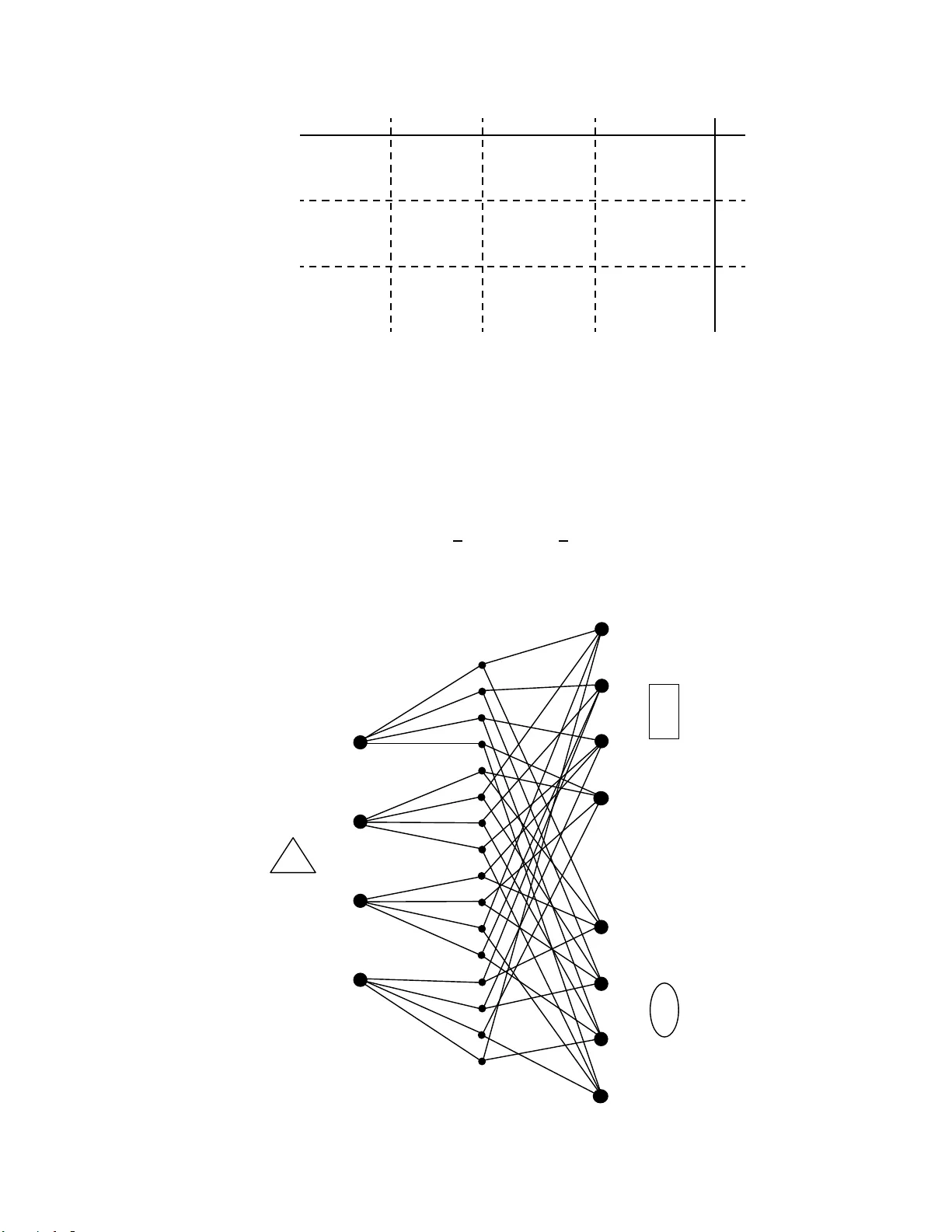
1 W o v en Graph Codes: Asymptotic Performances and Examples Irina E. Bocharo va and Boris D. Kudryashov Dept. of Information Syst ems, St. Petersb urg Univ . of Information T echnologies, Mechanics and Opti cs St. Petersb urg 197101, Russia Email: { iri na, boris } @eit.lt h.se Rolf J ohannesson Dept. of Electro and Information T echnology , Lun d University P . O. Box 118, SE-22100 Lund, Sweden Email: rolf@eit.lth. se V ictor V . Zyabl ov Inst. for Information Transm. Problems, Russian Academy of Sciences Moscow 101447, Russia Email: zyablov@iitp.ru Abstract Constructions of woven grap h codes based on co nstituent block and co n volutional codes ar e studied. It is shown that within th e ran dom ensemble of such cod es based on s -partite, s -un iform hypergrap hs, where s depend s only on the code rate, there exist cod es satisfying the V ar shamov-Gilbert (VG) and the Costello lower bou nd on the min imum distance and the free distance, respectively . A connec tion between regular bipartite graphs a nd tailbiting codes is shown. Som e examples of woven graph c odes are presented. Among them an example of a rate R wg = 1 / 3 woven graph code with d free = 32 based o n Heawood’ s bipartite graph and containin g n = 7 constituen t rate R c = 2 / 3 conv olutional cod es with overall con straint lengths ν c = 5 is gi ven. An encoding proc edure f or woven graph codes with co mplexity propo rtional to the numb er of constituen t codes an d the ir overall con straint length ν c is p resented. Index terms —Con voluti onal codes, girth, graphs, graph codes, hyper graphs, LDPC codes, tailbiting codes, w oven codes. I . I N T RO D U C T I O N W ov en graph cod es can be c onsidered a s a ge neralization of low-density parity-check (LDPC) bloc k cod es [1]. Their structure a s graph code s ma kes them suitable for iterativ e dec oding. Moreover , the LDP C block co des are known as co des with low- complexity dec oding an d they ca n be considered a s competitors to the turbo code s [2] wh ich are sometimes called pa rallel conc atenated codes. As me ntioned in [3], the u nderlying graph defines a permutation of the information sy mbols which resembles the interleaving in turbo coding sch emes. On the other h and, similarly to the LDPC c odes, g raph c odes u sually hav e minimum dis tances e ssentially smaller than tho se of the b est kn own l inear c odes of the sa me parameters. At a fi rst g lance, the minimum distance of a graph code does no t play an important role in iterativ e deco ding sinc e the error-correcting c apability of this s uboptimal procedure is often less than that guaran teed by the minimum distance . Ho we ver , in g eneral, the belief-propaga tion decoding algo rithms work better if the girth o f the underlying g raph is large, that is, if the minimum distance of the graph code is large [4]. In the sequ el we distinguish betwee n graph , graph-ba sed, and wo ven graph c odes. W e sa y tha t a graph code is a block co de wh ose pa rity-check ma trix co incides with the incide nce matrix of the corresp onding graph. Grap h-based codes con stitute a clas s o f concaten ated c odes with cons tituent block codes con catenated with a graph code (see , for example, [3]). Ea ch vertex in the underlying graph corresp onds to a constituent block code. The main feature of these codes is that the block length of the ir constituent block codes coincides with the degree of the unde rlying graph. 2 W e introduc e woven graph codes wh ich a re, in fact, graph -based c odes with co nstituent bloc k c odes wh ose block length is a multiple of the graph degree c , that is , the ir block len gth is l c , where l is an integer . In particular , when l tends to infinity we obtain co n v olutional con stituent code s. Distance properties of bipa rtite graph-based c odes with co nstituent b lock codes we re studied in [3]. It was shown tha t if the minimum distan ce of the c onstituent b lock code s is lar ger than o r eq ual to 3 , then there exist asymptotically g ood code s with fixed constituent codes amon g these graph-base d codes. Also it was shown in [3] that for some range of rates, random graph-ba sed cod es with bloc k constituent codes satisfy the VG bo und whe n the bloc k leng th of the c onstituent code s tends to infinity . One d isadvantage of graph-bas ed c odes tha t beco mes apparent in the a symptotic analysis is that good performances can only be achieved when the bloc k length of the constituent block codes (which in this case coincides with the graph degree c ) tends to infinity . In practice this leads to rathe r long graph-ba sed codes with not only rather high decoding complexity of the iterativ e dec oding procedures b ut also high encoding c omplexity . In this p aper , we con sider a class of the generalized graph-bas ed codes which we call woven graph codes with constituent block and con volutional c odes. They are ba sed on s -partite, s -uniform hyper graphs . Notice that grap h- based code s with cons tituent block codes b ased on hype r graphs were c onsidered in [5], [6 ]. It is mentioned in [5 ] that Ga llager’ s LDPC c odes are graph c odes over hypergraphs. W e cons ider first woven graph code s with c onstituent ( l c, lb ) block codes . A produc t-type lower bound on the minimum distance of such codes is deri ved. In order to analyze their asymptotic performances we mod ify the approach used in [3] to s -partite, s -un iform hy pergraphs and c onstituent ( l c, l b ) block co des 1 . It is shown that whe n l grows to infinity in the random ensemb le of w oven graph c odes with binary constituent block codes we can find s ≥ 2 such tha t there exist codes s atisfying the VG lower bound o n the minimum distance for any rate. In order to gen eralize the asymptotic a nalysis to wov en g raph codes with constituent conv olutional cod es we assume that the binary constituent b lock code is chosen a s a zero-tail (ZT) termi nated conv olutional c ode and consider a seq uence of ZT con v olutional code s of increasing block length l . It is shown that when the overall constraint length of the woven grap h c ode tends to infinity in the rando m ens emble of suc h c on v olutional c odes we can find s ≥ 2 suc h tha t there exist codes satisfying the Costello lo wer bound on the free distance for a ny rate. W e also des cribe the cons tituent con volutional code s as block c odes over the fie ld of b inary L aurent se ries [8]. This desc ription as we ll as the notion of block Hamming distance [9] of con volutional codes is us ed to deriv e a product-type lower bou nd on the free distance of woven graph codes with con stituent con voluti onal codes and to construct examples of such wov en code s with rate R wg = 1 / 3 . For a giv en hypergraph the free distance of the wov en graph code dep ends on the numbe ring of code symbols asso ciating to the hypergraph vertices. By a search over a ll possible permutations of the constituent code we found an example o f a rate R wg = 1 / 3 woven graph code with overall constraint length ν = 64 and free dis tance d free = 32 . The rate R wg = 1 / 3 woven graph co de is based on Heawood’ s bipartit e grap h [10] , [11] and contains constituent con voluti onal codes with overall con straint length ν c = 5 and free distan ce d c free = 6 . W e co nsider also the en coding prob lem for graph and woven grap h codes. The traditional enc oding technique for graph cod es has c omplexity O ( N 2 ) , where N is the blockleng th. W e show b y examp les that so me regular block graph code s are quasi-cyclic a nd thereby ca n be interpreted as tailbiting (TB) co des (see, for example, [12], [13]). It is kno wn that t he encoding complexity of su ch code s is proportional to the overall con straint length o f the parent con voluti onal c ode. By using a TB representation for the graph code we ca n construct an e xample of an enco der for a wov en graph code that is also represented in the form of a TB code but with overall con straint length less than or equal to 2 nν c , where n is the nu mber of constituent con v olutional co des with overall constraint length ν c each. In Section II, we c onsider some properties of s -partite, s -uniform, c -regular hypergraphs. W e define woven g raph codes with constituent block codes as well as with constituent con volutional codes and obtain product-type lower bounds on their minimum and free distances. Then, in Section II I, we deri ve a lo wer bound on the free dis tance o f the random ens emble o f woven graph code s. In Section IV , examp les o f woven graph code s a re given. W e c onclude the paper by conside ring encoding techniqu es for g raph co des and woven graph codes in Sec tion V . 1 When we were prep aring this paper we were informed that the possibility of achie ving the VG bou nd b y considering hyp ergraphs was kno wn to A. Barg [7]. 3 I I . P R E L I M I N A R I E S A hype r graph is a generalization of a g raph in which the edges are subse ts of vertices and may c onnec t (co ntain) any n umber of vertices. The se e dges are ca lled hypered ges. A hyp ergraph is called s -uniform if every hy peredge has ca rdinality s or , in other words, c onnects s vertices. If s = 2 the hypergraph is simply a grap h. The d e gr ee of a vertex in a hyp ergr aph is the n umber of h yperedge s that are connecte d to (contain) it. If all vertices h av e the same d egree we say that this is the degr ee of the hype r graph . The hy pergraph is c -r e gular if every vertex has the same d egree c . Let the set V of verti ces of a n s -uniform hype r graph be partitioned into t d isjoint subs ets V j , j = 1 , 2 , . . . , t . A hypergraph is s aid to be t -pa rtite if no edge conta ins two vertices from the same s et V j , j = 1 , 2 , . . . , t . In the sequel we conside r s -pa rtite, s -uniform, c -re gular hypergraphs. Such a hyper graph is a union of s disjoint subsets of vertices. Ea ch v ertex has no c onnections in its o wn set an d is connected wit h s − 1 vertices in the o ther subsets . In Fig. 1 a 3 -partite, 3 -uniform, 4 -re gular hypergraph is s hown. It con tains three sets of verti ces. They a re 0 1 2 3 4 5 6 7 10 9 11 8 Fig. 1. A 3-partite, 3-uniform, 4-regu lar hypergraph. shown by triangles, re ctangles, an d ovals, r espe cti vely . There are no edges conne cting vertices inside any of these three sets. The vertices are c onnected b y hyp eredges each of which conne cts three vertices. A c ycle of length L in the hype r graph is a n alternating sequ ence of L + 1 vertices and L hype redges where all vertices a re dis tinct e xcept t he initi al and the final vertex, which coincide, and all edges are distinct. The girth of a hypergraph is the length of its shortest cycle. In Fig. 2 we s how a subgrap h that contains the sh ortest cycle of the 3 -partite, 3 -uniform, 4 -re gular hyper graph in Fig. 1. It cons ists of the vertices 5 , 1 0 , and 5 a nd ha s girth equal to 2. W e introduce the notion of a c ompact ( ≥ d ) -connected su bgraph in the hy pergraph. It is a conn ected subgraph in which ea ch vertex is incident with at least d hy peredges . W e call the length (number of hypered ges) of t he shortest compact s ubgraph its ( s , d )-girth . In Fig. 2 the h yperedge s belonging to the sho rtest ( ≥ 2) -compact subgrap h are marked by circles. It is easy to see that ( 3 , 2 )-girth is 6 . A 2 -part ite, 2 -uniform hypergraph is a bipa rtite graph. For such a hypergraph the ( 2 , 2 )-gir th is equa l to the gir th and a compact subgraph is a cycle. He awood’ s bipartite graph [10], [11] wi th 1 4 vertices and 2 1 edges is shown in Fig. 3. This grap h contains a s et of n = 7 black and a set of n = 7 white vertices. Each vertex has no c onnections within its own set a nd is conn ected with c = 3 vertices from the other set. The girth of the Heawood graph is 6 . A. Graph-bas ed codes and graph codes In order to illustrate the structure of a binary graph-ba sed block c ode with constituent block codes we represent the Heawood bipartit e graph us ing a so-ca lled T an ner graph [15] a s sh own in Fig. 4. W e introdu ce a set of nc = 21 (variable) vertices which c orrespond to the code symbols. Ea ch of the 2 n = 14 (constraint) vertices on the ri ght- an d left-hand sides c orresponds to one of 14 parity checks . The c = 3 e dges 4 0 1 2 5 6 7 10 9 8 Fig. 2. A shortest compact subgraph . 2 3 4 5 6 7 8 9 1 0 11 12 13 0 1 Fig. 3. Heaw ood’ s bipa rtite graph. leaving one c onstraint vertex correspo nd to a codeword of the constituent ( c, b ) b lock co de of rate R c = b/c . The parity-check matrix of the co rresponding graph -based code with bina ry cons tituent block codes is H gb = H 1 H 2 (1) where the parity-chec k matrix H 1 of s ize n × nc = 7 × 21 has the form H 1 = H c 0 0 0 0 0 0 0 H c 0 0 0 0 0 . . . . . . . . . . . . . . . . . . . . . 0 0 0 0 0 0 H c where H c is a size ( c − b ) × c = (3 − b ) × 3 parity-check matrix of the c onstituent block code, and H 2 is a size n × nc = 7 × 21 parity-chec k matrix which is the permutation of the c olumns o f H 1 determined by the graph. Notice that in general by c hoosing b < c and assigning con stituent block c odes of d if ferent rates R c = b/c to the same graph we ca n ob tain graph-base d code s of d if ferent rates. In general, since in an s -partite, s -uniform, c -regular hyper graph the total number of parity checks is equal to sn ( c − b ) , the code rate R gb of the graph-ba sed code is R gb ≥ n ( c − s ( c − b )) nc = s ( R c − 1) + 1 (2) with eq uality if and o nly if all parity-checks are linearly independ ent. If s = 2 , then we g et R gb ≥ 2 R c − 1 . 5 0 21 20 19 18 17 16 15 14 13 12 11 10 9 8 7 6 5 4 3 2 1 1 3 11 9 7 5 3 1 1 2 1 0 8 6 4 2 Fig. 4. A T anner graph ( c = 3 , n = 7 ) representation of Heaw ood’ s b ipartite graph. The simplest example of a Heawood graph-base d code ca n be obtaine d by choo sing as constituent block c odes a single-parity-check code of rate R c = 1 / 3 . Th en the parity-check matrix H c has the form H c = 1 1 1 and the parity-check matrix of the graph-bas ed code is H gb = H g = 0 B B B B B B B B B B B B B B B B B B B B B B B @ 1 2 3 4 5 6 7 8 9 10 11 12 13 14 15 16 17 18 19 20 21 1 1 1 0 0 0 0 0 0 0 0 0 0 0 0 0 0 0 0 0 0 0 0 0 0 1 1 1 0 0 0 0 0 0 0 0 0 0 0 0 0 0 0 2 0 0 0 0 0 0 1 1 1 0 0 0 0 0 0 0 0 0 0 0 0 4 0 0 0 0 0 0 0 0 0 1 1 1 0 0 0 0 0 0 0 0 0 6 0 0 0 0 0 0 0 0 0 0 0 0 1 1 1 0 0 0 0 0 0 8 0 0 0 0 0 0 0 0 0 0 0 0 0 0 0 1 1 1 0 0 0 10 0 0 0 0 0 0 0 0 0 0 0 0 0 0 0 0 0 0 1 1 1 12 1 0 0 0 1 0 0 0 0 0 0 1 0 0 0 0 0 0 0 0 0 1 0 0 0 1 0 0 0 1 0 0 0 0 0 0 1 0 0 0 0 0 0 3 0 0 0 0 0 0 1 0 0 0 1 0 0 0 0 0 0 1 0 0 0 5 0 0 0 0 0 0 0 0 0 1 0 0 0 1 0 0 0 0 0 0 1 7 0 0 1 0 0 0 0 0 0 0 0 0 1 0 0 0 1 0 0 0 0 9 0 0 0 0 0 1 0 0 0 0 0 0 0 0 0 1 0 0 0 1 0 11 0 1 0 0 0 0 0 0 1 0 0 0 0 0 0 0 0 0 1 0 0 13 1 C C C C C C C C C C C C C C C C C C C C C C C A . (3) In this case the graph-base d code coincide s with the grap h code sinc e (3) is the inc idence matrix of the He awood graph. In [4] it is proved that the minimum dis tance of the bipartite grap h-based cod e with s ingle-parity-check constituent c odes is d min = g , wh ere g is the girth of the corresp onding graph . Notice t hat for the T anne r g raph we have d min = g / 2 . The parity-check matri x (3) is a 14 × 21 parity-check ma trix. T aking into acc ount that one check is linea rly de penden t on the othe r , we ob tain a (21 , 8) binary block co de. Its minimum distanc e is d min = g = 6 . 6 Consider the hy pergraph sho wn in Fig. 1. Its incidence matrix has the form H hg = H hgb = 0 B B B B B B B B B B B B B B B B B B B @ 1 2 3 4 5 6 7 8 9 10 11 12 13 14 15 16 1 1 1 1 0 0 0 0 0 0 0 0 0 0 0 0 0 0 0 0 0 1 1 1 1 0 0 0 0 0 0 0 0 1 0 0 0 0 0 0 0 0 1 1 1 1 0 0 0 0 2 0 0 0 0 0 0 0 0 0 0 0 0 1 1 1 1 3 1 0 0 0 0 1 0 0 0 0 1 0 0 0 0 1 4 0 1 0 0 0 0 1 0 0 0 0 1 1 0 0 0 5 0 0 1 0 0 0 0 1 1 0 0 0 0 1 0 0 6 0 0 0 1 1 0 0 0 0 1 0 0 0 0 1 0 7 1 0 0 0 1 0 0 0 1 0 0 0 1 0 0 0 8 0 1 0 0 0 1 0 0 0 1 0 0 0 1 0 0 9 0 0 1 0 0 0 1 0 0 0 0 1 0 0 0 1 10 0 0 0 1 0 0 0 1 0 0 1 0 0 0 1 0 11 1 C C C C C C C C C C C C C C C C C C C A (4) and is a 12 × 16 parity-check ma trix o f a hypergraph-based code which coincides with the pa rity-check matrix of the hypergraph c ode. Ea ch c olumn rep resents a h yperedge an d ea ch row represents a vertex of this hypergraph. For example, the first four ro ws repres ent the vertices 1, 2, 3, a nd 4 (triangles), the next four rows he vertices 5 , 6 , 7, and 8 (rectangles), an d the last four ro ws the vertices 9, 10, 11 , and 12 (ov als). The first c olumn repres ents the hyperedg e which c onnects the vertices 1, 5, and 9, the second column the hyperedge connecting v ertices 1, 6, and 10 e tc . The rows of (4) are linearly depe ndent. By removing two parity che cks we obtain a (16 , 6) linear block code with the minimum distance d min = g 3 , 2 = 6 , where g 3 , 2 is the ( 3 , 2 )-girt h of the hype r graph. The rate of this hypergraph code is R hg = 3 / 8 , which satisfies inequ ality (2), R hg ≥ 3 3 4 − 1 + 1 = 1 4 . The T an ner version of this h ypergraph is shown in Fig. 5. 16 15 14 13 12 11 10 9 8 7 6 5 4 3 2 1 5 4 3 2 1 0 6 7 9 8 10 11 Fig. 5. A T anner graph representation of the ( 16 , 6) hypergraph-based code. 7 For an s -partite, s -uniform, c -r egular hyper graph-bas ed cod e with constituent bloc k cod es we ha ve the following theorem. Theorem 1: The minimum distance of a hyp ergraph-based co de based on a n s -partite, s -uniform, c -regular hypergraph with ( s , d c min )-girth g s,d c min and co ntaining cons tituent b lock cod es with minimum distance d c min ≥ 2 is d min = g s,d c min . Pr oof . An y nonzero code word in an s -partite, s -uniform, c -regular hyper graph-base d code alw ays corresponds to a connec ted ( ≥ d c min ) -subgraph or a set of disjoint connected subgraphs. Thes e subgraphs are called active [ 14], [4]. All hyperedges a nd vertices in an activ e subgraph a re also called a ctive . The number o f hyperedges i n the shortest connec ted subgraph is e qual to g s,d c min . Any non zero symbo l in a codeword corresponds to an ac ti ve hyperedge in the graph. By using the arguments given above, we con clude that for any co dew ord v , w H ( v ) ≥ g s,d c min where w H ( v ) is the Hamming weight of v . Minimizing over v co mpletes the proof. B. W oven grap h codes with cons tituent block codes Now as sume tha t the co nstituent c ode assign ed to the hypergraph vertices is a binary ( l c, l b ) linear block code determined b y a parity-check ma trix H c = H c 11 H c 12 . . . H c 1 ,c H c 21 H c 22 . . . H c 2 ,c . . . . . . . . . . . . H c ( c − b ) , 1 H c ( c − b ) , 2 . . . H c ( c − b ) ,c (5) where H c ij ∈ B l × l is a size l × l matrix, B l × l is the set of a ll pos sible binary matrices of size l × l . Let C 2 ( H c ) denote such a binary ( l c, l b ) constituent bloc k c ode d etermined by the matrix (5). W e call the correspond ing hy pergraph-based co de with C 2 ( H c ) as constituent codes a w oven graph code wi th constituent bloc k codes. Consider an example o f a w oven graph cod e based o n the bipartite graph wit h girth g = 4 shown in Fig. 6. The T a nner version of this the so-called “utility” bipa rtite g raph is shown in Fig. 7. 5 4 3 2 1 0 Fig. 6. Utility bipartite graph. The inc idence matrix of this g raph is H g = 1 1 1 0 0 0 0 0 0 0 0 0 1 1 1 0 0 0 0 0 0 0 0 0 1 1 1 1 0 0 0 1 0 0 0 1 0 0 1 1 0 0 0 1 0 0 1 0 0 0 1 1 0 0 . (6) 8 Fig. 7. A T anner graph representation of the util ity bipartite graph. W e use a c onstituent ( 4 × 3 , 4 × 2 ) linear block code with d c min = 3 de termined by the p arity-check matrix H c = ( H c 1 H c 2 H c 3 ) = 1 0 0 0 1 1 1 0 1 1 0 0 0 1 0 0 0 1 1 1 0 1 1 0 0 0 1 0 1 0 1 1 0 0 1 1 0 0 0 1 1 1 0 1 1 0 0 1 . By sea rching over all possible permutations of the matrices H c 1 , H c 2 , and H c 3 we found the followi ng pa rity-check matrix of the wov en graph code with the best minimum distance H wg = 0 B B B B B @ H c 1 H c 2 H c 3 0 0 0 0 0 0 0 0 0 H c 1 H c 2 H c 3 0 0 0 0 0 0 0 0 0 H c 1 H c 2 H c 3 H c 2 0 0 0 H c 3 0 0 0 H c 1 0 0 H c 1 H c 2 0 0 0 H c 3 0 0 H c 3 0 0 0 H c 1 H c 2 0 0 1 C C C C C A . (7) The ma trix (7) desc ribes a (36 , 12) linear block code with d min = 10 . Any codeword v c of the ( l c, l b ) co nstituent block code c an be represe nted as a seq uence o f c blocks of length l , that is, v c = ( v c 1 , v c 2 , . . . , v c c ) , where v c i = ( v c i 1 , v c i 2 , . . . , v c il ) , i = 1 , 2 , . . . , c . W e define the minimum Hamming block distance betwe en the codewords v c and ˜ v c of the con stituent block code as d c block = min v c 6 = ˜ v c { w block ( v c − ˜ v c ) } where w c block ( v c ) = #( v c i 6 = 0 ) , i = 1 , 2 , . . . , c . Next we will p rove the followi ng theorem. Theorem 2: The minimum distance o f wov en g raph codes based on s -partite, s -uniform, c -regular h ypergraphs with ( s , d c block )-girth g s,d c block and co ntaining cons tituent block co des with minimum distance d c min and minimum block d istance d c block ≥ 2 can be lower -bounded b y d min ≥ max n g s,d c block c , s o d c min . Pr oof . Any nonze ro codeword c orresponds to a n a ctiv e c onnected s ubgraph or a set of disjoint con nected subgraph s and the nu mber of hyp eredges in the shortest subgraph is g s,d c block . Any nonzero symbol in a co dew ord activ ates a hyperedg e in the graph, tha t is, not less than s constituent subcodes c orrespond to a codeword. Since at most c hy peredges are conne cted with any hypergraph vertex then the number of a cti ve c onstituent subc odes ca n be lower -bounded b y g s,d c block c . T a king into account that any c odeword of block weight greater than or equa l to d c block in the constituent b lock co de has a weight at le ast equ al to d c min we obtain the follo wing ine quality w H ( v ) ≥ max n g s,d c block c , s o d c min for any codeword v and the proof is complete. From Th eorem 2 for the woven graph cod e determined b y (7) we obtain tha t d min ≥ max 4 4 , 3 3 = 9 . 9 C. W oven graph codes with con stituent con volutional code s W oven graph c odes with cons tituent c on v olutional c odes can be con sidered as a straightforward gene ralization of the woven graph code with constituent block co des. Assume that the C 2 ( H c ) code is chosen as a ze ro-tail terminated (ZT) c on v olutional co de and consider a sequ ence o f ZT con volutional cod es with increasing l . It is evident that when l tends to infinity the ( l c, lb ) co nstituent c ode C 2 ( H c ) can be chosen as a rate R c = b/c binary con v olutional code with cons traint leng th ν c . Then the correspo nding woven grap h code has rate R = s ( R c − 1) + 1 and its constraint leng th is at mos t s n ν c . Another de scription of woven graph code s with cons tituent con v olutional cod es follo ws from the rep resentation of the cons tituent co n v olutional c ode in polynomial form. Le t G c ( D ) be a minimal encod ing matrix [8] of a rate R c = b/c , memory m c con voluti onal c ode, given in polynomial form, tha t is, G c ( D ) = g c 11 ( D ) . . . g c 1 c ( D ) . . . . . . . . . g c b 1 ( D ) . . . g c bc ( D ) (8) where g c ij ( D ) = g c (0) ij + g c (1) ij D + g c (2) ij D 2 + · · · + g c ( m ) ij D m , i = 1 , 2 , . . . , b , j = 1 , 2 , . . . , c , are binary polynomials such that m c = m ax i,j { deg g c ij ( D ) } . The overall constraint length is ν c = P i max j { deg g c ij ( D ) } . The binary information se quenc e u c ( D ) = ( u c 1 ( D ) , u c 2 ( D ) , . . . , u c b ( D )) is enco ded as v c ( D ) = u c ( D ) G c ( D ) where v c ( D ) = ( v c 1 ( D ) , v c 2 ( D ) , . . . , v c c ( D )) is a binary code sequen ce. Let H c ( D ) denote a parity-check matrix for the same code, H c ( D ) = h c 11 ( D ) . . . h c 1 c ( D ) . . . . . . . . . h c r 1 ( D ) . . . h c r c ( D ) (9) where r = c − b is the redun dancy of the constituent c ode. W e deno te b y F 2 (( D )) the field o f binary La urent series a nd regard a rate R c = b/ c constituent co n v olutional code as a rate R c = b/c block co de C c over the field o f binary La urent series enco ded by G c ( D ) . Then its c odewords v c ( D ) are e lements of F 2 (( D )) c , which is the c -dimensional vector spa ce over the field of b inary Laurent s eries [8]. The minimum Ha mming block distance between the codewords v j ( D ) a nd v k ( D ) is d efined [9] as d block = min v j ( D ) 6 = v k ( D ) { w block ( v j ( D ) − v k ( D )) } where w block ( v ( D )) = #( v i ( D ) 6 = 0) is the Hamming (block) weight of v ( D ) = ( v 1 ( D ) , v 2 ( D ) , . . . , v c ( D )) . Represen ting a c on v olutional cod e as a block c ode over the fie ld o f binary Laurent series we c an o btain a wo ven graph code with cons tituent con v olutional codes as a generaliza tion of a graph -based code with binary con stituent block code s. For example, a parity-check ma trix H wg ( D ) of the rate R wg = 4 / 3 − 1 = 1 / 3 He awood’ s graph-based code with R c = 2 / 3 co nstituent con voluti onal c odes ha s the form H wg ( D ) = 0 B B B B B B B B B B B B B B B B B B B B B @ h c 1 h c 2 h c 3 0 0 0 0 0 0 0 0 0 0 0 0 0 0 0 0 0 0 0 0 0 h c 1 h c 2 h c 3 0 0 0 0 0 0 0 0 0 0 0 0 0 0 0 0 0 0 0 0 0 h c 1 h c 2 h c 3 0 0 0 0 0 0 0 0 0 0 0 0 0 0 0 0 0 0 0 0 0 h c 1 h c 2 h c 3 0 0 0 0 0 0 0 0 0 0 0 0 0 0 0 0 0 0 0 0 0 h c 1 h c 2 h c 3 0 0 0 0 0 0 0 0 0 0 0 0 0 0 0 0 0 0 0 0 0 h c 1 h c 2 h c 3 0 0 0 0 0 0 0 0 0 0 0 0 0 0 0 0 0 0 0 0 0 h c 1 h c 2 h c 3 t c 1 0 0 0 t c 3 0 0 0 0 0 0 t c 2 0 0 0 0 0 0 0 0 0 0 0 0 t c 1 0 0 0 t c 3 0 0 0 0 0 0 t c 2 0 0 0 0 0 0 0 0 0 0 0 0 t c 1 0 0 0 t c 3 0 0 0 0 0 0 t c 2 0 0 0 0 0 0 0 0 0 0 0 0 t c 1 0 0 0 t c 3 0 0 0 0 0 0 t c 2 0 0 t c 2 0 0 0 0 0 0 0 0 0 t c 1 0 0 0 t c 3 0 0 0 0 0 0 0 0 0 t c 2 0 0 0 0 0 0 0 0 0 t c 1 0 0 0 t c 3 0 0 t c 3 0 0 0 0 0 0 t c 2 0 0 0 0 0 0 0 0 0 t c 1 0 0 1 C C C C C C C C C C C C C C C C C C C C C A (10) 10 where h c i and t c i are short-hand for h c i ( D ) and t c i ( D ) , respectively , a nd H c ( D ) = ( h c 1 ( D ) h c 2 ( D ) h c 3 ( D )) is a parity-check matrix of the rate R c = 2 / 3 c onstituent conv olutional code and ( t c 1 ( D ) , t c 2 ( D ) , t c 3 ( D )) is o ne of six possible pe rmutations of h c 1 ( D ) , h c 2 ( D ) , h c 3 ( D ) . Exploiting the above defi nitions we can interpret this b ipartite wov en g raph-based code with constituent con- voluti onal c odes as follo ws. The left column o f vertices in Fig. 4 repres ents n parity chec ks each of which determines on e of n con stituent fixed an d iden tical conv olutional code s and the ir nc branche s represent the e lements v c L ij ( D ) ∈ F 2 (( D )) , i ev en, 0 ≤ i ≤ 2 n − 2 , 1 ≤ j ≤ c . Similarly , the right c olumn of vertices represen ts sa me con voluti onal cod es and the ir nc branches represe nt the elements v c R ij ( D ) ∈ F 2 (( D )) , i odd, 1 ≤ i ≤ 2 n − 1 , 1 ≤ j ≤ c , w here the set { v c R ij ( D ) } is a random p ermutation o f the set { v c L ij ( D ) } determined by the graph. W e can also regard the n left constituent con volutional codes as a warp with nc threa ds. Eac h of the n right constituent con v olutional codes a re tacked o n c of the threads in the warp such that each thread of the warp is tacked on exactly o nce. T hus, our con struction is a special ca se of a w oven code [17] and we call this graph-base d code a woven graph c ode. Theorem 3: The free distan ce of a woven graph code based on a n s -partite, s -uniform, c -regular hypergraph with the ( s , d c block )-girth g s,d c block and containing c onstituent c on v olutional c odes with free distanc e d c free and minimum block d istance d block ≥ 2 can be lower -bounded b y d free ≥ max n g s,d c block c , s o d c free . Pr oof . S ince w oven graph code s with cons tituent conv olutional co des can be cons idered as a gene ralization of wov en graph codes with cons tituent block codes, the theorem follows from Theorem 2 wh en l tend s to infinity . For a woven graph code based on a bipa rtite g raph with girth g an d con taining con stituent conv olutional codes with minimum block dis tance d c block = 2 and free distance d c free by a straightforward generaliza tion o f the approach of [4] we obtain the following tighter b ound on the free distan ce d free ≥ max n g 2 , 2 o d c free . (11) I I I . A S Y M P T OT I C B O U N D S O N T H E M I N I M U M D I S T A N C E O F WOV E N G R A P H C O D E S W e will show that the ense mble of rand om woven graph cod es based on rando m s -partite, s -uniform, c -regular hypergraphs wit h a fixed degree c and with a fixed number o f vertices n in each subgraph contains asymptotically good c odes. In order to prove this we will modify the approa ch in [3]. A. W oven grap h codes with cons tituent block codes First we conside r the ensemble of random woven graph codes w ith rate R c = b/c c onstituent block c odes determined by the ed ges of a random s -pa rtite, s -uniform, c -regular hypergraph corresponding to the time-v arying random pa rity-check matrix H wg = ˜ H 1 ˜ H 2 . . . ˜ H s = π 1 ( H 1 ) π 2 ( H 2 ) . . . π s ( H s ) (12) where ˜ H i = π i ( H i ) , i = 1 , 2 , . . . , s , is a b lock matrix of size nc (1 − R c ) × nc (or a binary matrix of size n ( c − b ) l × n cl ) and π i denotes a random permutation o f the columns of H i , H i = H c (1) i 0 . . . 0 0 H c (2) i 0 . . . . . . . . . . . . . . . 0 . . . 0 H c ( n ) i (13) where H c ( t ) i , t = 1 , . . . , n , den otes the ran dom pa rity-check ma trix (5) which dete rmines the ( l c, l b ) constituent block c ode and n is the number o f co nstituent cod es in each sub graph. 11 Remark : In [3] a more r estricted ensemble of rando m code s is studied in which all matrices are identical random matrices. In the proof of Theore m 1 we need that the synd rome compone nts are independ ent random variables in the produc t probability sp ace of ran dom matrices and random permutations. The follo wing simple example shows that this is not always the cas e if all matrices are identical. Consider n = 1 con stituent block code s of block length c = 2 with b = 1 information s ymbols. This example is rather artificial sinc e the rate o f the cons tituent block co de R c = 1 / 2 and therefore the rate of the grap h-based code with s = 2 is R wg = s ( R c − 1) + 1 = 2 R c − 1 = 0 . In this c ase the parity-check matrix of the code h as the form H wg = H 1 π ( H 2 ) where π is a random permutation of c elements. First ass ume tha t all matrices are identical, that is, H 1 = H 2 . There a re only 8 eq uiprobable eleme nts in the produ ct spa ce, namely , { H wg } = 0 0 0 0 , 0 0 0 0 , 0 1 0 1 , 0 1 1 0 , 1 0 1 0 , 1 0 0 1 , 1 1 1 1 , 1 1 1 1 . For any vector x of weight 1 we have the following se t of random eq uiprobable syn dromes: { x H T wg } = 0 0 , 0 0 , 0 0 , 0 1 , 1 1 , 1 0 , 1 1 , 1 1 . Therefore, P ( x H T wg = 0 | w H ( x ) = 1) = 3 8 > 1 4 . If H 1 and H 2 are both random a nd inde penden t this probability is equ al to 1/4. Although this rema rk co ntradicts the p roof o f Th eorem 3 i n [3], there exists a nother (co mbinatorial) way to prove the same statement for ide ntical H i [16]. Next we prove the following theorem. Theorem 4: (V arshamov-Gilbert lower b ound) F or any ǫ > 0 , some l 0 > 0 , some integer s > 0 and for a ll l > l 0 in the random ensemble of le ngth ncl woven graph codes with ( lc, l b ) binary block constituent cod es of rate R c = b/c there exist cod es of rate R wg = s ( R c − 1) + 1 such that t heir relati ve minimum distanc e δ wg = d min /ncl satisfies the inequ alities δ wg ≥ δ ( R wg ) − ǫ , if R wg > 1 + s log 2 (1 − δ VG ( R wg )) δ VG ( R wg ) − ǫ , if R wg ≤ 1 + s log 2 (1 − δ VG ( R wg )) (14) where δ ( R wg ) is a roo t of the equation (1 − s ) h ( δ ) − δ s log 2 2 − ( R wg − 1) /s − 1 = 0 and δ VG ( R wg ) is the solution of h ( δ ) + R wg − 1 = 0 , and h ( · ) deno tes the binary en tropy function. Pr oof. Le t w b e the Hamming weight of the c odeword v o f the random binary woven graph code C 2 ( H wg ) . W e are going to fin d a parameter d suc h that the proba bility P ( v H T wg = 0 | w ) tend s to 0 for all w < d . W e can rewri te P( v H T wg = 0 | w ) a s P( v H T wg = 0 | w ) = X j P( v H T wg = 0 | w , j )P( j | w ) (15) where j = ( j 1 , j 2 , . . . , j s ) and j i denotes the numb er of n onzero c onstituent co dew ords in the i th subg raph correspond ing to the codeword of weight w . In the e nsemble of random parity-chec k matrices H c ( t ) , t = 1 , 2 , . . . , n , of size l c (1 − R c ) × l c the probability that a nonz ero vector v c is a codeword of the co rresponding cons tituent ran dom b inary code C 2 ( H c ) is equal to 2 − ( c − b ) l since the s yndromes of the c onstituent code s are eq uiprobable sequ ences of length ( c − b ) l . T aking into 12 accoun t that in the i th su bgraph we have j i nonzero cons tituent codew ords the probability P( v H T wg = 0 | w , j ) can be up per- bound ed by P( v H T wg = 0 | w , j ) ≤ ncl w s Y i =1 2 − j i cl (1 − R c ) . (16) In orde r to estimate the prob ability P( j | w ) we prove the following lemma. Lemma 1 : For the ense mble of binary wov en g raph c odes w ith c onstituent b lock c odes d escribed in Theorem 14, the probability P( j | w ) that a codeword of weight w contains j = ( j 1 , j 2 , . . . , j s ) n onzero cons tituent codewords in the s subgraph s can be upper-bounded by P ( j | w ) ≤ s Y i =1 n j i cl w /j i j i w − 1 j i − 1 ncl w . (17) Pr oof. T a king into account that in the i th subg raph the number of nonzero co mponent cod ew ords is equal to j i and that the su bgraphs are ran dom and indepen dent we c an rewrite the p robability P ( j | w ) as P ( j | w ) = s Y i =1 P ( j i | w ) . The prob ability P ( j i | w ) c an be upper-bounded as P ( j i | w ) ≤ |H i ( v , w, j i ) | ncl w where H i ( v , w , j i ) = { H i | v H T i = 0 , w , j i } . The cardinality of H i ( v , w , j i ) ca n be upper-bounded as |H i ( v , w , j i ) | = X w k ≥ 1 , P w k = w n j i j i Y k =1 cl w k ≤ n j i cl w/j i j i w − 1 j i − 1 (18) where the sum is u pper-bounded by the maximal term times the n umber of terms w − 1 j i − 1 . Notice that in the above de ri vati ons we ignored the fact that w /j i can be noninteger s ince we consider the asymptotic b ehaviour of (15). It follows from Lemma 1 that P( v H T wg = 0 | w ) ≤ X j nl c w 1 − s s Y i =1 2 − j i cl (1 − R c ) n j i cl w/j i j i w − 1 j i − 1 ≤ ( n + 1) s nl c w 1 − s max j s Y i =1 2 − j i cl (1 − R c ) n j i cl w/j i j i w − 1 j i − 1 = ( n + 1) s nl c w 1 − s s Y i =1 max j i 2 − j i cl (1 − R c ) n j i cl w/j i j i w − 1 j i − 1 = ( n + 1) s nl c w 1 − s max j 2 − j cl (1 − R c ) n j cl w/j j w − 1 j − 1 ! s . (19) Consider the asymp totic beh aviour o f (15) when m te nds to infinity . Introduce the notations γ = j /n and δ = w/ ( ncl ) a nd the function F ( δ ) = lim l →∞ log 2 P( v H T = 0 | w ) nl c . 13 After s imple deriv ations we obtain F ( δ ) ≤ ˆ F ( δ ) , max γ ∈ (0 , 1] (1 − s ) h ( δ ) − (1 − R wg ) γ + sγ h δ γ (20) where R wg = s ( R c − 1) + 1 is the rate o f bina ry woven graph code . Maximizing (20) over 0 < γ ≤ 1 gives γ opt = min 1 , δ 1 − 2 ( R wg − 1) /s . Inserting γ opt < 1 an d γ opt = 1 into (20 ) we obtain ˆ F ( δ ) = h ( δ ) + R wg − 1 , if 0 < δ ≤ 1 − 2 ( R wg − 1) /s (1 − s ) h ( δ ) − δ s log 2 2 − ( R wg − 1) /s − 1 , if δ ≥ 1 − 2 ( R wg − 1) /s (21) which co incides with (9) and (10) in [3] for s = 2 , that is, if the graph is bipartite. For any R wg and δ from ˆ F ( δ ) < 0 , it follo ws that there e xist codes of rate R wg with relati ve minimum distance δ wg = δ . Let δ ( R wg ) de note the solution of the equation ˆ F ( δ ) = 0 (22) for 0 < δ ≤ 1 − 2 ( R wg − 1) /s and let δ V G ( R wg ) be the so lution of h ( δ ) + R wg − 1 = 0 . Solving (22) for γ opt < 1 and γ opt = 1 we obtain that there exist woven graph co des of rate R wg with the relati ve minimum distanc e δ wg satisfying the inequ alities: δ wg ≥ δ ( R wg ) − ǫ , if R wg > 1 + s log 2 (1 − δ VG ( R wg )) δ VG ( R wg ) − ǫ , if R wg ≤ 1 + s log 2 (1 − δ VG ( R wg )) . (23) 0 0.2 0.4 0.6 0.8 1 0 0.1 0.2 0.3 0.4 0.5 R wg s= ∞ (VG bound) s=2 s=3 δ (R wg ) Fig. 8. The relativ e minimum distance as a function of the code rate for the ensemble of binary wove n graph codes with block constituent codes. In Fig. 8 the lo wer bound (14) on the relati ve mi nimum distance for the ensemb le o f binary wov en graph codes with block constituent co des as a function of the code rate is shown. It is easy to s ee that wh en s g rows the ensemble of binary wov en graph code s contains co des meeting the VG bou nd for almost a ll rates 0 ≤ R wg ≤ 1 . Fig. 9 demo nstrates the gap R VG − R wg between the VG bo und and the code rate as a function of the relative minimum d istance δ wg for different values of s . It follows from Fig. 9 that for s ≥ 3 the diff erence in code rate compared to the VG bound is negligible. 14 0 0.05 0.1 0.15 0.2 0.25 0 0.02 0.04 0.06 0.08 0.1 δ s=2 s=3 s=4 s=5 R VG ( δ )−R wg ( δ ) Fig. 9. The gap between the V G bound and t he code rate as a function of the relative minimum distance. B. Asymp totic bound o n the fr ee d istance of woven grap h codes with cons tituent con volutional codes Consider a ZT conv olutional woven graph co de with constituent ZT con voluti onal c odes of rate R c = b/c . The length o f a ZT woven graph co dew ord in n c -tuples is equal to l + m wg where l is the numb er of nc -tuples influenced by information symbo ls a nd m wg is the me mory of the woven graph code of rate R wg = s ( R c − 1) + 1 . Den ote by d wg free the free distance o f the corresp onding wov en graph code. Now we ca n prove the following Theorem 5: (Costello lower boun d) For any ǫ > 0 , some m 0 > 0 , some integer s ≥ 2 , and for a ll m wg > m 0 in the random e nsemble of rate R wg = s ( R c − 1) + 1 woven graph codes ov er s -partite, s -uniform, c -regular hypergraphs with constituent co n v olutional cod es of rate R c = b/c there exists a cod e with memory m wg such that its relative free distanc e δ wg free = d wg free /ncm wg satisfies the Costello lo wer bound [8], δ wg free ≥ − R wg log 2 (2 1 − R wg − 1) − ǫ. (24) Pr oof : Analogou sly to the deri vations in the proof of Th eorem 4 let j = ( j 1 , j 2 , . . . , j s ) where j i denotes the number of nonze ro constituent cod ew ords in the i th subgraph corresp onding to the cod ew ord of weight w , j i ∈ { 1 , ..., n } . In o rder to evaluate the nu mber o f no nzero c onstituent codewords among the n constituent codewords, notice that the s et of su ch c odewords is a union of se ts of no nzero con stituent codewords belonging to e ach of the s subgrap hs. The cardinality of the union is at least j max = max i { j i } . Therefore the all-zero “tail” required to force t he encoder into the zero state ha s length at least j max cm wg . T he total number of redundant s ymbols c onsists of two parts: the numb er P s i =1 j i cl (1 − R c ) of parity-chec k symbols for the n onzero constituent codewords in the s subgraph s and at lea st j max cm wg redundan t sy mbols required for zero-tail terminating of the wov en graph code. Thus, formula (16) can be rewritt en as P( v H T wg = 0 | w , j ) ≤ nc ( l + m wg ) w s Y i =1 2 − j i cl (1 − R c ) ! 2 − j max cm wg . (25) The s tatement of the Lemma 1 is c hanged in a follo wing way P ( j | w ) ≤ s Y i =1 n j i c ( l + m wg ) w /j i j i w − 1 j i − 1 nc ( l + m wg ) w . (26) 15 Instead o f (19) we now hav e P( v H T wg = 0 | w ) ≤ ( n + 1) s nc ( l + m wg ) w 1 − s × max j ( 2 − j cl (1 − R c ) n j c ( l + m wg ) w/j j w − 1 j − 1 ! s 2 − j cm wg ) . (27) By introducing the notations δ = w ncm wg , µ = l m wg , γ = j n we obtain from (25)–(27) that F ( δ ) = lim m wg →∞ log 2 P( v H T = 0 | w ) ncm wg ≤ max γ ∈ (0 . 1] (1 − s )(1 + µ ) h δ 1 + µ − γ (1 + µ − µR wg ) + γ (1 + µ ) sh δ γ (1 + µ ) . (28) Maximizing (28) over 0 < γ ≤ 1 , we obtain γ opt = min 1 , δ (1 + µ )(1 − 2 − x ) (29) where x = 1 + µ (1 − R wg ) s (1 + µ ) . If s is large enough , then γ opt = 1 . It follo ws from (28) that F ( δ ) ≤ (1 + µ ) h δ 1 + µ − 1 − µ + µR wg , (30) Maximization of F ( δ ) over µ gives F opt ( δ ) ≤ − δ log 2 2 1 − R wg − 1 − R wg (31) where µ opt = δ 1 − 2 R wg − 1 − 1 . W e can find a bou nd on δ wg free by s olving F opt ( δ ) = 0 . Thu s, we can conc lude tha t for any ǫ > 0 we ca n find a wov en graph code su ch that (24) holds I V . E X A M P L E W e s tart with cons idering a graph code de termined by the parity-chec k matrix (3). As men tioned before, the matrix (3) can be conside red as a 14 × 21 p arity-check matrix. Since the parity che cks define d by the graph are linearly depende nt (the sum of the rows of ( 3) is equa l to zero) it turned out that by ignoring one parity chec k we obtain a parity-check matrix of a (21 , 8) linear block code. For simplicity we consider the rate R g = 1 / 3 code t hat is o btained by ignoring the eigh th information symbol which yields a (21 , 7) sub code of this cod e. It is eas y to see tha t renumbering the graph vertices by adding to each vertex n umber some fixed n umber modulo the t otal number of v ertices p reserves both the incidence and adjace ncy matrices of the graph. For example, in Fig. 3, by adding 2 modulo 14 we will get exactly the same graph. When we have a similar prope rty for l inear code s we call such codes quasi-cyclic code s an d the se b lock codes ca n be described as tailbiting (TB) con volutional codes. 16 Renumbering the vertices c orresponds to permuting the rows of (3). By row permutations, (3) can be reduced to the form 0 B B B B B B B B B B B B B B B B B B B B B @ 1 1 1 0 0 0 0 0 0 0 0 0 0 0 0 0 0 0 0 0 0 1 0 0 0 1 0 0 0 0 0 0 1 0 0 0 0 0 0 0 0 0 0 0 0 1 1 1 0 0 0 0 0 0 0 0 0 0 0 0 0 0 0 0 0 0 1 0 0 0 1 0 0 0 0 0 0 1 0 0 0 0 0 0 0 0 0 0 0 0 1 1 1 0 0 0 0 0 0 0 0 0 0 0 0 0 0 0 0 0 0 1 0 0 0 1 0 0 0 0 0 0 1 0 0 0 0 0 0 0 0 0 0 0 0 1 1 1 0 0 0 0 0 0 0 0 0 0 0 0 0 0 0 0 0 0 1 0 0 0 1 0 0 0 0 0 0 1 0 0 0 0 0 0 0 0 0 0 0 0 1 1 1 0 0 0 0 0 0 0 0 1 0 0 0 0 0 0 0 0 0 1 0 0 0 1 0 0 0 0 0 0 0 0 0 0 0 0 0 0 0 0 0 0 0 1 1 1 0 0 0 0 0 0 0 0 1 0 0 0 0 0 0 0 0 0 1 0 0 0 1 0 0 0 0 0 0 0 0 0 0 0 0 0 0 0 0 0 0 0 1 1 1 0 1 0 0 0 0 0 0 1 0 0 0 0 0 0 0 0 0 1 0 0 1 C C C C C C C C C C C C C C C C C C C C C A . (32) It follo ws from (32) that the graph shown in Fig. 3 correspo nds to a (21 , 7) TB co de with a paren t conv olutional code de termined by the p arity-check matrix H con v ( D ) = 1 1 1 1 D D 3 . (33) It means that this code is “tail-bitten” at the 7th le vel of the trellis diagram. A corresponding polynomial generator matrix of the parent co n v olutional cod e has the form G con v ( D ) = D + D 2 1 + D + D 2 1 . (34) The minimum dis tance of the (21 , 7) TB code is eq ual to the grap h girth, that is, d min = g = 6 . Notice that many regular bipartite graphs look v ery simil ar to the Heawood g raph in the sense that by manipulating the incidenc e (pa rity-check) ma trices and trunc ating lengths we can obtain infinite famili es of graphs. Some properties o f thes e g raphs can be eas ily predicted from the prope rties of the corresponding parent co n v olutional codes. Consider the parity-check matrix (10) of the woven graph code base d on the He awood bipartite graph with constituent c on v olutional co des of rate R c = 2 / 3 . This woven graph c ode h as the rate R wg = 2 / 3 · 2 − 1 = 1 / 3 . Let the rate R c = 2 / 3 constituent con volutional cod e of memory m = 3 a nd overall constraint length ν c = 5 with d c free = 6 be g i ven by the gen erator matrix G c ( D ) = 1 + D 2 D 2 1 + D + D 2 D + D 2 + D 3 1 1 + D 2 . (35) A c orresponding parity-check matrix H c ( D ) is H c ( D ) = 1 + D + D 4 1 + D + D 3 + D 4 + D 5 1 + D 2 + D 3 + D 4 + D 5 T . (36) Notice that the constituent c ode C c considered as a block co de over F (( D )) represents a (3 , 2) bloc k code with the minimum distanc e d c block = 2 . By using the product-type lo wer b ound (11) we ob tain d wg free ≥ ( g / 2) d c free = 3 × 6 = 18 . On the other hand , it was verified by computer s earch that a ny codeword of the wov en graph co de determined by (10) c onsists o f a t least three nonz ero codewords o f the comp onent co de C c described by (36). Moreover , it was found by computer se arch that each of these non zero codewords of C c has the minimum block weight d c block = 2 . Note that the codewords of the block co de over F (( D )) with block weight d c block = 2 c orresponds to the c odewords of the c on v olutional code be longing to its subcod es of rate R c = 1 / 2 . Th ese three subcode s ha ve generator matrices G c 1 ( D ) = g c 1 ( D ) g c 2 ( D ) G c 2 ( D ) = g c 3 ( D ) g c 2 ( D ) 17 G c 3 ( D ) = g c 1 ( D ) g c 3 ( D ) where g c 1 ( D ) = 1 + D + D 3 + D 4 + D 5 , g c 2 ( D ) = 1 + D + D 4 , a nd g c 3 ( D ) = 1 + D 2 + D 3 + D 4 + D 5 . The minimum free distance over all thes e subcod es of rate R c = 1 / 2 is equal to 8. T aking into acco unt that a ll other cod ew ords o f the woven grap h code con tain at least four nonzero c odewords of C c of block weigh t d c block = 3 we ob tain an improved lo wer b ound on the free distance of the woven graph c ode as d free ≥ min { 3 × 8 , 4 × 6 } = 24 . In order to obtain an upp er bou nd on the free distanc e o f the woven graph code we conside r the parity-check matrix (10 ) in more detail. It also describes a quasi-cyclic code and can by ro w permutations be redu ced to a parity-check matrix of a two-dimensional c ode, a TB (block) code in o ne dimens ion a nd a c on v olutional code in the other , H wg ( D ) = 0 B B B B B B B B B B B B B B B B B B B B B @ h c 1 h c 2 h c 3 0 0 0 0 0 0 0 0 0 0 0 0 0 0 0 0 0 0 t c 1 0 0 0 t c 2 0 0 0 0 0 0 t c 3 0 0 0 0 0 0 0 0 0 0 0 0 h c 1 h c 2 h c 3 0 0 0 0 0 0 0 0 0 0 0 0 0 0 0 0 0 0 t c 1 0 0 0 t c 2 0 0 0 0 0 0 t c 3 0 0 0 0 0 0 0 0 0 0 0 0 h c 1 h c 2 h c 3 0 0 0 0 0 0 0 0 0 0 0 0 0 0 0 0 0 0 t c 1 0 0 0 t c 2 0 0 0 0 0 0 t c 3 0 0 0 0 0 0 0 0 0 0 0 0 h c 1 h c 2 h c 3 0 0 0 0 0 0 0 0 0 0 0 0 0 0 0 0 0 0 t c 1 0 0 0 t c 2 0 0 0 0 0 0 t c 3 0 0 0 0 0 0 0 0 0 0 0 0 h c 1 h c 2 h c 3 0 0 0 0 0 0 0 0 t c 3 0 0 0 0 0 0 0 0 0 t c 1 0 0 0 t c 2 0 0 0 0 0 0 0 0 0 0 0 0 0 0 0 0 0 0 0 h c 1 h c 2 h c 3 0 0 0 0 0 0 0 0 t c 2 0 0 0 0 0 0 0 0 0 t c 3 0 0 0 t c 1 0 0 0 0 0 0 0 0 0 0 0 0 0 0 0 0 0 0 0 h c 1 h c 2 h c 3 0 t c 1 0 0 0 0 0 0 t c 2 0 0 0 0 0 0 0 0 0 t c 3 0 0 1 C C C C C C C C C C C C C C C C C C C C C A (37) A p arity-check matrix of the parent con vol utional co de for the TB code (37) gi ven in s ymbolic form is H ( D , Z ) = h c 1 ( D ) h c 2 ( D ) h c 3 ( D ) t c 1 ( D ) t c 2 ( D ) Z t c 3 ( D ) Z 3 (38) where Z and D are formal vari ables. The matrix (38) can b e considered as a parity-check matrix of a two- dimensional con voluti onal code . The v ariable Z c orresponds to the pare nt con v olutional code of the Heawood graph c ode (33), the vari able D is used for the cons tituent con v olutional cod e (36). A g enerator matrix of the two-dimensional con v olutional co de with the pa rity-check matrix (38) h as the form G ( D , Z ) = g c e ( D ) Z + g c c ( D ) Z 3 g c a ( D ) + g c d ( D ) Z 3 g c b ( D ) + g c f ( D ) Z (39) where g c a ( D ) = h c 3 ( D ) t c 1 ( D ) , g c b ( D ) = h c 2 ( D ) t c 1 ( D ) , g c c ( D ) = h c 2 ( D ) t c 3 ( D ) , g c d ( D ) = h c 1 ( D ) t c 3 ( D ) , g c e ( D ) = h c 3 ( D ) t c 2 ( D ) , a nd g c f ( D ) = h c 1 ( D ) t c 2 ( D ) . The ge nerator matrix (39) tail-bitt en over v ariable Z at length 21 yields the generator matrix G ( D ) of the code (37), G wg ( D ) = 0 B B B B B B B B @ g c c g c d 0 0 0 0 g c e 0 g c f 0 g c a g c b 0 0 0 0 0 0 0 0 0 0 0 0 g c c g c d 0 0 0 0 g c e 0 g c f 0 g c a g c b 0 0 0 0 0 0 0 0 0 0 0 0 g c c g c d 0 0 0 0 g c e 0 g c f 0 g c a g c b 0 0 0 0 0 0 0 0 0 0 0 0 g c c g c d 0 0 0 0 g c e 0 g c f 0 g c a g c b 0 g c a g c b 0 0 0 0 0 0 0 0 0 g c c g c d 0 0 0 0 g c e 0 g c f g c e 0 g c f 0 g c a g c b 0 0 0 0 0 0 0 0 0 g c c g c d 0 0 0 0 0 0 0 g c e 0 g c f 0 g c a g c b 0 0 0 0 0 0 0 0 0 g c c g c d 0 1 C C C C C C C C A (40) where g c i is s hort-hand for g c i ( D ) . Notice tha t any of the s ix permutations of the columns h c i ( D ) , i = 1 , 2 , 3 , gene rates a woven graph c ode. Th e permutation t c 1 ( D ) = h c 1 ( D ) , t c 2 ( D ) = h c 3 ( D ) , a nd t c 3 ( D ) = h c 2 ( D ) d escribes the woven graph code w ith the lar gest free distance. The overall con straint length of this generator matrix is equal to 70 but the matrix is not in minimal form. A minimal-basic gen erator matrix [8] has the overall constraint length equ al to 64 and dif fers from (40) by one row which can replac e any of the ro ws o f G ( D ) and has the form G 0 ( D ) G 0 ( D ) G 0 ( D ) G 0 ( D ) G 0 ( D ) G 0 ( D ) G 0 ( D ) where G 0 ( D ) = g c p ( D ) g c q ( D ) g c q ( D ) where g c p ( D ) = D + D 2 and g c q ( D ) = 1 + D + D 4 . 18 The matrix (40) is a generator matrix of a con volutional code of rate R wg = 7 / 21 . By applying the BEAST algorithm [19] to the minimal-basic gen erator matrices corresponding to the dif ferent permutations of the columns h c i ( D ) , i = 1 , 2 , 3 , we ob tained the free distance and a f ew spectrum coefficients o f the corresponding wov en graph codes. T he pa rameters of the be st obtained woven graph codes are prese nted in T able 1. T AB LE I S P E C T R A A N D O V E R A L L C O N S T R A I N T L E N G T H S O F R A T E R wg = 1 / 3 W O V E N G R A P H C O D E S P erm utation ν d free Sp ectrum h c 1 ( D ) , h c 3 ( D ) , h c 2 ( D ) 64 32 7 , 0 , 0 , 0 , 0 , 0 , 7 , 0 , 7 , 0 . . . h c 2 ( D ) , h c 1 ( D ) , h c 3 ( D ) 65 32 7 , 0 , 0 , 0 , 7 , 0 , 0 , 0 , 21 , 0 . . . h c 2 ( D ) , h c 3 ( D ) , h c 1 ( D ) 66 30 7 , 0 , 0 , 0 , 0 , 0 , 0 , 0 , 7 , 0 . . . V . E N C O D I N G Generally spe aking, enc oding o f graph-ba sed block cod es has complexity O ( N 2 ) , where N is the blockleng th. This technique implies that we find a generator matrix corresponding to the gi ven parity-check matrix and then multiply the information sequen ce by the o btained gen erator matrix. H owe ver , we showed by examples that some regular graph code s as well as woven graph codes are quas i-cyclic co des and the reby they can be inte rpreted a s TB codes. For this cla ss of codes the complexity of the enc oding is proportional to the constraint length o f the pa rent con voluti onal c ode. In this section we are going to illustrate by an exa mple an en coder of a woven grap h co de with c onstituent con voluti onal code s having encoding complexity proporti onal to the overall constraint length of the c orresponding wov en graph code ν wg ≤ n s ν c . Consider again the woven graph cod e in ou r examp le. It is b ased o n the Heawood graph an d us es constituent con voluti onal c odes of rate R c = 2 / 3 an d overall constraint length ν c = 5 . T aking into a ccoun t the repres entation (40) of the woven g raph code as a rate R wg = 7 / 2 1 two-dimensional co de, a TB (block) code in one dimen sion and a con volutional code in the other , we c an draw its enco der as sh own in Fig. 10. 3 v 2 v 1 v 7 u 6 u 5 u 4 u 3 u 2 u 1 u Fig. 10. An en coder of the two-dimension al w ov en graph code. The input symbols u 1 , u 2 , . . . , u 7 enter the encoder o nce per each cycle of duration s ev en time instants . At each time mo ment the c ontents of each register is rewritt en into the next (modu lo seven) register a nd the three o utput 19 symbols v 1 , v 2 , v 3 are gene rated. In othe r words, e ach of the registers correspo nding to the constituent cod e can be considered as an enlarged de lay eleme nt of the encod er of the “TB-dimens ion” c ode determined by the g raph. The sequen ce u 1 , u 2 , . . . , u 7 determines a transition b etween the states o f this encoder . After a cycle of sev en time instants we return to the starting s tate of the enlarged encoder a nd a TB-codew ord (or a w ord from one of its cosets) of length 21 has been generated. Then the following s even input sy mbols u 8 , u 9 , . . . , u 14 enter and after seven time insta nts ano ther word of length 21 has been g enerated, etc. V I . C O N C L U S I O N The as ymptotic behavior of the woven graph codes with block as well as with conv olutional c onstituent cod es has been studied. It was shown tha t in the rando m ensemble of suc h cod es based on s -partite, s -uniform, c -re gular hypergraphs we ca n fi nd a value s ≥ 2 such that for any code rate there exist codes meeting the VG a nd the Costello lo wer bound on the minimum distanc e and free d istance, respectively . Product-type lower boun ds on the minimum distan ce of graph-based and w oven graph co des have b een d eri ved. Example of a rate R wg = 1 / 3 wo ven graph code with fr ee distance above the product bound i s presen ted. It is shown, by an example, tha t wov en grap h codes c an be encoded w ith a complexity prop ortional to the constraint length of the constituent con volutional code. A C K N O W L E D G M E N T This work was su pported in part by the Royal Swe dish Acad emy of Sciences in c ooperation with the Russ ian Academy o f Scien ces and in part by the Swed ish Res earch Council un der Grant 621-2007 -6281. R E F E R E N C E S [1] R. G. Gallager, Low-density P arity-Check Codes , C ambridge, MA: MIT P ress, 1963. [2] C. Berrou, A. Glavieux , and P . Thitimajshima, “Near Shannon limit error-correcting coding and decoding: T urbo codes, ” in Pr oc . IEEE Int. Conf. Commun. (ICC) , Genev a, Switzerland, pp. 1064–1070, 1993. [3] A. Barg and G. Zemor , “Distance properties of expand er codes, ” IEEE T rans. Inf. Theory , vol. 52, no.1, pp. 78–90, Jan. 2006. [4] X.-Y . Hu and M. F . Fossorier “On the com putation of the minimu m distance of lo w-density parity-check codes, ” Int. Confer ence on Communications (ICC’04) , Paris, June 2004. [5] G. Schmidt, V . V . Zyablov , and M. Bos sert, “On ex pander codes based on h ypergrap hs, ” ISIT 2003 , Y okohama, Japan, June 29–July 4, 2003. [6] S. Hoory and Y . Bilu, “The codes from hypergraphs, ” Eur opea n Journa l of C ombinatorics vol. 25, Issue 3, pp. 339–354 , April, 2004. [7] A. Barg, Priv ate communication, May 2007. [8] R. Johannesson and K. Sh. Zigangirov , Fundamentals of Con volutional Coding , IEEE Press, P iscatawa y , NJ, 1999. [9] M. B ossert, C. Medina, and V . Sidorenko , “Encoding and distance estimation of product con v olutional codes, ” in Pro c. IEEE Int. Symp. Information Theory (ISIT’05) , Adelaide, Australi a, Sept. 4-9, pp. 10 63–1067 , 2005. [10] J. A. Bondy and U. S. R. Murty , G raph theory with Applications , N.Y .: North Holland , pp. 236 and 244, 1976. [11] F . Harary , Graph theory , Reading, MA.:Addison-W esley , p. 173, 1994. [12] G. Solomon and H. C. A. van Tilborg , “ A connection between block and con v olutional codes, ” SIAM J. Appl. Math. , vol. 37, pp. 358–36 9, 1 979. [13] J. H. Ma and J. K. W olf, “On tail-biting con v olutional codes, ” IEEE T ran s. Commun. , vol. COM-34, pp. 104–111, 1986. [14] R. M. T anner , “Minimum-distance bounds by graph analysis, ” IEEE Tr ans. Inf. Theory , vol. 47, no. 2, pp. 808–820, Feb . 2001. [15] R. M. T anner , “ A Recursiv e Approach to Lo w Complex ity Codes, ” IEEE T ran s. Inf. Theory , vol. 27, no. 5, pp. 533–547, S ep. 1981. [16] L. Bassalygo, priv ate communication, May 2007. [17] S. H ¨ o st, R. Johan nesson, and V . V . Zya blov , “W oven con v olutional codes I: Encode r properties, ” IEEE T rans. Inf. Theo ry , v ol. 48 , no. 1, pp. 149–161, Jan . 2002. [18] R. M. T anner , D. Sridhara, A. Sridharan, T . E. Fuja, and D. J. Costello, Jr ., “LDPC Block and Con v olutional Codes Based on Ci rculant Matrices, ” IEEE Tr ans. Inf. T heory , vol. 50, no. 12, pp. 2966–298 4, Dec. 2004. [19] I. E. Bocharov a, M. Handlery , R. Johannes son, and B.D. Kudryasho v , “ A BEAST for prowling in trees, ” IEEE T r ans. Inf. Theory , vol. 50, no. 6, pp. 1 295–1302 , June 2004. [20] I. E. Bocharov a, B . D. Kudryasov , R. Johannesson, and P . Stahl, “T ailbiti ng codes: bounds and search results, ” IEEE Tr ans. Inf. Theory , vol. 48, no. 1, pp. 137–148 , Jan. 2002.
Original Paper
Loading high-quality paper...
Comments & Academic Discussion
Loading comments...
Leave a Comment