Probabilistic coherence and proper scoring rules
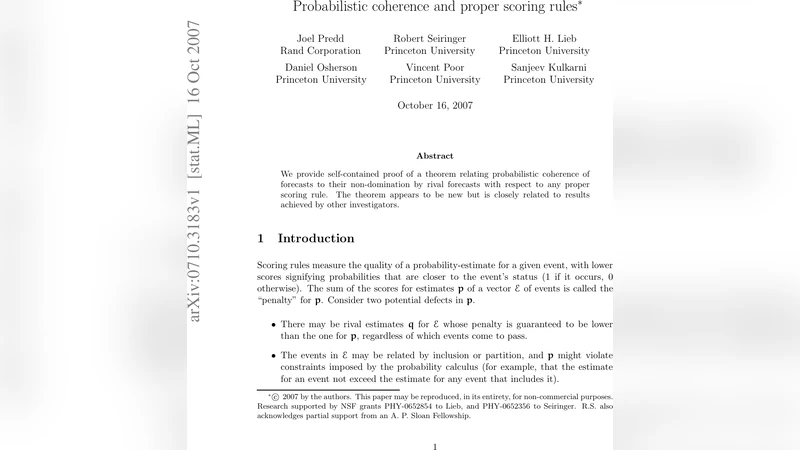
We provide self-contained proof of a theorem relating probabilistic coherence of forecasts to their non-domination by rival forecasts with respect to any proper scoring rule. The theorem appears to be new but is closely related to results achieved by other investigators.
💡 Research Summary
The paper establishes a deep and exact correspondence between two central concepts in probabilistic forecasting: probabilistic coherence (also called coherence or internal consistency of a probability forecast) and proper scoring rules (loss functions that incentivize honest reporting of probabilities). The authors present a self‑contained proof of a theorem that can be stated in two equivalent directions:
-
If a forecast is probabilistically coherent, then for every proper scoring rule its expected score cannot be strictly improved upon by any rival forecast. In other words, a coherent forecast is undominated with respect to the whole class of proper scoring rules.
-
Conversely, if a forecast is undominated for all proper scoring rules, then it must be probabilistically coherent. Thus non‑domination across the entire family of proper scores is a characterization of coherence.
The paper begins by formalizing the notions involved. A forecast is a vector of probabilities assigned to a finite collection of events (or to the outcomes of a discrete random variable). Coherence means that these assignments satisfy the axioms of probability: additivity for disjoint events, complementarity, and, more generally, that there exists a single joint probability distribution whose marginals coincide with the given forecasts. Proper scoring rules are functions (S(p, x)) where (p) is the reported probability distribution and (x) the realized outcome; they are proper if the expected score (\mathbb{E}_{X\sim q}
Comments & Academic Discussion
Loading comments...
Leave a Comment