On generalized topological groups
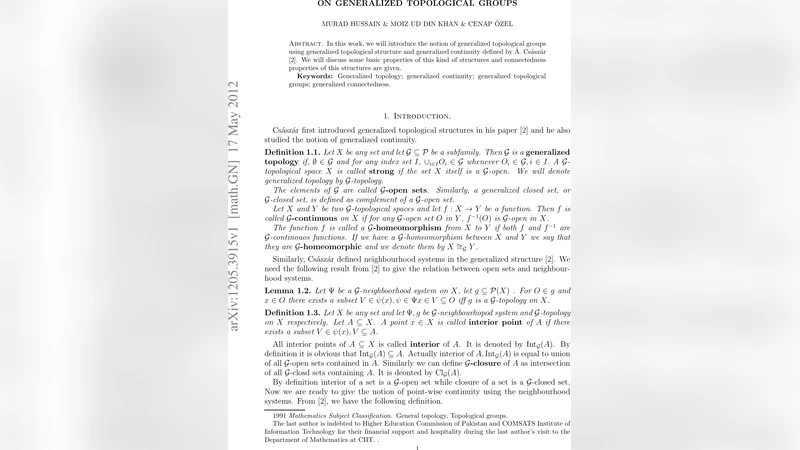
In this work, we will introduce the notion of generalized topological groups using generalized topological structure and generalized continuity defined by ?A. Cs?asz?ar [2]. We will discuss some basic properties of this kind of structures and connectedness properties of this structures are given. Keywords: Generalized topology; generalized continuity; generalized topological groups; generalized connectedness.
💡 Research Summary
The paper begins by recalling the notion of a generalized topology as introduced by A. Császár. Unlike classical topologies, a generalized topology on a set X is a collection 𝔗 of subsets that contains ∅ and X and is closed under arbitrary unions, but it does not require closure under finite intersections. This relaxation permits the treatment of spaces where the usual separation axioms fail, and it naturally leads to a broader concept of continuity: a map f : X→Y is called generalized continuous if the pre‑image of every generalized open set in Y belongs to the generalized open family of X.
With these preliminaries in place, the authors define a generalized topological group (GTG). A group G equipped with a generalized topology τ becomes a GTG precisely when the group multiplication μ : G×G→G and the inversion map ι : G→G are both generalized continuous, where the product space G×G carries the product generalized topology τ×τ (defined in the usual way by unions of products of τ‑open sets). This definition reduces to the classical notion of a topological group when τ is an ordinary topology, but it also admits many non‑standard examples.
The paper proceeds to develop the elementary algebraic‑topological properties of GTGs. First, any subgroup H of a GTG G inherits a sub‑generalized topology τ_H (the family of intersections of τ‑open sets with H), and (H,τ_H) is again a GTG. Second, the direct product of two GTGs, equipped with the product generalized topology, is a GTG; this shows that the category of GTGs is closed under finite products. Third, a homomorphism φ : G→H that is generalized continuous is called a GTG‑homomorphism; such maps preserve the group structure and the generalized topological structure, and they admit a natural notion of isomorphism (GTG‑isomorphism).
A substantial portion of the work is devoted to the interaction between the algebraic notion of normal subgroups and the generalized topological structure. The authors introduce the concept of a generalized closed set (a set whose complement belongs to the generalized open family) and prove that if N⊲G is a normal subgroup that is generalized closed, then the quotient set G/N carries a well‑defined quotient generalized topology making the canonical projection π : G→G/N a generalized continuous open map. Moreover, the quotient group (G/N,τ_{G/N}) is itself a GTG. This result mirrors the classical theorem for topological groups but requires careful handling because the lack of finite‑intersection closure can otherwise break the usual quotient construction.
The second major theme is generalized connectedness. Classical connectedness is defined via the impossibility of separating a space into two non‑empty disjoint open sets. In the generalized setting, such a definition would be too weak, as many spaces become trivially “connected” due to the permissive nature of the open families. To avoid this, the authors define a space X to be generally connected if there do not exist non‑empty disjoint τ‑open subsets U and V with U∪V = X. With this definition, they prove that every GTG can be uniquely decomposed into a disjoint union of its maximal generally connected components, each of which is a subgroup of G. They also show that GTG‑homomorphisms map connected components onto connected components, preserving this decomposition.
Illustrative examples are provided to demonstrate the breadth of the theory. The authors consider the discrete group ℤ equipped with the trivial generalized topology (only ∅ and ℤ are open) and show that it forms a GTG despite the lack of any non‑trivial open neighborhoods. They also examine groups endowed with the indiscrete generalized topology (all subsets are open), which yields a GTG where every map is automatically generalized continuous. These examples underline how the generalized framework captures both classical topological groups and exotic structures that would be excluded from the traditional theory.
In the concluding section, the authors argue that generalized topological groups furnish a flexible algebraic‑topological framework suitable for studying groups acting on non‑Hausdorff, non‑regular, or otherwise pathological spaces that arise in areas such as non‑standard analysis, theoretical computer science, and certain branches of mathematical physics. They outline several directions for future research: a systematic classification of GTG‑isomorphism types, the development of invariants analogous to Pontryagin duality in the generalized setting, and the exploration of applications to dynamical systems where the phase space carries only a generalized topology. Overall, the paper establishes the foundational definitions, proves basic structural theorems, and opens a pathway for further investigation into this newly broadened landscape of topological group theory.
Comments & Academic Discussion
Loading comments...
Leave a Comment