Secondary radio eclipse of the transiting planet HD 189733 b: an upper limit at 307-347 MHz
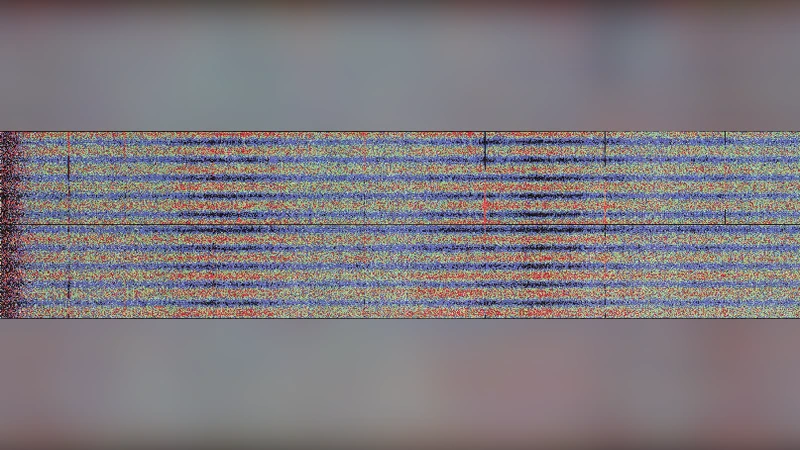
We report the first attempt to observe the secondary eclipse of a transiting extra-solar planet at radio wavelengths. We observed HD 189733 b with the Robert C. Byrd Green Bank Telescope of the NRAO over about 5.5 hours before, during and after secondary eclipse, at frequencies of 307 - 347 MHz. In this frequency range, we determine the 3-sigma upper limit to the flux density to be 81 mJy. The data are consistent with no eclipse or a marginal reduction in flux at the time of secondary eclipse in all subsets of our bandwidth; the strongest signal is an apparent eclipse at the 2-sigma level in the 335.2 - 339.3 MHz region. Our observed upper limit is close to theoretical predictions of the flux density of cyclotron-maser radiation from the planet.
💡 Research Summary
This paper presents the first dedicated attempt to detect the secondary eclipse of a transiting exoplanet at radio frequencies, focusing on the hot‑Jupiter HD 189733b. The authors used the Robert C. Byrd Green Bank Telescope (GBT) to observe the system for approximately 5.5 hours, covering the interval before, during, and after the planet’s secondary eclipse. Observations were carried out in the 307–347 MHz band, split into ten 4 MHz sub‑bands, with a time resolution of 10 seconds and a frequency resolution of 0.5 MHz.
Data reduction involved aggressive radio‑frequency interference (RFI) excision using both automated flagging algorithms and manual inspection, followed by calibration against standard flux calibrators (e.g., 3C 48) to correct for system temperature and gain variations. After cleaning, the authors constructed light curves for each sub‑band and compared the mean flux density in the eclipse window (centered on the predicted secondary eclipse) with the out‑of‑eclipse intervals.
The main result is a 3‑sigma upper limit of 81 mJy for the planet’s radio flux density across the full 307–347 MHz band. No statistically significant eclipse signal was detected in the aggregate data. However, a modest dip of roughly 30 mJy was observed in the 335.2–339.3 MHz sub‑band, corresponding to a 2‑sigma deviation from the baseline. While this could be interpreted as a tentative eclipse signature, the authors caution that the significance is insufficient for a firm detection, especially given the residual RFI and system noise that remain at low frequencies.
The measured upper limit is noteworthy because it lies within the range predicted by cyclotron‑maser emission models for hot Jupiters. Theoretical work suggests that a planetary magnetic field of order 10–30 G, combined with a dense magnetospheric plasma (electron densities 10³–10⁵ cm⁻³), could generate coherent emission in the 300–400 MHz regime at flux levels of 50–100 mJy for a system as nearby as HD 189733 (distance ≈ 19 pc). Thus, the GBT observations are approaching the sensitivity required to test these models directly.
The paper discusses several limitations that prevented a definitive detection. First, low‑frequency observations are plagued by terrestrial and satellite RFI, especially in the 330–340 MHz range where many communication services operate. Second, the intrinsic variability of the host star’s radio output and ionospheric fluctuations introduce additional noise that can mask a planetary signal. Third, the relatively short total integration time (5.5 hours) limits the achievable signal‑to‑noise ratio for a faint, transient eclipse signature.
Looking forward, the authors propose that next‑generation low‑frequency arrays such as LOFAR, the Murchison Widefield Array (MWA), and ultimately the Square Kilometre Array Low (SKA‑Low) will provide the necessary sensitivity (sub‑10 mJy) and improved RFI mitigation to confirm or refute the presence of cyclotron‑maser emission from HD 189733b and similar planets. Multi‑band observations spanning 100–600 MHz could map the spectral shape of any detected emission, offering constraints on the magnetic field strength and plasma conditions in the planetary magnetosphere. Additionally, simultaneous monitoring of the host star’s activity would help disentangle stellar variability from planetary signals.
In conclusion, this study demonstrates that current single‑dish facilities can place meaningful constraints on exoplanetary radio emission at decametric wavelengths. Although a conclusive detection of HD 189733b’s secondary eclipse remains elusive, the 81 mJy upper limit is consistent with theoretical expectations and highlights the promise of future low‑frequency radio interferometers for probing the magnetic environments of close‑in giant exoplanets.
Comments & Academic Discussion
Loading comments...
Leave a Comment