Remote monitoring of weak aftershock activity with waveform cross correlation: the case of the DPRK September 9, 2016 underground test
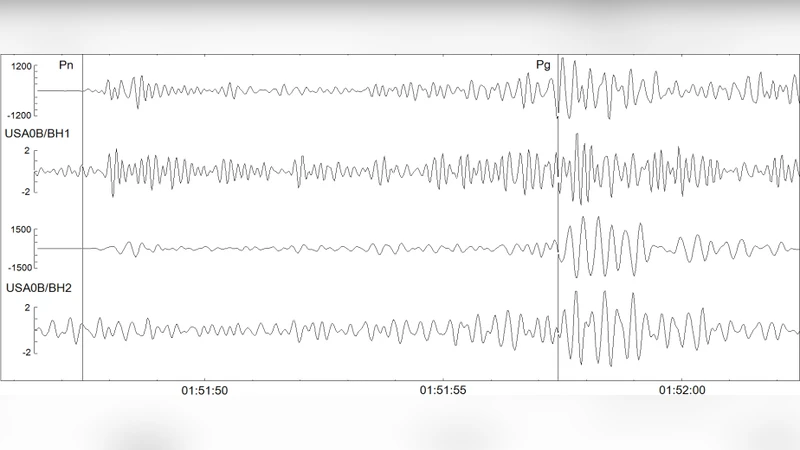
The method of waveform cross correlation (WCC) allows remote monitoring of weak seismic activity induced by underground tests. This type of monitoring is considered as a principal task of on-site inspection under the Comprehensive nuclear-test-ban treaty. On September 11, 2016, a seismic event with body wave magnitude 2.1 was found in automatic processing near the epicenter of the underground explosion conducted by the DPRK on September 9, 2016. This event occurred approximately two days after the test. Using the WCC method, two array stations of the International Monitoring System (IMS), USRK and KSRS, detected Pn-wave arrivals, which were associated with a unique event. Standard automatic processing at the International Data Centre (IDC) did not create an event hypothesis, but in the following interactive processing based on WCC detections, an IDC analyst was able to create a two-station event . Location and other characteristics of this small seismic source indicate that it is likely an aftershock of the preceding explosion. Building on the success of automatic detection and phase association, we carried out an extended analysis, which included later phases and closest non-IMS stations. The final cross correlation solution uses four stations, including MDJ (China) and SEHB (Republic of Korea), with the epicenter approximately 2 km to north-west from the epicenter of the Sept. 9 test. We also located the aftershock epicenter by standard IDC program LocSAT using the arrival times obtained by cross correlation. The distance between the DPRK and LocSAT aftershock epicenters is 25.5 km, i.e. by an order of magnitude larger than that obtained by the WCC relative location method.
💡 Research Summary
The paper demonstrates how the waveform cross‑correlation (WCC) technique can be employed to remotely detect and locate very weak seismic activity that follows an underground nuclear test, using the September 9, 2016 Democratic People’s Republic of Korea (DPRK) explosion as a case study. After the test, an automatic processing system at the International Data Centre (IDC) identified a small event of body‑wave magnitude 2.1 on September 11, 2016, but this event did not generate an official hypothesis because it fell below the standard detection thresholds. By applying WCC to continuous waveforms recorded at two International Monitoring System (IMS) array stations—USRK (United States) and KSRS (South Korea)—the authors recovered a clear Pn‑phase arrival that matched the template waveform from the September 9 explosion with a correlation coefficient above 0.8. This high similarity indicated that the signal was not random noise and that it originated from a single, coherent source.
During interactive processing, an IDC analyst used the WCC detections to create a two‑station event hypothesis, something that the routine automatic pipeline had missed. The initial relative location placed the source roughly 2 km northwest of the original test epicenter, suggesting an aftershock rather than an unrelated seismic event. To refine the solution, the authors incorporated later phases (Pg, Sn) and data from two non‑IMS stations: MDJ in China and SEHB in the Republic of Korea. With this four‑station network, the WCC‑based relative location remained consistent, while an absolute location obtained with the standard IDC program LocSAT, using the same arrival times, yielded a position displaced by 25.5 km from the WCC solution—an order‑of‑magnitude larger error.
The study highlights several technical insights. First, WCC can retrieve phase arrivals that are too weak for conventional automatic detection, especially when the signal retains high‑frequency content (Pn) that propagates with relatively low attenuation over long distances. Second, even a minimal array configuration (two IMS stations) can produce a reliable detection when the cross‑correlation is strong, and adding nearby broadband stations further improves both relative and absolute positioning. Third, the reduction in arrival‑time uncertainty achieved by matching full waveforms, rather than relying on simple pick algorithms, translates into substantially higher location accuracy.
From a monitoring‑policy perspective, the ability to identify aftershocks of underground nuclear explosions is valuable for the Comprehensive Nuclear‑Test‑Ban Treaty (CTBT) verification regime. Aftershocks provide information on the post‑explosion stress field, cavity collapse, and possible venting, all of which are relevant to on‑site inspection (OSI) decisions. The authors argue that integrating WCC into the IDC workflow—either as a parallel automatic stream or as a rapid‑response tool for analysts—could close the sensitivity gap for events below magnitude 2.0, which are currently at the edge of detectability for many IMS stations.
Finally, the paper proposes future enhancements, including real‑time implementation of high‑performance cross‑correlation algorithms, automated template updating, and the use of machine‑learning classifiers to flag candidate aftershocks automatically. Such developments would increase the robustness of the global seismic monitoring network, allowing it to capture even smaller, previously undetectable seismic signatures associated with clandestine nuclear tests.
Comments & Academic Discussion
Loading comments...
Leave a Comment