Relative relocation of earthquakes without a predefined velocity model: an example from a peculiar seismic cluster on Katla volcanos south-flank (Iceland)
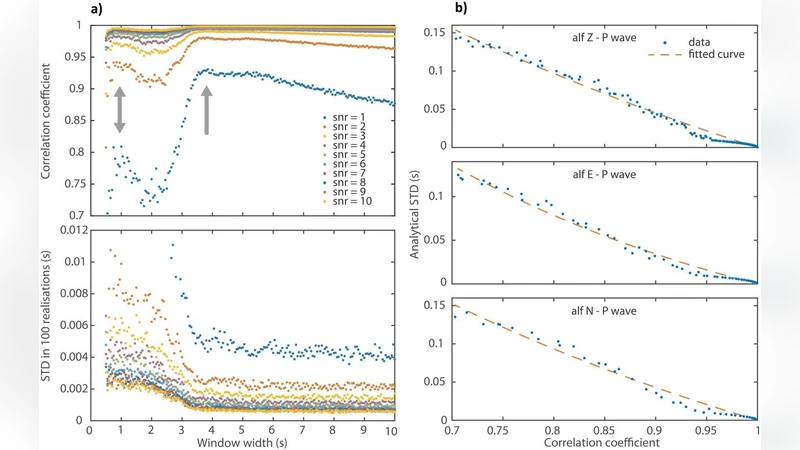
Relative relocation methods are commonly used to precisely relocate earthquake clusters consisting of similar waveforms. Repeating waveforms are often recorded at volcanoes, where, however, the crust structure is expected to contain strong heterogeneities and therefore the 1D velocity model assumption that is made in most location strategies is not likely to describe reality. A peculiar cluster of repeating low-frequency seismic events was recorded on the south flank of Katla volcano (Iceland) from 2011. As the hypocentres are located at the rim of the glacier, the seismicity may be due to volcanic or glacial processes. Information on the size and shape of the cluster may help constraining the source process. The extreme similarity of waveforms points to a very small spatial distribution of hypocentres. In order to extract meaningful information about size and shape of the cluster, we minimize uncertainty by optimizing the cross-correlation measurements and relative-relocation process. With a synthetic test we determine the best parameters for differential-time measurements and estimate their uncertainties, specifically for each waveform. We design a relocation strategy to work without a predefined velocity model, by formulating and inverting the problem to seek changes in both location and slowness, thus accounting for azimuth, take-off angles and velocity deviations from a 1D model. We solve the inversion explicitly in order to propagate data errors through the calculation. With this approach we are able to resolve a source volume few tens of meters wide on horizontal directions and around 100 meters in depth. There is no suggestion that the hypocentres lie on a single fault plane and the depth distribution indicates that their source is unlikely to be related to glacial processes as the ice thickness is not expected to exceed few tens of meters in the source area.
💡 Research Summary
The paper addresses a fundamental problem in seismology: how to precisely relocate clusters of repeating earthquakes when the underlying velocity structure is highly heterogeneous and a simple 1‑D velocity model is inadequate. The authors focus on a peculiar cluster of low‑frequency, waveform‑identical events recorded on the south‑flank of Katla volcano in Iceland from 2011 onward. Because the events occur at the rim of the glacier, their origin could be volcanic, glacial, or a combination of both, and the spatial extent of the hypocentres is crucial for discriminating between these mechanisms.
First, the authors collect a data set of roughly 200 events recorded by three broadband stations. All waveforms display an extreme degree of similarity, suggesting that the sources are confined to a very small volume. To exploit this similarity, they apply cross‑correlation to each pair of waveforms in order to obtain differential travel‑time measurements with sub‑sample precision. Recognizing that the optimal correlation window and band‑pass filter may differ from event to event, they conduct a synthetic test in which artificial events are generated with known separations. By varying the correlation window length, filter band, and signal‑to‑noise ratio, they identify the parameter set that minimizes the bias and variance of the measured time differences. Importantly, the synthetic test also yields an event‑specific uncertainty estimate for each differential time, which is later propagated through the relocation inversion.
The methodological innovation lies in formulating the relocation problem without assuming a predefined velocity model. Instead of using fixed ray‑paths derived from a 1‑D model, the authors linearize the travel‑time differences with respect to both changes in hypocentre coordinates (Δx, Δy, Δz) and changes in slowness vectors (Δs). The slowness vector captures deviations in azimuth, take‑off angle, and effective velocity, thereby allowing the inversion to absorb the effects of lateral heterogeneity and anisotropy. The resulting system of equations is solved explicitly by a weighted least‑squares approach, where the weights are the inverse of the covariance matrix assembled from the synthetic‑test‑derived uncertainties. This explicit solution enables a straightforward propagation of measurement errors into the final location uncertainties, providing realistic confidence intervals for each relocated event.
The synthetic validation demonstrates that the algorithm can recover a synthetic cluster with a true size of 10 m to within a few metres horizontally and about 15 m vertically, confirming that the method is not limited by the lack of a velocity model. When applied to the Katla data, the relocation reveals a three‑dimensional source volume roughly 30–40 m wide in the horizontal plane and about 100 m thick in depth. The distribution of hypocentres does not align on a single planar fault; instead, it shows a modest vertical scatter. The depth range, centred around 100 m below the surface, exceeds the expected ice thickness at the site (estimated to be no more than a few tens of metres). Consequently, the authors argue that the seismicity is unlikely to be driven by glacial processes such as basal sliding or crevasse formation, and is more plausibly linked to volcanic processes (e.g., magma movement, hydrothermal activity, or resonant oscillations within a shallow conduit).
In summary, the study provides a robust framework for relative relocation in structurally complex environments where traditional 1‑D velocity models fail. By integrating optimal cross‑correlation measurement, synthetic‑based uncertainty quantification, and a joint inversion for location and slowness, the authors achieve sub‑decametre precision without prior knowledge of the velocity field. The application to Katla’s south‑flank cluster not only refines the spatial geometry of the source region but also supplies critical evidence that the events are of volcanic origin rather than glacial. This methodology is readily transferable to other volcanic or tectonic settings characterized by repeating waveforms and strong velocity heterogeneity, offering a powerful tool for deciphering the physics of small‑scale seismic sources.
Comments & Academic Discussion
Loading comments...
Leave a Comment