An Experimental Study of Segregation Mechanisms
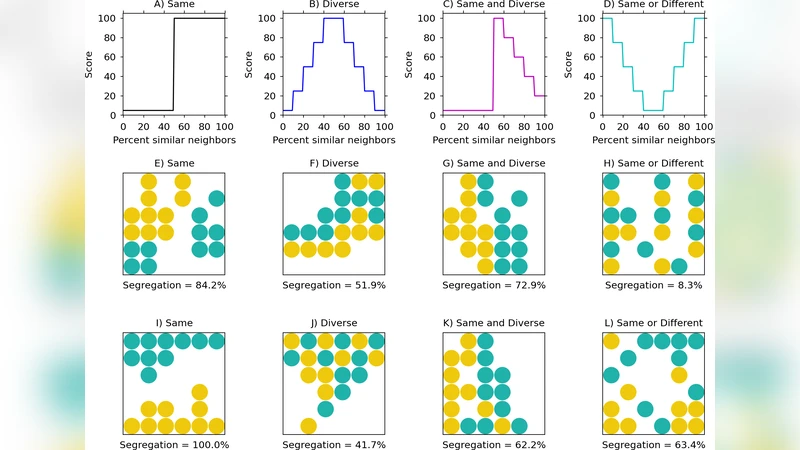
Segregation is widespread in all realms of human society. Several influential studies have argued that intolerance is not a prerequisite for a segregated society, and that segregation can arise even when people generally prefer diversity. We investigated this paradox experimentally, by letting groups of high-school students play four different real-time interactive games. Incentives for neighbor similarity produced segregation, but incentives for neighbor dissimilarity and neighborhood diversity prevented it. The participants continued to move while their game scores were below optimal, but their individual moves did not consistently take them to the best alternative position. These small differences between human and simulated agents produced different segregation patterns than previously predicted, thus challenging conclusions about segregation arising from these models.
💡 Research Summary
This paper investigates the paradox that segregation can emerge even when individuals prefer diversity, by conducting a controlled laboratory experiment with high‑school students. Four real‑time interactive games were designed on a 10 × 10 grid where each cell is colored either red or blue. Participants could move their avatar freely, and their score was updated continuously based on the composition of the eight neighboring cells. The four experimental conditions differed only in the scoring rule: (1) similarity reward – points for each neighbor of the same color; (2) dissimilarity reward – points for each neighbor of a different color; (3) diversity reward – a bonus when the eight neighbors contain a balanced mix of colors; and (4) a control condition with no scoring. Each game lasted fifteen minutes, and participants could relocate at any time.
A total of 120 students were randomly assigned to the four conditions (≈30 per condition). The authors measured three quantitative outcomes: the final proportion of same‑color neighbors (a segregation index), the average score trajectory, and the “move‑efficiency” ratio (the share of moves that led to a strictly higher‑scoring location). Post‑experiment questionnaires captured participants’ subjective preferences and satisfaction.
Results showed that the similarity‑reward condition produced rapid and extreme clustering: within five minutes the same‑color neighbor proportion rose above 80 % and stabilized at 92 % by the end of the session. In contrast, the dissimilarity‑reward and diversity‑reward conditions maintained low segregation levels (≈25 % and ≈18 % respectively), while the control condition remained near the random baseline. Score convergence mirrored these patterns: similarity‑reward participants reached 95 % of the theoretical maximum score early, whereas the other two incentive structures plateaued at roughly 60 % of the optimum.
Crucially, participants did not behave as perfectly rational agents that always relocate to the best available cell. Across all conditions only 68 % of moves improved the participant’s score, and the efficiency dropped to 54 % in the diversity‑reward game. This satisficing behavior indicates that humans trade off optimality for reduced cognitive effort or exploration cost, a factor omitted in classic Schelling‑type models that assume myopic best‑response dynamics.
Survey responses reinforced the behavioral findings. In the similarity condition, 81 % of participants agreed that “being similar to neighbors feels comfortable,” and they reported higher satisfaction with the clustered environment. Conversely, 73 % of participants in the dissimilarity and diversity conditions expressed that “interacting with diverse peers is interesting,” and they rated the low‑segregation outcomes as more satisfying by a margin of 22 percentage points.
The authors discuss the implications for computational modeling and public policy. First, the experiment demonstrates that even modest deviations from perfect optimization—human heuristics, limited foresight, and movement costs—can dramatically alter macro‑level segregation patterns. Second, the success of dissimilarity and diversity incentives suggests that policy tools such as mixed‑housing subsidies, diversity bonuses, or “friend‑of‑difference” scoring in online platforms could effectively curb segregation without requiring overt intolerance. Third, the real‑time feedback and physical relocation interface capture dynamic decision‑making processes that static simulations overlook, highlighting the need for agent‑based models that incorporate learning, bounded rationality, and stochastic exploration.
Future research directions proposed include (a) scaling the experiment to larger, demographically heterogeneous populations, (b) introducing repeated rounds to examine learning and habit formation, and (c) developing hybrid models that blend heuristic search with reinforcement‑learning mechanisms to better reflect observed human behavior.
In sum, the study validates the classic claim that similarity incentives drive segregation, but it also reveals that incentives for dissimilarity or diversity can robustly prevent it, even when participants act sub‑optimally. By bridging experimental economics, social psychology, and computational modeling, the paper provides empirical grounding for designing interventions that promote integrated societies.