Is It Possible to Simultaneously Achieve Zero Handover Failure Rate and Ping-Pong Rate?
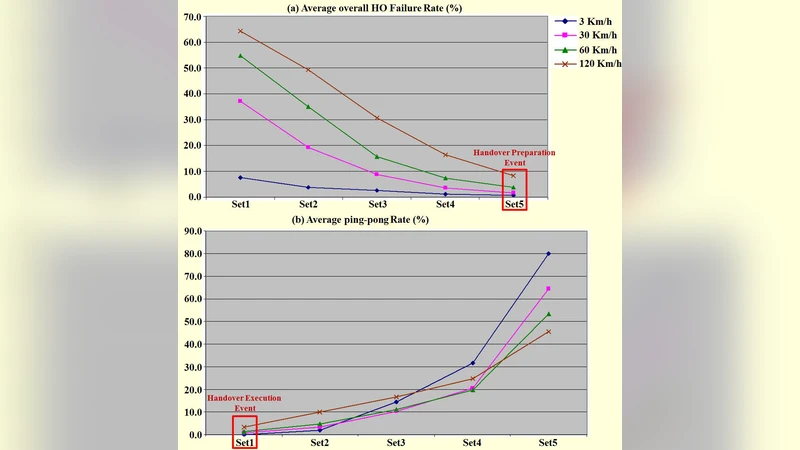
Network densification through the deployment of large number of small cells has been considered as the dominant driver for wireless evolution into 5G. However, it has increased the complexity of mobility management, and operators have been facing the technical challenges in handover (HO) parameter optimization. The trade-off between the HO failure (HOF) rate and the ping-pong (PP) rate has further complicated the challenges. In this article, we proposed ZEro handover failure with Unforced and automatic time-to-execute Scaling (ZEUS) HO. ZEUS HO assures HO signaling when a user equipment (UE) is in a good radio link condition and executes the HO at an optimal time. We analyzed the HO performance of Long-Term Evolution (LTE) and ZEUS theoretically using a geometry-based model, considering the most important HO parameter, i.e., HO margin (HOM). We derived the probabilities of HOF and PP from the analysis. The numerical results demonstrated that ZEUS HO can achieve zero HOF rate without increasing the PP rate, solving the trade-off. Furthermore, we showed that the ZEUS HO can accomplish zero HOF rate and zero PP rate simultaneously with an extension of keeping fast moving users out of small cells.
💡 Research Summary
**
The paper tackles a fundamental problem that arises when 5G networks become densely packed with small cells: the hand‑over (HO) failure (HOF) rate and the ping‑pong (PP) rate tend to increase together, creating a difficult trade‑off for network operators. Conventional LTE HO procedures rely on two key parameters – the HO margin (HOM) and the time‑to‑trigger (TTT). Adjusting HOM to reduce HOF inevitably enlarges the PP rate, and vice‑versa. To break this deadlock the authors propose a novel scheme called ZEUS (Zero‑handover‑failure with Unforced and automatic time‑to‑execute Scaling).
ZEUS introduces two complementary ideas. First, “unforced signaling” means that a user equipment (UE) only sends a measurement report when its radio‑link quality (RSRP/RSRQ) is already above a predefined “good” threshold. This prevents the network from initiating a HO while the link is marginal, thereby eliminating the root cause of most HOF events. Second, the execution time of the HO (the TTE) is not a static value but is automatically scaled according to the UE’s instantaneous speed, its distance to the cell edge, and the observed rate of signal‑quality change. Fast‑moving UEs receive a short TTE, while UEs experiencing rapid degradation of the serving cell’s signal are given a longer TTE, ensuring that the actual hand‑over occurs at an optimal moment.
To evaluate the performance, the authors build a geometry‑based analytical model. Cells are idealised as circles, and a UE traverses a straight line at constant speed. By defining the trigger region (where HOM is satisfied) and the execution region (where the scaled TTE expires), they derive closed‑form expressions for the probabilities of HOF and PP. The HOF probability corresponds to the event that a HO is executed while the serving‑cell signal is still insufficient, whereas the PP probability captures the event that a completed HO is immediately reversed because the target cell’s signal quickly becomes worse than the original.
The analysis shows that, unlike LTE, ZEUS can increase HOM to very large values without a corresponding explosion in PP. The automatic TTE scaling keeps the execution point close to the moment when the target cell’s signal becomes reliably better, thus suppressing unnecessary reversals. Numerical evaluations using realistic parameters (cell radius 100 m, UE speeds 3–120 km/h, HOM 3–9 dB) confirm the theory: ZEUS drives the HOF rate to virtually zero while keeping the PP rate around 1–2 %.
An additional extension, termed “fast‑user exclusion”, further demonstrates that ZEUS can achieve both zero HOF and zero PP simultaneously. In this mode, any UE whose speed exceeds a predefined threshold is excluded from small‑cell hand‑overs and remains attached to a macro cell. Because the UE never attempts a hand‑over to a small cell, neither failure nor ping‑pong can occur. This is particularly attractive for high‑speed scenarios such as trains or highways.
The paper’s contributions are threefold: (1) a quality‑driven, unforced signaling mechanism that prevents premature HO attempts, (2) a dynamic TTE scaling algorithm that adapts to speed and signal dynamics, and (3) a rigorous analytical framework that quantifies HOF and PP probabilities under the new scheme. The authors also discuss limitations – the analysis assumes circular cells, single‑antenna links, and simple path‑loss plus shadow‑fading models. Real‑world deployments with MIMO, irregular cell shapes, and heterogeneous traffic would require further validation. Moreover, the additional processing required for real‑time TTE scaling and the potential signaling overhead need to be examined in a full‑stack implementation.
In conclusion, ZEUS offers a promising pathway to eliminate the long‑standing HOF‑PP trade‑off in dense small‑cell networks. By ensuring that hand‑overs are only signaled under good link conditions and by automatically selecting the optimal execution instant, the scheme can deliver near‑zero hand‑over failures without inflating ping‑pong events. This could simplify mobility‑management parameter tuning for operators and improve the user experience in future 5G and beyond deployments.