A polynomial regularity lemma for semi-algebraic hypergraphs and its applications in geometry and property testing
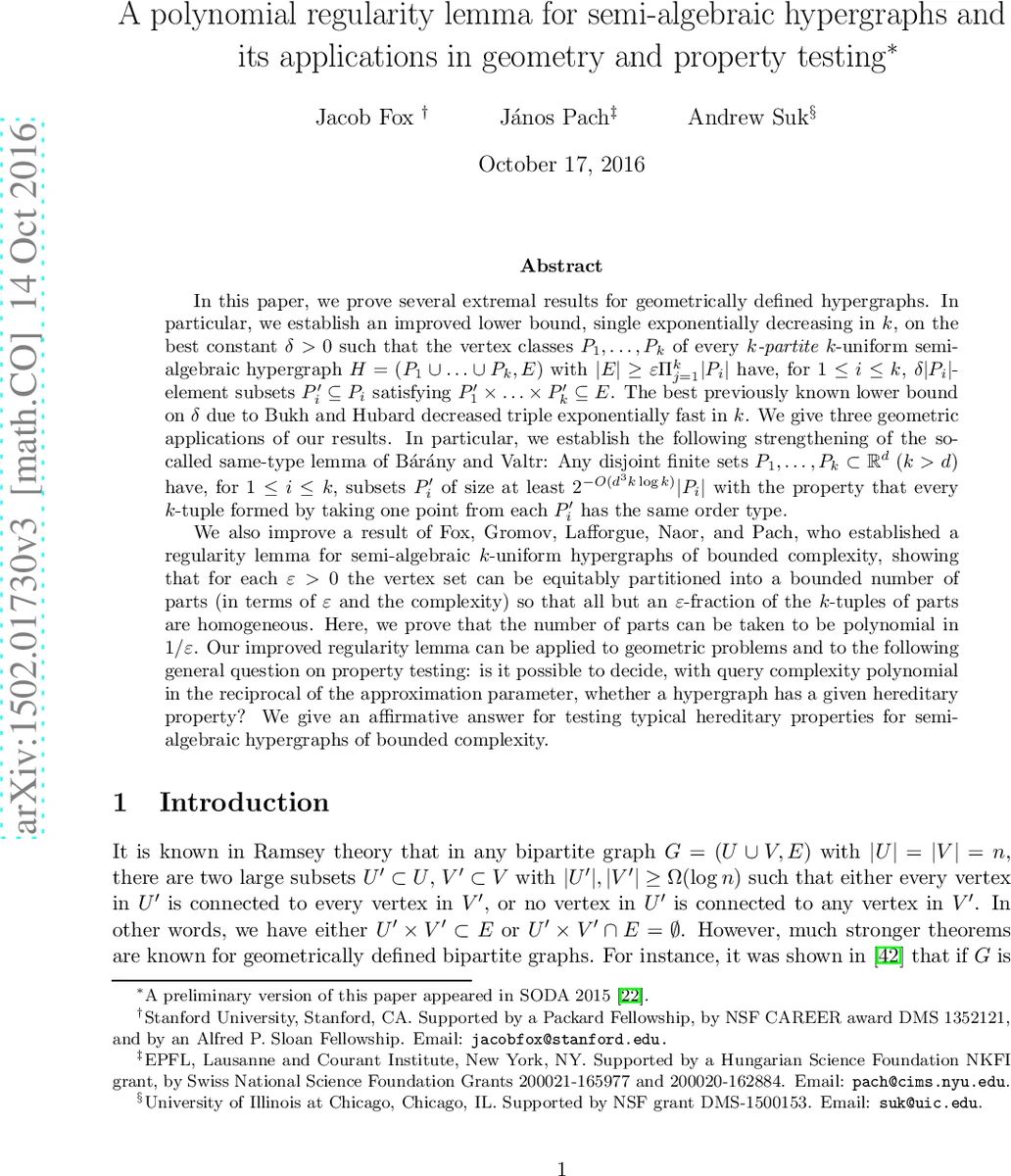
Fox, Gromov, Lafforgue, Naor, and Pach proved a regularity lemma for semi-algebraic $k$-uniform hypergraphs of bounded complexity, showing that for each $\epsilon>0$ the vertex set can be equitably partitioned into a bounded number of parts (in terms of $\epsilon$ and the complexity) so that all but an $\epsilon$-fraction of the $k$-tuples of parts are homogeneous. We prove that the number of parts can be taken to be polynomial in $1/\epsilon$. Our improved regularity lemma can be applied to geometric problems and to the following general question on property testing: is it possible to decide, with query complexity polynomial in the reciprocal of the approximation parameter, whether a hypergraph has a given hereditary property? We give an affirmative answer for testing typical hereditary properties for semi-algebraic hypergraphs of bounded complexity.
💡 Research Summary
This paper establishes a polynomial‑size regularity lemma for semi‑algebraic k‑uniform hypergraphs of bounded complexity and demonstrates several powerful geometric and algorithmic applications.
The authors first improve the density theorem of Fox, Gromov, Lafforgue, Naor and Pach. Previously, given a semi‑algebraic k‑partite hypergraph H with edge density ε, one could extract complete k‑partite subhypergraphs whose vertex subsets had size at least ε^{c(k)}|P_i|, where the exponent c(k) deteriorated exponentially in k. By employing Milnor–Thom cell decomposition together with an induction on k, the paper removes the dependence on k from the exponent. Theorem 1.1 shows that for any ε>0 one can find subsets P′_i⊆P_i with |P′_i|≥ε^{C·(d+ D d)^{k}}|P_i| (C depends only on the ambient dimension d, the number of defining polynomials t and their degree bound D). In the important case of complexity (t,1) this yields |P′_i|≥ε^{O(k·d·log d)}|P_i| (Corollary 1.2).
The second major contribution is a regularity lemma whose number of parts grows only polynomially in 1/ε. Classical Szemerédi regularity requires a tower‑type bound on the number of parts; even the semi‑algebraic version of Fox et al. gave only a qualitative bound. Theorem 1.3 proves that any semi‑algebraic k‑uniform hypergraph H can be equitably partitioned into at most (1/ε)^{c(k,d,t,D)} parts such that all but an ε‑fraction of the k‑tuples of parts are homogeneous (each k‑tuple is either completely inside E or completely outside). The exponent c is a polynomial function of k, d, t and D; for complexity (t,1) it is O(k·d·log d). The proof again uses cell decomposition to obtain a coarse partition and then refines it while preserving homogeneity, avoiding the heavy combinatorial blow‑up of the original Szemerédi argument.
Armed with these two tools, the authors derive three geometric corollaries.
- Same‑type lemma (Theorem 1.4). For k > d disjoint finite point sets P₁,…,P_k in ℝ^d in general position, one can select subsets P′_i of size at least 2^{-O(d³k log k)}|P_i| such that every transversal (p₁,…,p_k)∈P′_1×…×P′_k has the same order‑type. This improves the earlier bound 2^{-O(k·d)} of Bárány and Valtr.
- Homogeneous selections from hyperplanes (Theorem 1.5). Given d+1 families of hyperplanes L₁,…,L_{d+1} in general position, one can extract subfamilies L′i of size at least 2^{-O(d⁴ log d)}|L_i| and a point q∈ℝ^d such that for every (h₁,…,h{d+1})∈L′1×…×L′{d+1} the point q lies inside the simplex bounded by the hyperplanes. This strengthens the Bárány–Pach selection theorem, reducing the constant from doubly‑exponential to polynomial in d.
- Tverberg‑type result for simplices (Theorem 1.6). For d+1 disjoint n‑point sets P₁,…,P_{d+1} in general position, there exist subsets P′_i of size at least 2^{-O(d² log (d+1))}|P_i| and a point q such that every simplex with one vertex from each P′_i contains q. This improves earlier bounds of the form 2^{-O(d²)}.
Finally, the paper applies the polynomial regularity lemma to property testing. For any hereditary property P of semi‑algebraic hypergraphs with bounded complexity, the authors construct a one‑sided ε‑tester whose query complexity is polynomial in 1/ε. The tester samples a constant‑size random subhypergraph according to the polynomial partition, checks homogeneity, and decides whether the input hypergraph satisfies P or is ε‑far from it. This yields the first polynomial‑time testers for a broad class of geometric hypergraph properties, contrasting with the super‑polynomial lower bounds known for general graphs.
Overall, the work shows that the additional algebraic structure of semi‑algebraic hypergraphs allows one to replace the notoriously large tower‑type bounds of classical regularity theory with polynomial bounds, leading to substantially stronger quantitative results in extremal geometry and sublinear‑time algorithms.
Comments & Academic Discussion
Loading comments...
Leave a Comment