Analytic Solution for Self-regulated Collective Escape of Cosmic Rays from their Acceleration Sites
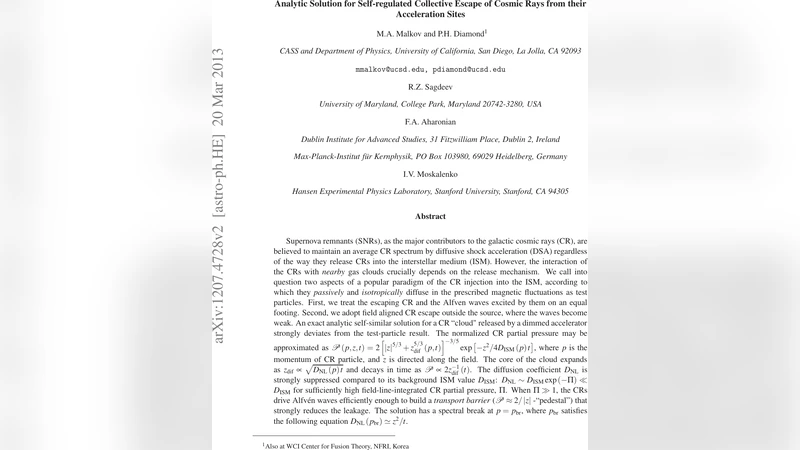
Supernova remnants (SNRs), as the major contributors to the galactic cosmic rays (CR), are believed to maintain an average CR spectrum by diffusive shock acceleration (DSA) regardless of the way they release CRs into the interstellar medium (ISM). However, the interaction of the CRs with nearby gas clouds crucially depends on the release mechanism. We call into question two aspects of a popular paradigm of the CR injection into the ISM, according to which they passively and isotropically diffuse in the prescribed magnetic fluctuations as test particles. First, we treat the escaping CR and the Alfven waves excited by them on an equal footing. Second, we adopt field aligned CR escape outside the source, where the waves become weak. An exact analytic self-similar solution for a CR “cloud” released by a dimmed accelerator strongly deviates from the test-particle result. The CR diffusion coefficient $D_{NL}$ is strongly suppressed compared to its background ISM value $D_{ISM}$: $D_{NL}\sim D_{ISM}\exp(-\Pi)« D_{ISM}$ for sufficiently high field-line-integrated CR partial pressure, $\Pi$. When $\Pi»1$, the CRs drive Alfven waves efficiently enough to build a transport barrier that strongly reduces the leakage. The solution has a spectral break at $p=p_{br}$, where $p_{br}$ satisfies the following equation $D_{NL}(p_{br})\simeq z^{2}/t$.
💡 Research Summary
The paper revisits the long‑standing paradigm that cosmic rays (CRs) accelerated in supernova remnants (SNRs) simply diffuse as test particles in a pre‑existing turbulent magnetic field. The authors argue that this view neglects two essential aspects: (1) the back‑reaction of escaping CRs on the Alfvén waves they generate, and (2) the fact that once the self‑generated turbulence weakens, CRs propagate preferentially along magnetic field lines rather than isotropically. To address these points, they formulate a coupled system of equations for the CR partial pressure (P_c(z,t)) and the wave energy density (W(z,t)). The wave growth term follows from the resonant streaming instability driven by the CR gradient, while damping includes non‑linear wave–particle interactions and ion–neutral collisions.
A key dimensionless parameter is the field‑line‑integrated CR pressure (\Pi). When (\Pi \gg 1), CRs efficiently amplify Alfvén waves, creating a “transport barrier” that dramatically reduces the effective diffusion coefficient. The authors derive an exact self‑similar solution for a CR “cloud” released by a dimmed accelerator. By introducing the similarity variable (\xi = z/\sqrt{t}), the non‑linear diffusion equation reduces to an ordinary differential equation whose solution splits naturally into two regimes. In the inner region, where wave amplitudes are large, the diffusion coefficient (D_{\rm NL}) is essentially constant and much smaller than the background ISM value (D_{\rm ISM}); the CR density remains quasi‑static. In the outer region, where waves have decayed, (D_{\rm NL}) grows as (\xi^{2}), reproducing the familiar (D\propto t^{-1}) scaling of linear diffusion.
The analytic expression for the diffusion coefficient is \