Histological and Histochemical Studies on the Esophagus, Stomach and Small Intestines of Vara-nus niloticus
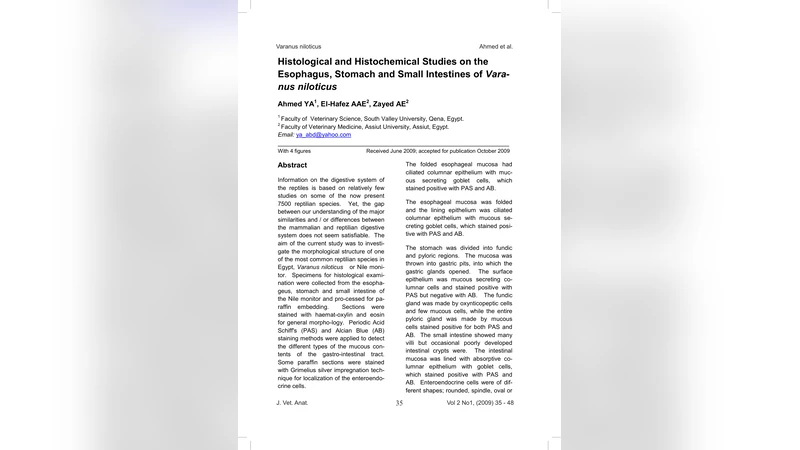
The aim of the current study was to investigate the morphological structure of one of the most common reptilian species in Egypt, Varanus niloticus or Nile monitor. Specimens for histological examination were collected from the esophageus, stomach and small intestine of the Nile monitor and processed for paraffin embedding. Sections were stained with haematoxylin and eosin for general morphology. Periodic Acid Schiff’s (PAS) and Alcian Blue (AB) staining methods were applied to detect the different types of the mucous con-tents of the gastro-intestinal tract. Some paraffin sections were stained with Grimelius silver impregnation technique for localization of the enteroendocrine cells. The folded esophageal mucosa had ciliated columnar epithelium with mucous secreting goblet cells, which stained positive with PAS and AB. The esophageal mucosa was folded and the lining epithelium was ciliated columnar epithelium with mucous secreting goblet cells, which stained positive with PAS and AB. The stomach was divided into fundic and pyloric regions. The mucosa was thrown into gastric pits, into which the gastric glands opened. The surface epithelium was mucous secreting columnar cells and stained positive with PAS but negative with AB. The fundic gland was made by oxynticopeptic cells and few mucous cells, while the entire pyloric gland was made by mucous cells stained positive for both PAS and AB. The small intestine showed many villi but occasional poorly developed intestinal crypts were. The intestinal mucosa was lined with absorptive columnar epithelium with goblet cells, which stained positive with PAS and AB. Enteroendocrine cells were of different shapes; rounded, spindle, oval or pyramidal and were localized in the surface epithelium of the esophagus and small intestine, and among the cells of the gastric glands.
💡 Research Summary
The present study provides a comprehensive histological and histochemical characterization of the esophagus, stomach, and small intestine of the Nile monitor lizard (Varanus niloticus), a reptile that is abundant in Egypt. Tissue samples were harvested, fixed in neutral‑buffered formalin, embedded in paraffin, and cut into 5 µm sections. Standard hematoxylin‑eosin staining was used for general morphology, while Periodic Acid‑Schiff (PAS) and Alcian Blue (AB) staining distinguished neutral versus acidic mucopolysaccharides. Grimelius silver impregnation identified enteroendocrine cells.
In the esophagus, the mucosa is highly folded and lined by a ciliated simple columnar epithelium. Interspersed goblet‑like cells produce mucus that reacts positively with both PAS and AB, indicating a mixture of neutral and acidic glycoconjugates. The cilia likely aid in particle clearance and mucus distribution, providing a protective, low‑friction surface for bolus transport.
The stomach is divided into fundic (proximal) and pyloric (distal) regions. The surface epithelium consists of mucous‑secreting columnar cells that are PAS‑positive but AB‑negative, suggesting primarily neutral mucins. Fundic glands are composed mainly of oxyntico‑peptic cells (combined parietal and chief cell functions) with a few mucous cells; these oxyntico‑peptic cells are PAS‑positive, reflecting their production of neutral glycogen‑rich secretions and possibly pepsinogen. The pyloric glands are almost entirely mucous cells that stain with both PAS and AB, indicating a blend of neutral and acidic mucins that protect the mucosa from the strong acid secreted by the fundic region. Gastric pits lead into these glands, forming a typical reptilian gastric architecture.
The small intestine displays numerous well‑developed villi and shallow crypts. The villous epithelium is a simple columnar layer with abundant microvilli and absorptive cells. Goblet cells are scattered among the absorptive cells and are PAS‑ and AB‑positive, confirming the secretion of both neutral and acidic mucus. This dual‑type mucus likely lubricates the lumen, buffers digestive enzymes, and protects the delicate villous surface. The crypts are relatively shallow compared with mammals, reflecting a reptilian pattern of epithelial turnover.
Grimelius staining revealed enteroendocrine cells of varied morphology—rounded, spindle‑shaped, oval, or pyramidal—in three locations: the surface epithelium of the esophagus, the gastric glandular epithelium, and the intestinal epithelium. Their distribution suggests a functional endocrine network that regulates motility, secretion, and nutrient sensing, analogous to gastrin, secretin, and cholecystokinin cells in other vertebrates.
The combined histochemical data highlight clear regional differences in mucin composition. The esophagus and intestine contain mixed neutral/acidic mucins (PAS + AB +), whereas the fundic stomach secretes mainly neutral mucins (PAS + AB‑), and the pyloric stomach produces mixed mucins (PAS + AB +). These patterns align with the distinct physiological roles of each segment: mechanical protection and lubrication in the esophagus, acid production and protein digestion in the fundic stomach, acid neutralization and mucosal protection in the pyloric stomach, and nutrient absorption with surface protection in the intestine.
Overall, this work delineates the specialized epithelial, glandular, and endocrine structures of the Nile monitor’s gastrointestinal tract, underscores the functional relevance of mucin diversity, and provides a valuable comparative baseline for reptilian digestive physiology. The findings support the concept that reptilian stomachs rely on a single oxyntico‑peptic cell type for both acid and enzyme secretion, and that mucosal protection is achieved through region‑specific mucin profiles. This detailed anatomical and biochemical portrait enhances our understanding of vertebrate gut evolution and may inform future studies on reptile health, nutrition, and conservation.
Comments & Academic Discussion
Loading comments...
Leave a Comment