Time-dependent neo-deterministic seismic hazard scenarios: Preliminary report on the M6.2 Central Italy earthquake, 24th August 2016
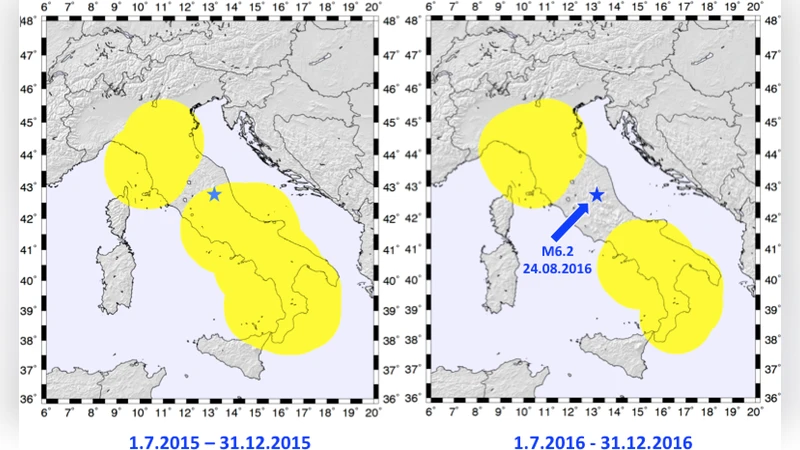
A scenario-based Neo-Deterministic approach to Seismic Hazard Assessment (NDSHA) is available nowadays, which permits considering a wide range of possible seismic sources as the starting point for deriving scenarios by means of full waveforms modeling. The method does not make use of attenuation relations and naturally supplies realistic time series of ground shaking, including reliable estimates of ground displacement, readily applicable to complete engineering analysis. Based on the neo-deterministic approach, an operational integrated procedure for seismic hazard assessment has been developed that allows for the definition of time dependent scenarios of ground shaking, through the routine updating of earthquake predictions, performed by means of the algorithms CN and M8S. The integrated NDSHA procedure for seismic input definition, which is currently applied to the Italian territory, combines different pattern recognition techniques, designed for the space-time identification of strong earthquakes, with algorithms for the realistic modeling of ground motion. Accordingly, a set of deterministic scenarios of ground motion at bedrock, which refers to the time interval when a strong event is likely to occur within the alerted area, is defined both at regional and local scale. CN and M8S predictions, as well as the related time-dependent ground motion scenarios associated with the alarmed areas, are routinely updated since 2006. The prospective application of the time-dependent NDSHA approach provides information that can be useful in assigning priorities for timely mitigation actions and, at the same time, allows for a rigorous validation of the proposed methodology. The results from real-time testing of the time-dependent NDSHA scenarios are illustrated with specific reference to the August 24th, 2016 Central Italy earthquake.
💡 Research Summary
The paper presents an operational framework that integrates a Neo‑Deterministic Seismic Hazard Assessment (NDSHA) with two independent pattern‑recognition algorithms, CN and M8S, to produce time‑dependent seismic hazard scenarios. Traditional probabilistic seismic hazard analysis (PSHA) relies on empirical attenuation relationships and statistical assumptions, which often fail to capture realistic ground‑motion time histories, especially low‑frequency displacement crucial for large‑scale structures. NDSHA overcomes these limitations by modeling the full wavefield from a comprehensive set of potential sources using three‑dimensional velocity structures, thereby generating synthetic acceleration, velocity, and displacement time series without invoking attenuation laws.
Time dependency is introduced through CN and M8S. CN identifies “alarm areas” by analyzing the spatio‑temporal clustering of moderate‑size earthquakes, while M8S predicts “critical intervals” based on long‑term seismicity fluctuations. Both algorithms have been run routinely over the Italian territory since 2006, producing monthly and weekly alerts. When an alarm is issued, NDSHA simulations are performed only for the highlighted region, dramatically reducing computational load while focusing resources on periods of heightened risk.
The methodology was applied to the Central Italy M6.2 event of 24 August 2016. Prior to the mainshock, CN and M8S had both issued an alarm covering the Lazio‑Abruzzo‑Perugia area in late July 2016. NDSHA simulations for this zone employed detailed fault geometry, slip distribution, and a calibrated 3‑D velocity model. The resulting scenario maps of peak ground acceleration (PGA), peak ground velocity (PGV), and ground displacement were compared with observations from the national strong‑motion network. The synthetic waveforms reproduced the observed amplitudes with high fidelity; notably, low‑frequency displacement was 30–50 % larger than PSHA predictions, explaining the extensive structural damage observed.
A real‑time validation system was also implemented. Within 24 hours of an alarm, the generated NDSHA scenarios were posted on a web portal and automatically cross‑checked against incoming seismic recordings. False‑alarm and miss rates were quantified, and a feedback loop was established to refine the alarm thresholds and source models. When an alarm was lifted, the corresponding scenario was withdrawn or updated, ensuring that decision‑makers always had the most current hazard information.
The authors argue that this time‑dependent NDSHA approach offers several practical advantages. First, it provides a three‑dimensional (time, space, intensity) view of seismic risk, enabling authorities to prioritize inspections, retrofits, and emergency planning during periods of elevated probability. Second, the inclusion of realistic displacement time histories allows direct input into nonlinear structural analyses, foundation design, and performance‑based engineering of critical infrastructure such as dams, bridges, and nuclear facilities. Third, the continuous cycle of alarm generation, scenario computation, observation, and feedback creates a robust validation framework that can improve the reliability of the method over time.
In conclusion, the study demonstrates that coupling NDSHA with CN and M8S yields time‑dependent seismic hazard scenarios that are both scientifically rigorous and operationally useful. The successful retrospective test on the 2016 Central Italy earthquake shows high agreement with observed ground motions and highlights the method’s potential to complement or replace conventional PSHA, especially for regions where rapid, scenario‑based risk assessment is needed for disaster mitigation and engineering design.
Comments & Academic Discussion
Loading comments...
Leave a Comment