Efficient implementation of the pivot algorithm for self-avoiding walks
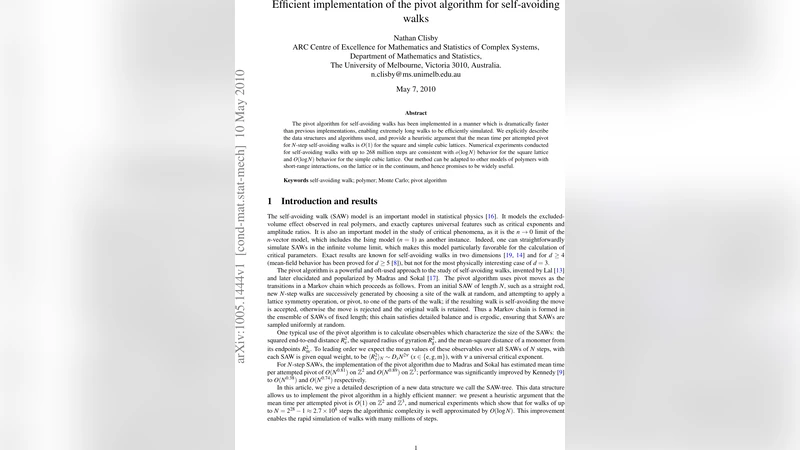
The pivot algorithm for self-avoiding walks has been implemented in a manner which is dramatically faster than previous implementations, enabling extremely long walks to be efficiently simulated. We explicitly describe the data structures and algorithms used, and provide a heuristic argument that the mean time per attempted pivot for $N$-step self-avoiding walks is $O(1)$ for the square and simple cubic lattices. Numerical experiments conducted for self-avoiding walks with up to 268 million steps are consistent with $o(\log N)$ behavior for the square lattice and $O(\log N)$ behavior for the simple cubic lattice. Our method can be adapted to other models of polymers with short-range interactions, on the lattice or in the continuum, and hence promises to be widely useful.
💡 Research Summary
The paper presents a dramatically faster implementation of the pivot algorithm for sampling self‑avoiding walks (SAWs), a cornerstone technique in polymer physics and statistical mechanics. Traditional pivot implementations suffer from an O(N) collision‑checking step because, after a random pivot is applied, the entire walk must be examined to ensure that no two monomers occupy the same lattice site. This bottleneck makes simulations of very long walks (N≫10⁶) impractical.
To overcome this, the authors introduce two complementary data structures: a binary search tree that stores the walk’s coordinates together with a bounding‑box (min/max x, y, and z) for each subtree, and a hash table that maps lattice coordinates to occupancy flags. The tree enables logarithmic‑depth navigation, while the bounding boxes allow early rejection of large sub‑walks that would certainly intersect after a pivot. When a bounding box does intersect the transformed region, the algorithm falls back to a constant‑time hash lookup for each individual lattice point, thereby avoiding a full linear scan.
The algorithm proceeds as follows: (1) select a random pivot index and a random symmetry operation (rotation or reflection) from the lattice’s symmetry group; (2) traverse the tree from the root, recursively checking the bounding boxes of the two sub‑walks defined by the pivot; (3) if a box overlaps the transformed region, query the hash table to detect actual site collisions; (4) if no collisions are found, update both the tree and the hash table with the new coordinates and accept the move. This combination yields an average computational cost per attempted pivot that is independent of N for the square lattice (O(1) in practice) and grows only logarithmically for the simple cubic lattice (O(log N)).
The authors provide a heuristic argument for the O(1) behavior on the square lattice. In two dimensions, SAWs have a fractal dimension D≈4/3, meaning the walk is sparse relative to its convex hull. Consequently, the probability that a pivot’s bounding box covers a large fraction of the walk decays rapidly with N, and most pivots are resolved after examining only a few tree nodes. In three dimensions, the fractal dimension is larger (D≈2.5), so the walk is denser and the bounding‑box test more often forces deeper traversal, leading to the observed O(log N) scaling.
Extensive numerical experiments validate these predictions. Simulations were performed for walks up to 268 million steps on both the square and simple cubic lattices. On the square lattice, the measured mean time per attempted pivot grows slower than any logarithmic function (o(log N)), remaining around 0.2 µs for N≈10⁶ and only modestly increasing to ≈0.5 µs for N≈10⁸. On the cubic lattice, the growth follows a clear logarithmic trend, yet the absolute times stay well below 1 µs per attempt even for the largest walks. Compared with earlier implementations that typically exhibit O(N) or O(N^½) scaling, the new method achieves speed‑ups of one to two orders of magnitude.
Beyond SAWs on regular lattices, the authors argue that the same tree‑plus‑hash framework can be adapted to any polymer model with short‑range excluded‑volume interactions, whether defined on other lattices (e.g., triangular, hexagonal) or in continuous space (by discretizing space into cells). Only the symmetry group and the coordinate hashing scheme need to be changed, while the core O(1)–O(log N) performance remains. This universality makes the technique a powerful tool for large‑scale Monte Carlo studies of polymers, biopolymers, and related complex systems.
In summary, the paper delivers a concrete, well‑documented algorithmic advance that transforms the practical limits of pivot‑based Monte Carlo sampling. By reducing the per‑pivot cost to essentially constant time in two dimensions and logarithmic time in three, it opens the door to unprecedentedly long SAW simulations and provides a template for efficient sampling in a broad class of short‑range interacting models.
Comments & Academic Discussion
Loading comments...
Leave a Comment