Coexistence in preferential attachment networks
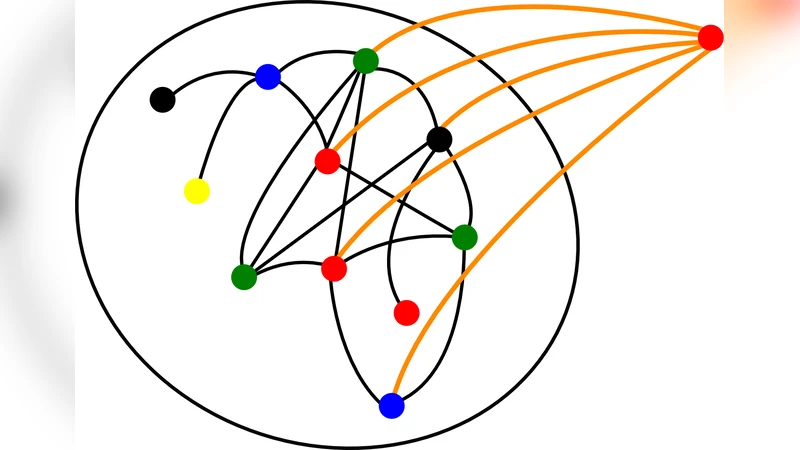
We introduce a new model of competition on growing networks. This extends the preferential attachment model, with the key property that node choices evolve simultaneously with the network. When a new node joins the network, it chooses neighbours by preferential attachment, and selects its type based on the number of initial neighbours of each type. The model is analysed in detail, and in particular, we determine the possible proportions of the various types in the limit of large networks. An important qualitative feature we find is that, in contrast to many current theoretical models, often several competitors will coexist. This matches empirical observations in many real-world networks.
💡 Research Summary
The paper introduces a novel framework for studying competition on growing networks, extending the classic preferential attachment (PA) model by coupling network growth with a type‑adoption process. At each discrete time step a new vertex v is added; it creates m edges to existing vertices, each endpoint chosen independently with probability proportional to the current degree of the target (the “independent” PA variant). After the connections are made, v adopts a type (red or blue in the binary case) according to a preset rule: if exactly k of its m neighbours are red, v becomes red with probability p_k (and blue with probability 1‑p_k). The parameters p_k (0 ≤ k ≤ m) can be linear (p_k = k/m) or any nonlinear function, allowing the model to capture a wide range of reinforcement behaviours.
The central object of study is the proportion of red vertices a_n = A_n/(A_n + B_n) after n additions, where A_n and B_n denote the numbers of red and blue vertices respectively. Because a_n alone is not Markovian, the authors consider the joint process (A_n, X_n) where X_n is the total degree of red vertices. This pair evolves as a Markov chain:
- u_{n+1} ~ Binomial(m, x_n) gives the number of red neighbours (x_n = X_n/(X_n+Y_n) is the red degree fraction);
- I_{n+1} ~ Bernoulli(p_{u_{n+1}}) decides whether the new vertex is red;
- A_{n+1}=A_n+I_{n+1}, X_{n+1}=X_n+u_{n+1}+m·I_{n+1}.
Using stochastic approximation theory, the authors show that x_n follows, up to vanishing noise, the ordinary differential equation (ODE) dz/dt = P(z), where the polynomial P(z) = (1/2m) Σ_{k=0}^m C(m,k) z^k (1−z)^{m−k} (p_k − k/m) encodes the deviation of the adoption rule from the linear case. Consequently, the asymptotic behaviour of a_n is dictated by the zero set Z_P = {z ∈
Comments & Academic Discussion
Loading comments...
Leave a Comment