Fermi Large Area Telescope observations of the Vela-X Pulsar Wind Nebula
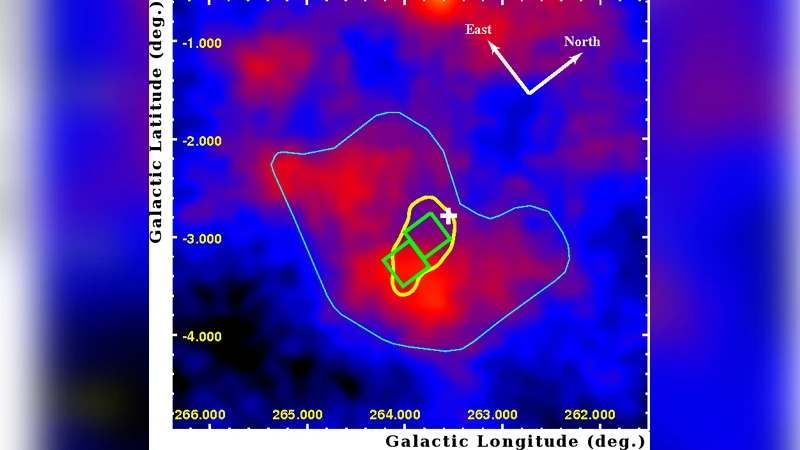
We report on gamma-ray observations in the off-pulse window of the Vela pulsar PSR B0833-45, using 11 months of survey data from the Fermi Large Area Telescope (LAT). This pulsar is located in the 8 degree diameter Vela supernova remnant, which contains several regions of non-thermal emission detected in the radio, X-ray and gamma-ray bands. The gamma-ray emission detected by the LAT lies within one of these regions, the 2*3 degrees area south of the pulsar known as Vela-X. The LAT flux is signicantly spatially extended with a best-fit radius of 0.88 +/- 0.12 degrees for an assumed radially symmetric uniform disk. The 200 MeV to 20 GeV LAT spectrum of this source is well described by a power-law with a spectral index of 2.41 +/- 0.09 +/- 0.15 and integral flux above 100 MeV of (4.73 +/- 0.63 +/- 1.32) * 10^{-7} cm^{-2} s^{-1}. The first errors represent the statistical error on the fit parameters, while the second ones are the systematic uncertainties. Detailed morphological and spectral analyses give strong constraints on the energetics and magnetic field of the pulsar wind nebula (PWN) system and favor a scenario with two distinct electron populations.
💡 Research Summary
The paper presents a comprehensive analysis of the Vela‑X pulsar wind nebula (PWN) using 11 months of survey data from the Fermi Large Area Telescope (LAT). By selecting only the off‑pulse intervals of the Vela pulsar (PSR B0833‑45), the authors effectively suppress the bright pulsed gamma‑ray background and isolate the emission associated with the surrounding nebula. The data set spans 200 MeV to 20 GeV, providing sufficient photon statistics for both spatial and spectral studies.
Spatially, several source morphologies were tested (point source, Gaussian, uniform disk). The maximum‑likelihood analysis identifies a uniformly bright disk with a radius of 0.88° ± 0.12° as the best description, confirming that the LAT‑detected gamma‑ray emission coincides with the 2° × 3° non‑thermal region traditionally called Vela‑X in radio and X‑ray images. This extended morphology had only been hinted at by earlier instruments (e.g., EGRET) and is now firmly established.
Spectrally, the emission is well described by a simple power‑law across the full LAT band. The photon index is Γ = 2.41 ± 0.09 (statistical) ± 0.15 (systematic), and the integrated flux above 100 MeV is (4.73 ± 0.63 ± 1.32) × 10⁻⁷ cm⁻² s⁻¹. Systematic uncertainties arise from the instrument response functions, background modeling, and the assumed source morphology. The relatively soft LAT spectrum contrasts with the harder synchrotron spectra seen at radio and X‑ray wavelengths, suggesting that different electron populations dominate different energy bands.
To interpret these findings, the authors combine the LAT results with existing multi‑wavelength data (radio, X‑ray, TeV). They propose a two‑component electron model:
-
A low‑energy electron population (GeV‑scale) residing in a region with an average magnetic field of ~10 µG. These electrons produce the observed radio synchrotron emission and generate the LAT gamma rays via inverse‑Compton (IC) scattering on ambient photon fields (cosmic microwave background, infrared dust emission).
-
A high‑energy electron population (TeV‑scale) located in zones of stronger magnetic field (~30 µG) or higher photon energy density. This component accounts for the X‑ray synchrotron emission and the TeV gamma rays detected by ground‑based Cherenkov telescopes.
The two‑population scenario naturally explains the LAT power‑law index, the spatial extension, and the energetics. By estimating the total energy stored in relativistic electrons and comparing it with the pulsar’s spin‑down power (~7 × 10³⁶ erg s⁻¹), the authors find that roughly 0.1 % of the spin‑down energy has been transferred to the particle population, a conversion efficiency comparable to that of other young PWNe such as the Crab and Vela‑Jr.
The paper also discusses implications for particle diffusion and cooling. The measured disk radius and spectral softness are consistent with electrons diffusing outward while losing energy via synchrotron and IC processes, leading to a gradual softening of the spectrum with distance from the pulsar.
In conclusion, the Fermi‑LAT observations provide the first high‑significance, spatially resolved detection of Vela‑X in the GeV band, delivering precise morphological and spectral parameters. The results strongly favor a composite PWN model with at least two distinct electron populations, offering new constraints on the magnetic field distribution, particle acceleration mechanisms, and energy budget within the nebula. The authors highlight that future observations with next‑generation facilities such as the Cherenkov Telescope Array (CTA) will be able to map the spatial variation of the two electron components in greater detail, thereby refining our understanding of pulsar wind nebula physics.