On Expansion and Topological Overlap
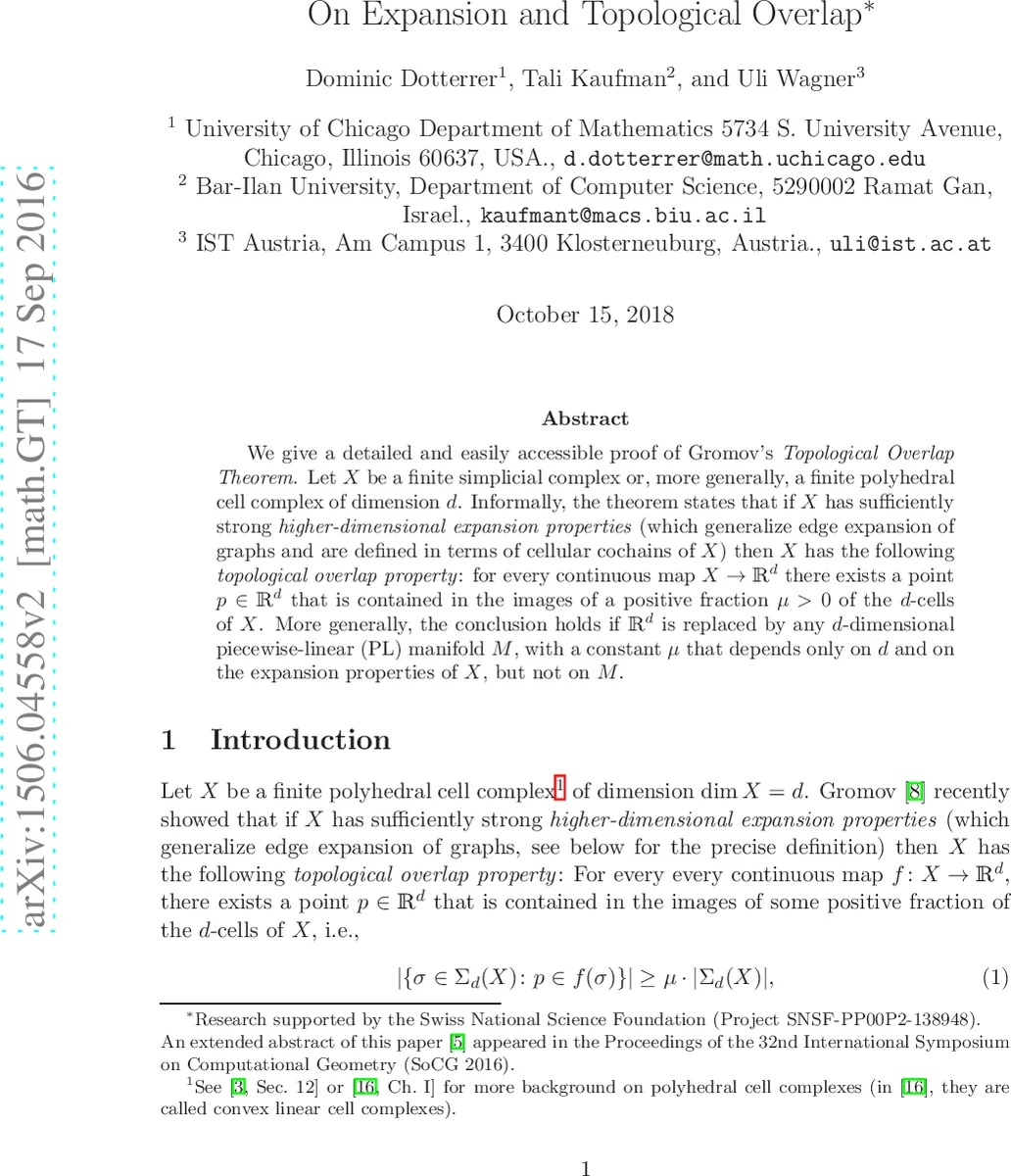
We give a detailed and easily accessible proof of Gromov’s Topological Overlap Theorem. Let $X$ be a finite simplicial complex or, more generally, a finite polyhedral cell complex of dimension $d$. Informally, the theorem states that if $X$ has sufficiently strong higher-dimensional expansion properties (which generalize edge expansion of graphs and are defined in terms of cellular cochains of $X$) then $X$ has the following topological overlap property: for every continuous map $X\rightarrow \mathbf{R}^d$ there exists a point $p\in \mathbf{R}^d$ that is contained in the images of a positive fraction $\mu>0$ of the $d$-cells of $X$. More generally, the conclusion holds if $\mathbf{R}^d$ is replaced by any $d$-dimensional piecewise-linear (PL) manifold $M$, with a constant $\mu$ that depends only on $d$ and on the expansion properties of $X$, but not on $M$.
💡 Research Summary
The paper presents a thorough and accessible proof of Gromov’s Topological Overlap Theorem, a deep result linking high‑dimensional expansion properties of a finite cell complex to a robust geometric‑topological overlap phenomenon. The authors consider a finite polyhedral cell complex (X) of dimension (d) and introduce a normalized Hamming norm on its (\mathbb{F}_2)‑valued cochains. This norm measures the “discrete volume’’ of a cochain by counting the number of cells on which it is non‑zero, scaled by the total number of cells of the same dimension.
Three quantitative conditions on (X) are defined:
-
(L)-cofilling inequality – For every coboundary (\beta) in dimension (k) there exists a cochain (\alpha) with (\delta\alpha=\beta) and (|\alpha|\le L|\beta|). This is shown (Lemma 4) to be equivalent to (\eta)-coboundary expansion, i.e. (|\delta\alpha|\ge \eta\cdot\operatorname{dist}(\alpha,B^{k-1})) for all ((k-1))-cochains, where (\eta=1/L).
-
(\vartheta)-large cosystoles – Every non‑trivial cocycle (a cocycle not a coboundary) in dimension (j) has norm at least (\vartheta). This guarantees that any non‑vanishing cohomology class occupies a substantial fraction of the cells, preventing “tiny holes’’ that could defeat overlap.
-
(\varepsilon)-local sparsity – For each cell (\tau) and each dimension (k), the proportion of (k)-cells intersecting (\tau) is at most (\varepsilon). In the normalized Hamming norm this simply bounds the number of cells disjoint from (\tau) relative to the total.
The main theorem (Theorem 8) states that if a complex (X) satisfies the above three conditions (with parameters (L,\vartheta,\varepsilon) depending only on (d)), then for any continuous map (f:X\to M) into a compact (d)-dimensional PL manifold (M) there exists a point (p\in M) that lies in the images of at least a fixed positive fraction (\mu=\mu(d,L,\vartheta,\varepsilon)) of the (d)-cells of (X). The constant (\mu) is independent of the particular map or of the target manifold; it depends solely on the expansion parameters and the dimension.
The proof proceeds in several conceptual stages:
-
PL Approximation – Using the simplicial approximation theorem, any continuous map is replaced by a PL map (g) that is arbitrarily close pointwise. Since the overlap condition is stable under small perturbations (Lemma 10), it suffices to treat PL maps.
-
General Position and Fine Triangulation – The target manifold (M) is equipped with a triangulation (T). By a small perturbation, the PL map can be made to be in strongly general position (Definition 11) with respect to the cell decomposition of (X) and in general position with respect to (T). A further refinement of (T) yields a sufficiently fine triangulation (Definition 13) ensuring that the number of (d!-!k) cells missing a given (k)-simplex of (T) is bounded by a multiple of the local sparsity constant.
-
Intersection Numbers – For each pair consisting of a (d!-!k) cell (\sigma) of (X) and a (k)-simplex (\tau) of (T), an algebraic intersection number is defined (Section 2.4). Because the map is in strong general position, these numbers are well‑defined and satisfy a bilinearity property.
-
Chain Homotopy Argument – The collection of intersection numbers yields a chain map from the cellular chain complex of (X) to the simplicial chain complex of (T). Using the (L)-cofilling inequality, one constructs a chain homotopy that “fills’’ the image of each (d)-cell with a controlled number of lower‑dimensional cells. The large cosystole condition guarantees that the homotopy cannot be trivial on a large set of cells, while the local sparsity condition prevents excessive cancellation.
-
Averaging and the Overlap Point – Summing the intersection numbers over all (d)-cells and all (k)-simplices of (T) gives a total that, by the previous steps, is bounded below by a positive multiple of (|\Sigma_d(X)|). By averaging, there must exist at least one point (p) (chosen as the barycenter of a simplex of (T)) that lies in the image of at least (\mu|\Sigma_d(X)|) many (d)-cells, establishing the desired overlap.
The authors emphasize that their exposition avoids the sophisticated machinery of simplicial sets and higher categorical tools present in Gromov’s original proof. Instead, they rely on elementary concepts: cellular cochains, basic homological algebra, and classical PL topology (general position, triangulations, and intersection theory). This makes the theorem more approachable for researchers in combinatorial topology, theoretical computer science, and discrete geometry.
Finally, the paper discusses applications: the theorem provides a key ingredient for constructing bounded‑degree simplicial complexes with strong topological overlap, which in turn have implications for property testing, high‑dimensional expanders, and the point‑selection problem in discrete geometry. The authors also note that the constants (\mu, \varepsilon_0) can be made explicit given quantitative bounds on the expansion parameters, opening the way for concrete constructions of expanders with prescribed overlap guarantees.
Comments & Academic Discussion
Loading comments...
Leave a Comment