On Semantic Generalizations of the Bernays-Sch"onfinkel-Ramsey Class with Finite or Co-finite Spectra
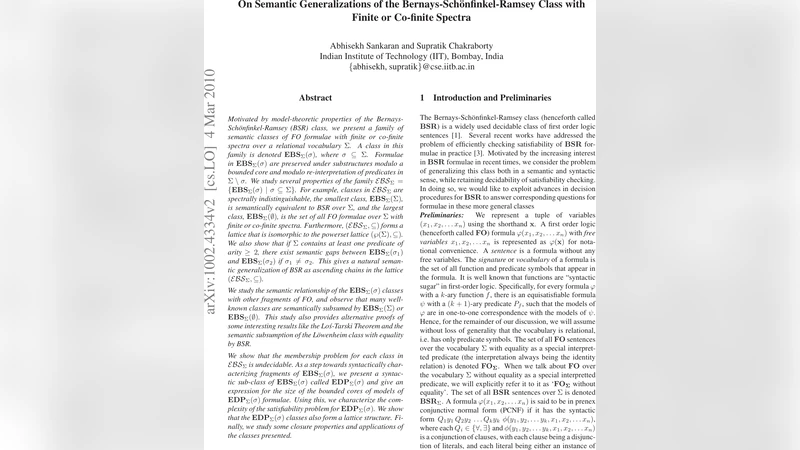
Motivated by model-theoretic properties of the BSR class, we present a family of semantic classes of FO formulae with finite or co-finite spectra over a relational vocabulary \Sigma. A class in this family is denoted EBS_\Sigma(\sigma), where \sigma is a subset of \Sigma. Formulae in EBS_\Sigma(\sigma) are preserved under substructures modulo a bounded core and modulo re-interpretation of predicates outside \sigma. We study properties of the family EBS_\Sigma = {EBS_\Sigma(\sigma) | \sigma \subseteq \Sigma}, e.g. classes in EBS_\Sigma are spectrally indistinguishable, EBS_\Sigma(\Sigma) is semantically equivalent to BSR over \Sigma, and EBS_\Sigma(\emptyset) is the set of all FO formulae over \Sigma with finite or co-finite spectra. Furthermore, (EBS_\Sigma, \subseteq) forms a lattice isomorphic to the powerset lattice (\wp({\Sigma}), \subseteq). This gives a natural semantic generalization of BSR as ascending chains in (EBS_\Sigma, \subseteq). Many well-known FO classes are semantically subsumed by EBS_\Sigma(\Sigma) or EBS_\Sigma(\emptyset). Our study provides alternative proofs of interesting results like the Lo's-Tarski Theorem and the semantic subsumption of the L"owenheim class with equality by BSR. We also present a syntactic sub-class of EBS_\Sigma(\sigma) called EDP_\Sigma(\sigma) and give an expression for the size of the bounded cores of models of EDP_\Sigma(\sigma) formulae. We show that the EDP_\Sigma(\sigma) classes also form a lattice structure. Finally, we study some closure properties and applications of the classes presented.
💡 Research Summary
The paper introduces a novel semantic hierarchy that extends the well‑known Bernays‑Schönfinkel‑Ramsey (BSR) class to a family of classes denoted EBS_Σ(σ), where Σ is a relational vocabulary and σ⊆Σ. An FO formula φ belongs to EBS_Σ(σ) if there exists a fixed natural number k such that for every structure A satisfying φ there is a substructure B⊆A with the following properties: (i) B and A interpret the predicates in σ identically, (ii) the size of the “core” of B (the part that witnesses φ) is at most k, and (iii) predicates outside σ may be re‑interpreted arbitrarily between A and B. This definition captures the essential model‑theoretic feature of BSR—existence of a bounded core—while allowing controlled flexibility on predicates not in σ.
Key results about the family EBS_Σ = {EBS_Σ(σ) | σ⊆Σ} are:
-
Spectral Uniformity – All classes in the family have exactly the same spectra: every formula in any EBS_Σ(σ) has a finite or co‑finite spectrum, and conversely any FO formula with such a spectrum belongs to EBS_Σ(∅). Hence the classes are spectrally indistinguishable.
-
Extremal Cases – When σ=Σ, EBS_Σ(Σ) coincides semantically with the classical BSR class; when σ=∅, EBS_Σ(∅) is precisely the set of all FO formulas whose spectra are finite or co‑finite. Thus the hierarchy interpolates between the most restrictive (BSR) and the most permissive (all finite/co‑finite‑spectrum formulas).
-
Lattice Structure – The inclusion order (EBS_Σ(σ₁)⊆EBS_Σ(σ₂) iff σ₁⊆σ₂) makes (EBS_Σ,⊆) a lattice isomorphic to the powerset lattice (℘(Σ),⊆). The bottom element is EBS_Σ(∅) and the top element is EBS_Σ(Σ). This provides a natural semantic generalisation of BSR as ascending chains in the lattice.
-
Connections to Classical Classes – The Löwenheim class with equality and the Loś‑Tarski preservation theorem are shown to be subsumed by EBS_Σ(Σ) or EBS_Σ(∅), giving alternative semantic proofs of well‑known results. In particular, BSR semantically subsumes the Löwenheim class.
-
Syntactic Sub‑class EDP_Σ(σ) – The authors define a syntactically restricted subclass called Existential‑Dual‑Preservation (EDP). Formulas in EDP_Σ(σ) retain the existential‑universal prefix of BSR but allow arbitrary reinterpretation of predicates outside σ. For any EDP_Σ(σ) formula, an explicit bound on the size of its core is derived as a function of |σ|, the maximal predicate arity, and the quantifier depth. This bound yields concrete size estimates for models and suggests algorithmic applications.
-
Closure Properties – Both EBS and EDP families are examined under logical operations (conjunction, disjunction, negation, existential and universal quantification). Certain operations preserve membership, while others may lead out of the class; the paper delineates precisely which closures hold.
-
Applications – The bounded‑core perspective is argued to be useful for automated reasoning, finite‑model search, and database query optimisation, especially in resource‑constrained settings where compressing a model to its core can dramatically reduce search space.
Methodologically, the paper proceeds by first formalising the bounded‑core preservation condition, then proving the lattice isomorphism via straightforward set‑inclusion arguments. Spectral indistinguishability follows from classic results on finite/co‑finite spectra and the fact that any such spectrum can be realised by a formula whose core size is bounded by a constant (the “core‑size” parameter). The equivalence between EBS_Σ(Σ) and BSR is established by showing that any BSR sentence can be rewritten to satisfy the bounded‑core condition with σ=Σ, and conversely any EBS_Σ(Σ) sentence can be transformed into an equivalent BSR sentence using Skolemisation and prenex normal form.
The syntactic subclass EDP_Σ(σ) is introduced to obtain constructive bounds. By analysing the quantifier prefix and the interaction of σ‑predicates with the core, the authors derive a bound of the form k ≤ |σ|·a·d, where a is the maximal arity of predicates in Σ and d is the quantifier depth. This bound is proved tight for certain families of formulas.
In summary, the paper delivers a robust semantic framework that generalises BSR, unifies several classical preservation results, and provides concrete syntactic subclasses with explicit model‑size guarantees. The lattice viewpoint clarifies how varying the set of “rigid” predicates σ tunes the strength of the preservation property, offering a flexible tool for both theoretical investigations and practical algorithm design in finite model theory and database theory.
Comments & Academic Discussion
Loading comments...
Leave a Comment