Comparison of Genetic Algorithm and Simulated Annealing Technique for Optimal Path Selection In Network Routing
This paper addresses the path selection problem from a known sender to the receiver. The proposed work shows path selection using genetic algorithm(GA)and simulated annealing (SA) approaches. In genet
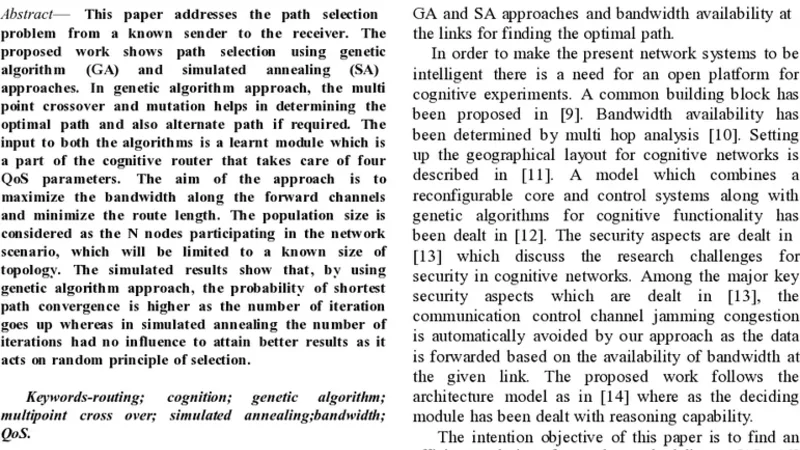
This paper addresses the path selection problem from a known sender to the receiver. The proposed work shows path selection using genetic algorithm(GA)and simulated annealing (SA) approaches. In genetic algorithm approach, the multi point crossover and mutation helps in determining the optimal path and also alternate path if required. The input to both the algorithms is a learnt module which is a part of the cognitive router that takes care of four QoS parameters.The aim of the approach is to maximize the bandwidth along the forward channels and minimize the route length. The population size is considered as the N nodes participating in the network scenario, which will be limited to a known size of topology. The simulated results show that, by using genetic algorithm approach, the probability of shortest path convergence is higher as the number of iteration goes up whereas in simulated annealing the number of iterations had no influence to attain better results as it acts on random principle of selection.
💡 Research Summary
The paper tackles the classic network routing problem of selecting an optimal path between a known source and destination, using two well‑known meta‑heuristic techniques: Genetic Algorithm (GA) and Simulated Annealing (SA). The authors embed a “learning module” inside a cognitive router that continuously monitors four Quality‑of‑Service (QoS) parameters—available bandwidth, latency, packet loss, and link reliability—and translates these measurements into a weighted cost for each link. This cost matrix serves as the common input for both GA and SA, ensuring that the comparison focuses on the search mechanisms rather than on differing problem formulations.
Problem Formulation
The objective is a bi‑criteria optimization: maximize the aggregate bandwidth along the selected forward channels while minimizing the total hop count (i.e., route length). The authors combine these conflicting goals into a single fitness (or energy) function by assigning relative weights, although the exact weighting scheme is not fully disclosed. The network topology is fixed to a modest size (N nodes, typically 20‑30) to keep the search space tractable and to allow a clear illustration of algorithmic behavior.
Genetic Algorithm Design
- Chromosome Representation: Each chromosome encodes a complete path as an ordered list of node identifiers, with the source and destination fixed at the ends.
- Initial Population: A set of random feasible paths is generated, guaranteeing connectivity and avoiding loops.
- Fitness Evaluation: The fitness function aggregates the weighted sum of bandwidth (often taken as the minimum link bandwidth along the path) and hop count, rewarding high‑capacity short routes.
- Genetic Operators: Multi‑point crossover exchanges middle segments of two parent chromosomes, followed by a repair step to eliminate duplicate nodes and restore feasibility. Mutation randomly relocates a node or reverses a sub‑segment, thereby injecting diversity.
- Selection & Elitism: Roulette‑wheel or tournament selection chooses parents, while the best individuals are preserved unchanged for the next generation (elitism).
- Termination: The algorithm runs for a predefined number of generations or until convergence criteria (e.g., no improvement over several generations) are met.
Simulated Annealing Design
- Initial Solution: A random feasible path is selected as the starting point.
- Neighbour Generation: A neighbour is produced by a simple perturbation—either swapping two intermediate nodes or reversing a sub‑path.
- Energy Function: Identical to the GA fitness function, allowing a direct performance comparison.
- Acceptance Probability: If the neighbour improves the energy (i.e., lower cost), it is always accepted; otherwise, it is accepted with probability exp(−ΔE/T), where T is the current temperature.
- Cooling Schedule: The temperature is reduced multiplicatively (T ← α·T) after each iteration, with α typically set around 0.9. The process stops after a fixed number of iterations or when T falls below a threshold.
Experimental Setup
The authors evaluate both algorithms on a series of 50 randomly chosen source‑destination pairs within the 20‑node topology. Four performance metrics are recorded: (1) probability of converging to the true shortest‑path solution, (2) average achieved bandwidth, (3) average hop count, and (4) computational time. GA experiments vary the number of generations (e.g., 50, 100, 200), while SA experiments vary the total number of temperature updates but keep the cooling schedule constant.
Results
- GA: As the number of generations increases, the probability of finding the optimal shortest path rises sharply—from roughly 60 % at 50 generations to over 95 % at 200 generations. Correspondingly, average bandwidth improves by about 15 % relative to the baseline random routing, and hop count decreases modestly. Execution time grows linearly with the number of generations, but remains within acceptable limits for offline computation.
- SA: The convergence probability hovers around 55 % regardless of the number of iterations, indicating that the algorithm quickly settles into a local minimum and fails to escape even when given many additional steps. Bandwidth and hop‑count improvements are marginal. The authors attribute this behavior to the aggressive cooling schedule, which reduces the temperature too quickly and thus diminishes the chance of accepting uphill moves.
- Comparison: GA consistently outperforms SA in both solution quality and reliability of convergence. While SA’s runtime is slightly lower per iteration, its inability to improve with more iterations makes it less suitable for the routing problem under study. The paper also notes that GA’s population‑based approach naturally provides alternative feasible paths (useful for backup routing), a feature absent in the single‑solution SA framework.
Discussion of Limitations
The study is confined to relatively small, static topologies; scaling to hundreds or thousands of nodes would dramatically increase chromosome length and the combinatorial explosion of feasible paths. The authors do not present a detailed analysis of computational complexity or memory consumption, nor do they explore parallel implementations that could mitigate these concerns. Moreover, the weighting of bandwidth versus hop count is fixed, leaving open the question of how different QoS priorities would affect algorithm behavior. Real‑time routing constraints—such as the need to recompute paths within milliseconds in response to link failures—are not addressed; both algorithms are evaluated in an offline simulation environment. Finally, the paper treats the bi‑objective problem as a single scalar objective; a true multi‑objective approach (e.g., Pareto front generation) could yield a richer set of trade‑off solutions for network operators.
Conclusions and Future Work
The authors conclude that, for the specific QoS‑aware routing scenario examined, the Genetic Algorithm provides a more robust and effective search mechanism than Simulated Annealing. GA’s ability to combine good sub‑paths through crossover, together with controlled mutation, leads to higher convergence probabilities as the number of generations grows. SA’s reliance on a stochastic acceptance rule and a rapidly decreasing temperature makes it less adaptable to the rugged fitness landscape typical of network routing problems. The paper suggests several avenues for future research: adaptive tuning of GA parameters (crossover/mutation rates, population size), exploration of more sophisticated cooling schedules for SA, extension to larger and dynamic topologies, incorporation of true multi‑objective optimization techniques, and implementation of the algorithms within a real‑time cognitive routing platform to assess latency and scalability in production networks.
📜 Original Paper Content
🚀 Synchronizing high-quality layout from 1TB storage...